

Download NCERT Solutions for Class 4 Environmental Studies Chapter 12 Changing Times
Review structured textbook solutions for Class 4 Environmental Studies Chapter 12 Changing Times. Built according to NCERT guidelines for the 2026-27 academic year, these downloadable answers support daily revision and problem-solving accuracy.
Access NCERT Solutions and Answers
Navigate directly to the solved Environmental Studies textbook exercises using the digital viewer below. Each solution includes detailed step-by-step explanations, allowing students to instantly cross-check their work and identify areas requiring further revision.
NCERT Solutions for Class 4 EVS Looking Around for Chapter 12 Changing Times
Find out and write (Page 98)
Q.1. Talk to any of your grandparents or other elderly people. Find out, when she or he was 8-9 years old:
(i) Where did she or he live?
Ans. She lived in a hut in a village.
(ii) From what materials was her or his house made?
Ans. Bamboo, mud, wood, straw, etc.
(iii) Did she or he have a toilet in her or his house?
Ans. There was a separate kitchen.
(iv) A lot of mud was used when chetandas house was made. Why?
Ans. Mud helps to keep the house cool in summer and warm in winter.
A changing house (Page 99)
The people who used the toilets did not clean them. Discuss.
Ans. People who use the toilet do not clean it. They think it is a dirty job.
Q.2. Is there a toilet in your house? Who cleans it?
Ans. We have a toilet. We clean it ourselves.
Seeing New things (Page 101)
Q.1. What materials have been used in making your house?
Ans. Cement, sand, brick, tiles, wood, iron, rods, etc.
Q.2. Find out the materials form which your friend’s house is made? Is there anydifference? Write about it.
Ans. My friend’s house is made of cement, sand, brick, stone, marble, iron rod, wood etc. Their house has marble on the floor.
Q.3. What kind of house do you think chetandas grandchildren will live in?
Ans. They will live in cemented houses.
Page 102
Q.1. Where would you like to live when you grow up? What kind of house would you like?
Ans. I would like to live in my own native place. I would like to live in a pucca house.
Q.2. You had written about the things that your grandparent’s house was made of. Havesome of those materials been used in your house? Name them.
Ans. Yes. Wood is used in my house as well as in my grandpa’s house.
Q.3. In your place, what do you call a person who works with wood?
Ans. Carpenter.
Q.4. Now, look at the picture and fill in the table.
What kind of work are different people doing? What tools are they using?
Ans.
Work | Tool | What is the person called |
1. | Electric wires, Screw driver | Electrician |
2. | Pipes, cutter, plier | Plumber |
3. | Cement, sand, etc. | Mason |
Page 103
Q.1. With your teacher or someone from home, go to a place where a building is beingconstructed. Talk to the people working there and find out answers to these questions.
(i) What is being built there?
Ans. A house.
(ii) How many people are working there?
Ans. About twenty.
(iii) What kinds of work are they doing?
Ans. Some people are mixing sand and cement. Some are carrying the mixture to another person. That person is placing bricks with the help of the mixture another person is cutting wood to make window frames, etc.
(iv) What kind of tools are they using?
Ans. They are using axe, drill, corni, spade, etc.
(v) How many men and women are there?
Ans. There are about 11 women and 9 men.
(vi) Are any children working there? What are they doing?
Ans. No.
(vii) How much money do these people get daily? Ask from any three different people.
Ans. 1. Carpenter – Rs. 200
2. Mason – Rs. 200
3. Helper – Rs. 100
(viii) Where do the people who work there live?
Ans. They live in tents near the building place.
(ix) What materials are being used for making the building?
Ans. Wood, cement, iron, rod, sand, brick, small stones, plastic, etc.
(x) Guess how many trucks of bricks and bags of cement will be used for making thebuilding?
Ans. Fifty bags of cement and 3 truck of bricks.
(xi) How does the material reach the building palce?
Ans. One bag of cement = Rs. 210
One brick = Rs. 3
One truck of sand = Rs. 4000
Ask a few other questions and write their answers.
(i) How much sand is mixed with cement?
Ans. Four bags of sand is mixed with one bag of cement.
(ii) Why is iron rod used?
Ans. It makes the building strong.
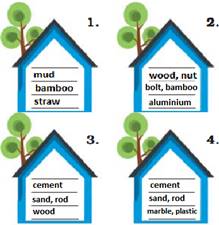
Q.2. In sixty years, different materials were used at different times in Chetandas house. List these in the correct order.
Ans.
Question. Which of these objects will be attracted to a magnet?

Answer : B
Question. Which of these properties is common to all the materials listed below?

(a) They do not get wet in water.
(b) They break if dropped.
(c) They can be eaten by people.
(d) They change shape if pressed.
Answer : D
Question. The tool shown in the figure would be BEST used

(a) to tighten a screw.
(b) to force a nail into a wall.
(c) as a paperweight.
(d) to smoothen surfaces.B
Answer : B
Question. Which of the following time keeping devices would be MOST suitable to measure the time taken for a 100 m race?

Answer : C
Question. The festival of Diwali is on 1 November. Swati and Supriya's parents bought crackers for Diwali in the first week of October. Which of the following is the BEST way to store the crackers?

Answer : A
Question. Which object below belongs to Jar Q?

Answer : C
Question. In a story, three pigs build houses to live in so that the wolf would not eat them. Here is the list of materials the pigs used for building the house. The wolf comes along and blows hard on each house. Which house will be the hardest for the wolf to blow
| Pig 1 | Straw |
| Pig 2 | Wood |
| Pig 3 | Bricks |
(a) The straw house
(b) The wood house
(c) The brick house
(d) All the houses will be difficult for the wolf to blow down.
Answer : C
Question. Sabina's mother separated certain objects into two groups. Which question did she probably ask to separate them?

(a) Does it break easily if dropped?
(b) Can it be used for measuring?
(c) Is it a man-made object?
(d) Does it make a loud sound if struck?
Answer : D
Question. Which of the following liquids will mix completely with water?

(a) 2 and 4 only
(b) 1, 2, and 3 only
(c) 1 and 3
(d) 1 only
Answer : C
Question. Which group consists of substances that will all dissolve in water?
(a) Sand, Mud, Instant Coffee
(b) Sugar, Mud, Soap
(c) Salt, Sugar, Instant Coffee
(d) Soap, Sand, Salt
Answer : C
Question. The picture here shows the water-cycle. What is the main difference between the water in P and Q?

(a) P - Water is in liquid form; Q - Water is in vapour form
(b) P - Water is in vapour form; Q - Water is in liquid form
(c) P - Water is salty to taste; Q - Water is not salty to taste.
(d) P - Water is not salty to taste; Q - Water is salty to taste.
Answer : D
Environmental Studies Class 4 Curriculum Solutions: Chapter 12 Changing Times
Textbook Solutions for Class 4 Environmental Studies Chapter 12 Changing Times
Explore reliable textbook solutions for Chapter 12 Changing Times tailored for Class 4 learners. Utilizing these complete exercise answers ensures your preparation aligns exactly with official NCERT standards for Environmental Studies.
Mastering Theoretical and Practical Questions
Beyond providing final answers, these guides offer step-by-step breakdowns for complex queries in the Class 4 Environmental Studies module. This approach helps students balance theoretical depth with practical problem-solving skills required for NCERT exams.
Effective Self-Study and Homework Assistance
These resources act as an effective roadmap for daily homework tasks and independent study. Supplement your review of Chapter 12 Changing Times with official sample papers and interactive practice tests available on our platform free of charge.
FAQs
The complete and updated NCERT Solutions Class 4 Environmental Studies Chapter 12 Changing Times is available for free on StudiesToday.com. These solutions for Class 4 Environmental Studies are as per latest NCERT curriculum.
Yes, our experts have revised the NCERT Solutions Class 4 Environmental Studies Chapter 12 Changing Times as per 2026 exam pattern. All textbook exercises have been solved and have added explanation about how the Environmental Studies concepts are applied in case-study and assertion-reasoning questions.
Toppers recommend using NCERT language because NCERT marking schemes are strictly based on textbook definitions. Our NCERT Solutions Class 4 Environmental Studies Chapter 12 Changing Times will help students to get full marks in the theory paper.
Yes, we provide bilingual support for Class 4 Environmental Studies. You can access NCERT Solutions Class 4 Environmental Studies Chapter 12 Changing Times in both English and Hindi medium.
Yes, you can download the entire NCERT Solutions Class 4 Environmental Studies Chapter 12 Changing Times in printable PDF format for offline study on any device.