

NCERT Solutions for Class 4 Environmental Studies: Chapter 13 A Rivers Tale
Explore reliable textbook solutions for Chapter 13 A Rivers Tale tailored for Class 4 learners. Utilizing these Environmental Studies answers ensures thorough preparation and strengthens foundational knowledge before final NCERT evaluations.
Practice Class 4 Environmental Studies Solutions: Chapter 13 A Rivers Tale
View or download the dedicated Chapter 13 A Rivers Tale solution resource below. Engaging with these textbook answers under focused study conditions ensures continuous academic progress and mastery of the 2026-27 curriculum for Environmental Studies.
NCERT Solutions for Class 4 EVS Looking Around for Chapter 13 A Rivers Tale
(Page 106)
Q.1. Look carefully at the picture of the river. Read the words given below. Use these words to make a story. Give a title to your story also.
Boat, flowing water, blue, fish, water-plants, river, foul, smell, big ship, oil, river banks, factories, washing clothes, animals, other work, change, city.
A River’s Agony
Ans. Flowing water in the river brings the memory of old times in the mind of river. Gone are the days when she used to be happy,. Dancing and flowing all the way to the sea. She was greeted by lash green crop fields in the river bank. White fishes playing in the blue water was a real treat to eyes. People used boats to cross raised. The waste chemicals having foul smell are thrown into river water. Big ships which burn and spill oil, run on river. These kill the water-plants. Washing clothes, bathing animals and other works add salt to the injury. All wastes form city are dumped into the river.
All these changes made river unhappy. The golden memories of old days bring tears to the river.
Page 107
Q.1. Look at the picture again and answer the following questions:
What is the colour of the river where it begins?
Ans. It is colourless.
Q.2. At some places, there are many fishes in the river, at some places there are few, and in some there are dead fish. What could be the reason for this? Discuss.
Ans. The fishes need fresh and water. People throw their useless materials into water. The water at that place becomes unfit for fishes.
Q.3. What can be seen in the river before it reaches the village?
Ans. Large number of fishes can be see because water is pure and fresh.
Q.4. At which places did the colour of the river water change? Why did this happen?Discuss.
Ans. The colour of the river changes when there are factory in nearby. This is because factory water are dumped into river.
Q.5. Which of the places shown in the picture would you like to live in? Why?
Ans. I would like to live in the place shown in the lower figure. It is more clean.
Q.6. Would you like to change any of the things that you see in the picture? Why? How?
Ans. I would like to remove the waste material from the bank of the river. This is because, these wastes will contaminate the water.
Page 108
Q.1. If you wanted to drink some water, form which part of the river would you like todrink? Why?
Ans. I would like to drink water from a little deep below the surface. There is less dirt.
Q.2. In the last part of this picture the river flows into the sea. Have you ever seen thesea? Where? In a fil, or anywhere else?
Ans. I have seen sea in Puri.
Q.3. Have you ever been near a river or sea? When?
Ans. I was near the river Ganges with my parents when I was in the IIIrd standard.
Q.4. How do the sea waves move?
Ans. The sea waves move up and down.
Q.5. Can you drink the sea water? Why?
Ans. We can’t drink sea water. It is very salty.
Q.6. Do you think that there would be some changes that take place in a river, pond, orstream, throughout the year? What kind of changes may take place? Discuss.
Ans. Yes. During the rainy season, there is maximum water. During winters, there is very little water. Pond, stream, etc. may even get dry.
Page 109
Q.1. Will there be the same amount of water in the ponds/rivers during the rainy season,and in the summer?
Ans. No, there is more water in the rainy season.
Q.2. Is there a pond, river or lake near your town or city?
(i) Are there any changes in the water in summer, rainy season or winter?
Ans. During rainy season, there is more water. The water becomes more muddy. In winter and starting of summer, there is very little water in ponds, some may even dry up.
(ii) What kinds of fishes are found there?
Ans. There are many kinds of fishes, small as well as big.
(iii) What kinds of trees and plants grow around there?
Ans. Grass, banana, etc.
(iv) What kind of birds come there?
Ans. Many kinds of birds, mainly carnivorous birds like eagle etc.
(v) Have you ever seen or read or heard about floods? Where?
Ans. I have heard about flood in Mumbai and Assam. I have seen in TV news also.
(vi) What happens when there is a flood?
Ans. There is excess of water everywhere. Water enters even in houses. People suffer a lot.
(vii) Have you seen dirty water in a river or pond?
Ans. Yes.
(viii) How can you know if the water is dirty? If the water looks clean, can you be sure that it is alright to drink that water? Discuss.
Ans. Pure water is clean and clear. Dirty water is not so. Even if the water looks clean, it may not be alright to drink that water. It may contain germs that causes diseases.
How does Water become Dirty? (Page 110)
Q.1. From where do you get your drinking water? A river or a lake? Do you think that like the river in the picture your river or lake can also be affected?
Ans. From a river. Yes, the same thing may happen to our river also.
Page 110
Q.1. Put (tick) mark in the right places.
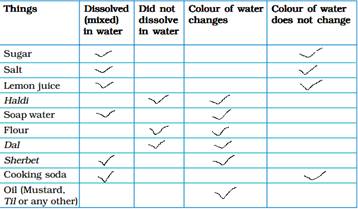
Q.2. Now based on your observation tell:
(i) Do all thing dissolve in water?
Ans. No.
(ii) Does the colour of the water always change?
Ans. No.
(iii) Imagine how it could be if nothing like sugar, salt, lemon juice, sherbet, etc. Could issove in water!
Ans. We would not be able to have drinks, tea, cook food and many more.
(iv) Imagine how it would be if things like stones, chalk, salt, lemon juice, sherbet, etc. could dissolve in water!
Ans. Everything would be dissolved in rain water. There would be nothing remaining in this world.
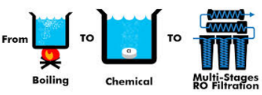
Q.3. How is drinking water made clean in your house?
Ans. In our house, first of all, alum is added to water. The mud settles down. The water form the above is then poured into filter. Chlorine tablet is also added to this water.
Q.4. Find out about different ways by which water can be made clean.
Ans. Adding alum, filtering, adding chlorine, etc.
Q.5. Draw pictures showing any two ways.
Ans.
Question. Which of the following is a liquid and has a strong smell?
| Name | Dissolves in water | Has a strong smell | Solid / Liquid |
| Salt | Yes | No | Solid |
| Petrol | No | Yes | Liquid |
| Milk | Yes | No | Liquid |
| Cooking oil | No | No | Liquid |
| Pepper powder | No | Yes | Solid |
| Butter | No | No | Solid |
(a) Water
(b) Petrol
(c) Milk
(d) Butter
Answer : B
Question. From the table above, we can say for sure that:
| Name | Dissolves in water | Has a strong smell | Solid / Liquid |
| Salt | Yes | No | Solid |
| Petrol | No | Yes | Liquid |
| Milk | Yes | No | Liquid |
| Cooking oil | No | No | Liquid |
| Pepper powder | No | Yes | Solid |
| Butter | No | No | Solid |
(a) Lemon juice does not dissolve in water.
(b) Anything that has a strong smell dissolves in water.
(c) No solid has a strong smell.
(d) Some solids and some liquids dissolve in water.
Answer : D
Question. The picture given below shows the water-cycle. Which arrow represents evaporation?
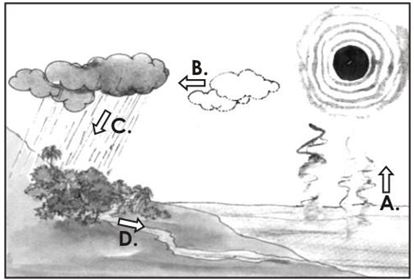
(a) A
(b) B
(c) C
(d) D
Answer : A
Question. The graph below shows the rainfall in Raghu’s town from January to June 2004.
How much rain did the town receive in June 2004?
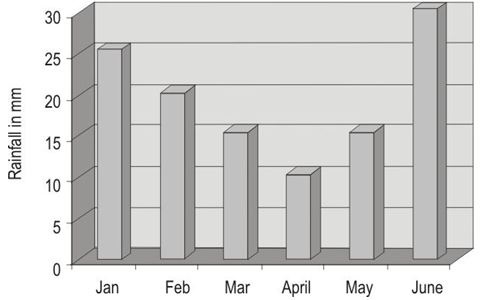
(a) 25 mm
(b) 30 mm
(c) 115 mm
(d) We cannot tell that from the graph.
Answer : B
Question. The graph below shows the rainfall in Raghu’s town from January to June 2004.
In which of these months did Raghu's town receive the LEAST rainfall?
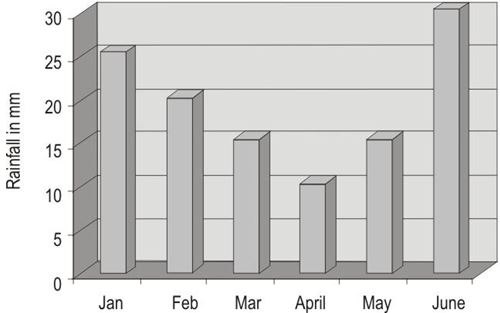
(a) Feb 2004
(b) Mar 2004
(c) Apr 2004
(d) May 2004
Answer : C
Question. Which of these happens when a vessel containing hot, boiled milk is covered with a lid?
(a) Water droplets form on the outside of the lid.
(b) Water droplets form on the inside of the lid
(c) Water droplets form on both sides of the lid
(d) No water droplets form on the lid.
Answer : B
Question. Asha and her friends are eating raw mangoes at her place and want salt. They find a bottle with a white powder in the store room. Asha: This looks like salt so it must be salt - let's have it." Karim: "This is not salt, because nothing is written on the label." Amala: "We should ask Asha's mother whether it is salt." Urmila: "Let's check if it dissolves in water - then it has to be salt. "Who is right?"
(a) Asha
(b) Karim
(c) Amala
(d) Urmila
Answer : C
Question. Anne buys a toffee while walking in the park. She wants to throw the wrapper, but can't find a dustbin nearby. What should Anne do?
(a) find an open space and throw the wrapper there
(b) find a drain (nullah) and throw the wrapper there
(c) keep the wrapper till she finds a dustbin or reaches home
(d) bury the wrapper under the ground and cover it with mud
Answer : C
Question. Which of these is/are example(s) of EVAPORATION? 1. water changing to water vapour from oceans and rivers. 2. water changing to water vapour from a glass kept in the open.
3. water vapour changing to water to produce rain
(a) only 1
(b) only 1 and 2
(c) only 2
(d) 1, 2 and 3
Answer : B
Question. Which of these correctly lists an advantage and disadvantage of plastic bags?
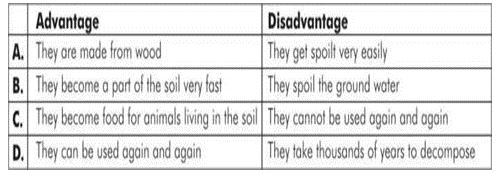
(a) A
(b) B
(c) C
(d) D
Answer : D
Question. Why do we call a river non-living?
(a) It cannot move anything.
(b) It does not have energy.
(c) It does not breathe.
(d) It cannot stay in one place.
Answer : C
Question. On a hot summer day, Revathi took some water in a glass and the same amount of cooking oil in another glass, and kept both of them undisturbed on a window sill. She noted the level then and again after 3 days. She is likely to find that:
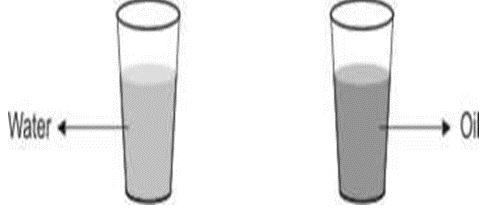
(a) The level is completely unchanged in both the glasses.
(b) The level has fallen by the same amount in both glasses.
(c) The level of oil has fallen more than the level of water.
(d) The level of water has fallen more than the level of oil.
Answer : D
Question. Which of the following can be used again and again many times?
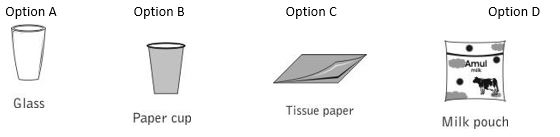
Answer : A
Question. Shama spilt some oil paint on her white dress. Use the information given below to find out how the paint can be removed from the dress. Which of these can be used to clean Shama's dress?
| Substances tried | Dissolves? |
| Water Paint + Cold Water | Yes |
| Oil Paint + Cold Water + Soap | No |
| Oil Paint + Kerosene | Yes |
| Oil Paint + Hot Water + Soap | No |
(a) cold water
(b) cold water with soap, or hot water
(c) hot water and soap
(d) kerosene
Answer : D
Question. Ravi is dissolving some sugar cubes in a glass of water. Which of these actions will make the sugar dissolve faster?
(a) Adding more sugar
(b) Using cold water
(c) Powdering the sugar cubes first
(d) Using less water
Answer : C
Question. Water can pass through blotting paper. Sand cannot pass through it. Amit made a cone of blotting paper as shown in the figure. He poured sandy water into it. What will come out into the jar?
Question. Do trees die?
(a) Yes, all trees die after getting sick or old.
(b) Only some types of trees die, others do not.
(c) Trees die only when they are cut by men.
(d) Trees never die, though they stop growing bigger.
Answer : A
Question. Which of the following can be used again and again many times?
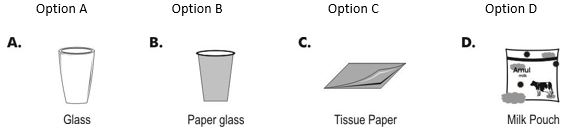
Answer : A
Question. The weather is a part of the daily news. Knowing about the weather is most important for people who_____________.
(a) work in shops
(b) sell cars
(c) catch fish
(d) use computers
Answer : C
Question. Most parts of India receive monsoon rains during which of these months?
(a) January - February
(b) March - May
(c) June - September
(d) October - December
Answer : C
Free NCERT Textbook Explanations: Class 4 Environmental Studies Chapter 13 A Rivers Tale
Accessing Chapter 13 A Rivers Tale Solutions
Access structured NCERT textbook solutions for Chapter 13 A Rivers Tale. Designed in alignment with the latest academic curriculum for Class 4 Environmental Studies, these answers cover all end-of-chapter exercises to support daily learning and homework completion.
Concept-Driven Answers for Class 4 Environmental Studies
Beyond providing final answers, these guides offer step-by-step breakdowns for complex queries in the Class 4 Environmental Studies module. This approach helps students balance theoretical depth with practical problem-solving skills required for NCERT exams.
Maximizing Study Efficiency
Frequent review of these structured answers builds strong analytical capabilities and response efficiency. Maximize your academic readiness by combining these textbook solutions with our curated study materials and mock evaluations for Class 4 Environmental Studies.
FAQs
The complete and updated NCERT Solutions Class 4 Environmental Studies Chapter 13 A Rivers Tale is available for free on StudiesToday.com. These solutions for Class 4 Environmental Studies are as per latest NCERT curriculum.
Yes, our experts have revised the NCERT Solutions Class 4 Environmental Studies Chapter 13 A Rivers Tale as per 2026 exam pattern. All textbook exercises have been solved and have added explanation about how the Environmental Studies concepts are applied in case-study and assertion-reasoning questions.
Toppers recommend using NCERT language because NCERT marking schemes are strictly based on textbook definitions. Our NCERT Solutions Class 4 Environmental Studies Chapter 13 A Rivers Tale will help students to get full marks in the theory paper.
Yes, we provide bilingual support for Class 4 Environmental Studies. You can access NCERT Solutions Class 4 Environmental Studies Chapter 13 A Rivers Tale in both English and Hindi medium.
Yes, you can download the entire NCERT Solutions Class 4 Environmental Studies Chapter 13 A Rivers Tale in printable PDF format for offline study on any device.