

NCERT Solutions for Class 12 Mathematics: Chapter 02 Inverse Trigonometric Functions
Review structured textbook solutions for Class 12 Mathematics Chapter 02 Inverse Trigonometric Functions. Built according to NCERT guidelines for the 2026-27 academic year, these downloadable answers support daily revision and problem-solving accuracy.
Practice Class 12 Mathematics Solutions: Chapter 02 Inverse Trigonometric Functions
Access the complete solution PDF for Class 12 Mathematics below. Regular practice with these targeted textbook answers builds familiarity with standard question patterns and helps secure higher marks in final school evaluations.
Exercise 2.1
Find the principal values of the following:
Question 1. sin-1(-1/2)
Answer :
1. Let sin-1(−1/2) = y, then
sin y = −1/2 = −sin(π/6) = sin(−π/6)
Range of the principal value of sn-1 is [-π/2, π/2] and sin -π/6) = -1/2
Therefore, the principal value of sin-1(-1/2) is -π/6.
Question 2. cos-1(√3/2)
Answer :
Let cos-1(√3/2) = y,
cos y = √3/2 = cos (π/6)
We know that the range of the principal value branch of cos-1 is [0, π] and cos (π/6) = √3/2
Therefore, the principal value of cos-1(√3/2) is π/6.
Question 3. cosec-1(2)
Answer :
Let cosec-1(2) = y.
Then, cosec y = 2 = cosec (π/6)
We know that the range of the principal value branch of cosec-1 is [-π/2, π/2] - {0} and cosec (π/6) = 2.
Therefore, the principal value of cosec-1(2) is π/6.
Question 4. tan-1(√3)
Answer :
Let tan-1(-√3) = y,
then tan y = -√3 = -tan π/3 = tan (-π/3)
We know that the range of the principal value branch of tan-1 is (-π/2, π/2) and tan (-π/3)
= -√3
Therefore, the principal value of tan-1 (-√3) is -π/3
Question 5. cos-1(-1/2)
Answer :
Let cos-1(-1/2) = y,
then cos y = -1/2 = -cos π/3 = cos (π-π/3) = cos (2π/3)
We know that the range of the principal value branch of cos-1 is [0, π] and cos (2π/3) = -1/2
Therefore, the principal value of cos-1(-1/2) is 2π
Question 6. tan-1(-1)
Answer :
Let tan-1(-1) = y. Then, tan y = -1 = -tan (π/4) = tan (-π/4)
We know that the range of the principal value branch of tan-1 is (-π/2, π/2) and tan (-π/4) = -1.
Therefore, the principal value of tan-1(−1) is -π/4.
Question 7. sec-1(2/√3)
Answer :
Let sec-1(2/√3) = y, then sec y = 2/√3 = sec (π/6)
We know that the range of the principal value branch of sec-1 is [0, π] − {π/2} and sec (π/6) = 2/√3.
Therefore, the principal value of sec-1(2/√3) is π/6.
Question 8. cot-1(√3)
Answer :
Let cot-1√3 = y, then cot y = √3 = cot (π/6).
We know that the range of the principal value branch of cot-1 is (0, π) and cot (π/6) = √3.
Therefore, the principal value of cot-1√3 is π.
Question 9. cos-1(-1/√2)
Answer :
Let cos-1(-1/√2) = y,
then cos y = -1/√2 = -cos (π/4) = cos (π - π/4) = cos (3π/4).
We know that the range of the principal value branch of cos-1 is [0, π] and cos (3π4) = -1/√2.
Therefore, the principal value of cos-1(-1/√2) is 3π/4.
Question 10. cosec-1(-√2)
Answer :
Let cosec-1(−√2) = y, then cosec y = −√2 = −cosec (π/4) = cosec (−π/4)
We know that the range of the principal value branch of cosec-1 is [-π/2, π/2]-{0} and cosec(-π/4) = -√2.
Therefore, the principal value of cosecc-1(-√2) is -π/4.
Find the values of the following:
Question 11. tan-1(1) + cos-1(-1/2) + sin-1(-1/2)
Answer :
Let tan-1(1) = x,
then tan x = 1 = tan(π/4)
We know that the range of the principal value branch of tan-1 is (−π/2, π/2).
∴ tan-1(1) = π/4
Let cos-1(−1/2) = y,
then cos y = −1/2 = −cosπ/3 = cos (π − π/3)
= cos (2π/3)
We know that the range of the principal value branch of cos-1 is [0, π].
∴ cos-1(−1/2) = 2π/3
Let sin-1(−1/2) = z,
then sin z = −1/2 = −sin π/6 = sin (−π/6)
We know that the range of the principal value branch of sin-1 is [-/π2, π/2].
∴ sin-1(-1/2) = -π/6
Now,
tan-1(1) + cos-1(-1/2) + sin-1(-1/2)
= π/4 + 2π/3 − π/6
= (3π + 8π − 2π)/12
= 9π/12 = 3π/4
Question 12. cos-1(1/2) + 2 sin-1(1/2)
Answer :
Let cos-1(1/2) = x, then
cos x = 1/2 = cos π/3
We know that the range of the principal value branch of cos−1 is [0, π].
∴ cos-1(1/2)
= π/3
Let sin-1(-1/2) = y, then
sin y = 1/2
= sin π/6
We know that the range of the principal value branch of sin-1 is [-π/2, π/2].
∴ sin-1(1/2) = π/6
Now,
cos-1(1/2) + 2sin-1(1/2)
= π/3 + 2×π/6
= π/3 + π/3
= 2π/3
Question 13. If sin-1 x = y, then
(A) 0 ≤ y ≤ π
(B) -π/2 ≤ y ≤ π/2
(C) 0 < y < π
(D) -π/2 < y < π/2
Answer :
It is given that sin-1x = y.
We know that the range of the principal value branch of sin-1 is [-π/2, π/2].
Therefore, -π/2 ≤ y ≤ π/2.
Hence, the option (B) is correct.
Question 14. tan-1√3 - sec-1(-2) is equal to
(A) π
(B) -π/3
(C) π/3
(D) 2π/3
Answer :
Let tan-1√3 = x,then
tan x = √3 = tan π/3
We know that the range of the principal value branch of tan-1 is (-π/2, π/2).
∴ tan-1√3 = π/3
Let sec-1(-2) = y, then
sec y = -2 = -sec π/3
= sec (π - π/3)
= sec (2π/3)
We know that the range of the principal value branch of sec-1 is [0, π]- {π/2}
∴ sec-1(-2) =2π/3
Now,
tan-1√3 - sec-1(-2)
= π/3 - 2π/3
= -π/3
Hence, the option (B) is correct.
Exercise 2.1
Prove the following
Question 1. 3sin-1x = sin-1(3x – 4x3), x ∈ [-/2, 1/2]
Answer :
To prove:
3sin-1x = sin-1(3x − 4x3), x ∈ [−1/2, 1/2]
Let sin-1x = θ, then x = sin θ.
We have,
RHS = sin-1(3x - 4x3)
= sin-1(3 sin θ - 4sin3θ)
= sin-1(sin 3θ) = 3θ
= 3sin-1x = LHS
Question 2. 3cos-1x = cos-1(4x3 – 3x) x ∈ [1, 1/2]
Answer :
To prove:
3cos-1x = cos-1(4x3 – 3x) x ∈ [1, 1/2].
Let cos-1x = θ, then x = cos θ.
We have,
RHS = cos-1(4x3 - 3x)
= cos-1(4cos3θ - 3cosθ)
= cos-1(cos 3θ) = 3θ
= 3cos-1x
= LHS
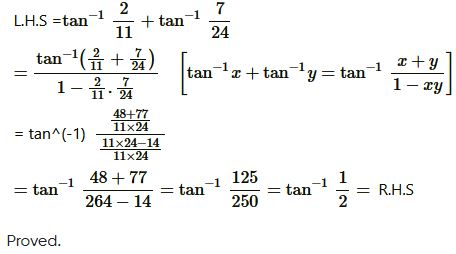
Question 3. tan-12/11 + tan-17/24 = tan-11/2
Answer :
Question 4. 2tan-11/2 + tan-11/7 = tan-131/17
Answer :

Write the following functions in the simplest form:
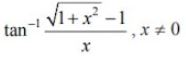
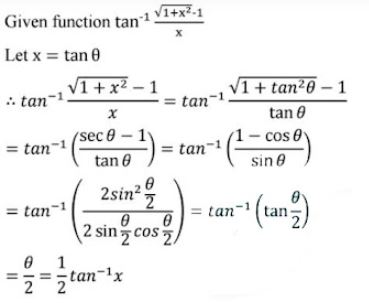
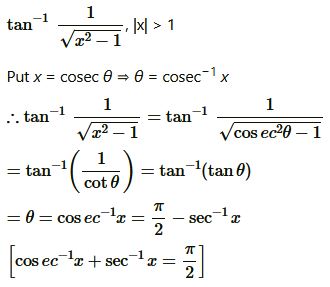
Question 5
Answer :
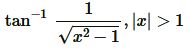
Question 6.
Answer :
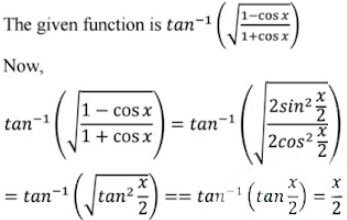
Question 7.
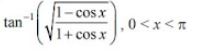
Answer :
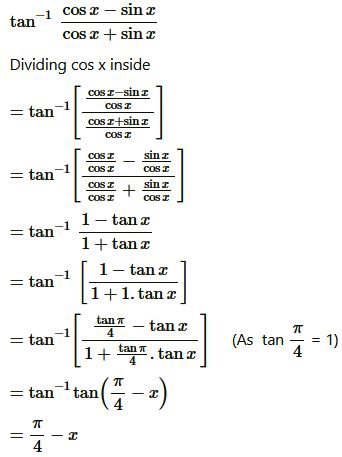
Question 8.

Answer :
Question 9.
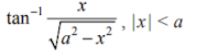
Answer :
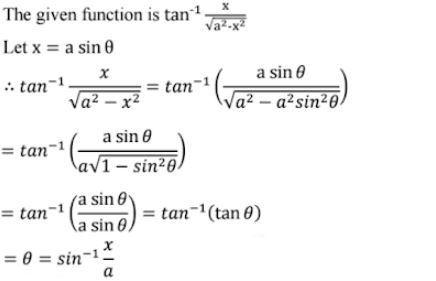
Question 10.

Answer :
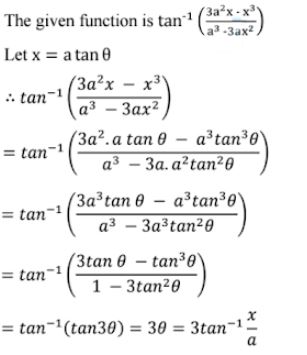
Question 11.
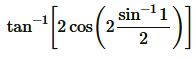
Answer :
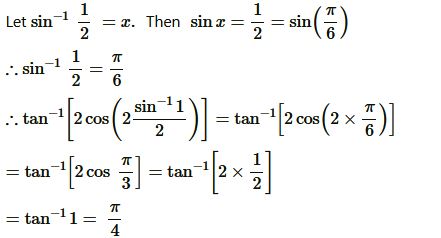
Question 12. cot (tan-1a + cot-1a)
Answer :
The given function is cot(tan-1a + cot-1a).
∴ cot(tan-1a + cot-1a)
= cot (π/2) [tan-1x + cot-1x = π/2]
= 0
Question 13.

Answer :
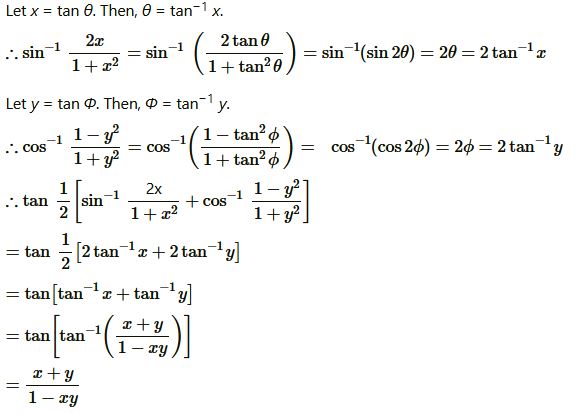
Question 14. If

Answer :
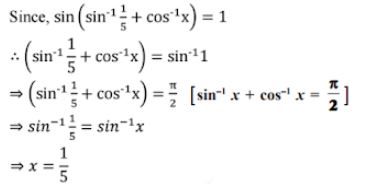
Question 15. If
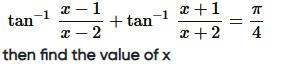
Answer :
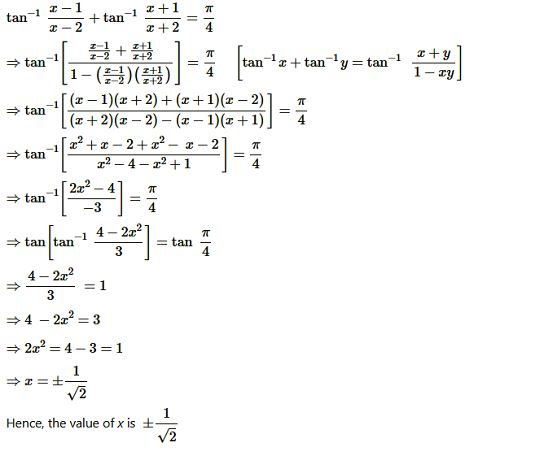
Question 16.
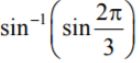
Answer :
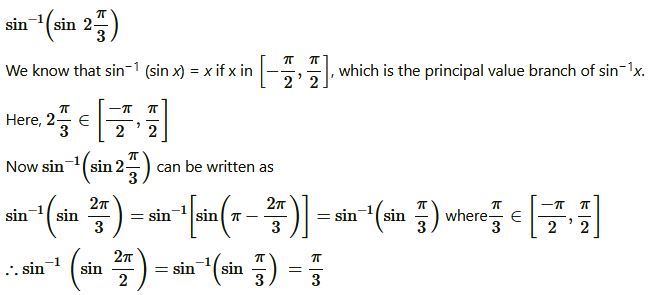
Question 17
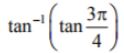
Answer :
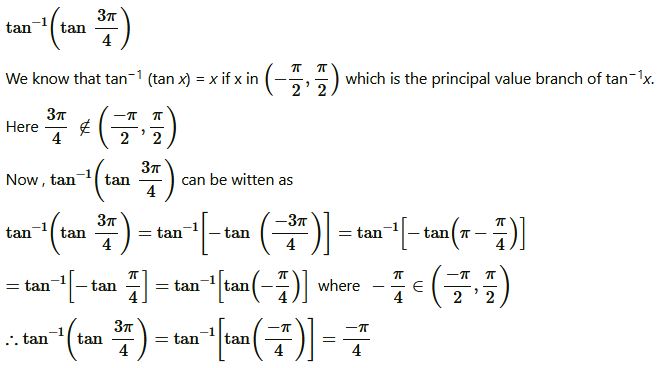
Question 18.
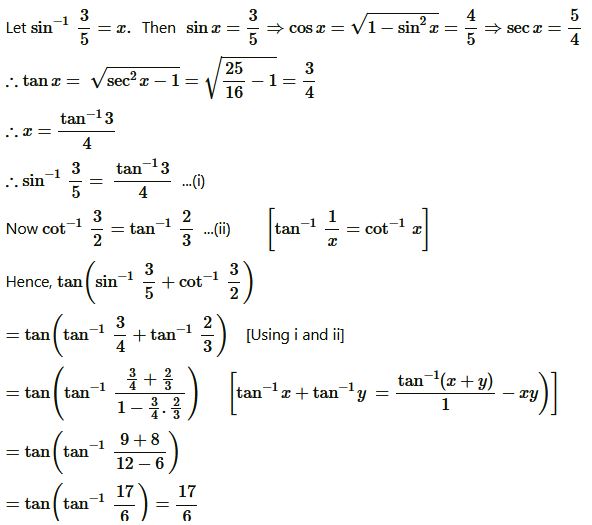
Answer :
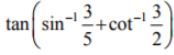
Question 19.
Answer :
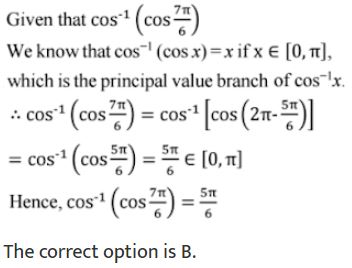
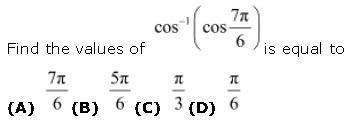
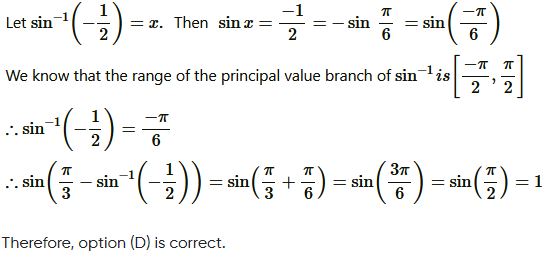
Question 20.

(A) 1/2
(B) 1/3
(C) 1/4
(D) 1
Answer :
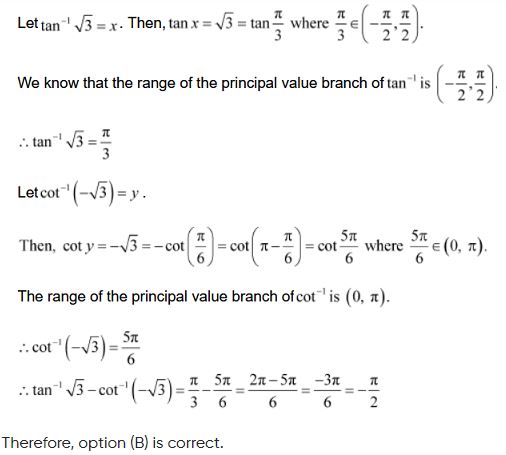
Question 21. tan-1√3 - cot-1 (-√3) is equal to:
(A) π
(B) -π/2
(C) 0
(D) 2√3
Answer :
Miscellaneous Solutions
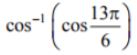
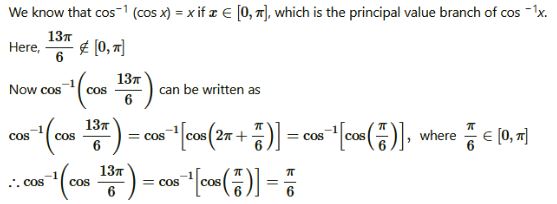
Question 1.
Answer :
Question 2.
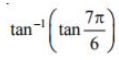
Answer :
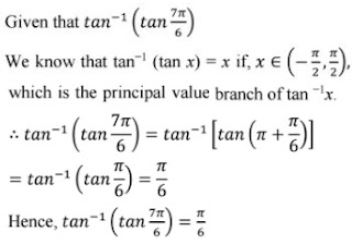
Question 3.
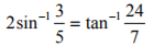
Answer :
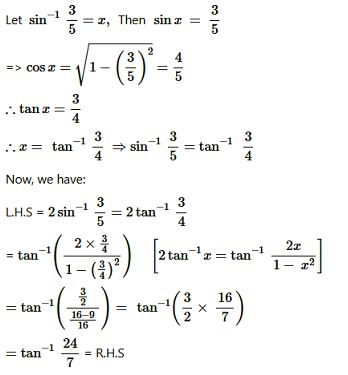
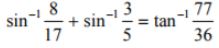
Question 4.
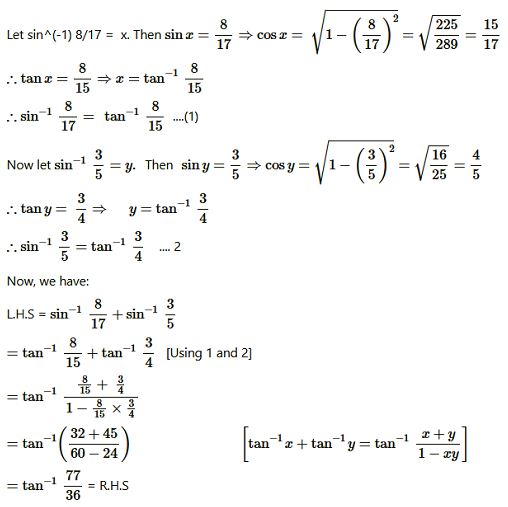
Answer :
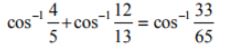
Question 5.
Answer :
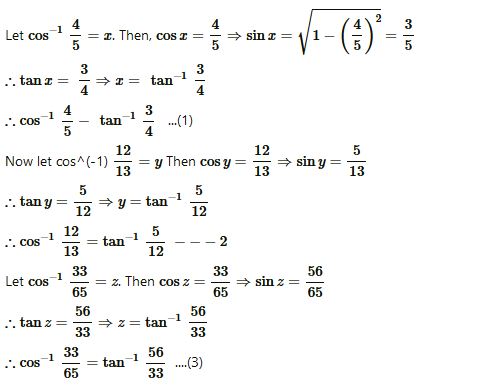
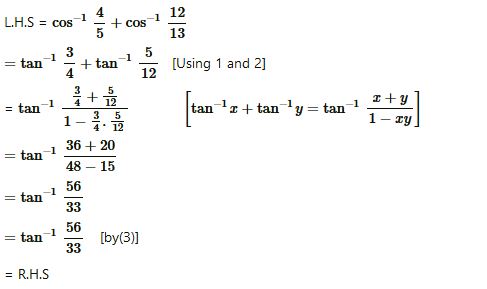
Question 6.

Answer :
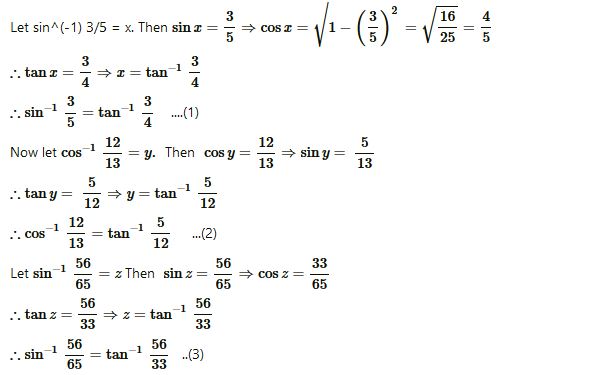
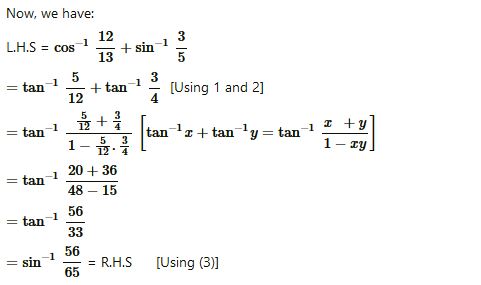
Question 7.

Answer :
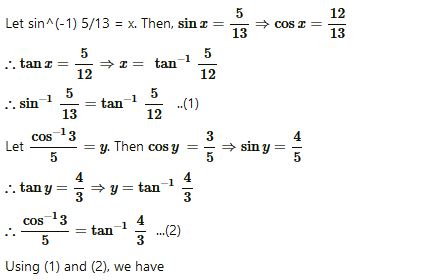
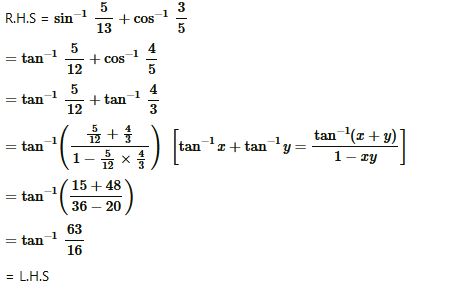
Question 8.

Answer :
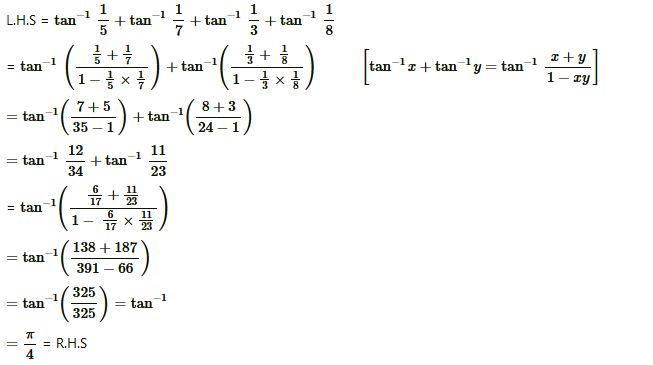
Question 9.

Answer :
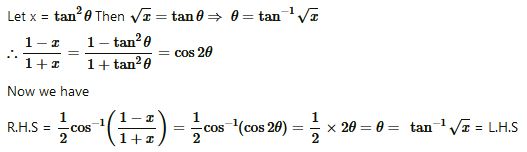
Question 10.

Answer :
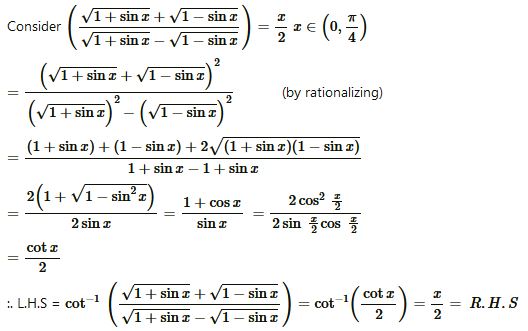
Question 11.

Answer :
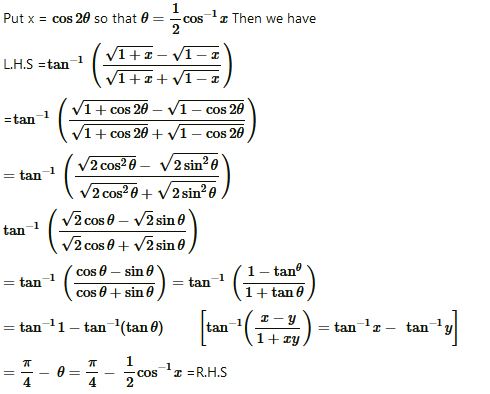
Question 12.

Answer :
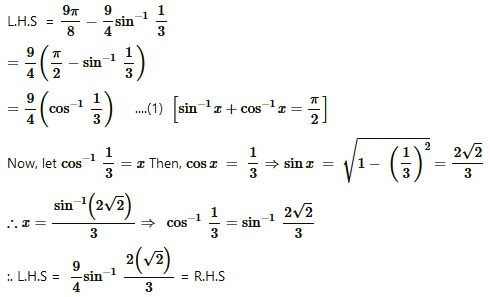
Question 13. 2 tan-1 (cos x) = tan-1 (2 cosec z) is equal to
Answer :
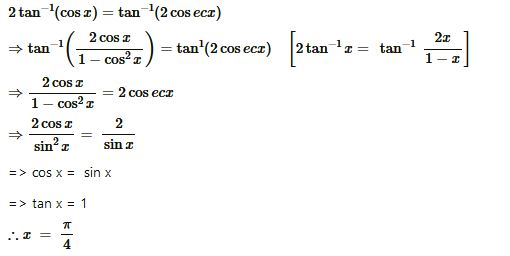
Question 14.

Answer :
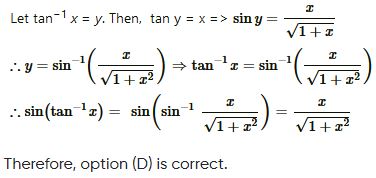
Question 15. sin (tan-1 x) │x│ <1 is equal to

Answer :
Question 16. sin–1(1 – x) – 2 sin–1x = π/2, then x is equal to
(A) 0, 1/2
(B) 1, 1/2
(C) 0
(D) 1/2
Answer :
Given that sin–1(1 − x) − 2sin–1x = π/2
Let x = sin y
∴ sin–1(1 − sin y) − 2y = π/2
⇒ sin–1(1 − sin y) = π/2 + 2y
⇒ 1 − sin y = sin (π/2 + 2y)
⇒ 1 − sin y = cos 2y
⇒ 1 − sin y = 1 − 2sin2y [as cos2y = 1−2sin2y]
⇒ 2sin2y − sin y = 0
⇒ 2x2 − x = 0 [as x = sin y]
⇒ x(2x − 1) = 0
⇒ x = 0 or, x = 1/2
But x = 1/2 does not satisfy the given equation.
∴ x = 0 is the solution of the given equation.
The correct option is C.
Question 17. tan–1(x/y) − tan–1(x-y/x+y) is equal to
(A) π/2
(B) π/3
(C) π/4
(D) -3π/4
Answer :

Free study material for Mathematics
Free NCERT Textbook Explanations: Class 12 Mathematics Chapter 02 Inverse Trigonometric Functions
Official NCERT Solutions for Chapter 02 Inverse Trigonometric Functions
Review comprehensive exercise answers for Class 12 Mathematics Chapter 02 Inverse Trigonometric Functions. Fully updated to match current NCERT syllabus guidelines, these textbook solutions help students verify their work and maintain accurate study notes.
Step-by-Step Explanations for Chapter 02 Inverse Trigonometric Functions
Clear, methodical explanations accompany every challenging problem within the Class 12 Mathematics text. Engaging with these detailed answers lays a solid foundation for advanced learning and improves foundational clarity for upcoming assessments.
Next Steps in Your Mathematics Revision
These resources act as an effective roadmap for daily homework tasks and independent study. Supplement your review of Chapter 02 Inverse Trigonometric Functions with official sample papers and interactive practice tests available on our platform free of charge.
FAQs
The complete and updated NCERT Solutions Class 12 Mathematics Chapter 2 Inverse Trigonometric Functions is available for free on StudiesToday.com. These solutions for Class 12 Mathematics are as per latest NCERT curriculum.
Yes, our experts have revised the NCERT Solutions Class 12 Mathematics Chapter 2 Inverse Trigonometric Functions as per 2026 exam pattern. All textbook exercises have been solved and have added explanation about how the Mathematics concepts are applied in case-study and assertion-reasoning questions.
Toppers recommend using NCERT language because NCERT marking schemes are strictly based on textbook definitions. Our NCERT Solutions Class 12 Mathematics Chapter 2 Inverse Trigonometric Functions will help students to get full marks in the theory paper.
Yes, we provide bilingual support for Class 12 Mathematics. You can access NCERT Solutions Class 12 Mathematics Chapter 2 Inverse Trigonometric Functions in both English and Hindi medium.
Yes, you can download the entire NCERT Solutions Class 12 Mathematics Chapter 2 Inverse Trigonometric Functions in printable PDF format for offline study on any device.