

Official NCERT Solutions for Class 12 Mathematics: Chapter 09 Differential Equations
Access comprehensive textbook solutions for Chapter 09 Differential Equations using the official curriculum guides for Class 12 Mathematics. Designed to align with the 2026-27 NCERT standards, these detailed answers help students reinforce core academic concepts.
Chapter-wise Solutions for Mathematics: Chapter 09 Differential Equations
Navigate directly to the solved Mathematics textbook exercises using the digital viewer below. Each solution includes detailed step-by-step explanations, allowing students to instantly cross-check their work and identify areas requiring further revision.
Exercise 9.1
1. Determine order and degree (If defined) of differential equation d4y /dx4 + sin(y') = 0
Solution
d4y /dx4 + sin(y''') = 0
⇒ y''' + sin(y''') = 0
The highest order derivative present in the differential equation is y''''. Therefore, its order is four.
The given differential equation is not a polynomial equation in its derivatives. Hence, its degree is not defined.
2. Determine order and degree(if defined) of differential equation y' + 5y = 0
Solution
The given differential equation is :
y' + 5y = 0
The highest order derivative present in the differential equation is y' . Therefore, its order is one.
It is a polynomial equation in y'. The highest power raised to y' is 1. Hence, its degree is one.
3. Determine order and degree (if defined of differential equation (ds/dt)4 + 3s d2s/dt2 = 0
Solution
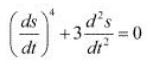
The highest order derivative present in the given differential equation is d2s/dt2. Therefore, its order is two .
It is a polynomial equation in d2s/dt2 and ds/dt. The power raised to d2s/dt2 is 1.
Hence, its degree is one.
4. Determine order and degree (if defined) of differential equation d2y/(ds2)2 + cos (dy/dx) = 0
Solution
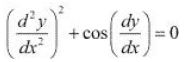
The highest order derivative present in the given differential equation is d2 y/dx2. Therefore, its order is 2.
The given differential equation is not a polynomial equation in its derivatives. Hence, its degree is not defined.
5. Determine order and degree (if defined) of differential equation d2 y/dx2 = cos 3x + sin 3x
Solution
d2y/dx2 = cos 3x + sin 3x
⇒ d2y/dx2 - cos 3x - sin 3x = 0
The highest order derivative present in the differential equation is d2y/dx2 . Therefore, its order is two.
It is a polynomial equation in d2 y/dx2 and the power raised to d2y/dx2 is 1.
Hence, its degree is one.
6. Determine order and degree (if defined) of differential equation
(y''') + (y'')3 + (y')4 + y5 = 0
Solution
(y''') + (y'')3 + (y')4 + y5 = 0
The highest order derivative present in the differential equation is y'''. Therefore, its order is three.
The given differential equation is a polynomial equation in y''' , y'' , and y' .
The highest power raised to y''' is 2. Hence, its degree is 2.
7. Determine order and degree(if defined) of differential equation y′′′ + 2y″ + y′ = 0
Solution
y′′′ + 2y″ + y′ = 0
The highest order derivative present in the differential equation is y'''. Therefore, its order is three.
It is a polynomial equation in y''', y'' and y' . The highest power raised to y''' is 1. Hence, its degree is 1.
8. Determine order and degree(if defined) of differential equation y′ + y = ex .
Solution
y′ + y = ex
⇒ y' + y - ex = 0
The highest order derivative present in the differential equation is y'. Therefore, its order is one.
The given differential equation is a polynomial equation in y' and the highest power raised to y' is one. Hence, its degree is one.
9. Determine order and degree (if defined) of differential equation y'' + (y')2 + 2y = 0
Solution
y'' + (y')2 + 2y = 0
The highest order derivative present in the differential equation is y''. Therefore, its order is two.
The given differential equation is a polynomial equation in y'' and y' and the highest power raised to y'' is one.
Hence, its degree is one .
10. Determine order and degree(if defined) of differential equation y″ + 2y′ + sin y = 0
Solution
y'' + 2y' + sin y = 0
The highest order derivative present in the differential equation is y''. Therefore, its order is two.
This is a polynomial equation in y'' and y' and the highest power raised to y'' is one. Hence, its degree is one.
11. The degree of the differential equation
(d2y/dx2 )3 + (dy/dx)2 + sin(dy/dx) + 1 = 0
(A) 3
(B) 2
(C) 1
(D) not defined
Solution

The given differential equation is not a polynomial equation in its derivatives. Therefore, its degree is not defined.
Hence, the correct answer is D.
12. The order of the differential equation 2x2(d2y/dx2) + 3(dy/dx) + y = 0 is
(A) 2
(B) 1
(C) 0
(D) not defined
Solution
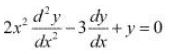
The highest order derivative present in the given differential equation is d2 y/dx2 . Therefore, its order is two.
Hence, the correct answer is A.
Exercise 9.2
1. Verify that the given functions (explicit or implicit) is a solution of the corresponding differential equation
y = ex + 1 : y″ – y′ = 0
Solution
y = ex + 1
Differentiating both sides of this equation with respect to x, we get :
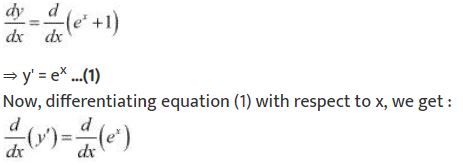
⇒ y' = ex
Substituting the values of y' and y'' in the given differential equation, we get the L.H.S. as :
y'' - y' = ex - ex = 0 R.H.S.
Thus, the given function is the solution of the corresponding differential equation.
2. verify that the given functions (explicit or implicit) is a solution of the corresponding differential equation
y = x2 + 2x + C : y′ – 2x – 2 = 0
Solution
y = x2 + 2x + C
Differentiating both sides of this equation with respect to x, we get :
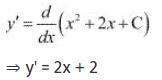
⇒ y' = 2x + 2
Substituting the value of y' in the given differential equation, we get :
L.H.S = y' - 2x - 2 = 2x + 2 - 2x - 2 = 0 R.H.S.
Hence, the given function is the solution of the corresponding differential equation.
3. verify that the given functions (explicit or implicit) is a solution of the corresponding differential equation
y = cos x + C : y′ + sin x = 0
Solution
y = cos x + C
Differentiating both sides of this equation with respect to x, we get :
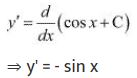
⇒ y' = - sin x
Substituting the value of y' in the given differential equation, we get :
L.H.S. = y' + sin x = - sin x + sin x = 0 = R.H.S.
Hence, the given function is the solution of the corresponding differential equation.
4. Verify that the given functions (explicit of implicit) is a solution of the corresponding differential equation y = √(1 + x2) : y' = xy/(1+ x2)
Solution
y = √(1 + x2 )
Differentiating both sides of the equation with respect to x, we get :
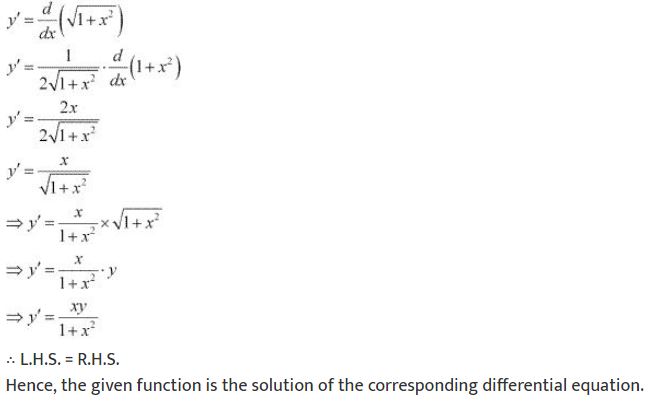
5. verify that the given functions (explicit or implicit) is a solution of the corresponding differential equation
y = Ax : xy′ = y (x ≠ 0)
Solution
y = Ax
Differentiating both sides with respect to x, we get :
y' = d/dx (Ax)
⇒ y' = A
Substituting the value of y' in the given differential equation we get :
L.H.S. = xy' = x.A = Ax = y = R.H.S
Hence, the given function is the solution of the corresponding differential equation.
6. verify that the given functions (explicit or implicit) is a solution of the corresponding differential equation y = x sin x : xy′ = y + x√(x2 - y2 ) (x ≠ 0 and x > y, or x < -y)
Solution
y = x sin x
Differentiating both sides of this equation with respect to x, we get :
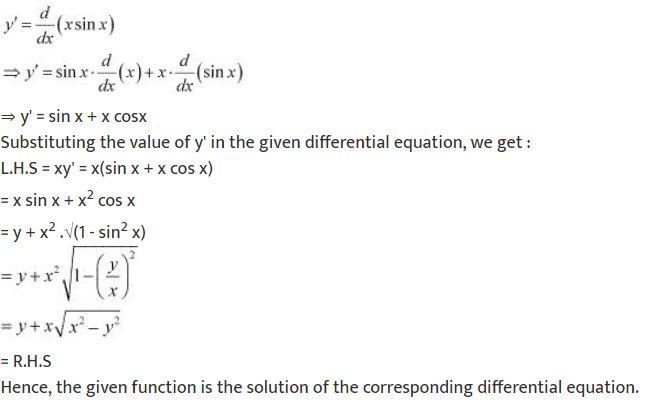
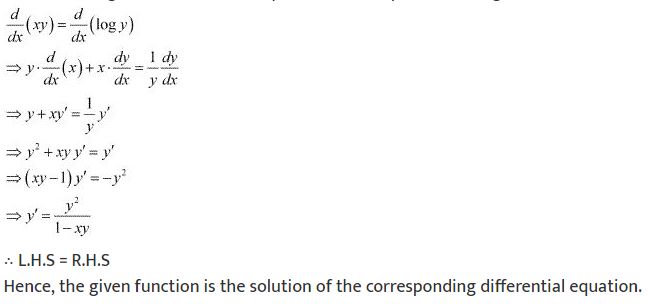
7. verify that the given functions (explicit or implicit) is a solution of the corresponding differential equation xy = log y + C : y' = y2/(1 - xy)(xy ≠ 1)
Solution
xy = log y + C
Differentiating both sides of this equation with respect to x, we get :
8. verify that the given functions (explicit or implicit) is a solution of the corresponding differential equation:
y – cos y = x : (y sin y + cos y + x) y′ = y
Solution
y - cos y = x ...(1)
Differentiating both sides of the equation with respect to x, we get :
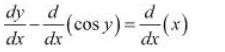
⇒ y' + sin y . y' = 1
⇒ y'(1 + sin y( = 1
⇒ y' = 1/(1 + sin y)
Substituting the value of y' in equation (1), we get :
L.H.S = (y sin y + cos y + x)y'
(y sin y + cos y + y - cos y) × ([1/(1 + siny)]
= y(1 + sin y). 1/(1 + sin y)
= y
= R.H.S.
Hence, the given function is the solution of the corresponding differential equation.
9. Verify that the given functions (explicit or implicit) is a solution of the corresponding differential equation
x + y = tan–1y : y2 y′ + y2 + 1 = 0
Solution
x + y = tan-1 y
Differentiating both sides of this equation with respect to x, we get:

= -1 - y2 + y2 + 1
= 0
= R.H.S.
Hence, the given function is the solution of the corresponding differential equation.
10. verify that the given functions (explicit or implicit) is a solution of the corresponding differential equation
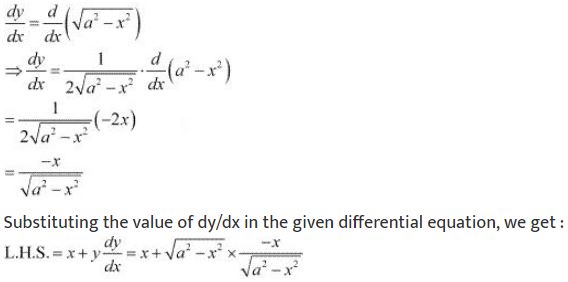
y = √(a2 - x2 x) ∈ (-a, a) : x + y (dy/dx) = 0 (y ≠ 0)
Solution
y = √(a2 - x2 )
Differentiating both sides of this equation with respect to x, we get :
= x - x
= 0
= R.H.S
Hence, the given function is the solution of the corresponding differential equation.
11. The numbers of arbitrary constants in the general solution of a differential equation of fourth order are:
(A) 0
(B) 2
(C) 3
(D) 4
Solution
We know that the number of constants in the general solution of a differential equation of order n is equal to its order.
Therefore, the number of constants in the general equation of fourth order differential equation is four.
Hence, the correct answer is D.
12.The numbers of arbitrary constants in the particular solution of a differential equation of third order are:
(A) 3
(B) 2
(C) 1
(D) 0
Solution
In a particular solution of a differential equation, there are no arbitrary constants.
Hence, the correct answer is D.
Exercise 9.3
1. Form a differential equation representing the given family of curves by eliminating arbitrary constants a and b.
x/a + y/b = 1
Solution
x/a + y/b = 1
Differentiating both sides of the given equation with respect to x, we get :
1/a + (1/b)(dy/dx) = 0
⇒ 1/a + (1/b)y' = 0
Again , differentiating both sides with respect to x, we get :
0 + (1/b)y" = 0
⇒ (1/b)y" = 0
⇒ y" = 0
Hence, the required differential equation of the given curve is y" = 0.
2. Form a differential equation representing the given family of curves by eliminating arbitrary constants a and b.
y2 = a (b2 – x2)
Solution
y2 = a (b2 – x2)
Differentiating both sides with respect to x, we get: 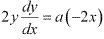
⇒ 2yy' = -2ax
⇒ yy' = -ax ...(1)
Again, differentiating both sides with respect to x, we get :
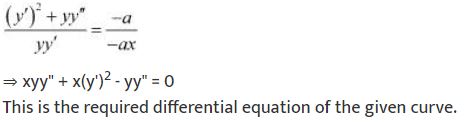
y'. y' + yy" = -a
⇒ (y')2 + yy" = -a ...(2)
Dividing equation (2) by equation (1), we get :
3. Form a differential equation representing the given family of curves by eliminating arbitrary constants a and b.
y = a e3x + b e–2x.
Solution
y' = 3ae3x - 2be-2x ...(2)
Again, differentiating both sides with respect to x, we get :

4. Form a differential equation representing the given family of curves by eliminating arbitrary constants a and b.
y = e2x (a + bx)
Solution
y = e2x (a + bx)
Differentiating both sides with respect to x, we get :
y' = 2e2x (a + bx) + e2x.b
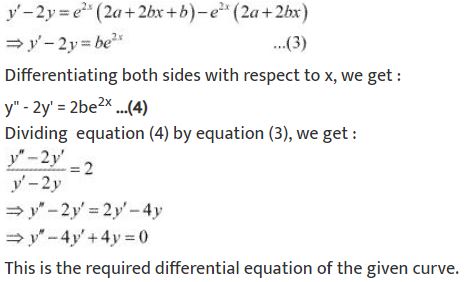
⇒ y' = e2x (2a + 2bx + b) ...(2)
Multiplying equation (1) with 2 and then subtracting it from equation (2),we get :
5. Form a differential equation representing the given family of curves by eliminating arbitrary constants a and b.
y = ex (a cos x + b sin x)
Solution
y = ex (a cos x + b sin x)
Differentiating both sides with respect to x, we get :
y' = ex (a cos x + b sin x) + ex (- a sin x + b cos x)
= y' = ex [(a + b) cos x - (a - b) sin x] ...(2)
Again, differentiating with respect to x, we get :
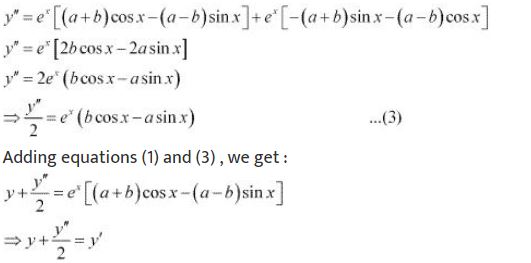
⇒ 2y + y" = 2y'
⇒ y" - 2y' + 2y = 0
This is the required differential equation of the given curve.
6. Form the differential equation of the family of circles touching the y-axis at the origin.
Solution
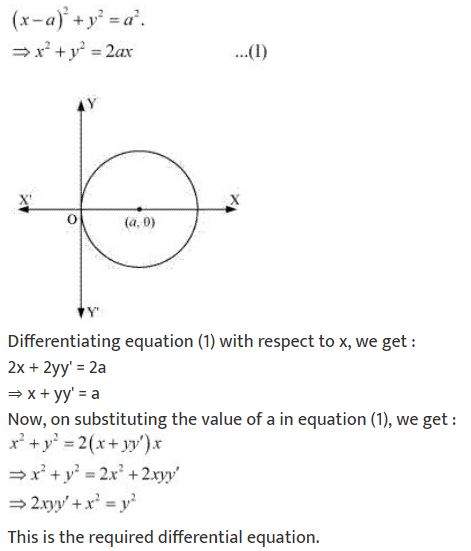
The centre of the circle touching the y - axis at origin lies on the x - axis.
Let (a, 0) be the centre of the circle.
Since it touches the y - axis at origin, its radius is a.
now, the equation of the circle with centre (a, 0) and radius (a) is
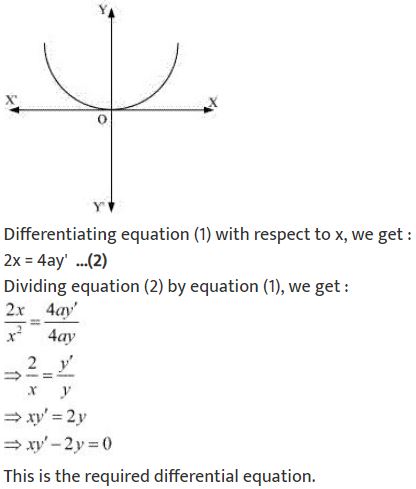
7. Form the differential equation of the family of parabolas having vertex at origin and axis along positive y-axis.
Solution
The equation of the parabola having the vertex at origin and the axis along the positive y axis is :
x2 = 4ay ...(1)
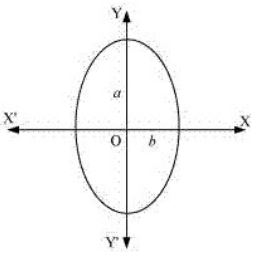
8. Form the differential equation of the family of ellipses having foci on y-axis and centre at origin.
Solution
The equation of the family of ellipses having foci on the y - axis and the centre at origin is as follows:
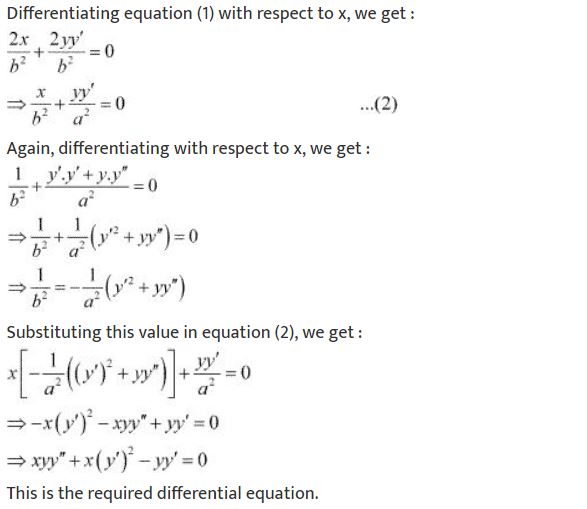
x2 /b2 + y2 /a2 = 1 ...(1)
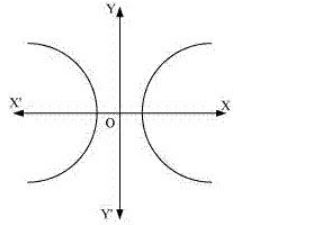
9. Form the differential equation of the family of hyperbolas having foci on x-axis and centre at origin.
Solution
The equation of the family of hyperbolas with the centre at origin and foci along the x - axis is :
x2 /a2 + y2 /b2 = 1 ...(1)
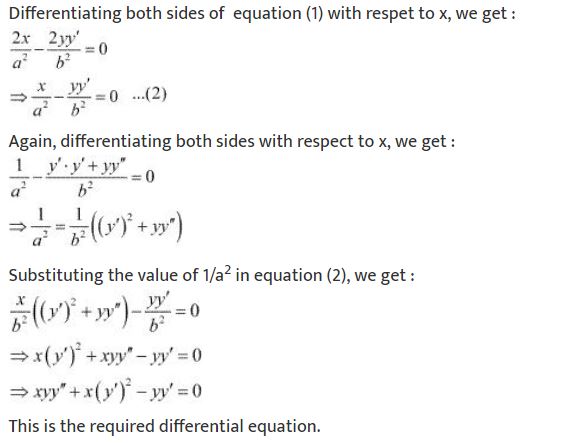
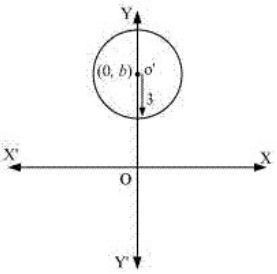
10. Form the differential equation of the family of circles having centre on y-axis and radius 3 units.
Solution
Let the centre of the circle on y - axis be (0, b).
The differential equation of the family of circles with centre at (0, b) and radius 3 is as follows :
x2 + (y - b)2 = 32
⇒ x2 + (y - b)2 = 9 ...(1)
Differentiating equation (1) with respect to x, we get :
2x + 2(y - b). y' = 0
⇒ (y - b). y' = -x
⇒ y - b = -x/y'
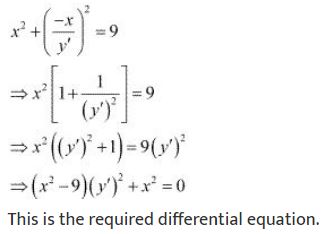
Substituting the value of (y - b) in equation (1), we get :
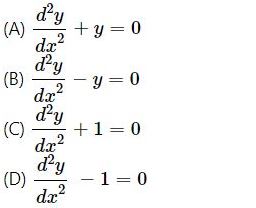
11. Which of the following differential equations has y = c1 ex + c2 e–x as the general solution ?
Solution
The given equation is :
y = c1 ex + c2 e–x ...(1)
Differentiating with respect to x, we get :
dy/dx = c1ex - c2e–x
Again, differentiating with respect to x, we get :
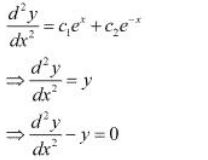
This is the required differential equation of the given equation of curve.
Hence, the correct answer is B.
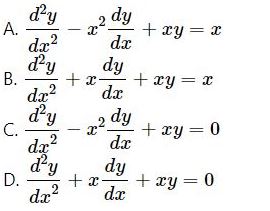
12. Which of the following differential equation has y = x as one of its particular solution ?
Solution
The given equation of curve is y = x.
Differentiating with respect to x, we get :
dy/dx =1 ...(1)
Again, differentiating with respect to x, we get :
d2 y/dx2 = 0 ...(2)
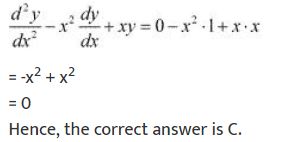
Now, on substituting the values of y, d2 y/dx2, and dy/dx from equation (1) and (2) in each of the given alternatives, we find that only the differential equation given in alternative C is correct.
Exercise 9.4
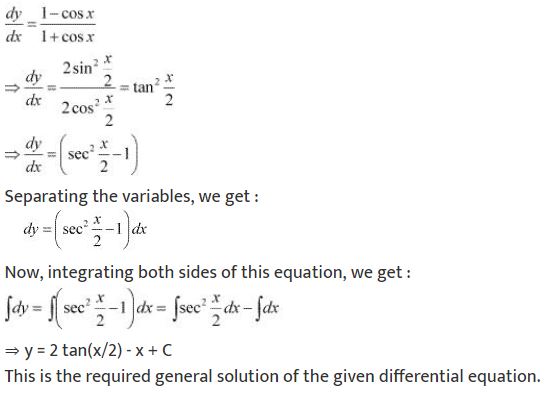
1. For the differential equations find the general solution :
dy/dx = (1 - cos x)/(1 + cos x)
Solution
The given differential equation is :
2. For the differential equation find the general solution :
dy/dx = √(4 – y2) (-2 < y < 2)
Solution
The given differential equation is :
dy/dx = √(4 – y2)
Separating the variables, we get :
⇒ dy/√(4 – y2) = dx
Now, integrating both sides of this equation, we get :
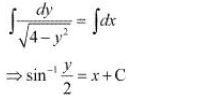
⇒ y/2 = sin(x + C)
⇒ y = 2 sin (x + C)
This is the required general solution of the given differential equation.
3. For the differential equations find the general solution :
dy/dx + y = 1(y ≠ 1)
Solution
The given differential equation is :
dy/dx + y = 1
⇒ dy + y dx = dx
⇒ dy = (1 - y) dx
Separating the variables, we get :
⇒ dy/(1 - y) = dx
Now, integrating both sides, we get :
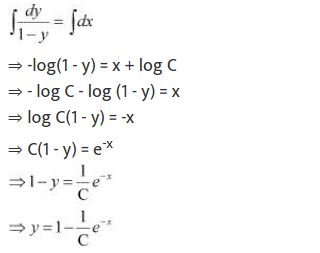
⇒ y = 1 + Ae-x (where A = -1/C)
This is the required general solution of the given differential equation.
4. For the differential equations find the general solution:
sec2 x tan y dx + sec2 y tan x dy = 0
Solution
The given differential equation is :
sec2 x tan y dx + sec2 y tan x dy = 0
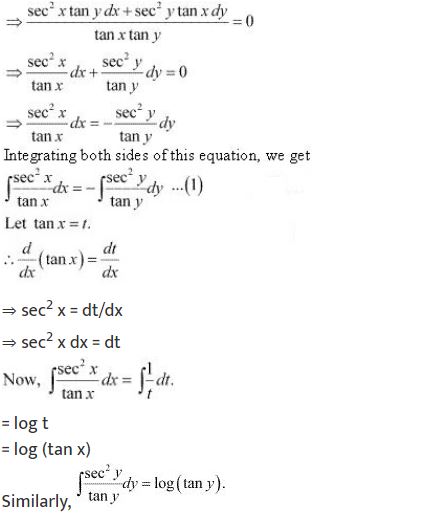
Substituting these values in equation (1), we get :
log (tan x) = - log (tan y) + log C
⇒ log (tan x) = log (C/tan y)
⇒ tan x = C/tan y
⇒ tan x tan y = C
This is the required general solution of the given differential equation.
5. For the differential equations find the general solution:
(ex + e–x) dy – (ex – e–x) dx = 0
Solution
The given differential equation is :
(ex + e–x) dy – (ex – e-x ) dx = 0
⇒ (ex + e-x ) dy = (ex - e-x )dx
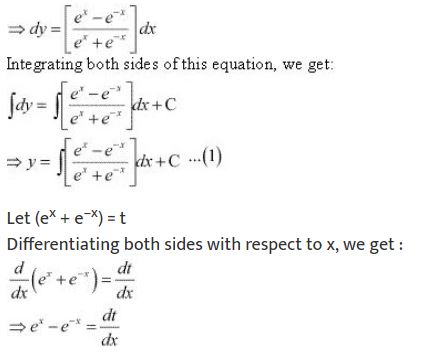
⇒ (ex + e–x) dx = dt
Substituting his value in equation (1), we get :
y = ∫(1 + t) dt + C
⇒ y = log(t) + C
⇒ y = log (ex + e–x) + C
This is the required general solution of the given differential equation.
6. For the differential equations find the general solution:
dy/dx = (1 + x2 )(1+ y2)
Solution
The given differential equation is :
dy/dx = (1 + x2 )(1+ y2)
⇒ dy/(1 + y2 ) = (1 + x2)dx
Integrating both sides of this equation, we get :
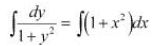
⇒ tan-1 y = ∫dx + ∫x2 dx
⇒ tan-1 y = x + x3/3 + C
This is the required general solution of the given differential equation.
7. For the differential equations find the general solution :
y log y dx - x dy = 0
Solution
The given differential equation is :
y log y dx - x dy = 0
⇒ y log y dx = x dy
⇒ dy/(y log y) = dx/ x
Integrating both sides, we get :
∫dy/(y log y) = ∫ dx/x ...(1)
Let log y = t
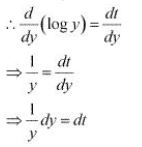
Substituting this value in equation (1), we get :
∫dt/t = ∫dx/x
⇒ log t = log x + log C
⇒ log (log y) = log Cx
⇒ log y = Cx
⇒ y = ecx
This is the required general solution of the given differential equation.
8. For the differential equations find the general solution :
x5 (dy/dx) = -y5
Solution
The given differential equation is :
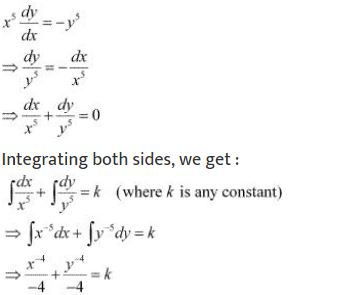
⇒ x-4 + y-4 = -4k
⇒ x-4 + y-4 = C (C = -4k)
This is the required general solution of the given differential equation.
9. For the differential equation find the general solution :
ex tan y dx + (1 – ex) sec2 y dy = 0
Solution
The given differential equation is :
dy/dx = sin-1 x
⇒ dy = sin-1 x dx
Integrating both sides, we get :
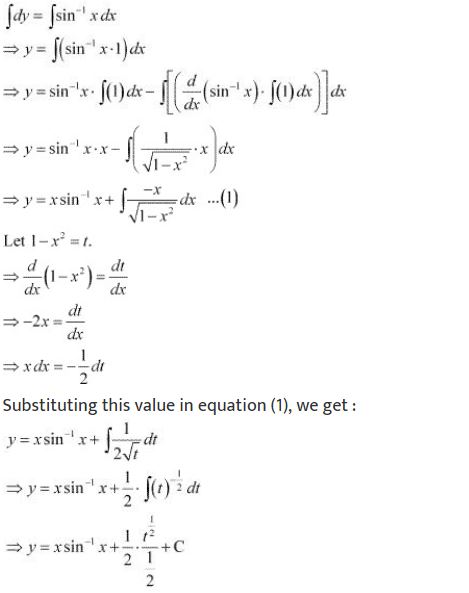
⇒ y = x sin-1 x + √t + C
⇒ y = x sin-1 x + √(1 - x2) + C
This is the required general solution of the given differential equation.
10. For the differential equations find the general solution:
ex tan y dx + (1 – ex) sec2 y dy = 0
Solution
The given differential equation is :
ex tan y dx + (1 – ex) sec2 y dy = 0
(1 - ex )sec2 y dy = -ex tan y dx
Separating the variables, we get :
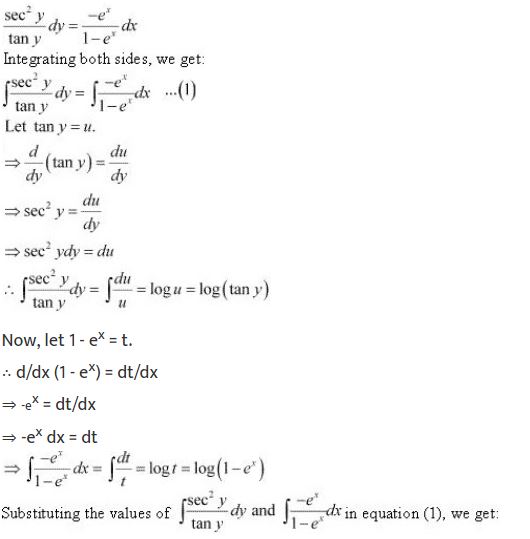
⇒ log (tan y) = log (1 - ex ) + log C
⇒ log (tan y) = log [C(1 - ex )]
⇒ tan y = C(1 - ex )
This is the required general solution of the given differential equation.
11. For each of the differential equations find a particular solution satisfying the given condition:
(x3 + x2 + x + 1) dy/dx = 2x2 + x; y = 1 when x = 0
Solution
The given differential equation is :
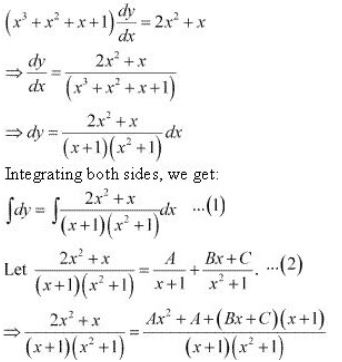
⇒ 2x2 + x = Ax2 + A + Bx2 + Bx + Cx + C
⇒ 2x2 + x = (A + B)x2 + (B + C)x + (A + C)
Comparing the coefficients of x2 and x, we get :
A + B = 2
B + C = 1
A + C = 0
Solving these equations, we get :
A = 1/2, B = 3/2 and C = -1/2
Substituting the values of A, B and C in equation (2), we get :
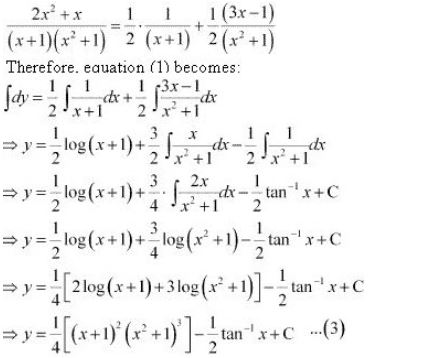
Now, y = 1 when x = 0.
⇒ 1 = (1/4) log (1) - (1/2) tan-1 0 + C
⇒ 1 = (1/4) × 0 - (1/2) × 0 + C
⇒ C = 1
Substituting C = 1 in equation (3), we get :
y = [(1/4) log (x + 1)2 (x2 + 1)3] - (1/2) tan-1 x + 1
12. For each of the differential equations find a particular solution satisfying the given condition :
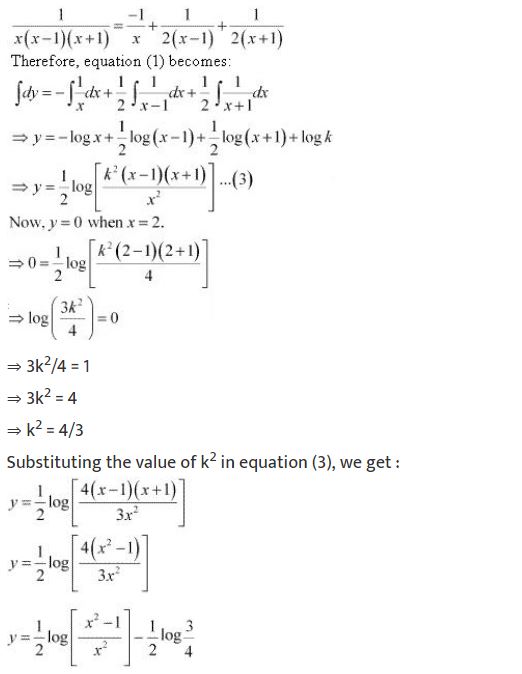
x(x2 - 1) dy/dx = 1, y = 0 when x = 2
Solution
x(x2 - 1) dy/dx = 1
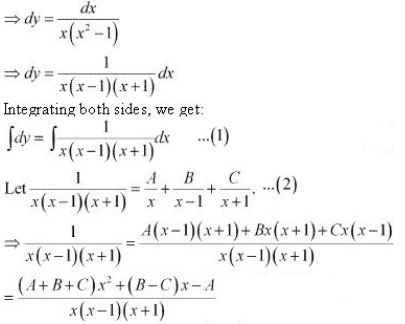
Comparing the coefficients of x2, x and constant, we get :
A = -1
B - C = 0
A + B + C = 0
Solving these equations, we get B = 1/2 and C = 1/2 .
Substituting the values of A, B, and C in equation (2), we get :
13. For each of the differential equations find a particular solution satisfying the given condition:
cos (dx/dy) = a (a ∈ R); y = 1 when x = 0
Solution
cos (dy/dx) = a
⇒ dy/dx = cos-1 a
⇒ dy = cos-1 a dx
Integrating both sides, we get :
∫dy = cos-1 a ∫dx
⇒ y = cos-1 a . x + C
⇒ y = x cos-1 a + C ...(1)
Now, y = 1 when x = 0
⇒ 1 = 0. cos-1 a + C
⇒ C = 1
Substituting C = 1 in equation (1), we get :
y = x cos-1 a + 1
⇒ (y -1)/x = cos-1 a
⇒ cos[(y -1)/x] = a
14. For each of the differential equations find a particular solution satisfying the given condition:
dy/dx = y tan x; y = 1 when x = 0
Solution
dy/dx = y tan x
⇒ dy/y = tan x dx
Integrating both sides, we get :
∫dy/y = ∫tan x dx
⇒ log y = log(sec x) + log C
⇒ log y = log (C sec x)
⇒ y = C sec x ...(1)
Now, y = 1 when x = 0.
⇒1 = C × sec 0
⇒1 = C × 1
⇒ C = 1
Substituting C = 1 in equation (1), we get :
y = sec x
15. Find the equation of a curve passing through the point (0, 0) and whose differential equation is y′ = ex sin x.
Solution
The differential equation of the curve is :
y' = ex sin x
⇒ dy/dx = ex sin x
⇒ dy = ex sin x dx
Integrating both sides, we get :
∫dy = ∫ex sin x dx ...(1)
Let I = ∫ex sin x dx.
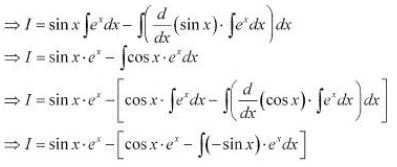
⇒ I = ex sin x - ex sin x - I
⇒ 2I = ex (sin x - cos x)
⇒ I = [ex (sin x - cos x)]/2
Substituting this value in equation (1), we get :
y = [ex (sin x - cos x)]/2 + C ...(2)
Now, the curve passes through point (0, 0)
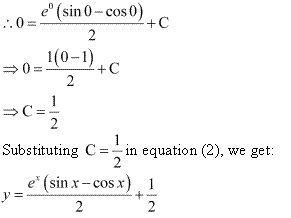
⇒ 2y = ex (sin x - cos x) + 1
⇒ 2y - 1 = ex (sin x - cos x)
Hence, the required equation of the curve is 2y - 1 = ex (sin x - cos x).
16. For the differential equation xy (dy/dx) = (x + 2)(y + 2) find the solution curve passing through the point (1, -1).
Solution
The differential equation of the given curve is :
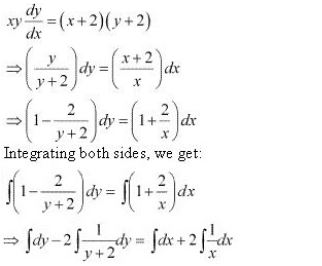
⇒ y - 2log(y + 2) = x + 2log x + C
⇒ y - x - C = log x2 + log (y + 2)2
⇒ y - x - C = log [x2 (y + 2)2 ] ...(1)
Now, the curve passes through point (1, -1).
⇒ -1 - 1 - C = log[(1)2 (-1 + 2)2 ]
⇒ -2 - C = log 1 = 0
⇒ C = -2
Substituting C = -2 in equation (1), we get :
y - x + 2 = log[x2 (y + 2)2 ]
This is the required solution of the given curve.
17. Find the equation of a curve passing through the point (0, –2) given that at any point (x ,y) on the curve, the product of the slope of its tangent and y-coordinate of the point is equal to the x-coordinate of the point.
Solution
Let x and y be the x - coordinate and y - coordinate of the point on the curve respectively.
We know that the slope of a tangent to the curve in the coordinate axes is given by the relation.
dy/dx
According to the given information, we get :
y (dy/dx) = x
⇒y dy = x dx
Integrating both sides, we get:
∫y dy = ∫x dx
⇒ y2/2 = x2 /2 + C
⇒ y2 - x2 = 2C ...(1)
Now, the curve passes through point (0, -2).
∴ (-2)2 - 22 = 2C
⇒ 2C = 4
Substituting 2C = 4 in equation (1), we get :
y2 - x2 = 4
This is the required equation of the curve.
18. At any point (x, y) of a curve, the slope of the tangent is twice the slope of the line segment joining the point of contact to the point (– 4, –3). Find the equation of the curve given that it passes through (–2, 1).
Solution
It is given that (x, y) is the point of contact of the curve and its tangent.
The slope (m1 ) of the line segment joining (x, y) and (-4, -3) is (y +3)/(x + 4)
We know that the slope of the tangent to the curve is given by the relation,
dy/dx
∴ Slope (m2 ) of the tangent = dy/dx
According to the given information :
m2 = 2m1
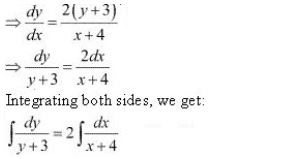
⇒ log (y + 3) = 2 log (x + 4) + log C
⇒ log (y + 3) = log C (x + 4)2
⇒ y + 3 = C(x + 4)2 ...(1)
This is the general equation of the curve.
It is given that it passes through point (-2, 1).
⇒ 1 + 3 = C(-2 + 4)2
⇒ 4 = 4C
⇒ C = 1
Substituting C = 1 in equation (1), we get :
y + 3 = (x + 4)2
This is the required equation of the curve.
19. The volume of spherical balloon being inflated changes at a constant rate. If initially its radius is 3 units and after 3 seconds it is 6 units. Find the radius of balloon after t seconds.
Solution
Let the rate of change of the volume of the balloon be k (where k is a constant )
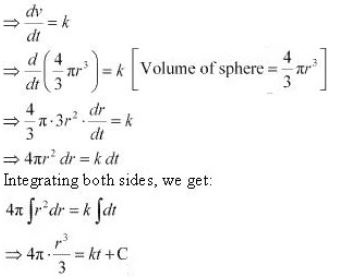
⇒ 4πr3 = 3(kt + C) ...(1)
Now, at t = 0, r = 3,
⇒ 4π × 33 = 3 (k × 0 + C)
⇒ 108π = 3C
⇒ C = 36π
At t = 3, r = 6:
⇒ 4π × 63 = 3 (k × 3 + C)
⇒ 864π = 3 (3k + 36π)
⇒ 3k = –288π – 36π = 252π
⇒ k = 84π
Substituting the values of k and C in equation (1), we get:
4πr3 = 3(84πt + 36π)
⇒ 4πr3 = 4π(63t + 27)
⇒ r3 = 63t + 27
⇒ r = (63t + 27)1/3
Thus, the radius of the balloon after t seconds is (63t + 27)1/3 .
20. In a bank, principal increases continuously at the rate of r% per year. Find the value of r if Rs 100 doubles itself in 10 years (loge2 = 0.6931).
Solution
Let p, t, and r represent the principal, time, and rate of interest respectively.
It is given that the principal increases continuously at the rate of r% per year.
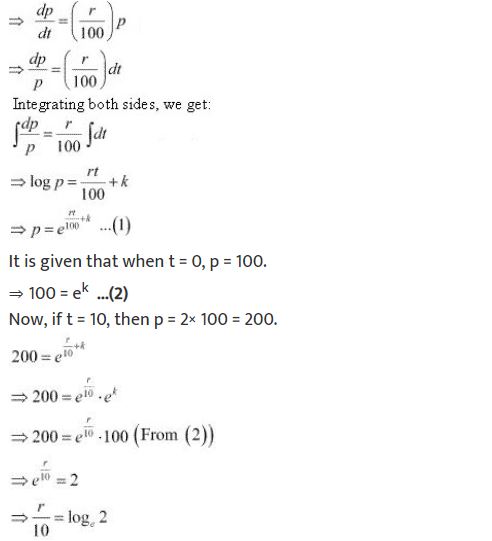
⇒ r/10 = 0.6931
⇒ r = 6.931
Hence, the value of r is 6.93 %.
21. In a bank, principal increases continuously at the rate of 5% per year. An amount of Rs 1000 is deposited with this bank, how much will it worth after 10 years (e0.5 = 1.648).
Solution
Let p and t be the principal and time respectively.
It is given that the principal increases continuously at the rate of 5 % per year.
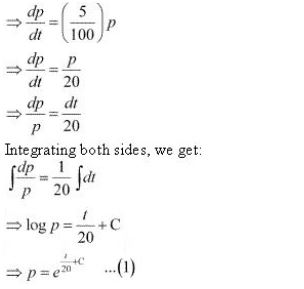
Now, when t = 0, p = 1000.
1000 = ec ...(2)
At t = 10, years the amount will worth Rs 1648.
22. In a culture, the bacteria count is 1,00,000. The number is increased by 10% in 2 hours. In how many hours will the count reach 2,00,000, if the rate of growth of bacteria is proportional to the number present?
Solution
Let y be the number of bacteria at any instant t.
It is given that the rate of growth of the bacteria is proportional to the number peresent.
∴ dy/dt ∝ y
⇒ dy/dt = ky (where k is a constant)
⇒ dy/y = kdt
Integrating both sides, we get:
∫dy/y = k ∫dt
⇒ log y = kt + C ...(1)
Let y0 be the number of bacteria at t = 0 .
log y0 be the number of bacteria at t = 0.
log y0 = C
Substituting the value of C in equation (1), we get :
log y = kt + log y0
⇒ log y - log y0 = kt
⇒ log (y/y0) = kt
⇒ kt = log (y/y0) ...(2)
Also, it is given that the number of bacteria increases by 10% in 2 hours.
⇒ y = (110/100)y0
⇒ y/y0 = 11/10 ...(3)
Substituting this value in equation (2), we get :
k⋅2 = log (11/10)
⇒ k = (1/2) log (11/10)
Therefore, equation (2) becomes :
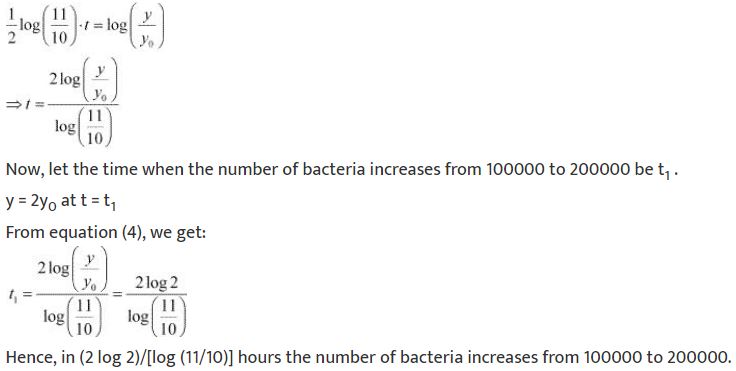
23. The general solution of the differential equation dy/dx = ex+y is
(A) ex + e–y = C
(B) ex + ey = C
(C) e–x + ey = C
(D) e–x + e–y = C
Solution
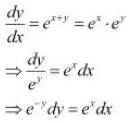
Integrating both sides, we get :
∫e–y dy = ∫ex dx
⇒ -e–y = ex + k
⇒ ex + e–y = -k
⇒ ex + e–y = c (c = -k )
Hence, the correct answer is A.
Exercise 9.5
1. Show that the given differential equation is homogeneous and solve each of them
(x2 + xy) dy = (x2 + y2) dx
Solution
The given differential equation i.e. (x2 + xy) dy = (x2 + y2) dx can be written as :
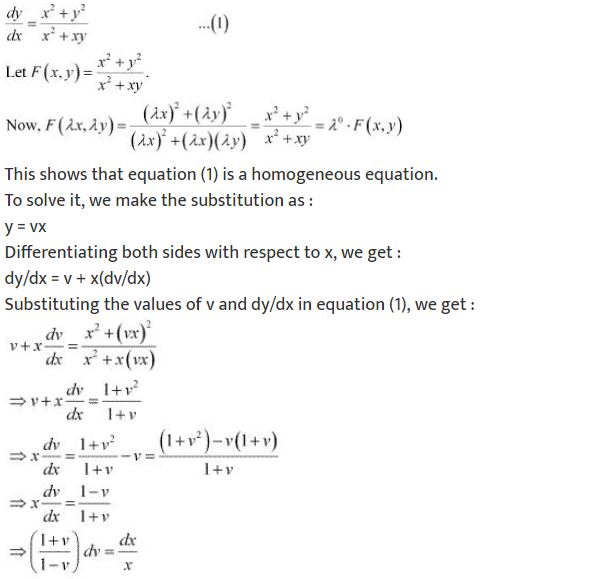
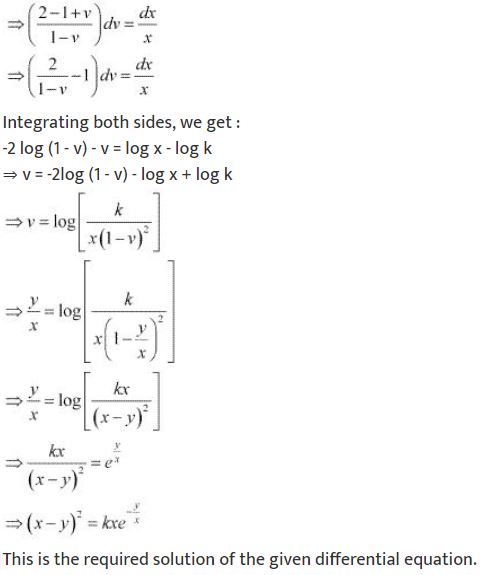
2. Show that the given differential equation is homogeneous and solve each of them
y' = (x + y)/x
Solution
The given differential equation is :
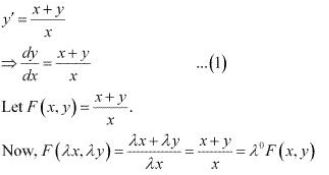
Thus, the given equation is a homogeneous equation .
To solve it, we make the substitution as :
y = vx
Differentiating both sides with respect to x, we get :
dy/dx = V + x(dv/dx)
Substituting the values of y and dy/dx in equation (1), we get :
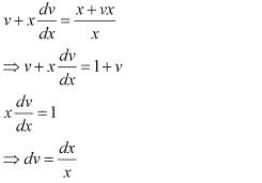
Integrating both sides, we get :
v = log x + C
⇒ y/x = log x + C
⇒ y = x log x + Cx
This is the required solution of the given differential equation.
3. Show that the given differential equation is homogeneous and solve each of them
(x – y) dy – (x + y) dx = 0
Solution
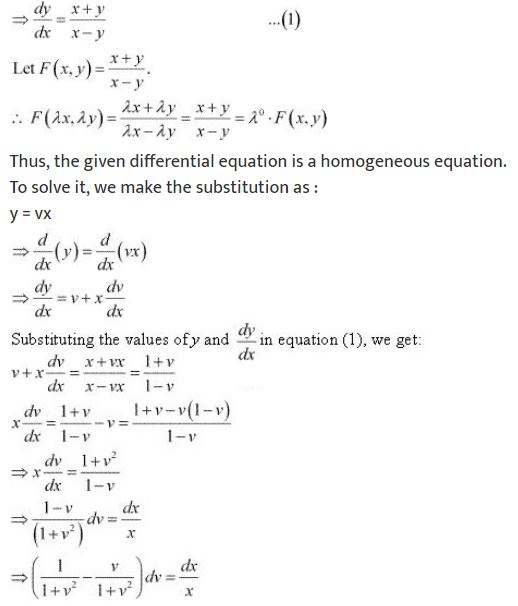
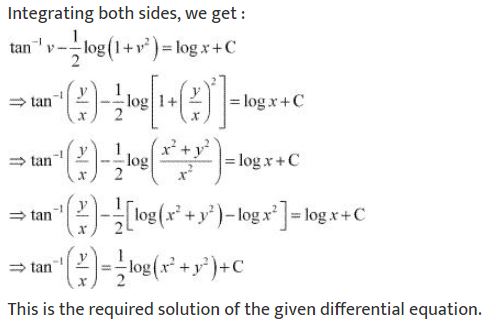
The given differential equation is :
(x - y)dy - (x + y)dx = 0
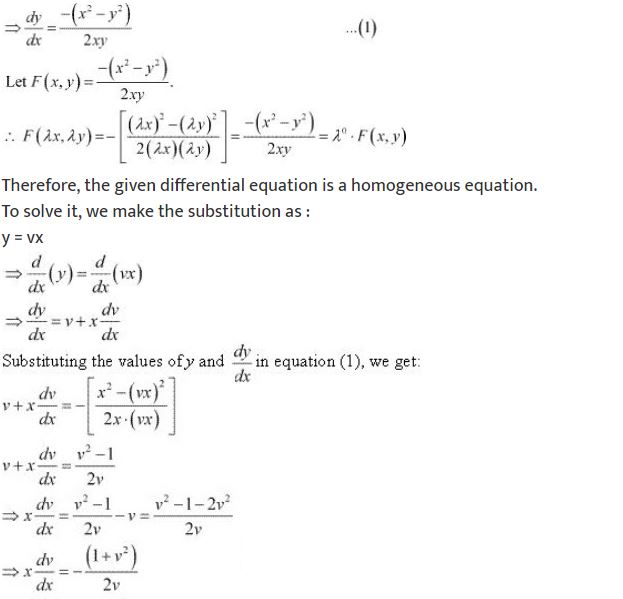
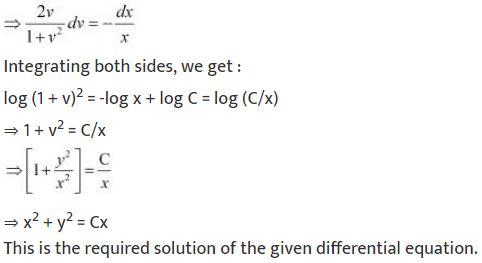
4. Show that the given differential equation is homogeneous and solve each of them
(x2 – y2) dx + 2xy dy = 0
Solution
The given differential equation is :
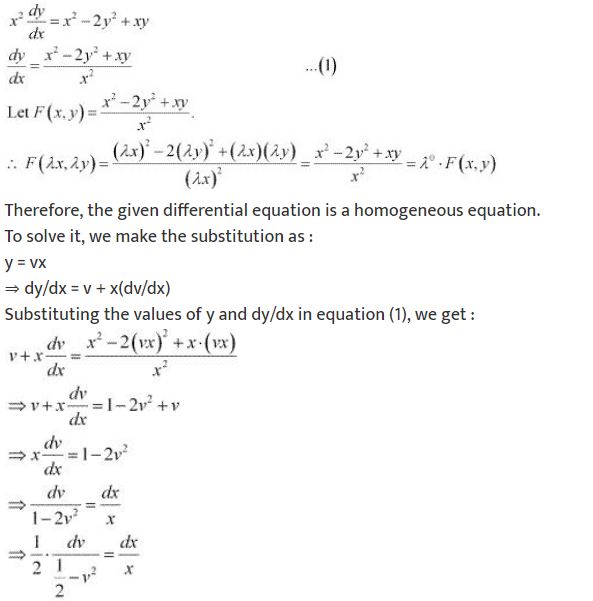
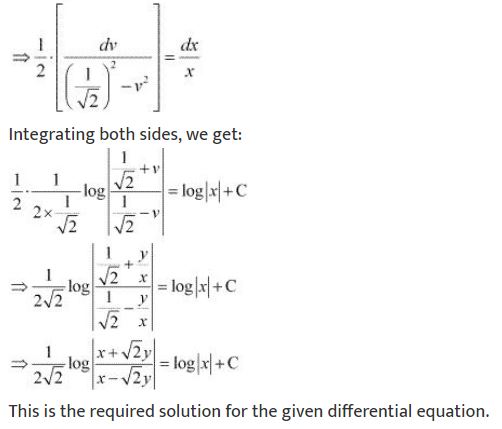
5. Show that the given differential equation is homogeneous and solve each of them
x2 (dy/dx) = x2 - 2y2 + xy
Solution
The given differential equation is :
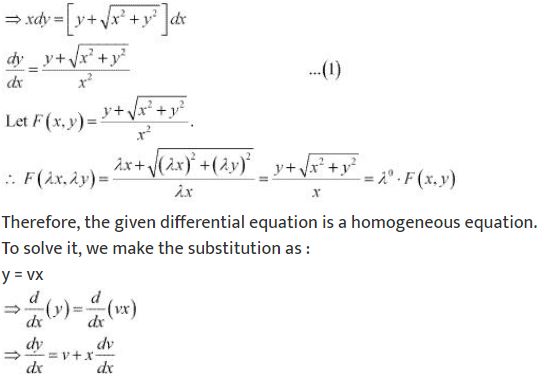
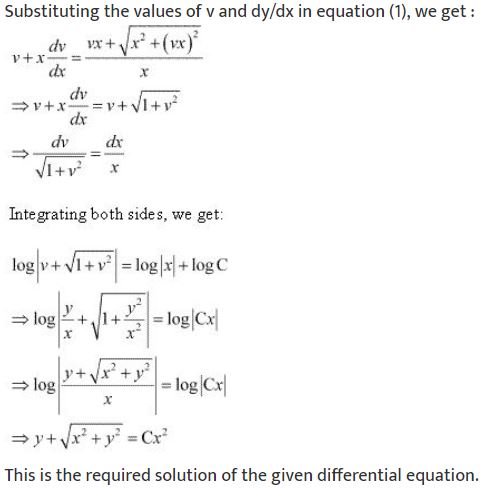
6. Show that the given differential equation is homogeneous and solve each of them
x dy -y dx = √(x2 + y2)dx
Solution
7. Show that the given differential equation is homogeneous and solve each of them
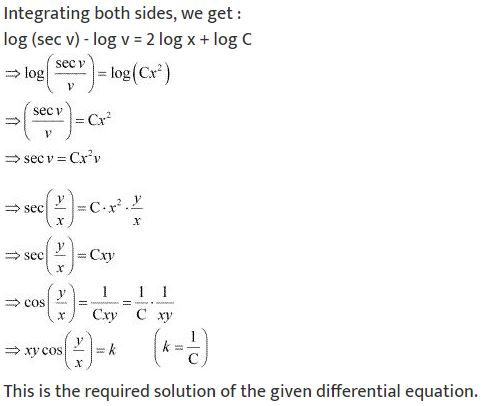
{x cos (y/x) + y sin (y/x)} ydx = {y sin (y/x) - x cos (y/x)} x dy
Solution
The given differential equation is :
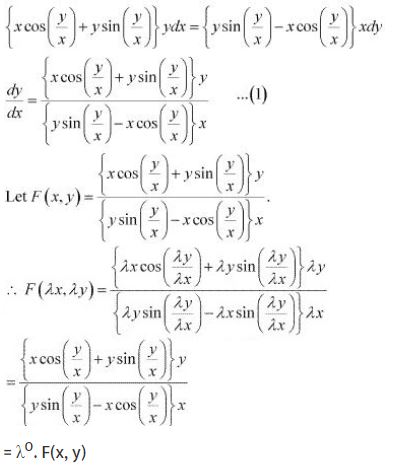
Therefore, the given differential equation is a homogeneous equation.
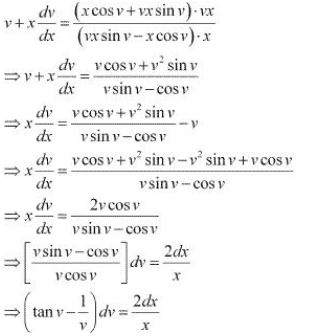
To solve it, we make the substitution as :
y = vx
⇒ dy/dx = v + x = dv/dx
Substituting the values of y and dy/dx in equation (1), we get :
8. Show that the given differential equation is homogeneous and solve
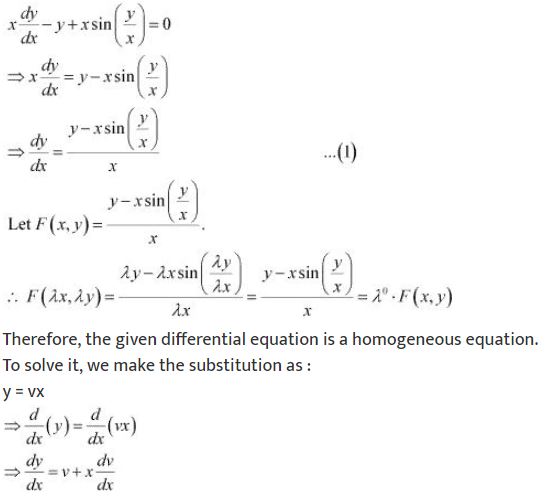
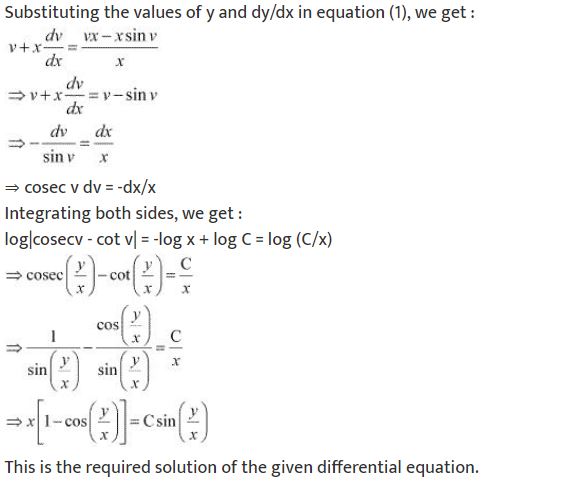
x (dy/dx) - y + x sin (y/x) = 0
Solution
9. Show that the given differential equation is homogeneous and solve
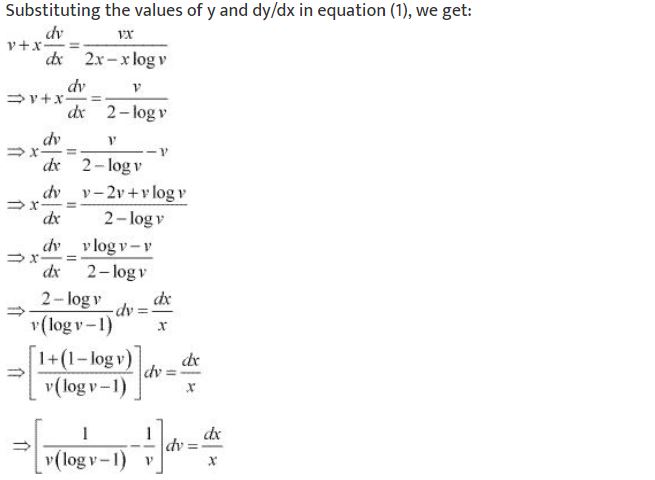
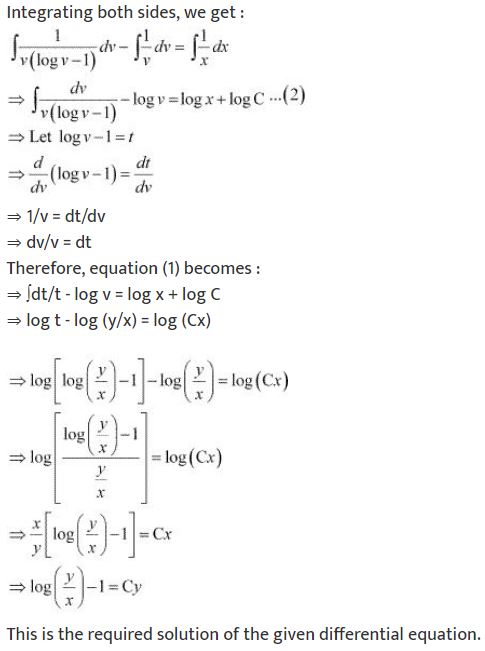
y dx + x log (y/x)dy - 2xdy = 0
Solution
y dx + x log(y/x) dy - 2xdy = 0

10. Show that the given differential equation is homogeneous and solve
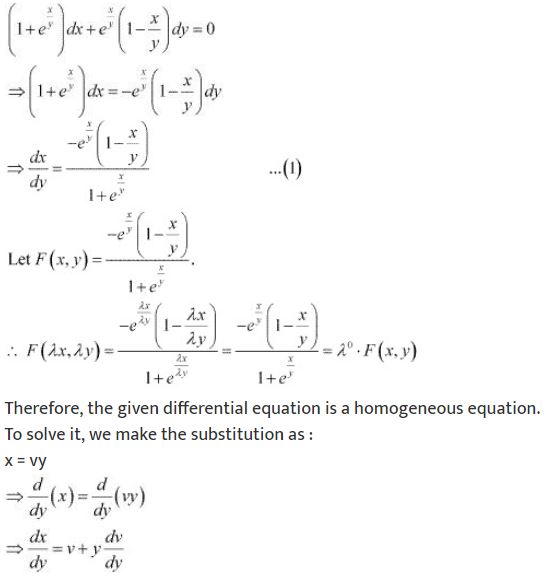
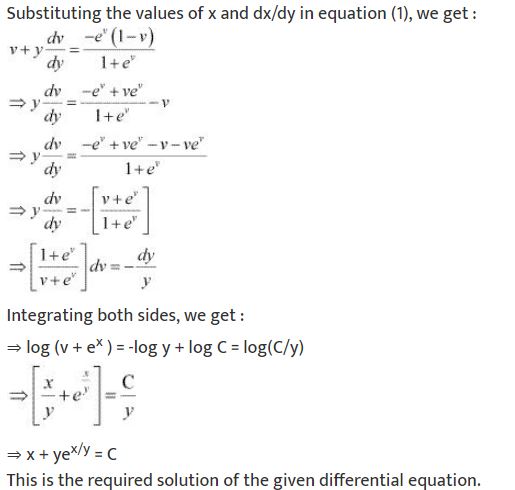
(1 + ex/y ) dx + ex/y (1 - x/y)dy = 0
Solution
11. For the differential equations find the particular solution satisfying the given condition:
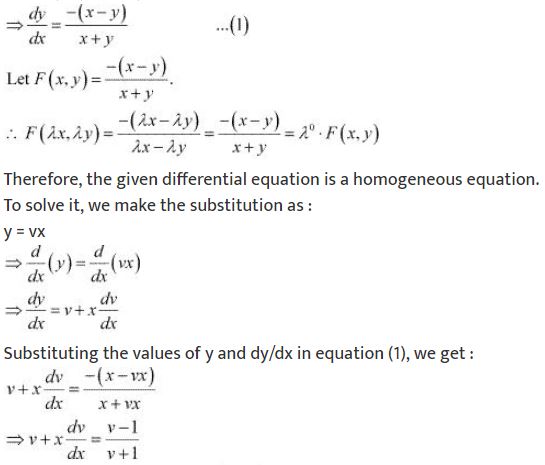
(x + y) dy + (x – y) dx = 0; y = 1 when x = 1
Solution
(x + y)dy + (x - y)dx = 0
⇒ (x + y)dy = -(x - y) dx
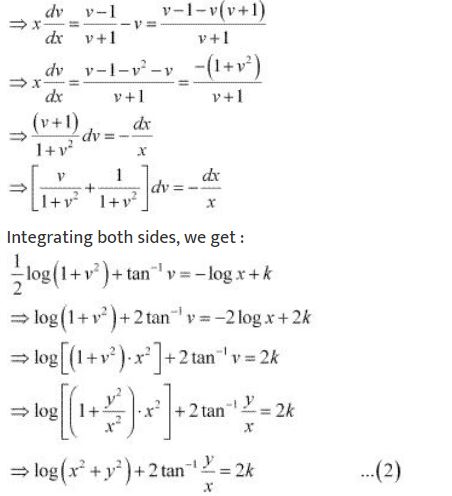
Now, y = 1 at x = 1.
⇒ log 2 + 2 tan-11 = 2k
⇒ log 2 + 2 × π/4 = 2k
⇒ π/2 + log 2 = 2k
Substituting the value of 2k in equation (2), we get :
log(x2 + y2) + 2 tan-1(y/x) = π/2 + log 2
This is the required solution of the given differential equation.
12.For the differential equations find the particular solution satisfying the given condition:
x2 dy + (xy + y2) dx = 0; y = 1 when x = 1
Solution
x2 dy + (xy + y2 )dx = 0
⇒ x2 dy = -(xy + y2 )dx
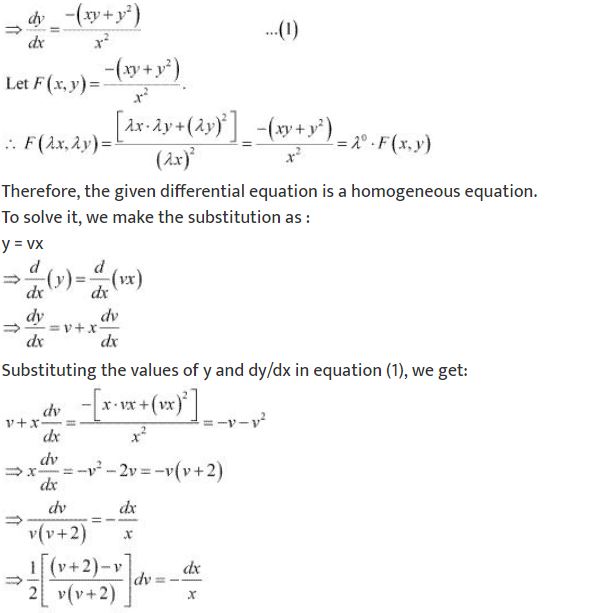
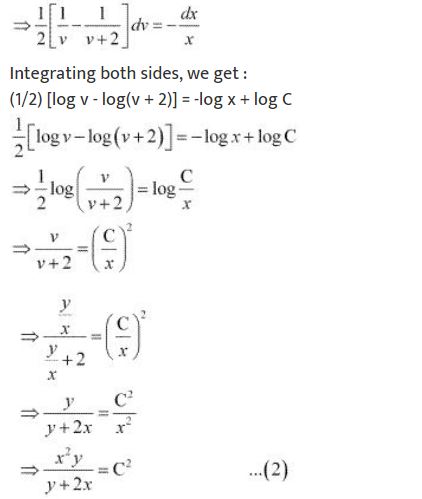
Now, y =1 at x = 1.
⇒ 1/(1+2) = C2
⇒ C2 = 1/3
Substituting C2 = 1/3 in equation (2), we get:
x2 y/(y + 2x) = 1/3
⇒ y + 2x = 3x2 y
This is the required solution of the given differential equation.
13. For the differential equations find the particular solution satisfying the given condition:
[x sin2 (y/x - y)] dx + xdy = 0; y = π/4 when x = 1
Solution
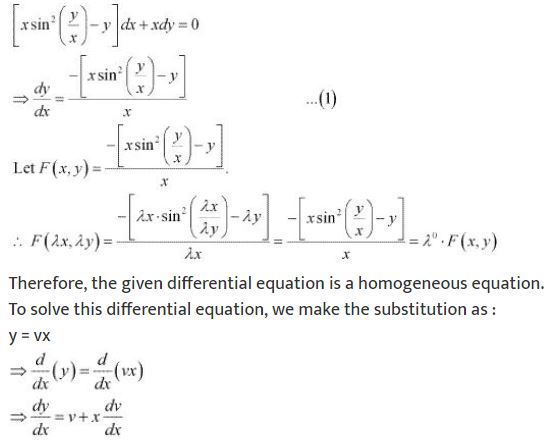
Therefore, the given differential equation is a homogeneous equation.
To solve this differential equation, we make the substitution as :
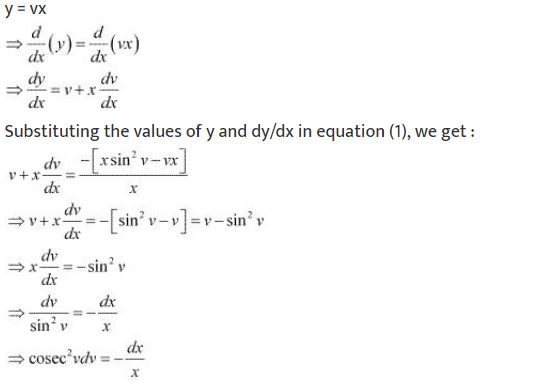
Integrating both sides, we get :
- cot v = -log |x| - C
⇒ cot v = log |x| + C
⇒ cot(y/x) = log |x| + log C
⇒ cot (y/x) = log |Cx| ...(2)
Now, y = π/4 at x = 1.
⇒ cot (π/4) = log |C|
⇒ 1 = log C
⇒ C = e1 = e
Substituting C = e in equation (2), we get :
cot (y/x) = log |ex|
This is the required solution of the given differential equation .
14. For the differential equations find the particular solution satisfying the given condition:
dy/dx - y/x + cosec(y/x) = 0; y = 0 when x = 1
Solution
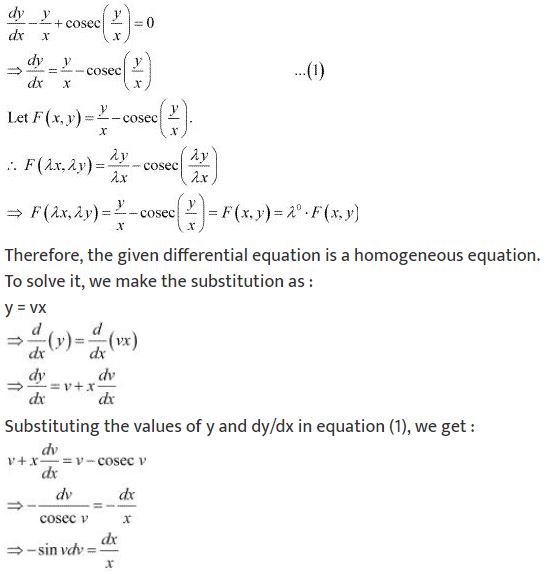
Integrating both sides, we get :
cos v = log x + log C = log |Cx|
⇒ cos (y/x) = log |Cx| ...(2)
This is the required solution of the given differential equation.
Now, y = 0 at x = 1.
⇒ cos (0) = log C
⇒ 1 = log C
⇒ C = e1 = e
Substituting C = e in equation (2), we get :
cos(y/x) = log |(ex)|
This is the required solution of the given differential equation.
15. For the differential equations find the particular solution satisfying the given condition:
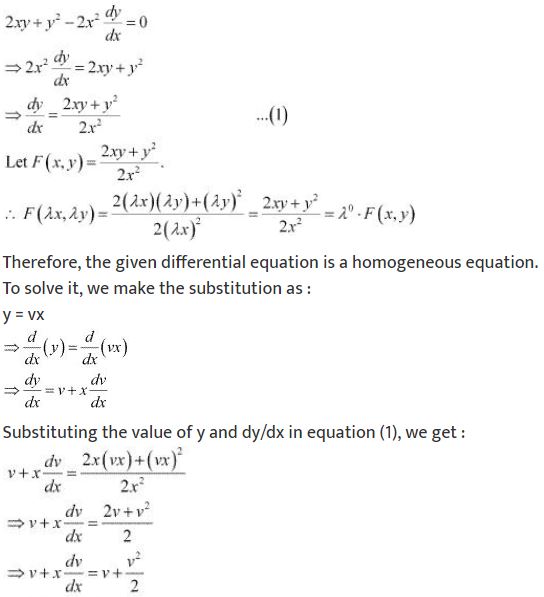
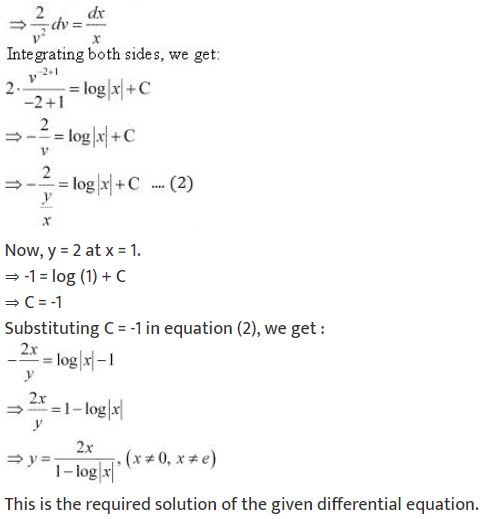
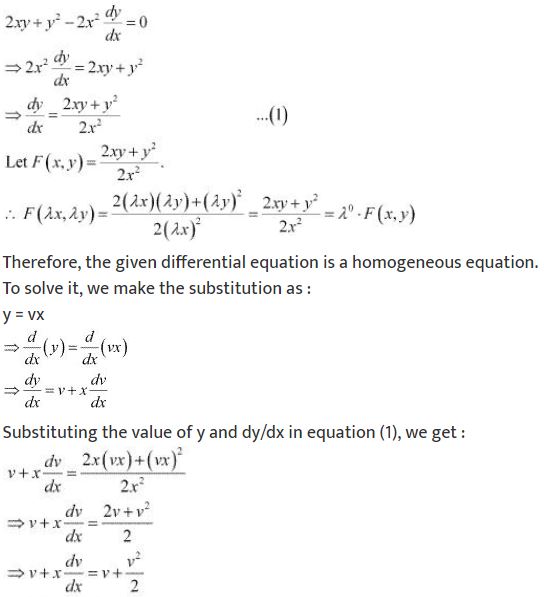
2xy + y2 - 2x2 (dy/dx) = 0; y = 2 when x = 1
Solution
16. A homogeneous differential equation of the from dx/dt = h(x/y) can be solved by making the substitution
(A) y = vx
(B) v = yx
(C) x = vy
(D) x = v
Solution
For solving the homogeneous equation of the form dx/dy = h(x/y), we need to make the substitution as x = vy.
Hence, the correct answer is C.
17. Which of the following is a homogeneous differential equation?
(A) (4x + 6y + 5) dy – (3y + 2x + 4) dx = 0
(B) (xy) dx – (x3 + y3) dy = 0
(C) (x3 + 2y2) dx + 2xy dy = 0
(D) y2 dx + (x2 – xy – y2) dy = 0
Solution
Function F(x, y) is said to be the homogenous function of degree n, if
F(λx, λy) = λn F(x, y) for any non - zero constant (λ).
Consider the equation given in alternative D :
y2 dx + (x2 - xy - y2 )dy = 0
Exercise 9.6
1. For the differential equation find the general solution :
dy/dx + 2y = sin x
Solution
The given differential equation is dy/dx + 2y = sin x
This is in the form of dy/dx + py = Q (where p = 2 and Q = sin x)
Now, I.F = e∫pdx = e∫3dx = e3x
The solution of the given differential equation is given by the relation,
y(I.F.) = ∫(Q × I.F.) dx + C
⇒ ye2x = ∫sin x. e2x dx + C ...(1)
Let I = ∫sin x. e2x
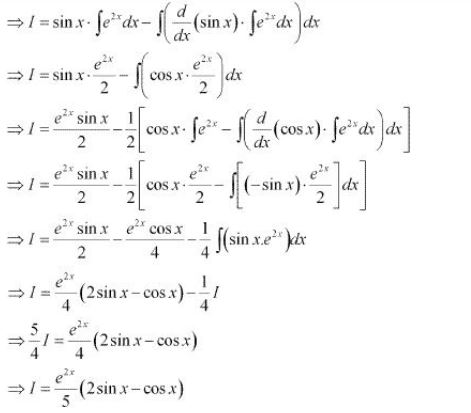
Therefore, equation (1) becomes:
ye2x = e2x/5 (2 sin x - cos x) + C
⇒ y = 1/5 (2 sin x - cos x) + Ce-2x
This is the required general solution of the given differential equation.
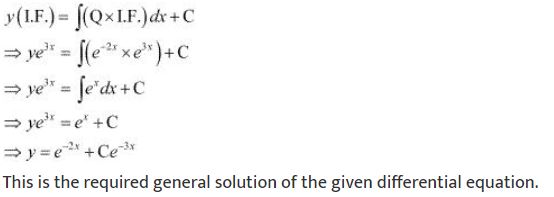
2. For the differential equations find the general solution:
dy/dx + 3y = e-2x
Solution
The given differential equation is dy/dx + py = Q (where p = 3 and Q = e-2x)
Now, I.F = e∫pdx = e∫3dx = e3x
The solution of the given differential equation is given by the relation,
3. For the differential equations find the general solution :
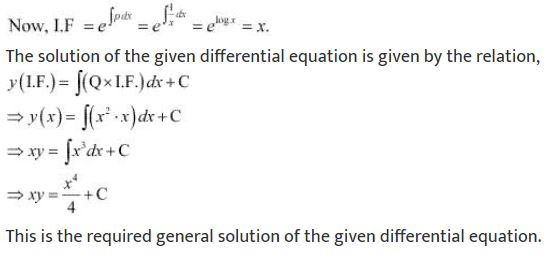
dy/dx + y/x = x2
Solution
The given differential equation is:
dy/dx + py = Q (where p = 1/x and Q = x2)
4. For the differential equations find the general solution :
dy/dx + sec xy = tan x(0 ≤ x < π/2)
Solution
The given differential equation is :
dy/dx + py = Q (where p = sec x and Q = tan x)
Now, I.F = e∫pdx = e∫secx dx = elog(secx + tanx) = sec x + tan x.
The general solution of the given differential equation is given by the relation,
y = (I.F.) = ∫(Q × I.F.) dx + C
⇒ y(sec x + tan x) = ∫tan x(sec x + tan x)dx + C
⇒ y(sec x + tan x) = ∫sec x tan x dx + ∫tan2 x dx + C
⇒ y(sec x + tan x) = sec x + ∫(sec2 x - 1)dx + C
⇒ y(sec x + tan x) = sec x + tan x - x + C
5. For the differential equations find the general solution :
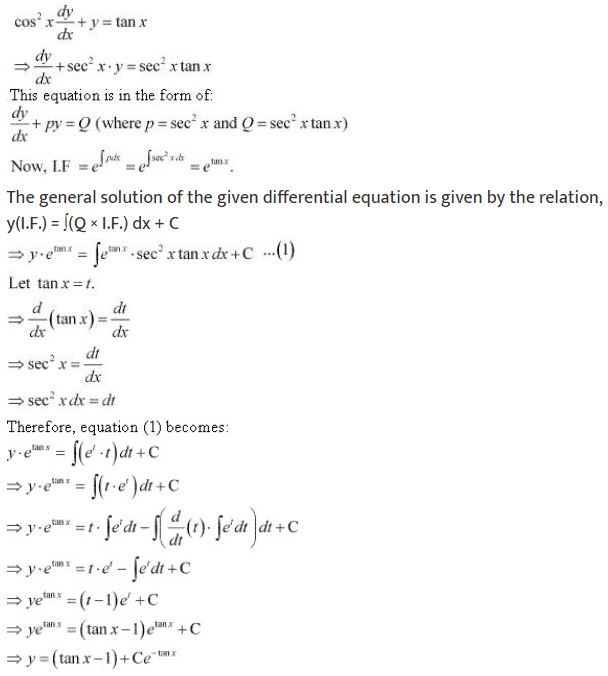
cos2 x (dy/dx) + y = tan x(0 ≤ x < π/2)
Solution
The given differential equation is :
6. For the differential equations find the general solution:
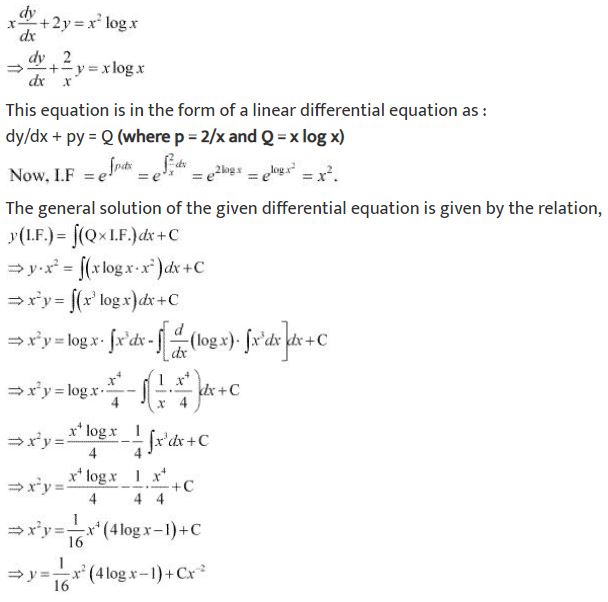
x(dy/dx) + 2y = x2 log x
Solution
The given differential equation is:
7. For the differential equations find the general solution:
x log x(dy/dx) + y = (2/x) log x
Solution
The given differential equation is :
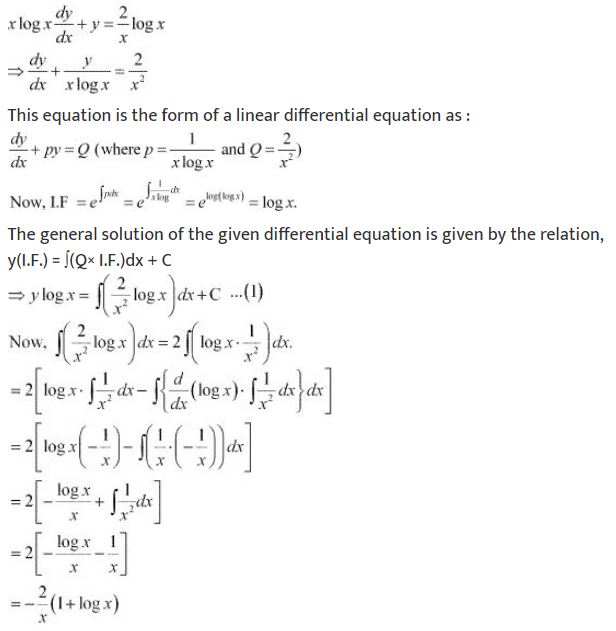
Substituting the value of ∫[(2/x2)log x] dx in equation (1), we get :
y log x = (-2/x) (1 + log x) + C
This is the required general solution of the given differential equation.
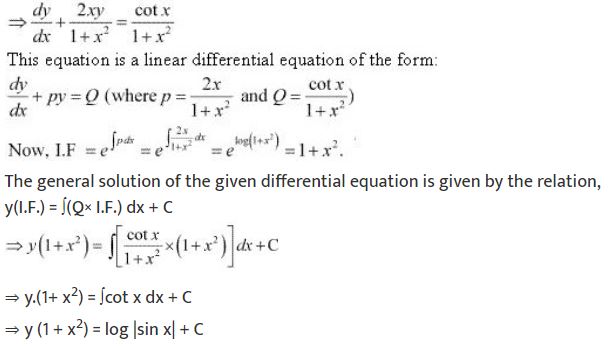
8. For the differential equations find the general solution: (1 + x2) dy + 2xy dx = cot x dx (x ≠ 0).
Solution
(1 + x2 )dy + 2xy dx = cot x dx
9. For the differential equations find the general solution:
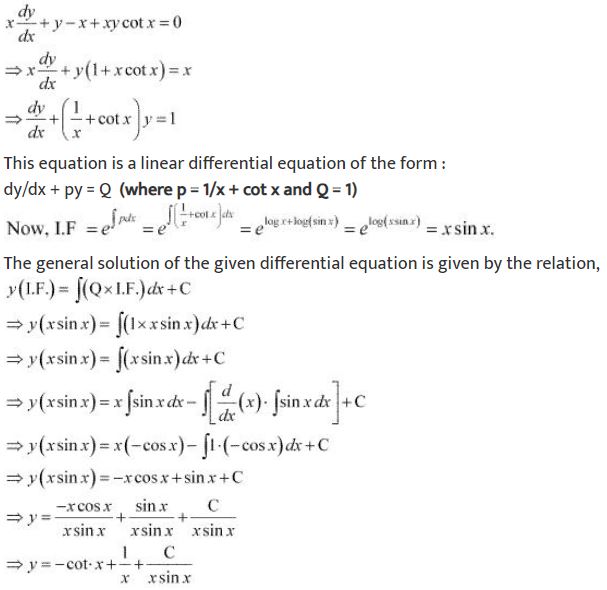
x(dy/dx) + y - x + xy cot x = 0 (x ≠ 0)
Solution
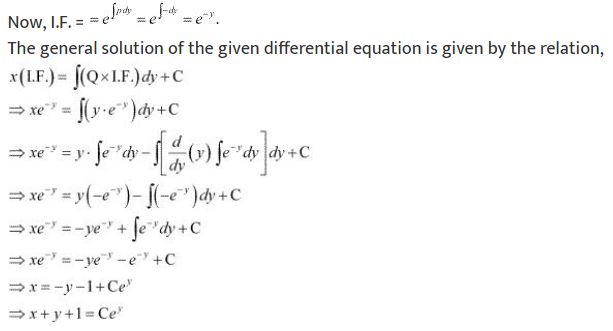
10. For the differential equations find the general solution :
(x + y) dy/dx = 1
Solution
(x + y) dy/dx 1
⇒ dy/dx = 1/(x + y)
⇒ dx/dy = x + y
⇒ (dx/dy) - x = y
This is a linear differential equation of the form :
dy/dx + px = Q (where p = -1 and Q = y)
11. For the differential equations find the general solution: y dx + (x – y2) dy = 0
Solution
y dx + (x - y2)dy = 0
⇒ y dx = (y2 - x)dy
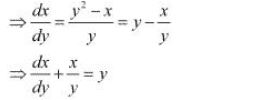
This is a linear differential equation of the form :
dy/dx + px = Q (where p = 1/y and Q = y)

The general solution of the given differential equation is given by the relation,
x(I.F.) = ∫(Q × I.F.) dy + C
⇒ xy = ∫(y.y) dy + C
⇒ x = ∫ y2 dy + C
⇒ xy = y3 /3 + C
⇒ x = y2/3 + C/y
12. For the differential equations find the general solution :
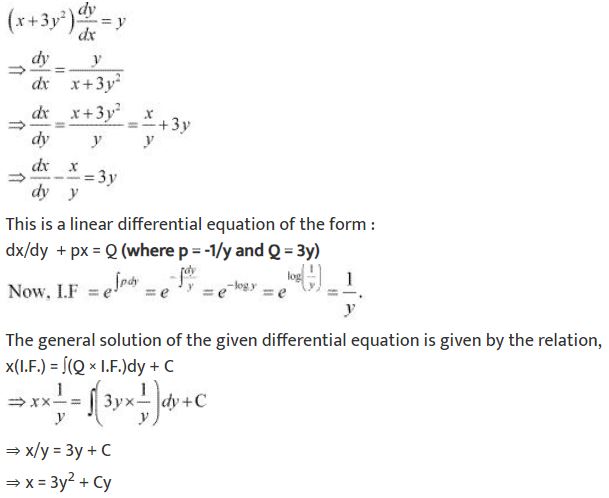
(x + 3y2 )(dy/dx) = y (y > 0)
Solution
13. For the differential equations given find a particular solution satisfying the given condition : dy/dx + 2y tan x = sin x ; y = 0 when x = π/3
Solution
The given differential equation is dy/dx + 2y tan x = sin x.
This is a linear equation of the form:
dy/dx + py = Q (where p = 2 tan x and Q = sin x)

The general solution of the given differential equation is given by the relation,
y(I.F.) = ∫(Q × I.F.)dx + C
⇒ y(sec2 x) = ∫(sin x. sec2 x)dx + C
⇒ y sec2 x = ∫(sec x. tan x)dx + C
⇒ ysec2 x = sec x + C ...(1)
Now, y = 0 at x = π/3 .
Therefore,
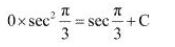
⇒ 0 = 2 + C
⇒C = -2
Substituting C = -2 in equation (1), we get :
y sec2 x = sec x - 2
⇒ y = cos x - 2cos2 x
Hence, the required solution of the given differential equation is y = cos x - 2cos2 x
14. For the differential equations given find a particular solution satisfying the given condition : (1 + x2)(dy/dx) + 2xy = 1/(1 + x2); y = 0 when x = 1
Solution
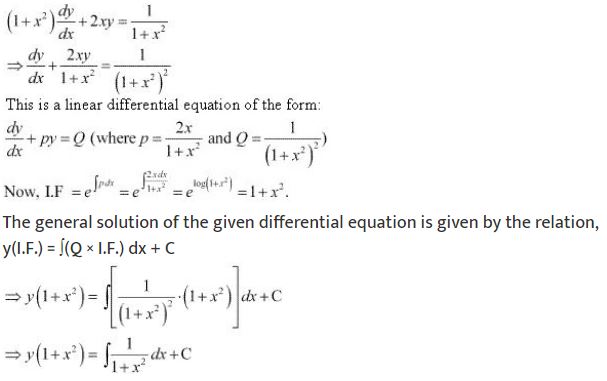
⇒ y(1 + x2 ) = tan-1 x + C ...(1)
Now, y = 0 at x = 1.
Therefore,
0 = tan-1 1 + C
⇒ C = -π/4
Substituting C = -π/4 in equation (1), we get :
y(1 + x2) = tan-1 x - π/4
This is the required general solution of the given differential equation.
15. For the differential equations given find a particular solution satisfying the given condition : dy/dx - 3y cot x = sin 2x; y = 2 when x = π/2
Solution
The given differential equation is dy/dx - 3y cot x = sin 2x.
This is a linear differential equation of the form :
dy/dx + py = Q (where p = -3 cot x and Q = sin 2x)
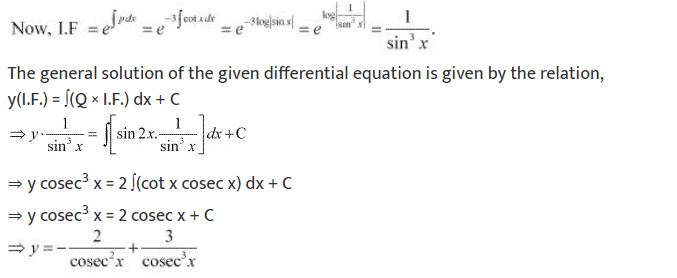
⇒ y = -2sin2 x + C sin3 x ...(1)
Now, y = 2 at x = π/2
Therefore, we get:
2 = -2 + C
⇒ C = 4
Substituting C = 4 in equation (1), we get :
y = -2sin2 x + 4sin3 x
⇒ y = 4sin3 x - 2sin2 x
This is the required particular solution of the given differential equation.
16. Find the equation of the curve passing through the origin given that the slope of the tangent to the curve at any point (x, y) is equal to the sum of the coordinates of the point.
Solution
Let F(x, y) be the curve passing through the origin.
At point (x, y), the slope of the curve will be dy/dx.
According to the given information:
dy/dx = x + y
⇒ dy/dx - y = x
This is a linear differential equation of the form :
dy/dx + py = Q (where p = -1 and Q = x)
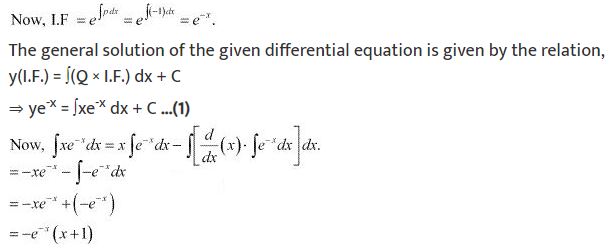
Substituting in equation (1), we get :
ye-x = -e-x (x + 1) + C
⇒ y = -(x + 1) + Cex
⇒ x + y + 1 = Cex ...(2)
The curve passes through the origin .
Therefore, equation (2) becomes :
1 = C
C = 1
Substituting C = 1 in equation (2), we get :
x + y + 1 =ex
Hence, the required equation of curve passing through the origin is x + y + 1 = ex
17. Find the equation of a curve passing through the point (0, 2) given that the sum of the coordinates of any point on the curve exceeds the magnitude of the slope of the tangent to the curve at that point by 5.
Solution
Let F(x, y) be the curve and let (x, y) be a point on the curve. The slope of the tangent to the curve at (x, y) is dy/dx.
According to the given information:
(dy/dx) + 5 = x + y
⇒ dy/dx - y = x - 5
This is a linear differential equation of the form :
dy/dx + py = Q (where p = -1 and Q = x - 5)
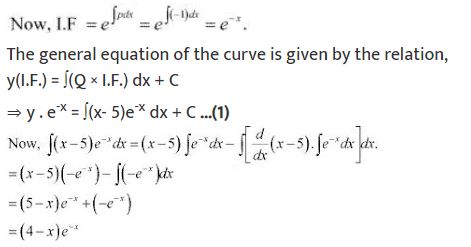
Therefore, equation (1) becomes :
ye-x = (4 - x)e-x + C
⇒ y = 4 - x + Cex
⇒ x + y - 4 = Cex ...(2)
The curve passes through point (0, 2).
Therefore, equation (2) becomes :
0 + 2 - 4 = Ce0
⇒ -2 = C
⇒ C = -2
Substituting C = -2 in equation (2), we get :
x + y - 4 = -2ex
⇒ y = 4 - x - 2ex
This is the required equation of the curve.
18. The integrating Factor of the differential equation (dy/dx) - y = 2x2 is
(A) e-x
(B) e-y
(C) 1/x
(D) x
Solution
The given differential equation is :
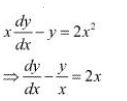
This is a linear differential equation of the form :
dy/dx + py = Q (where p = -1/x and Q = 2x)
The integrating factor (I.F.) is given by the relation,
The
Hence, the correct answer is C.
19. The integrating factor of the differential equation.
(1 - y2) dx/dy + yx = ay(-1 << 1) is
Solution
The given differential equation is :
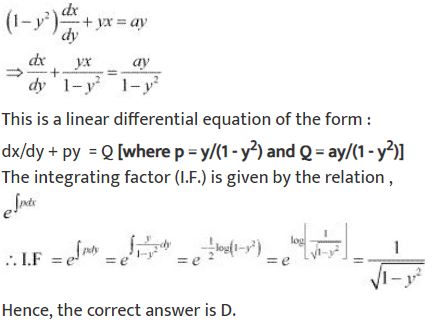
Miscellaneous Solutions
1. For differential equations given below, indicate its order and degree (if defined).
(i) (d2y/dx2 ) + 5x (dy/dx)2 – 6y = log x
(ii) (dy/dx)3 + 4 (dy/dx)2 + 7y = sin x
(iii) (d4y/dx4 ) - sin (d3y/dx3 ) = 0
Solution
(i) The differential equation is given as :
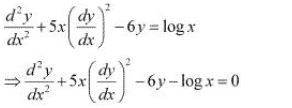
The highest order derivative present in the differential equation is d2y/dx2. Thus, its order is two . The highest power raised to d2y/dx2 is one. Hence, its degree is one.
(ii) The differential equation is given as :
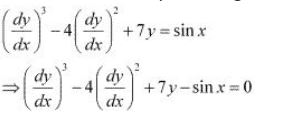
The highest order derivative present in the differential equation is dy/dx. Thus, its order is one. The highest power raised to dy/dx is three. Hence, its degree is three.
(iii) The differential equation is given as :
(d4y/dx4) - sin(d3y/dx3) = 0
The highest order derivative present in the differential equation is d4y/dx4. Thus, its order is four.
However, the given differential equation is not a polynomial equation. Hence, its degree is not defined.
2. For given below, verify that the given function (implicit or explicit) is a solution of the corresponding differential equation.
(i) y = aex + be-x + x2 : x (d2y/dx2) + 2(dy/dx) - xy + x2 - 2 = 0
(ii) y = ex (a cos x + b sin x) : d2 y/dx2 - 2(dy/dx) + 2y = 0
(iii) y = x sin 3x : (d2y/dx2) + 9y - 6cos 3x = 0
(iv) x2 = 2y2 log y: (x2 + y2) dy/dx - xy = 0
Solution
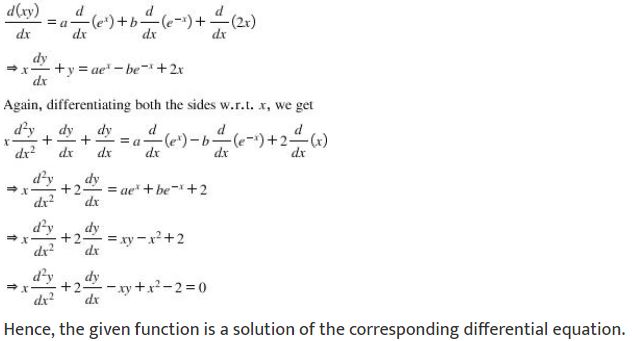
(i) xy = aex + be-x + x2
Differentiating both sides w.r.t. x we get
(ii) y = ex (a cos x + b sin x) = aex cos x + bex sin x.
Differentiating both sides with respect to x, we get :
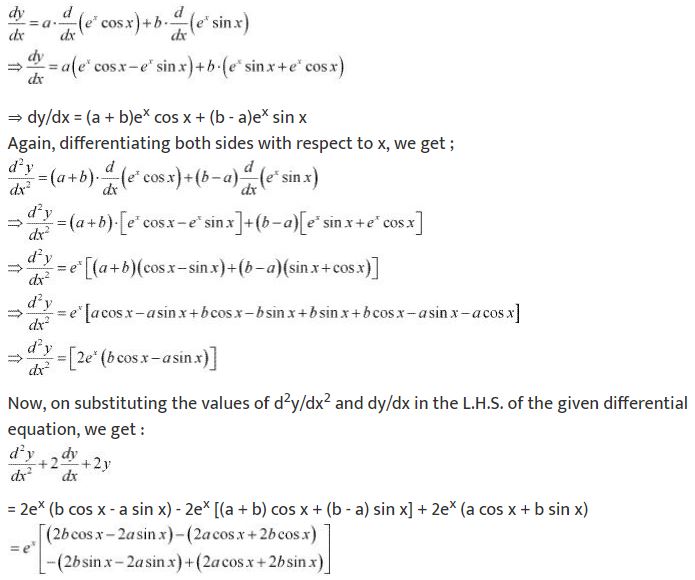
= ex [(2b - 2a - 2b + 2a) cos x] + ex [(-2a - 2b + 2a + 2b) sin x]
= 0
Hence, the given function is a solution of the corresponding differential equation.
(iii) y = x sin3x
Differentiating both sides with respect to x, we get :
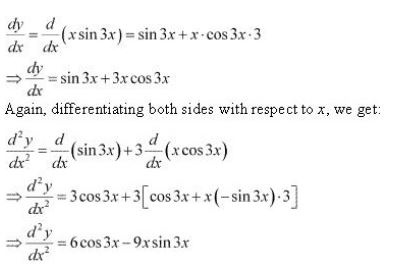
Substituting the value of d2 y/dx2 in the L.H.S. of the given differential equation, we get :
d2y/dx2 + 9y - 6 cos 3x
= (6.cos 3x - 9x sin 3x) + 9x sin 3x - 6 cos 3x
= 0
Hence, the given function is a solution of the corresponding differential equation.
(iv) x2 = 2y2 log y
Differentiating both sides with respect to x, we get :
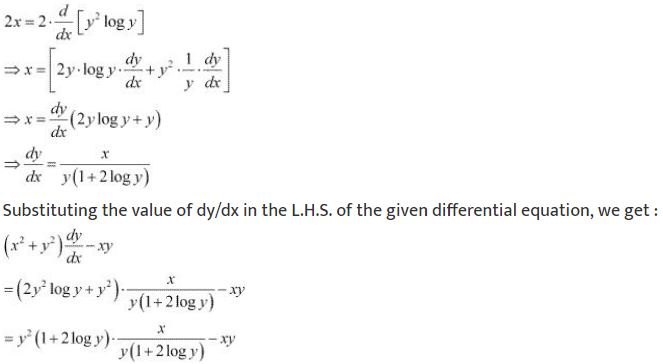
= xy - xy
= 0
Hence, the given function is a solution of the corresponding differential equation.
3. Form the differential equation representing the family of curves given by (x – a)2 + 2y2 = a2, where a is an arbitrary constant.
Solution
(x - a)2 + 2y2 = a2
⇒ x2 + a2 - 2ax + 2y2 = a2
⇒ 2y2 = 2ax - x2 ...(1)
Differentiating with respect to x, we get :
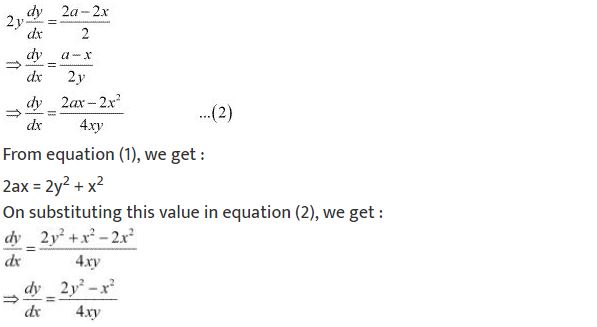
Hence, the differential equation of the family of curves is given as dy/dx = (2y2 - x2)/4xy.
4. Form the differential equation of the family of circles in the first quadrant which touch the coordinate axes.
Solution
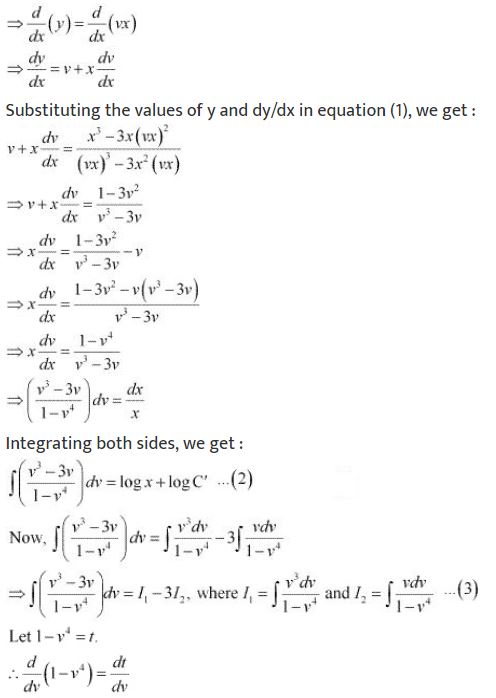
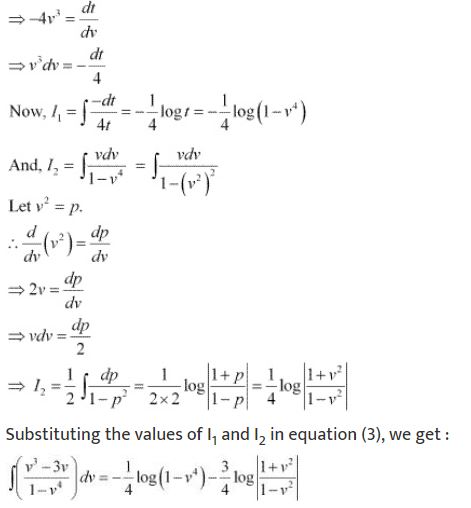
(x3 - 3xy2)dx = (y3 - 3x2 y)dy
⇒ dy/dx = (x3 - 3xy2)/(y3 - 3x2 y) ...(1)
This is a homogeneous equation. To simplify it, we need to make the substitution as :
y = vx
5. Prove that x2 – y2 = c (x2 + y2)2 is the general solution of differential equation (x3 – 3xy2) dx = (y3 – 3x2y) dy, where c is a parameter.
Solution
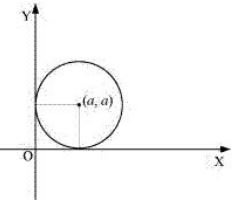
The equation of a circle in the first quadrant with centre (a, a) and radius (a) which touches the coordinate axes is :
(x - a)2 + (y - a)2 = a2 ...(1)
Differentiating equation (1) with respect to x, we get :
2(x - a) + 2(y - a) dy/dx = 0
⇒(x - a)+ (y - a)y' = 0
⇒ x - a + yy' - ay' = 0
⇒ x + y y' - a(1 + y') = 0
⇒ a = (x + yy')/(1 + y')
Substituting the value of a in equation (1), we get :
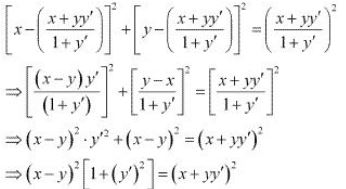
Hence, the required differential equation of the family of circles is
(x - y)2 [1 +(y')2 ] = (x + yy')2.
6. Find the general solution of the differential equation dy/dx + √(1 - y2)/(1 - x2) = 0
Solution
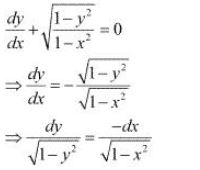
Integrating both sides, we get :
sin-1y = -sin-1x + C
⇒ sin-1x + sin-1y = C
7. Show that the general solution of the differential equation dy/dx + (y2 + y + 1)/(x2 + x + 1) = 0 is given by (x + y + 1) = A (1 - x - y - 2xy), where A is parameter.
Solution
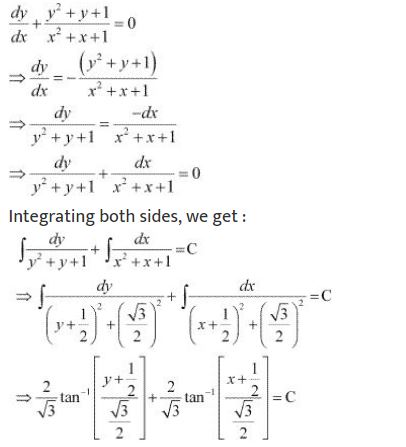
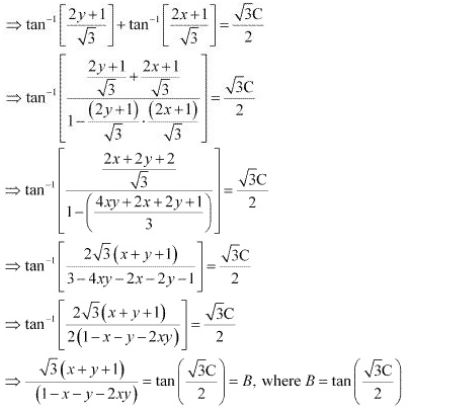
The differential equation of the given curve is :
sin x cos y dx + cos x sin ydy = 0
⇒ (sin x cos ydx + cos x sin ydy)/(cos x cos y) = 0
⇒ tan x dx + tan y dy = 0
Integrating both sides, we get :
log (sec x) + log (sec y) =log C
log (sec x .sec y) = log C
⇒ sec x .sec y = C ...(1)
The curve passes through point (0, π/4).
∴ 1 × √2 = C
⇒ C = √2
On substituting C = √2 in equation (1), we get :
sec x . sec y = √2
⇒ sec x . 1/cos y = √2
⇒ cos y = sec x/√2
Hence, the required equation of the curve is cos y = sec x/√2.
9. Find the particular solution of the differential equation (1 + e2x)dy + (1 + y2) ex dx = 0, given that y = 1 when x = 0.
Solution
(1 + e2x )dy + (1 +y2 )ex dx = 0
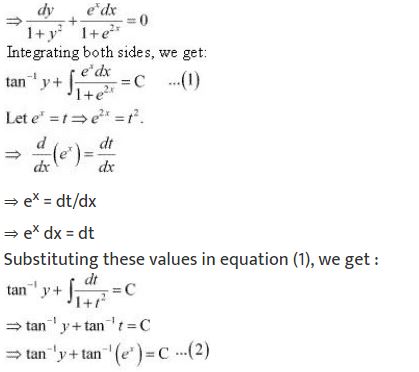
Now, y = 1 at x = 0.
Therefore, equation (2) becomes:
tan-1 1 + tan-1 1 = C
⇒ π/4 + π/4 = C
⇒ C = π/4
Substituting C = π/4 in equation (2), we get :
tan-1 y + tan-1 (ex) = π/2
This is the required particular solution of the given differential equation.
10. Solve the differential equation yex/y dx = (xex/y + y2)dy (y ≠ 0)
Solution

From equation (1) and equation (2), we get :
dz/dy = 1
⇒ dz = dy
Integrating both sides, we get :
z = y + C
⇒ ex/y = y + C
11. Find a particular solution of the differential equation (x – y) (dx + dy) = dx – dy, given that y = –1, when x = 0. (Hint: put x – y = t)
Solution
(x - y)(dx + dy) = dx - dy
⇒ (x - y + 1)dy = (1 - x + y)dx
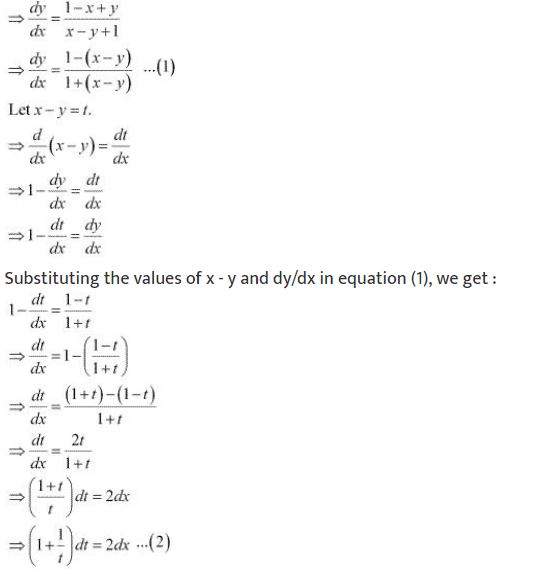
Integrating both sides, we get :
t + log |t| = 2x + C
⇒ (x - y) + log |x - y| = 2x + C
⇒ log |x - y| = x + y + C ...(3)
Now, y = -1 at x = 0 . Therefore, equation (3) becomes :
log 1 = 0 - 1 + C
C = 1
Substituting C = 1 in equation (3) we get :
log |x - y| = x + y + 1
This is the required particular solution of the given differential equation.
12. Solve the differential equation [(e-2√x /√x) – y/√x] dx/dy = 1(x ≠ 0)
Solution
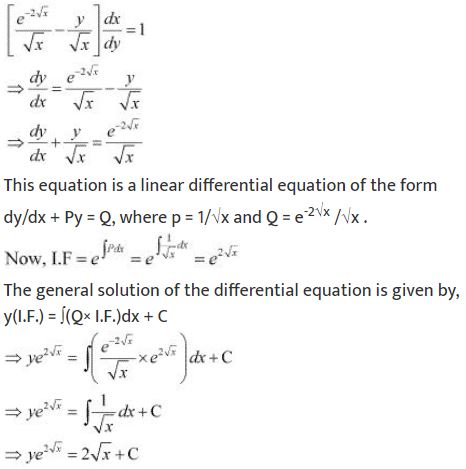
13. Find a particular solution of the differential equation dy/dx + y cot x = 4x cosec x (x ≠ 0), given that y = 0 when x = π/2
Solution
The given differential equation is :
dy/dx + y cot x = 4 x cosec x
This equation is a linear differential equation of the form
dy/dx + py = Q, where p = cot x and Q = 4x cosec x.

The general solution of the given differential equation is given by,
y(I.F.) = ∫(Q × I.F.)dx + C
⇒ y sin x = ∫(4x cosec x . sin x)dx + C
⇒ y sin x = 4 ∫x dx + C
⇒ y sin x = 4. x2 /2 + C
⇒ y sin x = 2x2 + C ...(1)
Now, y = 0 at x = π/2
Therefore, equation (1) becomes :
0 = 2 × (π2/4) + C
⇒ C = -(π2/2)
Substituting C = -(π2/2) in equation (1), we get :
y sin x = 2x2 - (π2/2)
This is the required particular solution of the given differential equation.
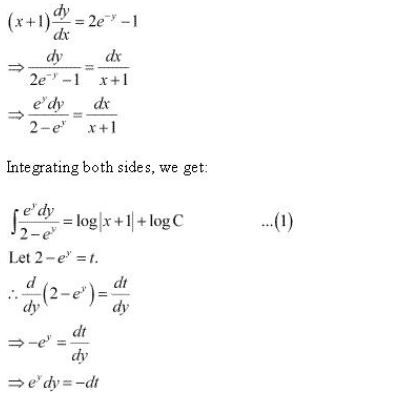
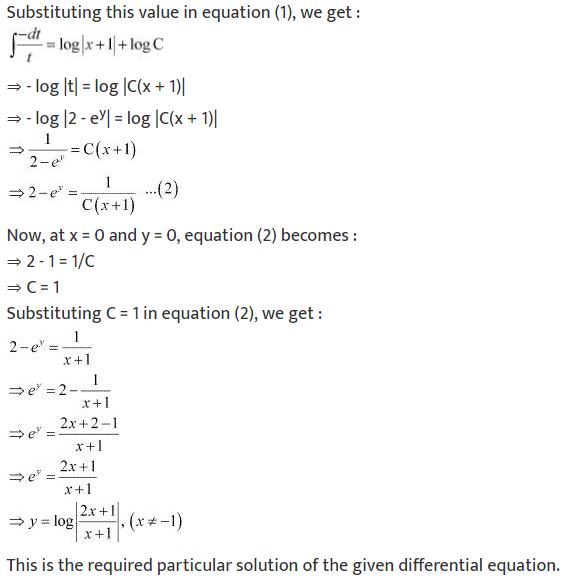
14. Find a particular solution of the differential equation (x + 1) dy/dx = 2e-y - 1, given that y = 0 when x = 0
Solution
15. The population of a village increases continuously at the rate proportional to the number of its inhabitants present at any time. If the population of the village was 20000 in 1999 and 25000 in the year 2004, what will be the population of the village in 2009?
Solution
Let the population at any instant (t) be y.
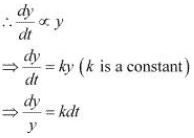
It is given that the rate of increase of population is proportional to the number of inhabitants at any instant .
Integrating both sides, we get :
log y + kt + C ...(1)
In the year 1999, t = 0 and y = 20000.
Therefore, we get :
log 20000 = C ...(2)
In the year 2004, t = 5 and y = 25000.
Therefore, we get :
Log 25000 = k. 5 + C
⇒ log 25000 = 5k + log 20000
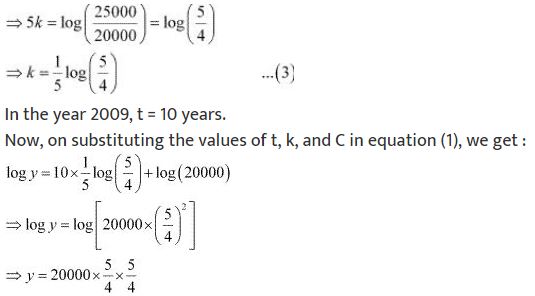
⇒ y = 20000× 5/4 × 5/4
⇒ y = 31250
Hence, the population of the village in 2009 will be 31250.
16. The general solution of the differential equation (ydx - xdy)/y = 0
(A) xy = C
(B) x = Cy2
(C) y = Cx
(D) y = Cx2
Solution
The given differential equation is :
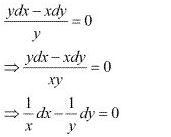
Integrating both sides, we get :
log |x| - log |y| = log k
⇒ log |x/y| = log k
⇒ x/y = k
⇒ y = (1/k)x
⇒ y = Cx where C = 1/x
Hence, the correct answer is C.
17. The general solution of a differential equation of the type dx/dy + P1x = Q is
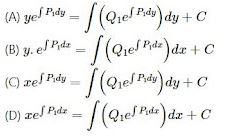
Solution
The integrating factor of the give differential equation dx/dy + P1x = Q1 is e∫p1dy.
The general solution of the differential equation is given by,
x(I.F.) = ∫(Q × I.F.) dy + C
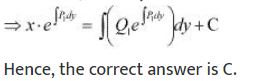
18. The general solution of the differential equation exdy + (y ex + 2x) dx = 0 is
(A xey + x2 = C
(B) xey + y2 = C
(C) yex + x2 = C
(D) yey + x2 = C
Solution
The given differential equation is :
ex dy + (yex + 2x)dx = 0
⇒ ex (dy/dx) + yex + 2x = 0
⇒ dy/dx + y = -2xe-x
This is a linear differential equation of the form
dy/dx + Py = Q, where P = 1 and Q = -2xe-x.

The general solution of the given differential equation is given by,
y(I.F.) = ∫(Q × I.F.) dx + C
⇒ yex = ∫(-2xe-x .ex) dx + C
⇒ yex = -∫2xdx + C
⇒ yex = -x2 + C
⇒ yex + x2 = C
Hence, the correct answer is C.
Free study material for Mathematics
Free NCERT Textbook Explanations: Class 12 Mathematics Chapter 09 Differential Equations
Accessing Chapter 09 Differential Equations Solutions
Review comprehensive exercise answers for Class 12 Mathematics Chapter 09 Differential Equations. Fully updated to match current NCERT syllabus guidelines, these textbook solutions help students verify their work and maintain accurate study notes.
Concept-Driven Answers for Class 12 Mathematics
Beyond providing final answers, these guides offer step-by-step breakdowns for complex queries in the Class 12 Mathematics module. This approach helps students balance theoretical depth with practical problem-solving skills required for NCERT exams.
Maximizing Study Efficiency
These resources act as an effective roadmap for daily homework tasks and independent study. Supplement your review of Chapter 09 Differential Equations with official sample papers and interactive practice tests available on our platform free of charge.
FAQs
The complete and updated NCERT Solutions Class 12 Mathematics Chapter 9 Differential Equations is available for free on StudiesToday.com. These solutions for Class 12 Mathematics are as per latest NCERT curriculum.
Yes, our experts have revised the NCERT Solutions Class 12 Mathematics Chapter 9 Differential Equations as per 2026 exam pattern. All textbook exercises have been solved and have added explanation about how the Mathematics concepts are applied in case-study and assertion-reasoning questions.
Toppers recommend using NCERT language because NCERT marking schemes are strictly based on textbook definitions. Our NCERT Solutions Class 12 Mathematics Chapter 9 Differential Equations will help students to get full marks in the theory paper.
Yes, we provide bilingual support for Class 12 Mathematics. You can access NCERT Solutions Class 12 Mathematics Chapter 9 Differential Equations in both English and Hindi medium.
Yes, you can download the entire NCERT Solutions Class 12 Mathematics Chapter 9 Differential Equations in printable PDF format for offline study on any device.