

Download Full Course Study of Representative Elements Concept Summaries: NEET Chemistry Study Of Representative Elements Revision Notes
Explore reliable concept summaries and revision materials through the NEET Chemistry Study Of Representative Elements Revision Notes. Tailored for Full Course learners, utilizing these notes for Study of Representative Elements Study Of Representative Elements ensures thorough preparation and strengthens core academic definitions before final evaluations.
Access Study Of Representative Elements Notes and Study Material
View or download the dedicated Study Of Representative Elements revision resource below. Engaging with these structured concept notes daily ensures continuous academic progress and mastery of the 2026-27 curriculum for Study of Representative Elements.
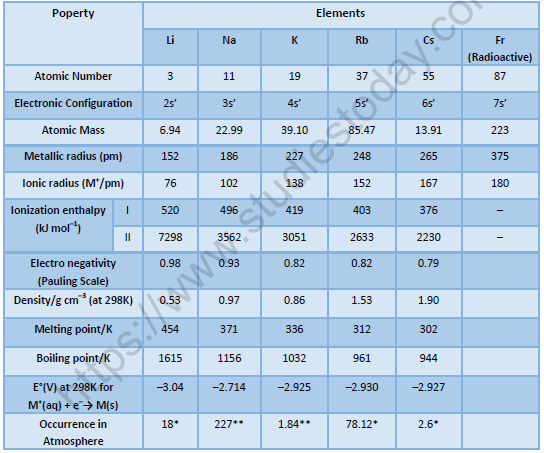

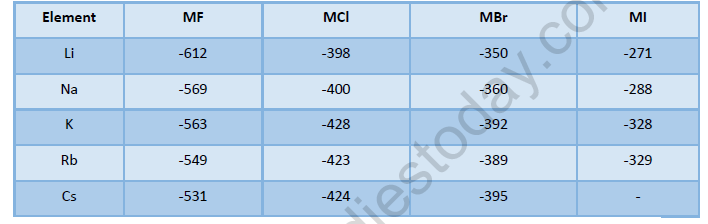
Question. Which of the following properties of red P and white P are related to their structure?
a. Large difference in m.p.
b. Difference in hardness
c. Ignition behavior
d. None of these
Answer : A, B, C
Question. Electrolysis of KH produces H2 :
a. at the cathode
b. at the anode
c. either at the cathode or at the anode
d. Cannot be predicted
Answer : A, B
Question. In which of the following cases, does N2 evolve as agaseous product?
a. KNO3 reacts with K on heating
b. Na2O2 reacts with NH3
c. NH3 reacts with bleaching powder
d. None of these
Answer : A, B, C
Question. Which of the following form dimeric halides
a. Al
b. Mg
c. In
d. Ga
Answer : A, C, D
Question. Which of the following processes cannot give Cl2 gas as aproduct?
a. Electrolysis of aq. NaCl
b. Oxidation of conc. HCl by K2CrO4
c. Electrolysis of very dilute aq. NaCl
d. Oxidation of conc. HCl by MnO2
Answer : A, B, C
Question. The temporary hardness of water is caused by which of the following compound(s):
a. CaCl2
b. Mg(HCO3)2
c. Ca(HCO3)2
d. MgSO4
Answer : B, C
Question. Which of the following statements are correct regardingthe diagonal relationship between Al and Be?
a. BeO and Al2O3 are amphoteric in nature
b. Carbides of both produce the same gas on hydrolysis
c. Both can form complexes.
d. Hydrides of both the elements are covalent in nature
Answer : A, B, C
Question. Which of the following statements are correct?
a. NO is a diamagnetic liquid
b. B2 and C2 are diamagnetic
c. N2O4 is diamagnetic
d. BH3 loses its planarity on dimerization
Answer : A, C
Question. Phosphine is obtained from the following ore
a. Calcium superphosphite
b. Calcium phosphide
c. Potassium phosphide
d. Calcium hypophosphide
Answer : B, C
Question. Which statement is false
a. Electronegativity of fluorine is maximum
b. Electron affinity of fluorine is maximum
c. Melting point of fluorine is minimum
d. Boiling point of fluorine is maximum
Answer : B, D
Question. White phosphorus (P4) has
a. Six P - P single bonds
b. Four P - P single bonds
c. Four lone pairs of electrons
d. PPP angle of 60°
Answer : A, D
Question. Among the members of V A group (N, P, As, Sb and Bi), which of the following properties shows an increase as we go down from nitrogen to bismuth:
a. Stability of +3 oxidation state
b. Reducing character of hydrides
c. Electronegativity
d. Acidic nature of the pentoxide
Answer : A, B
Question. SO2 is obtained when
a. Oxygen reacts with dilute sulphuric acid
b. Hydrolysis of dilute H2SO4
c. Concentrated H2SO4 reacts with Na2SO3
d. All of these
Answer : B, C
Question. When NaOHis prepared, the gas released is:
a. Cl2
b. H2
c. O2
d. H2O
Answer : A, B
Question. Ammonia on reaction with hypochlorite anion, can form:
a. NO
b. NH4Cl
c. N2H4
d. HNO2
Answer : B,C
Assertion and Reason
Note: Read the Assertion (A) and Reason (R) carefully to mark the correct option out of the options given below:
a. If both assertion and reason are true and the reason is the correct explanation of the assertion.
b. If both assertion and reason are true but reason is not the correct explanation of the assertion.
c. If assertion is true but reason is false.
d. If the assertion and reason both are false.
e. If assertion is false but reason is true.
Question. Assertion: HF, NH3 and H2O form intermolecular hydrogen bonding.
Reason: HF, NH3 and H2O molecules are bonded in same manner.
Answer : C
Question. Assertion: SeCl4, does not have a tetrahedral structure.
Reason: Se in SeCl4 has two lone pairs.
Answer : C
Question. Assertion: H2O2 is stored in wax-lined glass.
Reason: Presence of metal surfaces, traces of alkali (present in glass) etc. increases its decomposition.
Answer : A
Question. Assertion: Reaction of SO2 and H2S in the presence of Fe2O3 catalyst gives elemental sulphur.
Reason: SO2 is a reducing agent.
Answer : B
Question. Assertion: Calgon is used for removing Ca2+ and Mg2+ ions from hard water.
Reason: Calgon forms precipitate with Ca2+ and Mg2+ ions.
Answer : D
Question. Assertion: A nearly tetrahedral arrangement of the orbitals about the oxygen atom allows each water molecule to form hydrogen bonds with as many as four neighbouring water molecules.
Reason: In ice each water molecule form four hydrogen bond as each molecule is fixed in the space.
Answer : A
Question. Assertion: Hard water does not lather with soap.
Reason: In hard water, the sodium stearate of soap changes to the corresponding calcium magnesium salt which precipitates out.
Answer : A
Question. Assertion: Borax bead test is not suitable for Al(III).
Reason: Al2O3 is insoluble in water.
Answer : B
Question. Assertion: Ozone is a powerful oxidizing agent in comparison to O2.
Reason: Ozone is diamagnetic but O2 is paramagnetic.
Answer : B
Question. Assertion: Halogens do not occur in free-state.
Reason: Halogens are highly reactive.
Answer : A
Question. Assertion: The fluorine has lower reactivity.
Reason: F – F bond has low bond dissociation energy.
Answer : C
Question. Assertion: SiF62− is known but SiCl62− is not.
Reason: Size of fluorine is small and its lone pair of electrons interacts with d-orbitals of Si strongly.
Answer : A
Question. Assertion: Potassium and caesium are used in photoelectric cells.
Reason: Potassium and caesium emit electrons on exposure to light.
Answer : A
Question. Assertion: Lithium forms Lithium oxide (LIO2).
Reason: N2 molecule have unpaired electrons.
Answer : A
Question. Assertion: Liquid NH3 is used for refrigeration.
Reason: Liquid NH3 quickly vaporises.
Answer : A
Comprehension Based
Paragraph –I
s-block elements having ns–1 (alkali metals) or ns2 (alkaline earth metals) include Li, Na, K, Rb, Cs, Fr and Be, Mg, Ca, Sr, Ba, Ra respectively. These metals are soluble in NH3 and their ammonia solution is strongly conducting, paramagnetic as well as show colour. All of these are reactive metals due to low values of ionization energy. The physical properties of alkali metals almost describe a regular trend form Li to Cs whereas no such trend is noticed in alkaline earth metals. Also the properties such as density m.pt, b.pt for alkaline earth metals are more than alkali metals. Li in alkali metals and Be in alkaline earth metals differ markedly in many of their properties with their respective group elements.
Question. The conductivity of alkali metals in liq. NH3 at –33ºC:
a. Increases with increase in temperature
b. Decrease with increase in temperature
c. Remains same with increase or decrease in temperature
d. Due to ions furnished by metals
Answer : B
Question. Which set of statements are correct?
(I) ΔHhyd for Sr2+ > ΔHhyd for Ag+
(II) Ca(OH2)is less soluble in water than Ba(OH2)
(III) Ba2+ is more powerful reducing agent than Ca2+ in acidic solution
(IV) Ca2+ is more powerful reducing agent in alkaline medium
a. I, II, III, IV
b. I, II
c. I, III, IV
d. II, IV
Answer : C
Question. Select the wrong statement:
a. Hydration energy: Mg2+ Mg Na+
b. λ released during flame colour: Li > Na > K > Rb > Cs
c. Conducting power in solution: Cs+ > Rb+ > K+ Na+ Li+
d. Density: Be > Mg > Ca > Sr > Ba > Ra
Answer : D
Paragraph –II
Group 14 of periodic table includes C, Si, Se Te and Po. Carbon forms two oxides CO (neutral) and CO2 (acidic) whereas other members of group 14 forms amphoteric oxides. Both CO and CO2 are covalent compounds. Si does not form monoxide.
Question. CO although neutral acts as acid as well as π-electron acceptor in the reactions respectively:
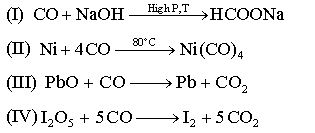
a. I, II
b. II, III
c. III, II
c. I, IV
Answer : A
Question. Which statement is not correct?
a. The CO2 molecule possesses sp-hybridization and also shows resonating structure
b. The structure of CO is [:C =C:]
c. Ammoniacal CuCl absorbs CO forms adduct product
d. Asphyxia is law level poisoning produced in a atmosphere of CO2
Answer : D
Question. Which statement is not correct?
a. CO is isoelectronic with N2 but less reactive than N2
b. CO is isoelectronic with N2 and possesses more bond energy
c. CO is isoelectronic with N2 and more reactive than N2
d. CO is isoelectronic with N2 and required for respiration
Answer : A
Paragraph –III
Group 15 includes pnicogens i.e., N, P, As, Sb and Bi elements with ns2np3 configuration. N2 is gas. All these elements except Bi show allotropy. Phosphorus exists in three allotropic forms, white phosphorus, red phosphorus and black phosphorus. The later being most stable (thermodynamically) form of P. Each member of this forms hydrides of the molecular formula MH3 .Nitrogen however forms three hydrides NH3, N3H and N2H4. The thermal stability, basic nature and solubility in water of hydrides (MH3) however decreases form N to Bi.
Question. The correct order for acidic nature is:
a. NH+4 < PH+4 < AsH +4
b. NH+4 > PH+4 > AsH+4
c. AsH+4 > NH+4 > PH+4
d. AsH+4 < NH+4 < PH+4
Answer : A
Question. Which hydride of group 15 is most powerful reducing agent?
a. NH3
b. PH3
c. AsH3
d. SbH3
Answer : D
Question. The correct order of bond angles is:
a. NH3 > PN3 > AsH3 >SbH3
b. SbH3 > AsH3 >PN3 > NH3
c. SbH3 > PN3 > AsH3 >NH3
d. PN3 > NH3 > SbH3 > BiH3
Answer : A
Paragraph –IV
There are some deposits of nitrates and phosphates in earth’s crust. Nitrates are more soluble in water. Nitrates are difficult to reduce under the laboratory conditions but microbes do it easily. Ammonia forms larger number of complexes with transition metal ions. Hybridization easily explains the ease of sigma donation capability of NH3 and PH3. Phosphine is a flammable gas and is prepared form white phosphorus.
Question. Among the following, the correct statement is:
a. Phosphates have no biological significance in humans
b. between nitrates and phosphates, phosphates are less abundant in earth’s crust
c. Between nitrates and phosphates, nitrates are less abundant in earth’s crust
d. Oxidation of nitrates is possible in soil
Answer : C
Question. Among the following, the correct statement is:
a. Between NH3 and PH3,NH3 is a better electron donor because the lone pair of electrons occupies spherical ‘s’ orbital and is less directional
b. Between NH3 and PH3,NH3 is a better electron donor because the lone pair of electrons occupies sp3- orbital and is more directional
c. Between NH3 and PH3,NH3 is a better electron donor because the lone pair of electrons occupies sp3- orbital and is more directional
d. Between NH3 and PH3,NH3 is a better electron donor because the lone pair of electrons occupies spherical ‘s’ orbital and is less directional
Answer : C
Question. White phosphorus on reaction with NaOH gives PH3 as one of the products. This is a:
a. dimerization reaction
b. disproportionation reaction
c. condensation reaction
d. precipitation reaction
Answer : B
Match the Column
Question. Match the chemical properties with the compounds:
| Column I | Column II |
| (A) Ca | 1. Produces H2 on reaction with H2O. |
| (B) CaH2 | 2. Produce Ca(OH)2 on reaction with H2O |
| (C) CaO | 3. The compound is ionic. |
| (D) CaC2 | 4. Can absorb N2 under hot conditions |
a. A→1,4; B→1,2,3; C→2,3; D→2,3,
b. A→1,3,4; B→1,2,4; C→2,3; D→2,3,4
c. A→1,2,4; B→1,3; C→2,3; D→2,3,4
d. A→1,2,4; B→1,2,3; C→2,3; D→2,3,4
Answer : D
Question. Match the compounds with their uses / properties:
| Column I | Column II |
| (A) NaCO3 ⋅10H2O | 1. Desiccating agent |
| (B) CaCl2(anhydride) | 2. Used for preparing freezing mixture |
| (C) CaSO4(anhydride) | 3. Washing soda |
| (D) NaCl | 4. Dead burnt. |
| 5. Soluble in water. |
a. A→1,5; B→1,4; C→4; D→2,5
b. A→3,5; B→1,5; C→4; D→2,3
c. A→3,5; B→1,5; C→4; D→2,5
d. A→3,5; B→3,5; C→4; D→1,5
Answer : C
Question. Match the xenon compounds with their properties.
| Column I | Column II |
| (A) XeO64- | 1. Central atom in sp3d2 hybridized |
| (B) XeF4 | 2. On treatment with conc. H2SO4 produces XeO4. |
| (C) XeO3 | 3. Only one lone pair is present on the central atom |
| (D) XeO2F4 | 4. Central atom of the molecule has four surrounding atoms |
a. A→1,3; B→1,2; C→3; D→3,4
b. A→1,3; B→2,4; C→3; D→3,4
c. A→1,2; B→1,4; C→3; D→3,4
d. A→1,2; B→1,4; C→1; D→1,4
Answer : C
Integer
Question. Among the following elements, the number of elements that release H2 on reaction with NaOH is …………… Be, Al, B, Mg, Ca, Zn, Sn
Answer : 5
Question. The Among the following compounds, the number of compounds which do not produce acidic or basic solutions which do not produce acidic or basic solutions when dissolved in water is ……………? NaCl2, BeCl2 , Li2 O,MgO,CaH2, CaSO4
Answer : 3
Question. The number of bicarbonates that do not exist in solid form among the following is ……………
LiHCO3, NaHCO3, Ca(HCO3)2 ,KHCO3, NH4HCO3, Ba(HCO3)2, Mg(HCO3)2
Answer : 4
Question. The ratio of the number of water of crystallization in gypsum and that in plaster of Paris is ……………
Answer : 4
Question. The number of planes of symmetry in [BeH4]2– is ……………
Answer : 6
Download NEET Revision Notes: Full Course Study of Representative Elements Study Of Representative Elements
Key Concepts and Summary for Full Course Study of Representative Elements Study Of Representative Elements
Review targeted chapter notes for Full Course Study of Representative Elements Study Of Representative Elements. Built according to official NEET guidelines, these summaries highlight high-yield topics frequently tested in school evaluations.
NCERT-Aligned Chapter Summary and Notes
Built using the official NCERT book for Full Course Study of Representative Elements, these notes provide reliable academic guidance. Pair your summary review with our recommended NCERT solutions to master optimal problem-solving approaches.
Next Steps in Your Exam Preparation
Wrap up your chapter revision by testing your knowledge against standard question formats. Everything on our platform is provided free of charge.
FAQs
You can download the teacher prepared revision notes for NEET Chemistry Study Of Representative Elements Revision Notes from StudiesToday.com. These notes are designed as per 2026-27 academic session to help Full Course students get the best study material for Study of Representative Elements.
Yes, our NEET Chemistry Study Of Representative Elements Revision Notes include 50% competency-based questions with focus on core logic, keyword definitions, and the practical application of Study of Representative Elements principles which is important for getting more marks in 2026 NEET exams.
Yes, our NEET Chemistry Study Of Representative Elements Revision Notes provide a detailed, topic wise breakdown of the chapter. Fundamental definitions, complex numerical formulas and all topics of NEET syllabus in Full Course is covered.
These notes for Study of Representative Elements are organized into bullet points and easy-to-read charts. By using NEET Chemistry Study Of Representative Elements Revision Notes, Full Course students fast revise formulas, key definitions before the exams.
No, all study resources on StudiesToday, including NEET Chemistry Study Of Representative Elements Revision Notes, are available for immediate free download. Full Course Study of Representative Elements study material is available in PDF and can be downloaded on mobile.