NEET Chemistry Chemical Kinetics Revision Notes

Download the latest NEET Chemistry Chemical Kinetics Revision Notes in PDF format. These Full Course Chemical Kinetics revision notes are carefully designed by expert teachers to align with the 2025-26 syllabus. These notes are great daily learning and last minute exam preparation and they simplify complex topics and highlight important definitions for Full Course students.

Chapter-wise Revision Notes for Full Course Chemical Kinetics Chemical Kinetics

To secure a higher rank, students should use these Full Course Chemical Kinetics Chemical Kinetics notes for quick learning of important concepts. These exam-oriented summaries focus on difficult topics and high-weightage sections helpful in school tests and final examinations.

Chemical Kinetics Revision Notes for Full Course Chemical Kinetics


Revision Notes on Chemical Kinetics
 
Rate of Reaction:
 
 Rate of change of extent of reaction is the rate of reaction.
 Rate of reaction is positive for product and negative for reactant.
 For reaction aA →bB
Rate =1/b(Δ*B+/ Δ t) = -1/a (Δ [A]/ Δt)
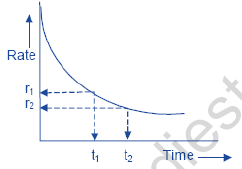
 It goes on decreasing as the reaction progress due to decrease in the concentration(s) of the reactant(s).
NEET Chemistry Chemical Kinetics Revision Notes
 
 Unit of rate of reaction : mol L-1 s-1
 The rate measured over a long time interval is called average rate and the rate measured for an infinitesimally small time interval is called instantaneous rate.
 In a chemical change, reactants and products are involved. As the chemical reaction proceeds, the concentration of the reactants decreases, i.e., products are produced.
 The rate of reaction (average rate) is defined as the change of concentration of any one of its reactants (or products) per unit time.
 
Order of Reaction
 
For reaction aA + bB + ….. → cC+ ….
R ∝[A]m[B]n or R = k[A]m[B]n….
Where m and n may or may not be equal to a & b.
m is order of reaction with respect to A and n is the order of reaction with respect to B.
m + n +… is the overall order of the reaction.
 
Elementary Reaction:
 
 It is the reaction which completes in a single step.
 A reaction may involve more than one elementary reactions or steps also.
 Overall rate of reaction depends on the slowest elementary step and thus it is known as rate determining step.
 
Molecularity of Reaction:
 
 Number of molecules taking part in an elementary step is known as its molecularity.
 Order of an elementary reaction is always equal to its molecularity.
 Elementary reactions with molecularity greater than three are not known because collisions in which more than three particles come together simultaneously are rare.
 
Differential and Integrated Rate Laws:
 
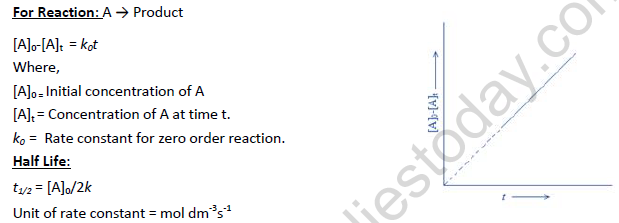
Zero Order Reactions:
NEET Chemistry Chemical Kinetics Revision Notes1
 
Examples:
 Enzyme catalyzed reactions are zero order with respect to substrate concentration.
 Decomposition of gases on the surface of metallic catalysts like decomposition of HI on gold surface.
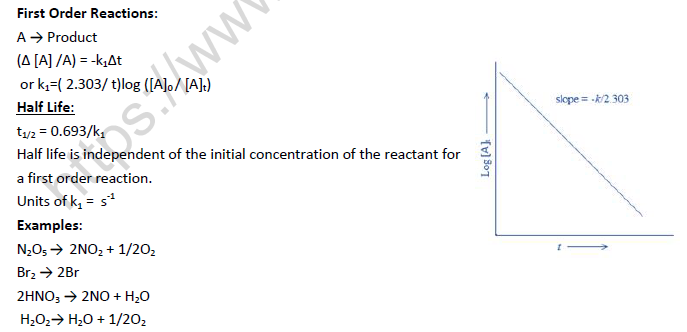
NEET Chemistry Chemical Kinetics Revision Notes2
 
Pseudo First Order Reactions:
 
These are the reactions in which more than one species is involved in the rate determining step but still the order of reaction is one.
 
Examples:
• Acid hydrolysis of ester: CH3COOEt + H3O+ →CH3COOH + EtOH
• Inversion of cane sugar:
NEET Chemistry Chemical Kinetics Revision Notes3
 
 Decomposition of benzenediazonium halides C6H5N=NCl +H2O → C6H5OH +N2 +HCl
 
Half – Life of a nth Order Reaction:
 
kt1/2 = (2n-1-1)/(n-1)[A0]n-1
Where, n = order of reaction ≠1
 
Parallel Reactions:
 
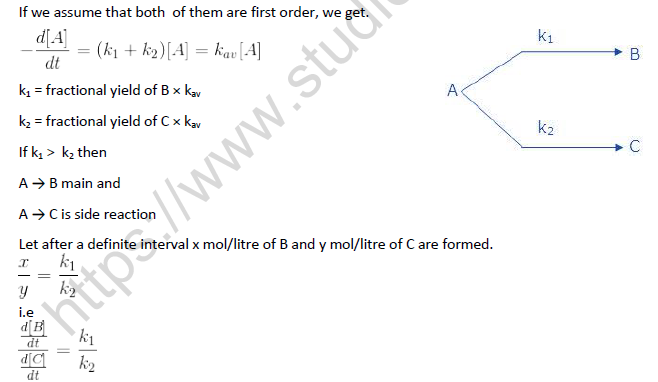
The reactions in which a substance reacts or decomposes in more than one way are called parallel or side reactions.
 
NEET Chemistry Chemical Kinetics Revision Notes4
 
This means that irrespective of how much time is elapsed, the ratio of concentration of B to that of C from the start (assuming no B and C in the beginning ) is a constant equal to k1/k2.
NEET Chemistry Chemical Kinetics Revision Notes5
 
 
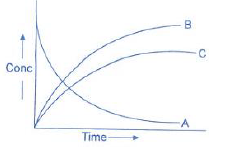
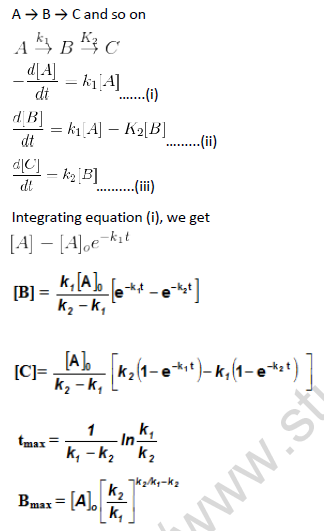
Sequential Reactions:
 
This reaction is defined as that reaction which proceeds from reactants to final products through one or more intermediate stages. The overall reaction is a result of several successive or consecutive steps.
NEET Chemistry Chemical Kinetics Revision Notes6
 
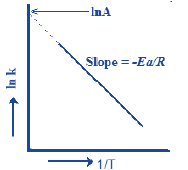
Arrhenius Equation:
 
k = A exp(-Ea/RT)
Where, k = Rate constant
A = pre-exponential factor
Ea = Activation energy
 
Temperature Coefficient:
 
The temperature coefficient of a chemical reaction is defined as the ratio of the specific reaction rates of a reaction at two temperature differing by 10oC.
 
μ = Temperature coefficient= k(r+10)/kt
 
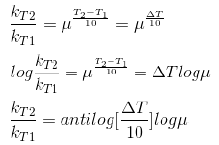
Let temperature coefficient of a reaction be ' μ ' when temperature is raised from T1 to T2; then the ratio of rate constants or rate may be calculated as
NEET Chemistry Chemical Kinetics Revision Notes7
 
NEET Chemistry Chemical Kinetics Revision Notes8
 
Its value lies generally between 2 and 3.
 
Collision Theory of Reaction Rate
 
 A chemical reaction takes place due to collision among reactant molecules.
 The number of collisions taking place per second per unit volume of the reaction mixture is known as collision frequency (Z).
 The value of collision frequency is very high, of the order of 1025 to 1028 in case of binary collisions.
 Every collision does not bring a chemical change.
 The collisions that actually produce the products are effective collisions.
 The effective collisions which bring chemical change are few in comparison to the form a product are ineffective elastic collisions, i.e., molecules just collide and
 disperse in different directions with different velocities.
 For a collision to be effective, the following two barriers are to be cleared.
1. Energy Barrier
2. Orientation Barrier
 
Radioactivity:
 
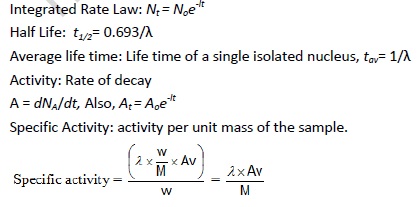
All radioactive decay follow 1st order kinetics
For radioactive decay A ->B
-(dNA/dt) =l NA
Where, l = decay constant of reaction
NA = number of nuclei of the radioactive substance at the time when rate is calculated. Arrhenius equation is not valid for radioactive decay.
NEET Chemistry Chemical Kinetics Revision Notes9
 
 Units: dps or Becquerrel
 

NEET Full Course Chemical Kinetics Chemical Kinetics Notes

Students can use these Revision Notes for Chemical Kinetics to quickly understand all the main concepts. This study material has been prepared as per the latest NEET syllabus for Full Course. Our teachers always suggest that Full Course students read these notes regularly as they are focused on the most important topics that usually appear in school tests and final exams.

NCERT Based Chemical Kinetics Summary

Our expert team has used the official NCERT book for Full Course Chemical Kinetics to design these notes. These are the notes that definitely you for your current academic year. After reading the chapter summary, you should also refer to our NCERT solutions for Full Course. Always compare your understanding with our teacher prepared answers as they will help you build a very strong base in Chemical Kinetics.

Chemical Kinetics Complete Revision and Practice

To prepare very well for y our exams, students should also solve the MCQ questions and practice worksheets provided on this page. These extra solved questions will help you to check if you have understood all the concepts of Chemical Kinetics. All study material on studiestoday.com is free and updated according to the latest Chemical Kinetics exam patterns. Using these revision notes daily will help you feel more confident and get better marks in your exams.

Where can I download the latest PDF for NEET Chemistry Chemical Kinetics Revision Notes?

You can download the teacher prepared revision notes for NEET Chemistry Chemical Kinetics Revision Notes from StudiesToday.com. These notes are designed as per 2025-26 academic session to help Full Course students get the best study material for Chemical Kinetics.

Are these Chemical Kinetics notes for Full Course based on the 2026 board exam pattern?

Yes, our NEET Chemistry Chemical Kinetics Revision Notes include 50% competency-based questions with focus on core logic, keyword definitions, and the practical application of Chemical Kinetics principles which is important for getting more marks in 2026 NEET exams.

Do these Full Course notes cover all topic-wise concepts for Chemical Kinetics?

Yes, our NEET Chemistry Chemical Kinetics Revision Notes provide a detailed, topic wise breakdown of the chapter. Fundamental definitions, complex numerical formulas and all topics of NEET syllabus in Full Course is covered.

How can I use NEET Chemistry Chemical Kinetics Revision Notes for quick last-minute revision?

These notes for Chemical Kinetics are organized into bullet points and easy-to-read charts. By using NEET Chemistry Chemical Kinetics Revision Notes, Full Course students fast revise formulas, key definitions before the exams.

Is there any registration required to download Full Course Chemical Kinetics notes?

No, all study resources on StudiesToday, including NEET Chemistry Chemical Kinetics Revision Notes, are available for immediate free download. Full Course Chemical Kinetics study material is available in PDF and can be downloaded on mobile.