NEET Chemistry Solution And Colligative Properties Revision Notes

Download the latest NEET Chemistry Solution And Colligative Properties Revision Notes in PDF format. These Full Course Solution and Colligative Properties revision notes are carefully designed by expert teachers to align with the 2025-26 syllabus. These notes are great daily learning and last minute exam preparation and they simplify complex topics and highlight important definitions for Full Course students.

Chapter-wise Revision Notes for Full Course Solution and Colligative Properties Solution And Colligative Properties

To secure a higher rank, students should use these Full Course Solution and Colligative Properties Solution And Colligative Properties notes for quick learning of important concepts. These exam-oriented summaries focus on difficult topics and high-weightage sections helpful in school tests and final examinations.

Solution And Colligative Properties Revision Notes for Full Course Solution and Colligative Properties


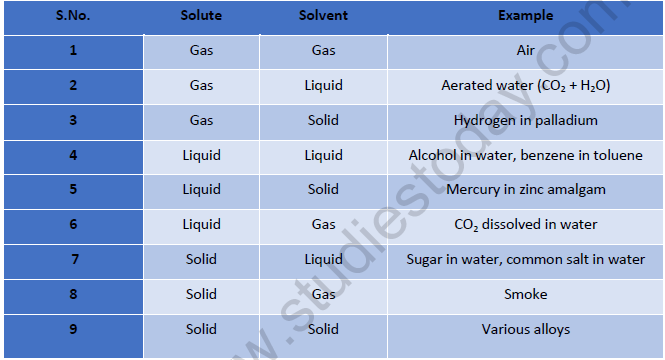
Type of Solutions
 
Vapour Pressure:
 
NEET Chemistry Solution and Colligative Properties Revision Notes
 
Raoult’s Law:
 
“The partial vapour pressure of any component in the solution is directly proportional to its mole fraction”.
 
For a binary solution of two components A and B,
PA = XA
PB = XB
Where
P0A = vapour pressure of component A in pure state.
PA = vapour pressure of component A in the solution.
P0B = vapour pressure of component B in pure state.
PB = vapour pressure of component B in the solution
 
Limitations of Raoult’s Law
 
 Raoult’s law is applicable only to very dilute solutions.
 It is applicable to solutions containing non-volatile solute only.
 It is not applicable to solutes which dissociate or associate in a particular solution
 
Raoult’s Law in Combination with Dalton’s Law of Partial Pressure:
PT = XA P0A + XB P0B = P0B + (P0A -P0B) XA
 
Where
PT = Total Vapour Pressure of the Solution.
Ideal and Non-Ideal Solutions:
 
 Ideal Solution:
For Ideal Solution:
1. dHmixing = 0, i.e. no heat should be absorbed or evolved during mixing
2. dVmixing = 0, i.e. no expansion or contraction on mixing
Examples , Ethyl chloride and ethyl bromide, n–hexane and n–heptane , CCl4 and SiCl4
 
 Non-Ideal Solution:
?These solutions deviate from ideal behaviour and do not obey Raoult’s law over entire range of
composition.
For non ideal solutions,
1. dHmixing ≠ 0
2. dHmixing ≠ 0
 
Here we may have two cases
 
A) Positive Deviation:
1. PA > XA & PB > XB
2. dHmix > 0
3. dVmix > 0
Example: Cyclohexane and Ethanol
 
B) Negative Deviation:
1. PA > XA & PB > XB
2. dHmix < 0
3. dVmix < 0
 
Colligative Properties
 
Lowering of Vapour Pressure by a Non-Volatile Solute
Elevation of Boiling Point by a Non-Volatile Solute :
Depression of Freezing Point by a Non-Volatile Solute:
 
Osmosis and Osmotic Pressure:
 
• Osmosis: The phenomenon of the passage of pure solvent from a region of lower concentration
(of the solution) to a region of its higher concentration through a semi-permeable membrane.
 
 Osmotic Pressure: Excess pressure which must be applied to a solution in order to prevent flow of solvent into the solution through the semi-permeable membrane.
                              V = nRT
 
where
= Osmotic pressure
V = volume of solution
n = no. of moles of solute that is dissolved
R = Gas constant
T = Absolute temperature
 
Isotonic Solutions: A pair of solutions having same osomotic pressure is called isotonic solutions.
Abnormal Molecular Weight and Van't Hoff Factor:
 
Van't Hoff Factor:
Van't Hoff, in order to account for all abnormal cases introduced a factor i known as the Van't Hoff
factor, such that
Degree of Association:
Let a be the degree of association, then,
The number of unassociated moles = 1-α
The number of associated moles = α/n
Total number of effective moles = 1- α+ α /n
Obviously, i < 1
 
Degree of Dissociation
The fraction of the total number of molecules which dissociates in the solution, that is, breaks into simpler molecules or ions.
KCl ↔ K+ + Cl-
1-α α α
Thus, the total number of moles after dissociation = 1-α + α+α = 1+α
Hence, i = (1+α )/1
i = 1+α = 1+ (2–1)
In general, i = 1+ (n–1) α,
Where, n = number of particles ( ions) formed after dissociation
From the above formula, it is clear that i > 1


Please click the link below to download pdf file of NEET Chemistry Solution and Colligative Properties Revision Notes


NEET Full Course Solution and Colligative Properties Solution And Colligative Properties Notes

Students can use these Revision Notes for Solution And Colligative Properties to quickly understand all the main concepts. This study material has been prepared as per the latest NEET syllabus for Full Course. Our teachers always suggest that Full Course students read these notes regularly as they are focused on the most important topics that usually appear in school tests and final exams.

NCERT Based Solution And Colligative Properties Summary

Our expert team has used the official NCERT book for Full Course Solution and Colligative Properties to design these notes. These are the notes that definitely you for your current academic year. After reading the chapter summary, you should also refer to our NCERT solutions for Full Course. Always compare your understanding with our teacher prepared answers as they will help you build a very strong base in Solution and Colligative Properties.

Solution And Colligative Properties Complete Revision and Practice

To prepare very well for y our exams, students should also solve the MCQ questions and practice worksheets provided on this page. These extra solved questions will help you to check if you have understood all the concepts of Solution And Colligative Properties. All study material on studiestoday.com is free and updated according to the latest Solution and Colligative Properties exam patterns. Using these revision notes daily will help you feel more confident and get better marks in your exams.

Where can I download the latest PDF for NEET Chemistry Solution And Colligative Properties Revision Notes?

You can download the teacher prepared revision notes for NEET Chemistry Solution And Colligative Properties Revision Notes from StudiesToday.com. These notes are designed as per 2025-26 academic session to help Full Course students get the best study material for Solution and Colligative Properties.

Are these Solution and Colligative Properties notes for Full Course based on the 2026 board exam pattern?

Yes, our NEET Chemistry Solution And Colligative Properties Revision Notes include 50% competency-based questions with focus on core logic, keyword definitions, and the practical application of Solution and Colligative Properties principles which is important for getting more marks in 2026 NEET exams.

Do these Full Course notes cover all topic-wise concepts for Solution and Colligative Properties?

Yes, our NEET Chemistry Solution And Colligative Properties Revision Notes provide a detailed, topic wise breakdown of the chapter. Fundamental definitions, complex numerical formulas and all topics of NEET syllabus in Full Course is covered.

How can I use NEET Chemistry Solution And Colligative Properties Revision Notes for quick last-minute revision?

These notes for Solution and Colligative Properties are organized into bullet points and easy-to-read charts. By using NEET Chemistry Solution And Colligative Properties Revision Notes, Full Course students fast revise formulas, key definitions before the exams.

Is there any registration required to download Full Course Solution and Colligative Properties notes?

No, all study resources on StudiesToday, including NEET Chemistry Solution And Colligative Properties Revision Notes, are available for immediate free download. Full Course Solution and Colligative Properties study material is available in PDF and can be downloaded on mobile.