NEET Chemistry Periodic Table Revision Notes

Download the latest NEET Chemistry Periodic Table Revision Notes in PDF format. These Full Course Periodic Table revision notes are carefully designed by expert teachers to align with the 2025-26 syllabus. These notes are great daily learning and last minute exam preparation and they simplify complex topics and highlight important definitions for Full Course students.

Chapter-wise Revision Notes for Full Course Periodic Table Periodic Table

To secure a higher rank, students should use these Full Course Periodic Table Periodic Table notes for quick learning of important concepts. These exam-oriented summaries focus on difficult topics and high-weightage sections helpful in school tests and final examinations.

Periodic Table Revision Notes for Full Course Periodic Table

Modern Periodic Law:
 
 Properties of elements are the periodic function to their atomic numbers.
 The periodicity in properties is due to repetition of similar outer shell electronic configuration at a certain regular intervals.
 In modern periodic table is based on modern periodic law in which elements are arranged in increasing order of their atomic numbers.
 In the modern periodic table, the elements are arranged in rows and columns. These rows and columns are known as periods and groups respectively.
 The table consists of 7 periods and 18 groups
 Period indicates the value of ‘n’ (principal quantum number) for the outermost or valence shell.
 Same number of electrons is present in the outer orbitals (that is, similar valence shell electronic configuration
 
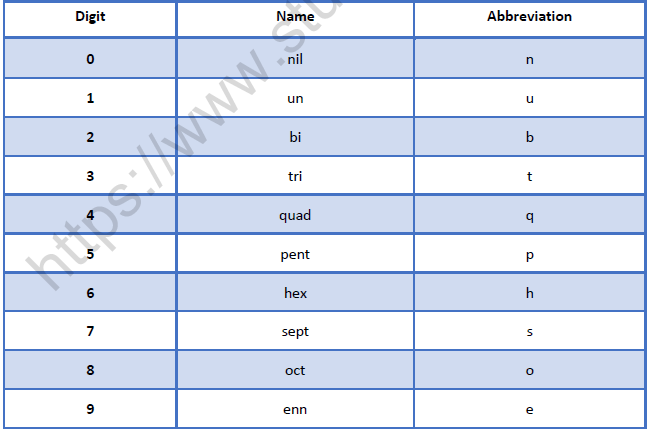
IUPAC Nomenclature for Elements with Atomic Number 100
 
NEET Chemistry Periodic Table Revision Notes
 
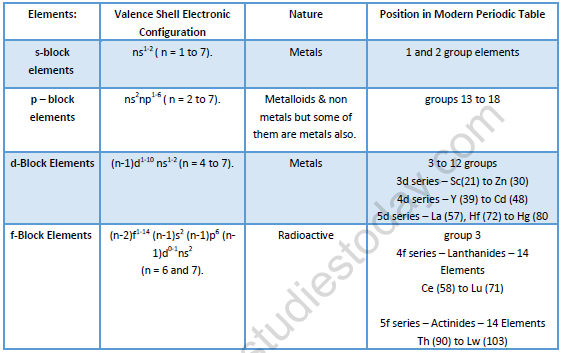
Classification of Elements:
 
NEET Chemistry Periodic Table Revision Notes-1
 
Periodicity in Atomic Properties:
 
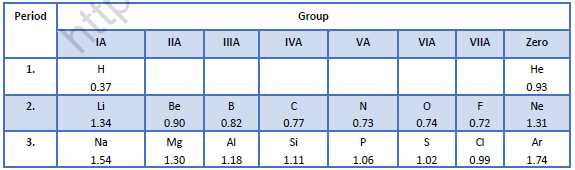
1. Atomic Radius:
 
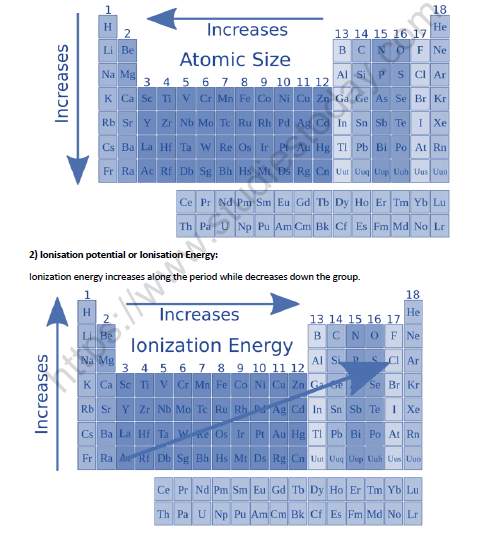
 Within a given period atomic radius decreases from left to right. This is due to the effect of increase in nuclear charge while the electrons are being added to the same shell.
 Within a given group atomic radius increases down the group. This is due to the increase in number of shells.
 
NEET Chemistry Periodic Table Revision Notes-2
 
 In the first transition series the atomic size slightly decreases from Sc to Mn because effect of effective nuclear charge is stronger than the shielding effect. The atomic size from Fe to Ni remains almost the same because both the effects balance each other.
 
 The atomic size from Cu to Zn slightly increases because shielding effect is more than effective nuclear charge due to d10 structure of Cu and Zn.
 
 Inner transition elements – As we move along the lanthanide series, there is a decrease in atomic as well as ionic radius. The decrease in size is regular in ions but not so regular in atoms. This is called lanthanide contraction.
 NEET-Chemistry-Periodic-Table-Revision-Notes 1
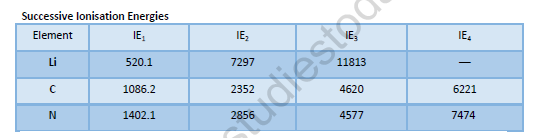
Factors which influence I.E.
 
  Atomic size: the larger the size of the atom, the smaller the I.E. i.e., I.E. μ
 
  Effective nuclear charge: The greater the effective charge on the nucleus of an atom, the more difficult it would be to remove an electron from the atom because electrostatic force of attraction between the nucleus and the outermost electron increases. So greater energy will be required to remove the electron.
 
  Penetration effect of orbitals: The order of energy required to remove electron from s,p,d-and¦- orbitals of a shell is s>p>d>¦.
 
  Shielding or screening effect: Screening effect results in decrease of force of attraction between the nucleus and the outermost electron and lesser energy is required to separate the electron. Thus the value of I.P. decreases.
 
  Stability of half-filled and fully-filled orbitals: According to Hund's rule the stability of half filled or completely filled degenerate orbitals is comparatively high. So comparatively more energy is required to separate the electron from such atoms.
NEET-Chemistry-Periodic-Table-Revision-Notes 2
 
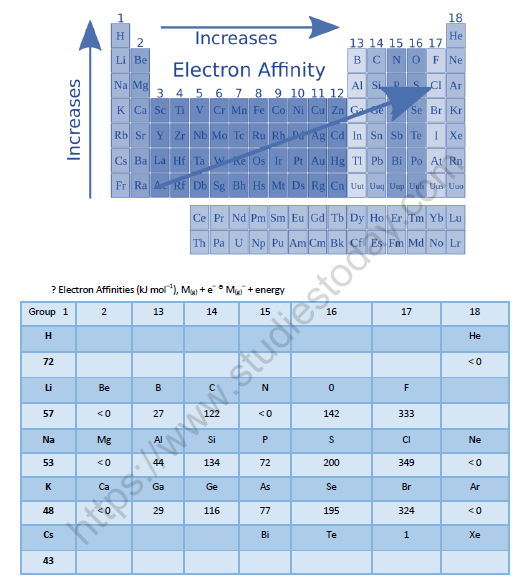
3) Electron Affinity:
 
Electron affinity increases along the period while decreases down the group.
Factors affecting the magnitude of electron affinity
 
 Atomic size – In general electron affinity value decreases with the increasing atomic radius because electrostatic force of attraction decreases between the electron being added and the atomic nucleus due to increase of distance between them.
 
 Effective nuclear charge – Electron affinity value of the element increase as the effective nuclear charge on the atomic nucleus increases because electrostatic force of attraction between the electron being added and the nucleus increases. As the electrostatic force of attraction increases,amount of energy released is more.
 
 Screening or Shielding effect – Electron affinity value of the elements decreases with the increasing shielding or screening effect. The shielding effect between the outer electrons and the nucleus increases as the number of electrons increases in the inner shells.
Stability of half filled and completely filled orbitals – The stability of half filled and completely filled degenerate orbitals of a sub shell is comparatively more, so it is difficult to add electron in such orbitals and lesser energy is released on addition of electron hence the electron affinity value will decrease.
NEET-Chemistry-Periodic-Table-Revision-Notes 3
 
Please click the link below to download pdf file of NEET Chemistry Periodic Table Revision Notes

NEET Full Course Periodic Table Periodic Table Notes

Students can use these Revision Notes for Periodic Table to quickly understand all the main concepts. This study material has been prepared as per the latest NEET syllabus for Full Course. Our teachers always suggest that Full Course students read these notes regularly as they are focused on the most important topics that usually appear in school tests and final exams.

NCERT Based Periodic Table Summary

Our expert team has used the official NCERT book for Full Course Periodic Table to design these notes. These are the notes that definitely you for your current academic year. After reading the chapter summary, you should also refer to our NCERT solutions for Full Course. Always compare your understanding with our teacher prepared answers as they will help you build a very strong base in Periodic Table.

Periodic Table Complete Revision and Practice

To prepare very well for y our exams, students should also solve the MCQ questions and practice worksheets provided on this page. These extra solved questions will help you to check if you have understood all the concepts of Periodic Table. All study material on studiestoday.com is free and updated according to the latest Periodic Table exam patterns. Using these revision notes daily will help you feel more confident and get better marks in your exams.

Where can I download the latest PDF for NEET Chemistry Periodic Table Revision Notes?

You can download the teacher prepared revision notes for NEET Chemistry Periodic Table Revision Notes from StudiesToday.com. These notes are designed as per 2025-26 academic session to help Full Course students get the best study material for Periodic Table.

Are these Periodic Table notes for Full Course based on the 2026 board exam pattern?

Yes, our NEET Chemistry Periodic Table Revision Notes include 50% competency-based questions with focus on core logic, keyword definitions, and the practical application of Periodic Table principles which is important for getting more marks in 2026 NEET exams.

Do these Full Course notes cover all topic-wise concepts for Periodic Table?

Yes, our NEET Chemistry Periodic Table Revision Notes provide a detailed, topic wise breakdown of the chapter. Fundamental definitions, complex numerical formulas and all topics of NEET syllabus in Full Course is covered.

How can I use NEET Chemistry Periodic Table Revision Notes for quick last-minute revision?

These notes for Periodic Table are organized into bullet points and easy-to-read charts. By using NEET Chemistry Periodic Table Revision Notes, Full Course students fast revise formulas, key definitions before the exams.

Is there any registration required to download Full Course Periodic Table notes?

No, all study resources on StudiesToday, including NEET Chemistry Periodic Table Revision Notes, are available for immediate free download. Full Course Periodic Table study material is available in PDF and can be downloaded on mobile.