NEET Chemistry Isolation Of Metals Revision Notes

Download the latest NEET Chemistry Isolation Of Metals Revision Notes in PDF format. These Full Course Isolation of Metals revision notes are carefully designed by expert teachers to align with the 2025-26 syllabus. These notes are great daily learning and last minute exam preparation and they simplify complex topics and highlight important definitions for Full Course students.

Chapter-wise Revision Notes for Full Course Isolation of Metals Isolation Of Metals

To secure a higher rank, students should use these Full Course Isolation of Metals Isolation Of Metals notes for quick learning of important concepts. These exam-oriented summaries focus on difficult topics and high-weightage sections helpful in school tests and final examinations.

Isolation Of Metals Revision Notes for Full Course Isolation of Metals


Isolation of Metals
 
General Principles & Processes of Isolation of Metals
 
Types of Ores:
Ores may be divided into four groups
 
• Native Ores: These ores contain the metal in free state eg. Silver gold etc. These are usually formed in the company of rock or alluvial impurities like clay, sand etc.
 Oxidised Ores: These ores consist of oxides or oxysalts (eg. carbonates, phosphate) and silicate of metal. Important oxide ore includes, Fe2O3, Al2O3.2H2O etc. and important cabonate ores are limestone (CaCO3), Calamine (ZnCO3) etc.
 Sulphurised Ores: These ores consist of sulfides of metals like iron, lead, mercury etc. Examples
are iron pyrites (FeS2). galena (PbS), Cinnabar (HgS)
 Halide ores: Metallic halides are very few in nature. Chlorides are most common examples include horn silver (AgCl) carnallite KCl. MgCl2.6H2O and fluorspar (CaF2) etc.
 
Metallurgy:
 
It is the process of extracting a metal from its ores. The following operations are carried out for obtaining the metal in the pure form.
 Crushing of the ore
 Dressing or concentration of the ore.
 Reduction of metal.
 Purification or refining of the metal
 
Concentration
Physical Method
 
Gravity separation: The powdered ores is agitated with water or washed with a running stream of water. The heavy ore particles of sand, clay etc. are washed away.
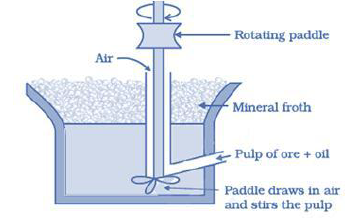
Froth Floatation Process: The finely divided ore is introduced into water containing small quantity of oil (e.g. Pine Oil). The mixture is agitated violently with air a froth is formed which carries away along with it the metallic particles on account of the surface tension forces. The froth is transferred to another bath where gangue-free ore settles down.
NEET Chemistry Isolation of Metals Revision Notes
 
Electro Magnetic Separator: A magnetic separator consists of a belt moving over two rollers, one of which is magnetic. The powdered ore is dropped on the belt at the other end. Magnetic portion of the ore is attracted by the magnetic roller and falls near to the roller while the non-magnetic impurity falls farther off
 
Chemical Methods
 
Calcination: Carbonate or hydrated oxide ores are subjected to the action of heat in order of expel water from hydrated oxide and carbon dioxide from a carbonate.
Examples: 
ZnCO3 --> ZnO + CO2
CaCO3 --> CaO + CO2
Al2O3×2H2O --> Al2O3 + 2H2O
2Fe2O3×3H2O --> 2Fe2O3 + 3H2O
 
Roasting: Sulphide ores either are subjected to the action of heat and air at temperatures below their melting points in order to bring about chemical changes in them.
Examples: 
2PbS + 3O2 --> 2PbO + 2SO2
PbS + 2O2 --> PbSO4
2ZnS + 3O2 --> 2ZnO + 2SO2
ZnS + 2O2 --> ZnSO4
CuS + 2O2 --> CuSO4
2Cu2S + 3O2 --> 2Cu2O + 2SO2
 
Leaching: It involves the treatment of the ore with a suitable reagent as to make it soluble while impurities remain insoluble. The ore is recovered from the solution by suitable chemical method.
Al2O3 + 2NaOH -->2 NaAlO2 + H2O
 
Reduction of Free Metal:
Smelting:
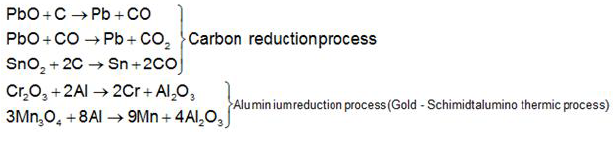
Reduction of a metal from its ore by a process involving melting Several reducing agents such as sodium, magnesium and aluminium are used for reduction.
The calcinated or roasted ore is mixed with carbon (coal or coke) and heated in a reverberatory or a blast furnace.
Carbon and carbon monoxide produced by incomplete combustion of carbon reduce the oxide to the metal.
NEET Chemistry Isolation of Metals Revision Notes-1
 
Flux:
 
The ores even after concentration contain some earthy matter called gangue which is heated combine with this earthy matter to form an easily fusible material. Such a substance is known as flux and the fusible material formed during reduction process is called slag.
 
 Acidic fluxes like silica, borax etc are used when the gangue is basic such as lime or other metallic oxides like MnO, FeO, etc
 Basic fluxes like CaO, lime stone (CaCO3), magnesite (MgCO3), hematite (Fe2O3) etc are used when the gangue is acidic like silica, P4O10 etc.
 
Refining
The metals obtained by the application of above reduction methods from the concentration ores are usually impure. The impure metal is thus subjected to some purifying process known as refining in order to remove undesired impurities. Various process for this are
a) Liquation process
b) Distillation process
c) Cupellation
d) Poling
e) Electrolytic refining
f) Bessemerisation
 
Thermodynamic Principles of Metallurgy:
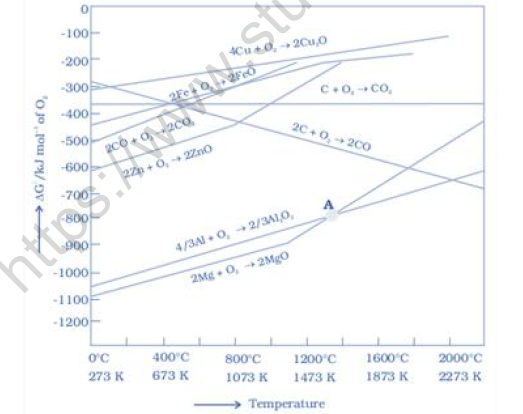
ΔG =ΔH-TS
or ΔG0 =-RT ln K
 
NEET Chemistry Isolation of Metals Revision Notes-2
 
An element A can reduce element B if ΔG value for oxidation of A to AO is lower than the ΔG value for oxidation of B to BO.
i.e. ΔG(A→AO) < ΔG(B→BO)
 
 
Please click the link below to download pdf file of NEET Chemistry Isolation of Metals Revision Notes
 

NEET Full Course Isolation of Metals Isolation Of Metals Notes

Students can use these Revision Notes for Isolation Of Metals to quickly understand all the main concepts. This study material has been prepared as per the latest NEET syllabus for Full Course. Our teachers always suggest that Full Course students read these notes regularly as they are focused on the most important topics that usually appear in school tests and final exams.

NCERT Based Isolation Of Metals Summary

Our expert team has used the official NCERT book for Full Course Isolation of Metals to design these notes. These are the notes that definitely you for your current academic year. After reading the chapter summary, you should also refer to our NCERT solutions for Full Course. Always compare your understanding with our teacher prepared answers as they will help you build a very strong base in Isolation of Metals.

Isolation Of Metals Complete Revision and Practice

To prepare very well for y our exams, students should also solve the MCQ questions and practice worksheets provided on this page. These extra solved questions will help you to check if you have understood all the concepts of Isolation Of Metals. All study material on studiestoday.com is free and updated according to the latest Isolation of Metals exam patterns. Using these revision notes daily will help you feel more confident and get better marks in your exams.

Where can I download the latest PDF for NEET Chemistry Isolation Of Metals Revision Notes?

You can download the teacher prepared revision notes for NEET Chemistry Isolation Of Metals Revision Notes from StudiesToday.com. These notes are designed as per 2025-26 academic session to help Full Course students get the best study material for Isolation of Metals.

Are these Isolation of Metals notes for Full Course based on the 2026 board exam pattern?

Yes, our NEET Chemistry Isolation Of Metals Revision Notes include 50% competency-based questions with focus on core logic, keyword definitions, and the practical application of Isolation of Metals principles which is important for getting more marks in 2026 NEET exams.

Do these Full Course notes cover all topic-wise concepts for Isolation of Metals?

Yes, our NEET Chemistry Isolation Of Metals Revision Notes provide a detailed, topic wise breakdown of the chapter. Fundamental definitions, complex numerical formulas and all topics of NEET syllabus in Full Course is covered.

How can I use NEET Chemistry Isolation Of Metals Revision Notes for quick last-minute revision?

These notes for Isolation of Metals are organized into bullet points and easy-to-read charts. By using NEET Chemistry Isolation Of Metals Revision Notes, Full Course students fast revise formulas, key definitions before the exams.

Is there any registration required to download Full Course Isolation of Metals notes?

No, all study resources on StudiesToday, including NEET Chemistry Isolation Of Metals Revision Notes, are available for immediate free download. Full Course Isolation of Metals study material is available in PDF and can be downloaded on mobile.