NEET Chemistry Halogen Derivatives Of Organic Compounds Revision Notes

Download the latest NEET Chemistry Halogen Derivatives Of Organic Compounds Revision Notes in PDF format. These Full Course Halogen Derivatives of Organic Compounds revision notes are carefully designed by expert teachers to align with the 2025-26 syllabus. These notes are great daily learning and last minute exam preparation and they simplify complex topics and highlight important definitions for Full Course students.

Chapter-wise Revision Notes for Full Course Halogen Derivatives of Organic Compounds Halogen Derivatives Of Organic Compounds

To secure a higher rank, students should use these Full Course Halogen Derivatives of Organic Compounds Halogen Derivatives Of Organic Compounds notes for quick learning of important concepts. These exam-oriented summaries focus on difficult topics and high-weightage sections helpful in school tests and final examinations.

Halogen Derivatives Of Organic Compounds Revision Notes for Full Course Halogen Derivatives of Organic Compounds


Halogen Derivatives of Organic Compounds
 
Organic Compounds Containing Halogens can be divided into two groups:
• Alkyl Halides: Aliphatic carbon chain with halogen atom(s) as substitution.
Example: Chlorobutane.
 Aryl Halides: Aromatic carbon ring with halogen atom(s) as substitution on ring.
Example: Chlorobenzene.
 
Methods of Preparation of Alkyl Halides:
 
Grove’s process: Replacement of “OH” group in primary and secondary alcohols with an “X’ atom in presence of Zinc chloride.
NEET Chemistry Halogen Derivatives of Organic Compounds Revision Notes
 
The reaction follows SN2 mechanism when the concentration of zinc chloride is low.
 
Darzen Process: Reaction of thionyl chloride with straight-chain primary alcohols without presence or absence of pyridine.
In presence of pyridine:
ROH + SOCl2 → HCl + ROSOCl
HCl+C5H5N →C5H5NH++Cl-
ROSOCl + Cl →RCl + SO2 (SN2)
 
• Action of a phosphorus halide on the alcohol: ROH + PCl5 → RCl + HCl + POCl3.
• By addition of Halogen to an alefins: R-CH=CH2 +Br2+CCl4 →R-CH(Br)CH2Br
• Photohalogenation: CH4 + Cl2 +hv → CH3Cl + HCl
• Displacement of one halogen atom by another:RCl + NaI →RI + NaCl
• Bonodine – Hünsdiecker Reaction: RCO2Ag + Br2→RBr + CO2 + AgBr
 
• Hydrohalogenation of unsaturated hydrocarbons:
 
 In absence of peroxide: RCH=CH2 +HBr→RCH(Br)CH3
 In presence of peroxide: RCH=CH2 +HBr + Peroxide →RCH2CH2Br
 
Methods of Preparation of aryl halides
  Halogenation: Ar-H + X2 +Lewis Base → Ar-x + HX
  From diazonium salts:
 C6H5N2Cl + HBF4 →C6H5F (Schiemann Reaction)
 C6H5N2Cl + CuCl →C6H5Cl (Sandmeyer Reaction)
 C6H5N2Cl + Cu powder →C6H5Cl (Gatterman Reaction)
 
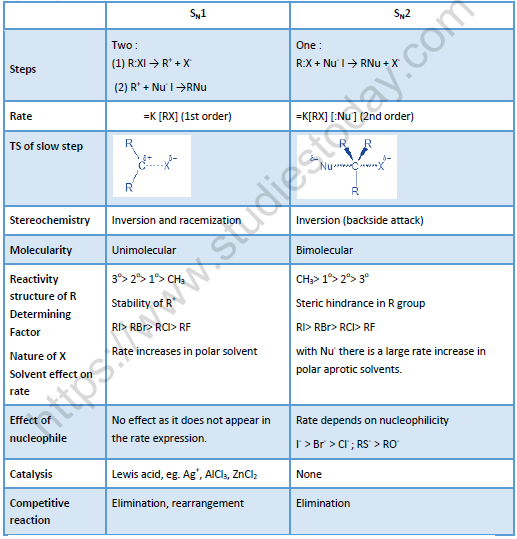
SN1 and SN2 mechanism:
 
NEET Chemistry Halogen Derivatives of Organic Compounds Revision Notes-1
 
Reactions of Alkyl Halides:
 
• Hydrolysis: : RX + OH → ROH + X
• Williamson Synthasis: R-ONa +R'X → R-R' + NaX
• Reaction with dry silver oxide: 2R-X + Ag2O → R-O-R
• Reaction with sodio-Alkynides: R-C≡C-Na +X-R→ R-C=C-R +NaX
• Reaction with potassium-cyanide: KCN+X-R→ RCN +KX
• Reaction with silver-cyanide: AgCN+X-R→ RNC +AgX
• Reaction with silver-nitrite: AgNO2+X-R→ RNO2 +AgX
• Reaction with potassium-nitrite: KNO2+X-R→ R-O-N=O +KX
• Fridal Craft Reaction: R-X + C6H6 + AlCl3→C6H5-R
• Malonic Ester Synthasis: R-X + -CH(CO2C2H5)2 →R-CH(CO2C2H5)2 +HX
• Acetoacetic Ester Synthasis: R-X + -CH(CO2CH3)2 →R-CH(CO2CH3)2 +HX
• Reaction with Ammonia: R-X +NH3→ R-NH2 +HX
• Wurtz Reaction: 2R-I+ 2Na →R—R + 2NaI
• Dehydrohalogenation: CH3.CH2.CH2Br + alco.KOH → CH3–CH = CH2 + KBr + H2O
• Reaction with alcoholic AgNO3: R-X +AgNO3 → R+ + AgX↓+HNO3
 
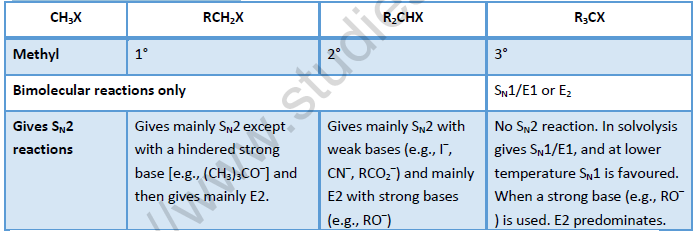
Substitution Versus Elimination:
 
NEET Chemistry Halogen Derivatives of Organic Compounds Revision Notes-2
 
 
Haloform(Tri halide):
 
• Preparation: It can be prepared from any alcohol having –CH(OH)CH3 group or from the aldehydes and ketones formed from above type of alcohols i.e, from a carbonyl compound
having three a - hydrogen atoms by the action of X2and an alkali or Na2CO3.
• Laboratory Preparation of CHCl3:
NEET Chemistry Halogen Derivatives of Organic Compounds Revision Notes-3
• Physical properties of CHCl3: colourless liquid with sweet smell and test. It is heavier than water and insoluble in it but soluble in alcohol and ether.
 
Chemical Reactions of CHCl3:
 
•  Oxidation: CHCl3 + 1/2 O2 → HCl + COCl2 (phosgene)
•  Hydrolysis: CHCl3 + 4NaOH → HCOONa + 3NaCl + 2H2O
•  Carbyl amine reactions: CHCl3 + CH3NH2 + 3NaOH →CH3N≡C +3NaCl +3H
 
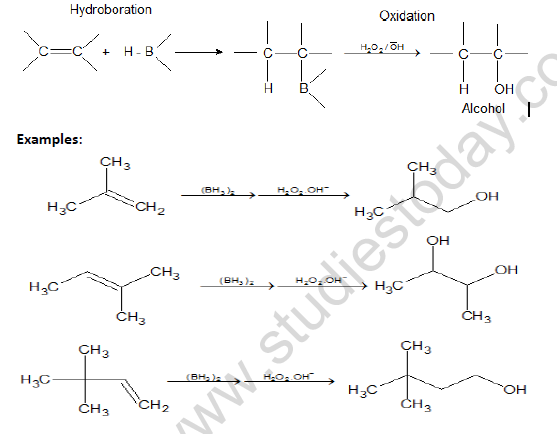
5. Hydroboration-Oxidation:
 
NEET Chemistry Halogen Derivatives of Organic Compounds Revision Notes-4
 
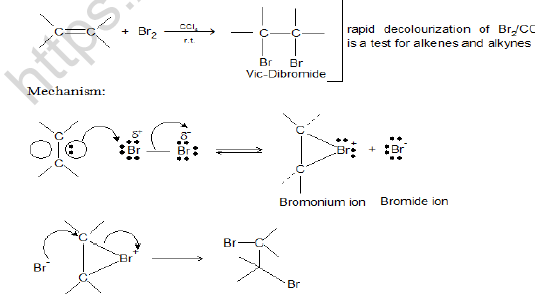
6. Halogen Addition in Non-polar Solvent:
 
NEET Chemistry Halogen Derivatives of Organic Compounds Revision Notes-5
 
 
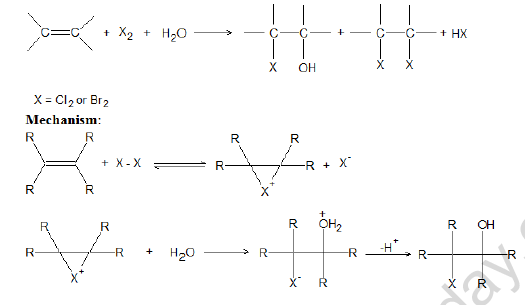
7. Halogen Addition in Aqueous Medium:
 
NEET Chemistry Halogen Derivatives of Organic Compounds Revision Notes-6
 
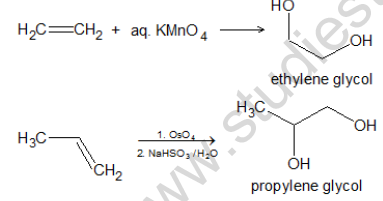
8. Syn – Hydroxylation: Formation of di-oles.
 
NEET Chemistry Halogen Derivatives of Organic Compounds Revision Notes-7
 
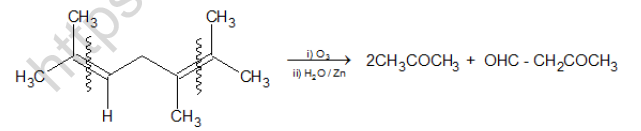
9. Ozonolysis of Alkenes:
NEET Chemistry Halogen Derivatives of Organic Compounds Revision Notes-8
Alkyne
 Saturated open chain hydrocarbon with general formula (CnH2n-2).
 At least one -c≡c- (triple bond) group i.e. sp hybridisation, is present throughout the chain.
 Physical properties of alkynes are similar to those of the corresponding alkenes
 
Preparation
 
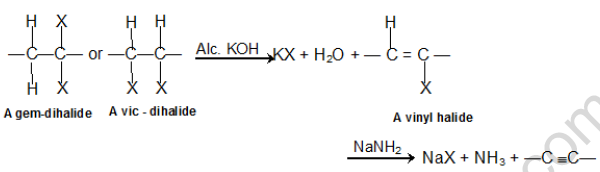
1. Dehydrohalogenation of vic-Dihalides or gem-Dihalides
NEET Chemistry Halogen Derivatives of Organic Compounds Revision Notes-9
 
2. Dehalogenation of vic-Tetrahalogen Compounds
NEET Chemistry Halogen Derivatives of Organic Compounds Revision Notes-10
 
3. Alkyl Substitution in Acetylene; Acidity of º C-H
NEET Chemistry Halogen Derivatives of Organic Compounds Revision Notes-11
4. From Calcium Carbide:
CaC2 +2H2O → Ca(OH)2+ C2H2
 
5. Kolbe’s Electrolysis:
NEET Chemistry Halogen Derivatives of Organic Compounds Revision Notes-12
 
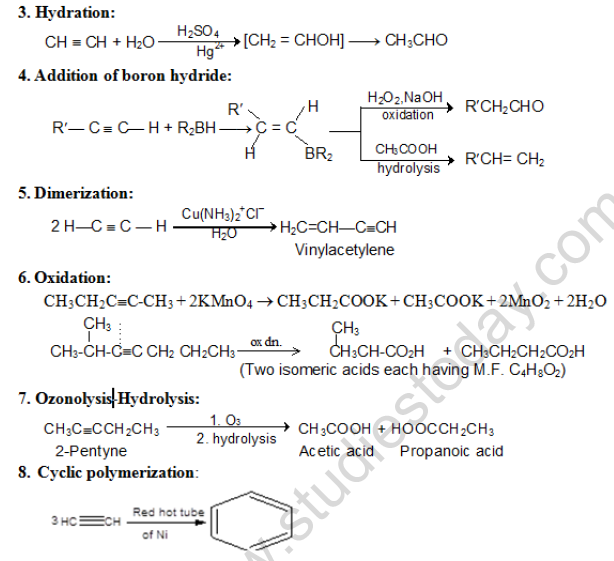
Chemical Properties
 
1. Hydrogenation: RC ≡ CCH2CH3 + 2H2 → CH3CH2CH2CH2CH3
2. Hydro-halogenation:
Markovnikov addition: RC≡CH +HBr → RCBr=CH2 +HBr→ RCBr2-CH3
Anti-markovnikov addition: RC≡CH +HBr +peroxide → RCH=CHBr
 
NEET Chemistry Halogen Derivatives of Organic Compounds Revision Notes-13
 
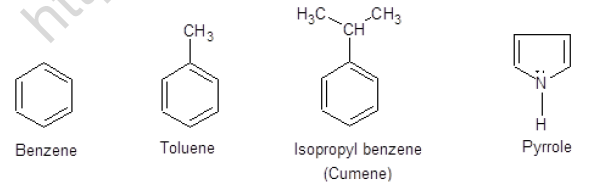
Aromatic Hydrocarbons:
For being aromatic a hydrocarbon should
 
 be a cyclic compounds.
 have planarity in geometry.
 have complete delocalization of electrons over ring.
 follow Huckel Rule i.e. number of ?? electrons in ring = (4n+2).
NEET Chemistry Halogen Derivatives of Organic Compounds Revision Notes-14
 
Benzene (C6H6)
 
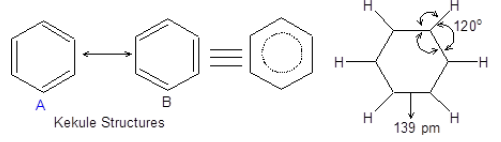
1. Structure:
NEET Chemistry Halogen Derivatives of Organic Compounds Revision Notes-15
 
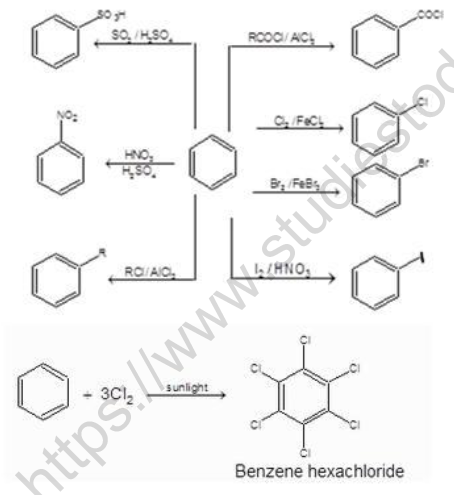
2. Chemical Reactions of Benzene:
NEET Chemistry Halogen Derivatives of Organic Compounds Revision Notes-16
 
Anti-aromatic Hydrocarbons:
 
Highly unstable compounds.
Number of π electrons in ring = 4n.
Example:
NEET Chemistry Halogen Derivatives of Organic Compounds Revision Notes-17
 

NEET Full Course Halogen Derivatives of Organic Compounds Halogen Derivatives Of Organic Compounds Notes

Students can use these Revision Notes for Halogen Derivatives Of Organic Compounds to quickly understand all the main concepts. This study material has been prepared as per the latest NEET syllabus for Full Course. Our teachers always suggest that Full Course students read these notes regularly as they are focused on the most important topics that usually appear in school tests and final exams.

NCERT Based Halogen Derivatives Of Organic Compounds Summary

Our expert team has used the official NCERT book for Full Course Halogen Derivatives of Organic Compounds to design these notes. These are the notes that definitely you for your current academic year. After reading the chapter summary, you should also refer to our NCERT solutions for Full Course. Always compare your understanding with our teacher prepared answers as they will help you build a very strong base in Halogen Derivatives of Organic Compounds.

Halogen Derivatives Of Organic Compounds Complete Revision and Practice

To prepare very well for y our exams, students should also solve the MCQ questions and practice worksheets provided on this page. These extra solved questions will help you to check if you have understood all the concepts of Halogen Derivatives Of Organic Compounds. All study material on studiestoday.com is free and updated according to the latest Halogen Derivatives of Organic Compounds exam patterns. Using these revision notes daily will help you feel more confident and get better marks in your exams.

Where can I download the latest PDF for NEET Chemistry Halogen Derivatives Of Organic Compounds Revision Notes?

You can download the teacher prepared revision notes for NEET Chemistry Halogen Derivatives Of Organic Compounds Revision Notes from StudiesToday.com. These notes are designed as per 2025-26 academic session to help Full Course students get the best study material for Halogen Derivatives of Organic Compounds.
Are these Halogen Derivatives of Organic Compounds notes for Full Course based on the 2026 board exam pattern?

Yes, our NEET Chemistry Halogen Derivatives Of Organic Compounds Revision Notes include 50% competency-based questions with focus on core logic, keyword definitions, and the practical application of Halogen Derivatives of Organic Compounds principles which is important for getting more marks in 2026 NEET exams.

Do these Full Course notes cover all topic-wise concepts for Halogen Derivatives of Organic Compounds?

Yes, our NEET Chemistry Halogen Derivatives Of Organic Compounds Revision Notes provide a detailed, topic wise breakdown of the chapter. Fundamental definitions, complex numerical formulas and all topics of NEET syllabus in Full Course is covered.

How can I use NEET Chemistry Halogen Derivatives Of Organic Compounds Revision Notes for quick last-minute revision?

These notes for Halogen Derivatives of Organic Compounds are organized into bullet points and easy-to-read charts. By using NEET Chemistry Halogen Derivatives Of Organic Compounds Revision Notes, Full Course students fast revise formulas, key definitions before the exams.

Is there any registration required to download Full Course Halogen Derivatives of Organic Compounds notes?

No, all study resources on StudiesToday, including NEET Chemistry Halogen Derivatives Of Organic Compounds Revision Notes, are available for immediate free download. Full Course Halogen Derivatives of Organic Compounds study material is available in PDF and can be downloaded on mobile.