NEET Chemistry Biomolecules Revision Notes

Download the latest NEET Chemistry Biomolecules Revision Notes in PDF format. These Full Course Biomolecules revision notes are carefully designed by expert teachers to align with the 2025-26 syllabus. These notes are great daily learning and last minute exam preparation and they simplify complex topics and highlight important definitions for Full Course students.

Chapter-wise Revision Notes for Full Course Biomolecules Biomolecules

To secure a higher rank, students should use these Full Course Biomolecules Biomolecules notes for quick learning of important concepts. These exam-oriented summaries focus on difficult topics and high-weightage sections helpful in school tests and final examinations.

Biomolecules Revision Notes for Full Course Biomolecules


Revision Notes on Biomolecules

Carbohydrates

Classification of carbohydrates:
• Monosaccharides
•  Oligosaccharides
•  Trisaccharides
•  Polysaccharides
 
• Monosaccharides
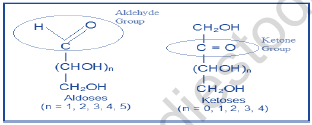
The Aldoses, which contain an aldehyde group (-CHO).
The Ketoses, which contain a ketone group (>C=O).
 
NEET Chemistry Biomolecules Revision Notes
 
NEET Chemistry Biomolecules Revision Notes1
 
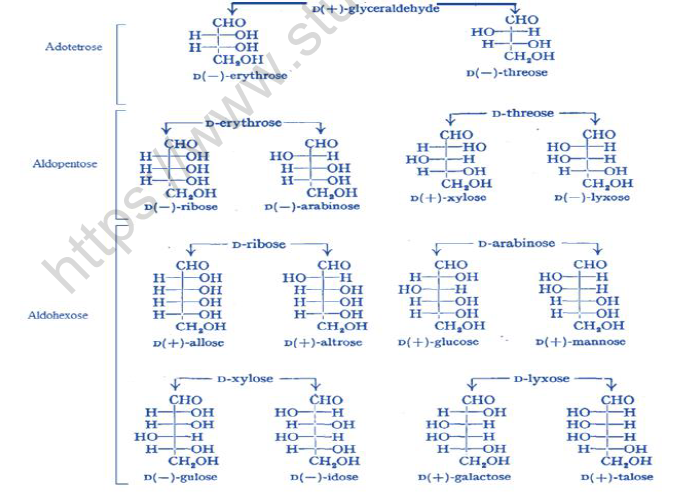
Stereo Isomerism in Carbohydrates:
 
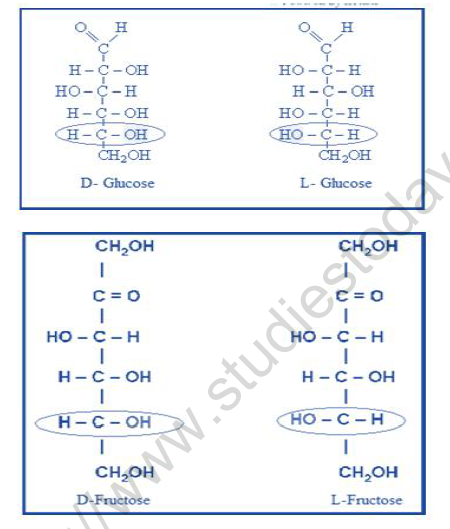
• If the hydroxyl group on the asymmetric carbon atom farthest from aldehyde or ketone group projects to the right, the compound is a member of the D-family.
 
• If the hydroxyl group on the farthest asymmetric carbon projects to the left, the compound is a member of theL-family.
 
NEET Chemistry Biomolecules Revision Notes2
 
• Maximum Number of Optical Isomers = 2n, where n = the number of asymmetric carbon atoms.
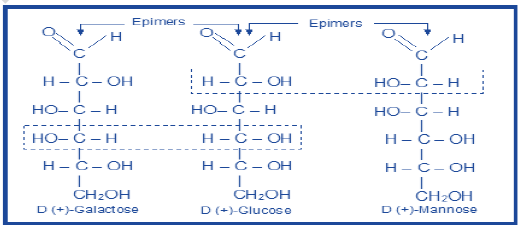
•  Epimer: A pair of diastereomers that differ only in the configuration about of a single carbon atom are said to be epimers.
 
NEET Chemistry Biomolecules Revision Notes3
 
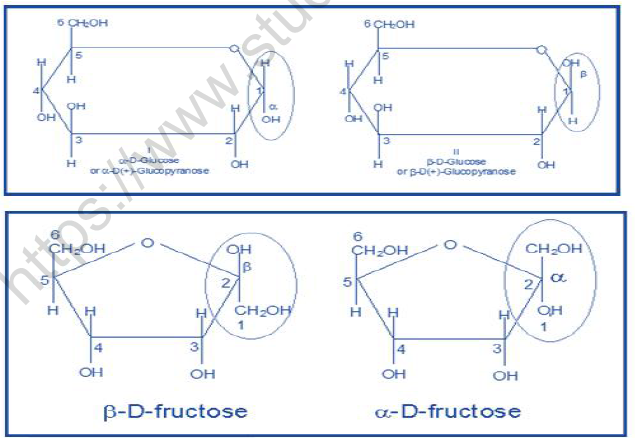
Cyclic Form of Monosaccharide:
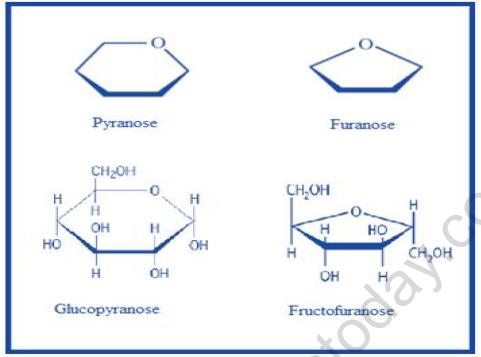
• Pyranose and Furanose Forms:
NEET Chemistry Biomolecules Revision Notes4
 
• Anomers: Pair of stereoisomers which differ in configuration only around C1 are called anomers and the C1carbon is called Anomeric carbon.In a- anomer-, the OH group at C1 is towards right while in b-anomer, the OH group at C1 is toward
NEET Chemistry Biomolecules Revision Notes5
 
Mutarotation:
 
Change in rotation of an optically active sugar in solution with time, to an equilibrium value, is calledmutarotation. During mutarotation, the ring opens and then recloses either in the inverted position or in the original position giving a mixture of a-and-b-forms.
 
Reactions of Glucose:
 
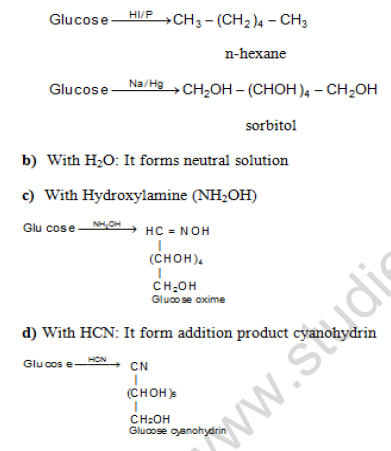
a) With HI/P: It undergoes reduction to form n-hexane while with sodium amalgam it forms orbitol.
 
NEET Chemistry Biomolecules Revision Notes Reaction
 
e) Oxidation: Glucose on oxidation with Br2 gives gluconic acid which on further oxidation with HNO3 gives glucaric acid.
f) With Tollen reagent and Fehling solution. Glucose forms silver mirror and red ppt. of Cu2O respectively.
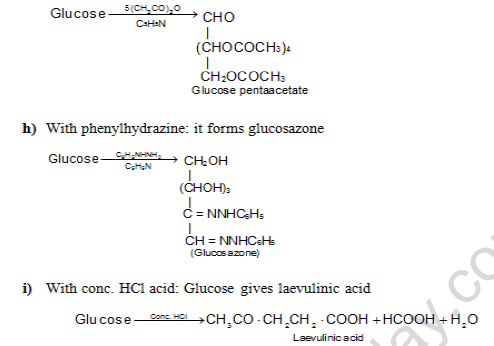
g) With acetic anhydride. In presence of pyridine glucose forms pentaacetate.
 
NEET Chemistry Biomolecules Revision Notes Reaction2
 
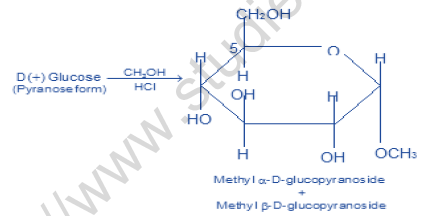
j) Glycoside formation: When a small amount of gaseous HCl is passed into a solution of D (+) glucose in methanol , a reaction takes place that results in the formation of amomeric methyl acetals.
 
NEET Chemistry Biomolecules Revision Notes Reaction3
 
Carbohydrate acetals, genrally are called glycosides and an acetal of glucose is called glucoside.
 
k) Kiliani - Fischer Synthesis: - This is a method of lengthening the carbon chain of an aldose.
 
NEET Chemistry Biomolecules Revision Notes Reaction4
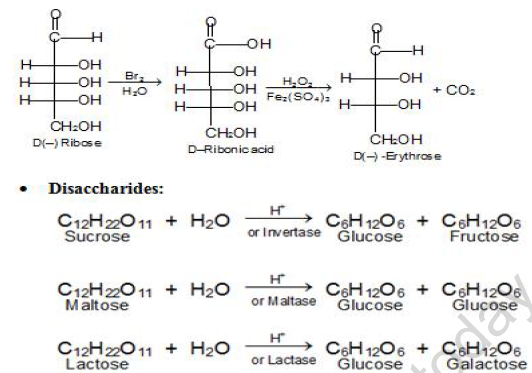
i) Ruff Degradation: It is opposite to Kiliani Fischer synthesis that can be used to shorten the chain by a similar unit.
NEET Chemistry Biomolecules Revision Notes Reaction5
 
 
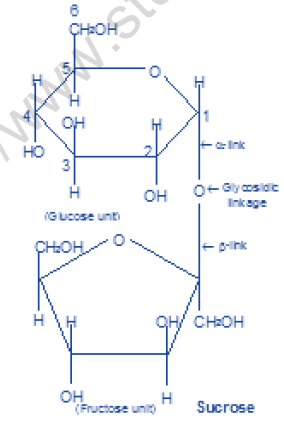
a) Sucrose:
 
Non-reducing sugar.
Formed by condensation of one molecule of glucose and one molecule of fructose.
NEET Chemistry Biomolecules Revision Notes Reaction6
 
 
Hydrolysis: (Invert Sugar or Invertose). Hydrolysis of sucrose with hot dilute acid yields D-glucose and D-fructose.
 
 
Polysaccharides
 
a. Starch:
 
i. A polymer of glucose.
ii. Mixture of two components – a water soluble component called amylose (20%) and a water
insoluble component called amylopectin (80%).
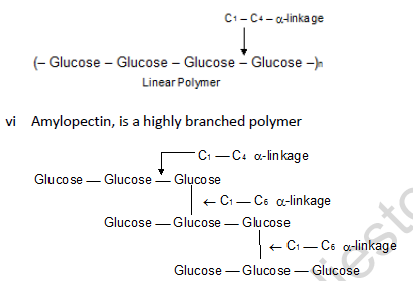
iii. Both amylose and amylopectin are polymers of a-D-glucose.
iv. Amylose is a linear polymer of a-D-glucose
 
NEET Chemistry Biomolecules Revision Notes Reaction7
 
Amino Acids,
 
Amino acids are molecules, which contain two functional groups, one is carboxylic group and another is amino group
H2N CH2 COOH : Amino acetic acid, or Glycine
CH3 CH (NH2) COOH : a - Amino propionic acid or Alanine
H2N CH2 CH2COOH : b - Amino propionic acid
 
Acidic Amino Acid: These amino acids contain a second carboxyl group or a potential carboxyl group in the form of carboxamide.
 
Basic Amino Acids: These contain a second basic group which may be an amino group
 
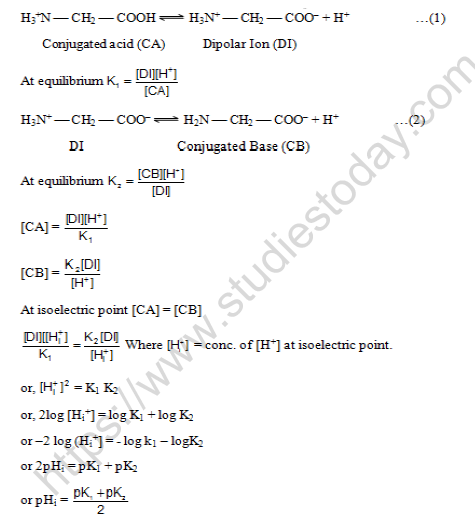
Iso Electric Point:
 
The hydrogen ion concentration of the solution in which a particular amino acid does not migrate under the influence of an electric field is called the isoelectric point of that amino acid.
 
Peptides
A peptides as the amides formed by interaction between amino groups and carboxyl groups of amino acids.
 
NEET Chemistry Biomolecules Revision Notes Reaction8
 
Depending upon the number of amino acid residues per molecule, they are known as dipeptides, tripeptides and so on and finally polypeptides.
 
Every two amino acids are linked by means of a –CO-NH group, which is commonly referred as peptide bond.
 
NEET Chemistry Biomolecules Revision Notes Reaction9

NEET Full Course Biomolecules Biomolecules Notes

Students can use these Revision Notes for Biomolecules to quickly understand all the main concepts. This study material has been prepared as per the latest NEET syllabus for Full Course. Our teachers always suggest that Full Course students read these notes regularly as they are focused on the most important topics that usually appear in school tests and final exams.

NCERT Based Biomolecules Summary

Our expert team has used the official NCERT book for Full Course Biomolecules to design these notes. These are the notes that definitely you for your current academic year. After reading the chapter summary, you should also refer to our NCERT solutions for Full Course. Always compare your understanding with our teacher prepared answers as they will help you build a very strong base in Biomolecules.

Biomolecules Complete Revision and Practice

To prepare very well for y our exams, students should also solve the MCQ questions and practice worksheets provided on this page. These extra solved questions will help you to check if you have understood all the concepts of Biomolecules. All study material on studiestoday.com is free and updated according to the latest Biomolecules exam patterns. Using these revision notes daily will help you feel more confident and get better marks in your exams.

Where can I download the latest PDF for NEET Chemistry Biomolecules Revision Notes?

You can download the teacher prepared revision notes for NEET Chemistry Biomolecules Revision Notes from StudiesToday.com. These notes are designed as per 2025-26 academic session to help Full Course students get the best study material for Biomolecules.

Are these Biomolecules notes for Full Course based on the 2026 board exam pattern?

Yes, our NEET Chemistry Biomolecules Revision Notes include 50% competency-based questions with focus on core logic, keyword definitions, and the practical application of Biomolecules principles which is important for getting more marks in 2026 NEET exams.

Do these Full Course notes cover all topic-wise concepts for Biomolecules?

Yes, our NEET Chemistry Biomolecules Revision Notes provide a detailed, topic wise breakdown of the chapter. Fundamental definitions, complex numerical formulas and all topics of NEET syllabus in Full Course is covered.

How can I use NEET Chemistry Biomolecules Revision Notes for quick last-minute revision?

These notes for Biomolecules are organized into bullet points and easy-to-read charts. By using NEET Chemistry Biomolecules Revision Notes, Full Course students fast revise formulas, key definitions before the exams.

Is there any registration required to download Full Course Biomolecules notes?

No, all study resources on StudiesToday, including NEET Chemistry Biomolecules Revision Notes, are available for immediate free download. Full Course Biomolecules study material is available in PDF and can be downloaded on mobile.