

Official Class 7 Science Worksheets: Chapter 01 Nutrition in Plants
Explore structured practice materials through the CBSE Class 7 Science Nutrition In Plants Worksheet. Tailored for Class 7 learners, utilizing these Science worksheets ensures thorough preparation and strengthens problem-solving accuracy before final school evaluations.
Solved Practice Worksheets for Science
Navigate directly to the solved Science worksheets using the digital viewer below. Each practice set includes detailed step-by-step solutions, allowing students to instantly cross-check their work and identify areas requiring further revision.
Learn and write the following questions and answers.
Question 1: What are the components of food?
Answer: Carbohydrates, proteins, fats, vitamins and minerals are the components of food.
Question 2: What is nutrition?
Answer: The process of utilization of food by a living organism to obtain energy is called nutrition.
Questions 3: What is autotroph?
Answer: Organisms that make their food themselves are called autotrophs.
Question 4: What is autotrophic mode of nutrition?
Answer: The mode of nutrition in which the organism makes its own food is called autotrophic mode of nutrition.
Question 5: Give some example of autotrophs.
Answer: All green plants, such as grass, mango, bougainvillea, etc. are the examples of autotrophs. Some bacteria also show autotrophic nutrition.
Question 6: What is heterotrophic mode of nutrition?
Answer: The mode of nutrition in which an organism takes food from another organism is called heterotrophic mode of nutrition. The nutrition in animals and non-green plants is the example of heterotrophic mode of nutrition.
Question 7: Give examples of Heterotrophs.
Answer:Animals and non green plants are the examples of heterotrophs.
Question 8: What are saprotrophs?
Answer:Organisms which get their nutrition from dead or decaying plants in liquid form are called saprotrophs.
Question 9: What is the ultimate source of energy?
Answer: Sun is the ultimate source of energy.
Question 10: Why do farmers add nitrogenous fertilizers to the soil?
Answer: Farmers add nitrogenous fertilizers to the soil to fulfill the requirement of nitrogen of the plants. Nitrogen is necessary to synthesize proteins.
1.If the pitcher plant is green and carries out photosynthesis then why does it feed on insects?
2.Which of the following part/s of a desert plant perform the function of photosynthesis?
(A) Leaves.
(B) Stem.
(C) Both (a) and (b).
(D) None of these.
3.The green coloured pigment in the leaves is-
(A) Chlorophyll.
(B) Anthocyanin.
(C) Protoplast.
(D) Chloroplast.
4.Which of the following is a parasitic plant?
(A) Cuscuta
(B) Algae
(C) Pitcher plant
(D) Lichen
5.Saprophytic mode of nutrition is found in-
(A) Lichens.
(B) Pitcher.
(C) Mushroom.
(D) Cuscuta.
6.Which of the following is the function of stomata?
(A) Carbon dioxide enters the leaf through stomata.
(B) Nitrogen discharges into the atmosphere from the leaf through stomata.
(C) Food material synthesised in the leaf is discharged into the atmosphere from the leaf through
stomata.
(D) Oxygen enters the leaf through stomata.
7.Which of the following raw material is not necessary for photosynthesis?
(A) CO2
(B) H2O
(C) Sunlight
(D) Nitrogen
8.Name a plant that has both autotrophic as well as heterotrophic mode of nutrition.<
9.Name the pores through which leaves exchange gases.
10.What is a lichen?
11.Which of the following statement is false?
(A) Green plants are autotrophs.
(B) Photosynthesis takes place mostly in green leaves which contain green pigment, chlorophyll inside
chloroplasts.
(C) Non-green plants and animals are heterotrophs.
(D) Photosynthesis does not take place in deep red, violet or brown leaves.
12.Which of the following is not true about saprophytic plants?
12.Which of the following is not true about saprophytic plants?
(A) These plants are green in colour.
(B) These plants are commonly seen during and after rain.
(C) Yeast shows saprophytic mode of nutrition.
(D) These plants secrete digestive juices on the dead and decaying organic matter.
13.Pitcher plant is green in colour but it eats insects to complete the requirement of-
(A) Water.
(B) Carbon dioxide.
(C) Nitrogen.
(D) Oxygen.
14.Why our body cannot make food from carbon dioxide , water and minerals like plants do? <$>
<What is so special about the leaves that they can synthesize food a=but other parts of the plant cannot
15.Why our body cannot make food from carbon dioxide , water and minerals like plants do?
16.The bacterium calledcan take atmospheric nitrogen and convert it into a soluble form called
17.During photosynthesis plants take in .............. and release.................
18.In photosynthesis solar energy is captured by the pigment called
19.Green plants are called since they synthesise their own food.
20.Why fungi have a different mode of nutrition ?
21.Why insectivorous plants eat insects ?
22.Why only plants can make their food ?
23.Why all living organisms require food ?
24.What is the stored form of carbohydrates in plants?
25.During photosynthesis, carbohydrates get converted to-
(A) Proteins.
(B) Starch.
(C) Carbohydrates.
(D) All of them.
26.Identify 'X' in the following reaction :
CO2+Water light/chorophyll X + Oxygen
(A) Vitamin.
(B) Protein.
(C) Carbohydrate.
(D) Minerals.
27.Why in the rainy season does a loaf of bread turn blue, brown or greenish?
28.In lichen, which of the following is autotrophic?
(A) Algal partner.
(B) Fungal partner.
(C) Both (a) and (b).
(D) None of these.
29.Slimy green patches are formed in ponds by-
(A) Fungi.
(B) Algae.
(C) Bacteria.
(D) Lichens.
30.Living organisms are made up of tiny units called-
(A) Nucleus.
(B) Cell.
(C) Cytoplasm.
(D) Cell membrane.
31.Which of the following does not help in providing nitrogen to the soil?
(A) Peas
(B) Gram
(C) Beans
(D)Wheat
32.Which of the following requires nitrogen for its synthesis?
(A) Carbohydrates
(B) Proteins
(C) Fats
(D) Vitamins
33.Two different organisms living together and both benefitted from each other, are known as-
(A) Saprophytic.
(B) Symbiotic.
(C) Parasitic.
(D) Heterotrophs.
34.Photosynthesis is a-
(A) Natural process.
(B) Chemical process.
(C) Natural chemical process.
(D) Physical process.
35.Which of the following season provides ideal conditions for a fungi to grow?
(A) Cold weather.
(B) Rainy season.
(C) Hot and humid weather.
(D) Both (B) and (C).
36.Which of the following is correct?
(A) Fungi like yeast and mushrooms are useful.
(B) Some fungi cause diseases in plants.
(C) Some fungi are also used in medicines.
(D) All of these.
37.Stomata is surrounded by-
(A) Guard cells.
(B) Chlorophyll.
(C) Carbohydrates.
(D) None of them.
38.Which one of the following organisms is a producer?
(A) Yeast.
(B) Cow.
(C) Grass.
(D) Paramecium.
39.Farmers need to add nitrogenous fertilizers to the soil in which-
(A) Moong beans are grown.
(B) Peas are grown.
(C) Gram is grown.
(D)Wheat is grown.
40.Which of the following is a false statement?
(A) Rhizobium can take atmospheric nitrogen and convert it into a soluble form.
(B) Though nitrogen gas is available in plenty in the air, plants cannot use it in the manner they can use carbon dioxide.
(C) Plants need nitrogen in a soluble form.
(D) Rhizobium feed on atmospheric nitrogen.
41.Match the given terms in list I with their definitions in list II:
I. Nutrition A. Organism deriving its food from dead and decaying plants and animals.
II. Parasite B. Association of two different organisms in which both are benefitted.
III.Saprophyte C. Process of obtaining and utilising food.
IV. Symbiosis D. Organism that derives its food from the living body of another organism.
(A) I-B, II-C, III-D, IV-A
(B) I-C, II-D, III-A, IV-B
(C) I-D, II-A, III-B, IV-C
(D) I-A, II-B, III-C, IV-D
<2M>
42.What is Autotrophic nutrition? Give example of autotrophs.
43.Write chemical equation of photosynthesis
44.How are nutrients replenished in the soil?
45.Why does the pitcher plant feed on insects though it is green?
46.What do you mean by Heterotrophs?
47.What are nutrients?
48.How do fungi appear suddenly during the rainy season?
49.What are autotrophs ?
50.What are cells ?
51.How do plants prepare their own food?
52.How would you test the presence of starch in leaves?
53.Define nutrition.
54.Why do organisms need to take food?
<3M>
55.What is the difference between a parasite and a saprotroph? Give example.
56.What is photosynthesis?
<5M>
57.Why are leaves called the food factories of plants? Explain.
Q1 Define Nutrients?
Q2 Why do organisms need to take food?
Q3 What are the essential components of food?
Q4 What are the different modes of nutrition. Explain by making the flow chart?
Q5 Why our body cannot make food from carbon dioxide and water like plants?
Q6 What is the ultimate source of energy for all the living organisms?
Q7 Which organ is known as food factories of the plant. Why?
Q8 How water and minerals absorbed by the roots of the plants reach the leaves?
Q9 Explain the process of photosynthesis in plants along with the diagram?
Q10 Name the pigment present in the leaves that captures sunlight?
Q11 Draw a well labeled diagram of a) section of a leaf b) stomata
Q12 Can plants with leaves other than green carry out photosynthesis. Justify your answer?
Q13 Explain the mode of nutrition in algae?
Q14 How can you test the presence of starch in the leaves?
Q15 Differentiate betweena)
Host and parasite
b) Saprophytes and parasite
c) Fungi and algae
Q16 Some plants show heterotrophic mode of nutrition. Justify your answer by giving an example.
Q17 Identify the mode of nutrition in
a) Mushroom
b) Cuscuta
c) Leech
d) Tapeworm
e) bacteria
f) Yeast
f) Ticks
Q17 Explain the different types of heterotrophic nutrition?
Q18 With which group of plants ,Rhizobium is assosciated and what is its role?
Q19 What is a symbiotic mode of nutrition .Give its example.
Q20 Lichens show symbiotic mode of nutrition. Justify your statement.
Q21 What are the favourable conditions for the growth of fungus?
Q21 During rainy season your shoes get spoiled .Why?
Q22 Fungi can be useful as well as harmful.Comment.
Q23 How do saprophytes obtain their nourishment?
Q24 What are the three ways by which nutrients are replenished in the soil?
Q25 What are stomata? What is its role?
Q26 If a farmer is growing leguminous plant in his field ,he does not have to add nitrogen fertilizers to the soil .Why?
Q27 What are insectivorous plants? Give its example.
Q28 Human beings are autotroph as they cook their food using different ingredients. Is this true?
Justify your answer.
Q29 How does a pitcher plant gets its nutrition?
Q30 Describe the ways by which green plants procure all the raw materials required for photosynthesis.
Learn and write the following key words –
1 Autotrophs – Organisms that can make their food from simple inorganic substances.
2 Heterotrophs - Organisms that cannot make their food and depend on green plants for their food.
3 Saprophytes- Plants which derive their food from dead and decaying g organic matter.
4 Parasites- Organisms that derive their food from the body of host plant or animal.
5 Insectivorous plants- green plants which make their own food but depend on insects for nitrogenous food.
6 Symbionts- two plants which live together as part of the same plant and mutually help each other.
7 Symbiosis – the mode of nutrition in which two different organisms work together for their mutual benefit.
8 Photosynthesis - the process by which green plants make their food.
9 Herbivores- the animals which eat only grass, plants or plant products are called herbivores. ex-cow, goat etc.
10 Carnivores-The animals which eat meat or flesh of the other animals are called carnivores. ex –lion, frog etc.
11 Omnivores- the animals which eat both plants and meat are called omnivores. ex –crow, dog etc.
Read the following paragraph and answer the questions -
The process by which green plants make their food from carbon dioxide and water in the presence of sunlight and chlorophyll is called photosynthesis. The basic products formed during photosynthesis are glucose and oxygen.
Q1 The gas which is used in the process of photosynthesis.
Answers : Carbon dioxide
Q2 The gas which is produced in the process of photosynthesis.
Answers : Oxygen
Q3 Name the factors which are important for the process of photosynthesis.
Answers : Co2 ,water, solar energy and chlorophyll in leaves
Q4 Describe the role of leaves in photosynthesis.
Answers : Photosynthesis occurs mostly in leaves .The inner structure of the leaf shows two important features- 1 Presence of chlorophyll containing cells.,2 Presence of stomata CO2 enters a leaf through these pores
Q5 Name the factors which affect the process of photosynthesis.
Answers : Light intensity, Temperature and poor availability of CO2 and water
Name the following :
1. A plant pigment that absorbs sunlight.
2. Small openings on leaves.
3. Part of a plant where photosynthesis generally occurs.
4. A plant that eats insects is called as this .
5. The process by which plants and some bacteria use the energy from sun to produce carbohydrates.
6. The cells which form stomata.
7. The raw materials required for photosynthesis.
8. The gas released during photosynthesis.
9. The raw materials required for photosynthesis?
10. Name the elements of which carbohydrates are made up of?
Fill in the blanks:
1. The entire process of taking in food and using it for growth and maintenance of the body by the living organisms is called------------
2. The relationship in which the both the types of plants mutually gain from each other is called --------
3. ------------is an association between a fungus and an algae.
4. During photosynthesis , plants obtain carbon di oxide from the atmosphere through-------------.
5. ------------plants grow in places with lot of rotting places.
Ans the following:-
1. What are nutrients ? Give examples.
2. What is nutrition? Name the major modes of nutrition.
3. Differentiate between autotrophs and heterotrophs.
4. What is photosynthesis? Write equation for photosynthesis.
5. Where are stomata located? Write two important functions performed by stomata.
6. How are the minerals and water reach the leaves from the roots?
7. How does chlorophyll help in the process of Photosynthesis?
8. How do we test the presence of starch in the leaves?
9. Draw and label a neat diagram of stomata.
10.What are algae? Are they autotrophs?
11. How do plants obtain nitrogen to synthesise proteins?
12. What mode of nutrition is found in cuscuta and why?
13. efine host and parasite?
14. What are insectivorous plants? How do they obtain food?
15. Name the white cottony growth that develops on the rotting bread.
16. What is saprotrophic mode of nutrition?
17. What is symbiosis? Illustrate.
18. Why do farmers add fertilizers to the soil?
19. What is Rhizobium? Name four leguminous crops
20. How are leguminous crops and Rhizobium related to each other?
Learn and write the following questions and answers-
Question 1: Why do organisms need to take food?
Answer: Organisms need to take food so that they can get raw material for growth and repair and can get energy for carrying out various activities.
Question 2: Distinguish between a parasite and a saprotroph.
Answer: A parasite lives on or inside the body of another organism; to get shelter and food. A parasite lives on a live host. On the other hand, a saprotroph feeds on dead and decaying remains of animals and plants.
Question 3: How would you test the presence of starch in leaves?
Answer: Steps to test the presence of starch in leaves:
● Boil the leaf in water for about 10 minutes.
● After that, boil the leaf in alcohol; over water bath.
● Wash the boiled leaf with cold water and spread on a flat surface.
● Pour a few drops of iodine on the leaf. If the iodine turns into dark blue colour, it shows the presence of starch in the leaf.
Question 4: Give a brief description of the process of synthesis of food in green plants.
Answer: Photosynthesis is the process by which green plants make food. Green plants trap solar energy with the help of chlorophyll. Water and carbon dioxide are the raw materials, which are converted into carbohydrates; during the process. Oxygen is the byproduct of photosynthesis. This can be shown by the following equation: 6CO2 + 6H2O → C6H12O6 + 6O2
Question 4: How do nutrients get replenished in the soil?
Answer: There are two main means through which nutrients get replenished in the soil. One of them is the nitrogen fixation in soil. Nitrogen fixation replenishes nitrogenous nutrients in the soil. Another mean is decomposition of dead remains of plants and animals (or farm waste). Decomposition of dead remains replenishes various other nutrients in the soil.
Question 5: What is the meaning of word ‘Symbiosis’?
Answer: It is a relationship between two organisms in which both the organisms benefit each other.
Question 6: What is Lichen?
Answer: The lichen is a composite organism formed because of symbiosis of algae and fungi.
Question 7: What do you understand by saprotrophs?
Answer: An organism which feed on dead and decaying material is called a saprotroph. In this mode of nutrition, digestive enzymes are secreted on the food. The digested food is then absorbed by the organism. In saprotrophs digestion takes place outside the body of the organism.
Question 8: What is an insectivorous plant?
Answer: A plant which fulfills its nitrogenous needs by eating insects is called an insectivorous plant.
Question 9: Give an example of insectivores plant?
Answer: Pitcher plant, Venus Fly trap, Bladderwort, Drosera, Rafflesia
Question 10: Why does a plant eat insects?
Answer: Plants living in marshy areas do not get nitrogen from the soil. To fulfill their nitrogenous need, they need to eat insects.
Nutrition in Plants
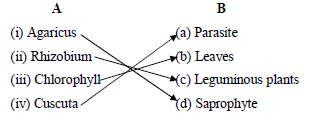
Question 3- Match the Following:
More question-
I) Fill in the blanks:
1. The components of food which are necessary for our body are called _______________
2. Green plants synthesise their own food themselves by the process of __________________.
3. ______________________ is the mode of taking food by an organism and its utilization by the body.
4. Complex chemical substances such as ______________ are the products of photosynthesis.
5. ___________________ gas is produced during photosynthesis.
6. Organisms that are dependent on others for their nutrition are called ______________________
7. _________________ are the tiny pores present on the surface of the leaves and are surrounded by guard cells.
8. ____________________is the ultimate source of energy for all living organisms.
9. Organisms which derive their nutrition from dead decaying matter are called _______________.
10. Some organisms live together and share shelter and nutrients, this is called _____________________.
11. Carbohydrates are made up of _________,__________ and __________.
II) Name the following :
1. A bacterium that can take atmospheric nitrogen and convert it into a soluble form.
2. An insectivorous plant.
3. The mode of nutrition in mushrooms.
4. The indicator used to test the presence of starch in leaves.
III) Write True or False :
1. Some fungi are used in medicines.[ ]
2. Most of the pulses are obtained from leguminous plants. [ ]
3. Cuscuta (Amarbel) is a host.[ ]
4. Lichens, an alga and a fungus show symbiotic relationship. [ ]
5. In desert plants, green stems carry out photosynthesis.[ ]
IV) Define the following
1. Autotrophs
2. Saprotrophs
3. Heterotrophs
4. Nutrition
V) Diagrams :
1. Cell
2. Photosynthesis in plants.
FILL IN THE BLANKS:
Question 1. ____________________ are the food factories of the plant.
Answer: Leaves
In simple words: Leaves make food for the plant using sunlight, water, and carbon dioxide.
Exam Tip: Remember that leaves contain chlorophyll which traps solar energy.
Question 2. Tiny pores present on the surface of leaves are called ____________________.
Answer: Stomata
In simple words: Stomata are tiny openings that allow plants to take in and release gases.
Exam Tip: Stomata are typically surrounded by guard cells that control their opening and closing.
Question 3. Carbohydrates are made of ____________________, ____________________ and ____________________.
Answer: Carbon, hydrogen, oxygen
In simple words: These three chemical elements combine during photosynthesis to form carbohydrates.
Question 4. ____________________ derive their food from the dead and decaying matter.
Answer: Saprotrophs (or Saprophytes)
In simple words: Organisms like fungi feed on rotting organic material to get their nutrition.
Exam Tip: Do not confuse saprotrophs with parasites, which feed on living hosts.
Question 5. Two e.g. for useful fungi are ____________________ and ____________________.
Answer: Yeast and Penicillin (or Mushroom)
In simple words: Yeast helps in baking and brewing, while Penicillin is used to make life-saving antibiotics.
Exam Tip: Give common examples that are widely recognized as beneficial rather than disease-causing.
Question 6. The bacteria ____________________ converts atmospheric nitrogen into a soluble form.
Answer: Rhizobium
In simple words: Rhizobium bacteria live in the roots of leguminous plants and fix nitrogen from the air into the soil.
Exam Tip: Rhizobium has a symbiotic relationship with leguminous plants like gram, peas, and beans.
Question 7. The limiting layer or thin outer boundary of a cell is called as the ____________________.
Answer: Cell membrane
In simple words: The cell membrane surrounds and protects the contents inside a living cell.
Exam Tip: Plant cells have an additional rigid outer covering called the cell wall outside the cell membrane.
CORRECT THE FALSE STATEMENT GIVEN BELOW:
Question 1. Photosynthesis takes place only in green leaves.
Answer: Photosynthesis takes place not only in green leaves but also in other green parts of plants such as green stems and green branches.
In simple words: Any plant part that contains chlorophyll can perform photosynthesis.
Exam Tip: Mention desert plants like cacti where stems turn green and take over the function of leaves.
Question 2. All animals are autotrophic in nutrition.
Answer: All animals are heterotrophic in nutrition.
In simple words: Animals cannot make their own food and depend directly or indirectly on plants.
Exam Tip: Autotrophic nutrition is restricted mainly to green plants and some bacteria.
Question 3. In desert plants flowers are reduced to spines.
Answer: In desert plants leaves are reduced to spines.
In simple words: Desert plants modify their leaves into spines to reduce water loss through transpiration.
Exam Tip: Distinguish carefully between flowers, leaves, and stems when describing plant adaptations.
NAME THE FOLLOWING:
Question 1. Green coloured pigment in plants.
Answer: Chlorophyll
In simple words: Chlorophyll gives plants their green color and traps sunlight for food production.
Exam Tip: Spell chlorophyll correctly as it is a key biological term in this chapter.
Question 2. Food preparing process in plants.
Answer: Photosynthesis
In simple words: Photosynthesis is the process by which green plants make food using carbon dioxide and water in the presence of sunlight.
Exam Tip: 'Photo' means light and 'synthesis' means to combine.
Question 3. Jelly like substance present inside a cell.
Answer: Cytoplasm
In simple words: Cytoplasm is the fluid matrix enclosed by the cell membrane where cell organelles are embedded.
Exam Tip: Do not confuse cytoplasm with the nucleus or cell membrane.
Question 4. Microscopic units which make up the bodies of living organisms.
Answer: Cells
In simple words: Cells are the basic structural and functional units of all living things.
Exam Tip: Cells can only be seen under a microscope.
Question 5. Limiting layer of a cell.
Answer: Cell membrane
In simple words: The cell membrane forms the outer boundary that holds the cell contents together.
Exam Tip: Keep in mind that plant cells also possess a thick cell wall.
Question 6. The gas released during photosynthesis.
Answer: Oxygen
In simple words: Plants release oxygen into the atmosphere as a byproduct of making food.
Exam Tip: This oxygen is essential for the respiration of all aerobic organisms.
Question 7. Stored form of carbohydrates.
Answer: Starch
In simple words: Plants store extra food in the form of starch in their leaves and other parts.
Exam Tip: The presence of starch in leaves indicates the occurrence of photosynthesis.
Question 8. The gas which forms the major constituent of air.
Answer: Nitrogen
In simple words: Nitrogen makes up about 78 percent of Earth's atmosphere.
Exam Tip: Although abundant in air, plants cannot use atmospheric nitrogen directly without fixation.
Question 9. Nitrogenous substances which contain nitrogen.
Answer: Proteins
In simple words: Proteins are nitrogenous organic compounds essential for body building and repair.
Exam Tip: Animals and plants need nitrogen primarily to synthesize proteins.
Question 10. Two e.g. for animal parasite which suck human blood.
Answer: Mosquito and Leech (or Tick / Bedbug)
In simple words: Parasitic animals feed directly on the blood of living host organisms.
Exam Tip: Give precise biological examples of external parasites (ectoparasites).
CHOOSE THE CORRECT ANSWER:
Question 1. Fungi are
(a) Cotton-like threads spread on a piece of bread.
(b) Fluffy umbrella-like patches growing on rotten wood.
(c) Also used in medicines.
(d) All of the options.
Answer: (d) All of the options.
Fungi exhibit various forms such as bread moulds, mushrooms, and medicinal strains like Penicillium.
In simple words: All these statements correctly describe different forms and uses of fungi.
Exam Tip: Fungi are heterotrophic organisms that grow in warm and humid places.
Question 2. Prominent, spherical, centrally located structure inside a cell is
(a) Cytoplasm
(b) Nucleus
(c) Cell membrane
(d) Nucleolus
Answer: (b) Nucleus
The nucleus is a prominent, spherical structure usually located in the center of a cell, controlling its activities.
In simple words: The nucleus acts as the control center of the cell.
Question 3. The plant on which a Cuscuta climbs is called a
(a) Host
(b) Parasite
(c) Saprophyte
(d) Bryophyte
Answer: (a) Host
Cuscuta is a parasitic plant that climbs on another living plant, known as the host, to derive ready-made food.
In simple words: The host is the organism that provides food and shelter to a parasite.
Exam Tip: Cuscuta does not have chlorophyll; hence it depends entirely on the host plant.
Question 4. The fungal spores are generally present in the
(a) Air
(b) Water
(c) Soil
(d) All of the options
Answer: (a) Air
Fungal spores float continuously in the air and germinate when they land on wet and warm surfaces.
In simple words: Spores are tiny reproductive particles that travel freely through the air.
Exam Tip: Although spores can settle on soil or water, they are famously suspended and spread through the air.
Question 5. Usually crops require a lot of ____________________ to make proteins.
(a) Potassium
(b) Phosphorus
(c) Nitrogen
(d) None of the options
Answer: (c) Nitrogen
Crops require a large amount of nitrogen to synthesize proteins for their growth and development.
In simple words: Nitrogen is an essential nutrient required by plants for protein synthesis.
Exam Tip: Farmers frequently add fertilizers rich in nitrogen to enrich depleted soil.
GIVE REASON:
Question 1. Leaves and green parts of a plant can only synthesise food. Why?
Answer: Leaves and green parts of plants contain a specialized green pigment called chlorophyll, which is essential for trapping solar energy. Without chlorophyll, solar energy cannot be captured to convert carbon dioxide and water into carbohydrates.
In simple words: Only green parts have chlorophyll to trap sunlight needed for making food.
Exam Tip: Mention chlorophyll and sunlight capture as the primary reasons for this restriction.
Question 2. Plants with red, violet & brown also carry out photosynthesis. How?
Answer: These plants contain chlorophyll just like green leaves do. However, the large amount of red, brown, or other pigments masks the green color of chlorophyll. Photosynthesis still takes place inside these leaves using that hidden chlorophyll.
In simple words: Other pigments hide the green color, but chlorophyll is still present inside the leaves to make food.
Exam Tip: Color does not determine photosynthesis; the presence of chlorophyll does.
Question 3. Fungi appear suddenly during rainy season. How?
Answer: Fungal spores are generally floating freely in the air. When they land on wet, warm, and organic surfaces during the rainy season, they find ideal conditions of moisture and temperature to germinate and grow rapidly.
In simple words: Rain and warmth provide the perfect environment for airborne spores to grow quickly.
Exam Tip: Connect spore germination with warm and humid weather conditions.
Question 4. Saprotrophs cannot make their food by photosynthesis. Why?
Answer: Saprotrophs completely lack chlorophyll and cannot trap solar energy. Therefore, they are incapable of manufacturing their own food through photosynthesis and must absorb nutrients from dead and decaying matter.
In simple words: They lack chlorophyll, so they feed on dead matter instead of making food from sunlight.
Exam Tip: Highlight the absence of chlorophyll as the fundamental reason.
ANSWER THE FOLLOWING
Question (a) Identify the plant given.
Answer: Pitcher plant (Nepenthes)
In simple words: The plant shown in the diagram is the insectivorous pitcher plant.
Exam Tip: Recognize the pitcher-shaped leaf modification designed to trap insects.
Question (b) Pitcher like structure is the modified part of a ____________________.
Answer: Leaf
In simple words: The apex of the leaf forms a lid and the lamina forms the pitcher tube.
Exam Tip: Remember that the pitcher is a modified leaf, not a separate floral organ.
Question (c) If the pitcher plant is green and carries out photosynthesis, then why does it feed on insects?
Answer: Pitcher plants grow in soil that is deficient in nitrogen. Although they prepare their own carbohydrates through photosynthesis, they consume insects to fulfill their nitrogen requirement for protein synthesis.
In simple words: They eat insects to get nitrogen, which is missing in the soil where they grow.
Exam Tip: Clarify that insectivorous plants are autotrophs for carbohydrates but heterotrophs for nitrogen.
(OR)
Question Why are insectivorous plants called as partial heterotrophs?
Answer: Insectivorous plants are called partial heterotrophs because they possess chlorophyll and can manufacture their own food by photosynthesis like autotrophs, but they also capture and digest insects to obtain essential nitrogen nutrients like heterotrophs.
In simple words: They make their own food using sunlight but depend on insects for nitrogen, making them both autotrophic and heterotrophic.
Exam Tip: Use the term 'partial heterotroph' when explaining plants that combine both modes of nutrition.
Free study material for Science
CBSE Class 7 Science Worksheets for Chapter 01 Nutrition in Plants
Mastering Chapter 01 Nutrition in Plants with Printable Worksheets
Review targeted practice exercises for Class 7 Science Chapter 01 Nutrition in Plants. Curated to match official CBSE guidelines, these printable problem sets support daily revision and improve overall test readiness.
Verified Solutions and NCERT Alignment
Each worksheet draws directly from authorized standard textbooks to maintain academic accuracy. Evaluating your finished exercises against expert-verified solutions helps master the formal presentation standards expected in school evaluations.
Additional Study Resources for Class 7 Science
Consistent engagement with these exercises builds familiarity with recurring exam themes. If specific areas within Chapter 01 Nutrition in Plants cause trouble, utilize our dedicated NCERT solutions for Class 7 Science to clear up doubts immediately.
FAQs
You can download the latest chapter-wise printable worksheets for Class 7 Science Chapter 01 Nutrition in Plants for free from StudiesToday.com. These have been made as per the latest CBSE curriculum for this academic year.
Yes, Class 7 Science worksheets for Chapter 01 Nutrition in Plants focus on activity-based learning and also competency-style questions. This helps students to apply theoretical knowledge to practical scenarios.
Yes, we have provided solved worksheets for Class 7 Science Chapter 01 Nutrition in Plants to help students verify their answers instantly.
Yes, our Class 7 Science test sheets are mobile-friendly PDFs and can be printed by teachers for classroom.
For Chapter 01 Nutrition in Plants, regular practice with our worksheets will improve question-handling speed and help students understand all technical terms and diagrams.