

Download Class 7 Science Practice Worksheets
Review targeted academic worksheets with the CBSE Class 7 Science Winds Storms And Cyclones Worksheet. Built according to official educational standards for the 2026-27 term, these downloadable Class 7 Science resources support effective daily practice and detailed self-evaluation for Chapter 08 Winds Storms and Cyclones.
Access Chapter 08 Winds Storms and Cyclones Practice Papers and Solutions
Access the complete worksheet PDF for Class 7 Science below. Regular practice with these targeted academic tasks builds familiarity with standard question patterns and helps secure higher marks in final school examinations.
winds, storms and cyclones
ACTIVITY- 8.1 : Air exerts pressure.
Question 1- The can gets crushed because of the atmospheric pressure. (True/False)
Answer- True.
Question 2- Air exerts pressure. (True/False)
Answer- True.
ACTIVITY- 8.2 : High speed winds are accompanied by reduced air pressure.
Question 1- Both balloons should be of equal size. (True/False)
Answer- True.
Question 2- The fast moving wind creates …….….pressure.
Answer- Low.
ACTIVITY- 8.3: Air expands on heating.
Question 1- The air ………on heating.
Answer- Expands.
Question 2- On cooling the boiling tube, the balloon expands. (True/False)
Answer- False.
ACTIVITY- 8.4: Hot air is lighter than Cold air.
Question 1- Hot air is ………..than cold air.
Answer- lighter.
Question 2- The paper cup over the burning candle comes down as it becomes heavier. (True/False)
Answer- False.
EXERCISE
1- Fill In The Blanks.
(i) Air exerts pressure.
(ii) Moving air is called wind.
(iii) Near earth the hot air rises up and cold air comes down.
(iv) Winds are generated due to uneven heating of earth.
(v) The centre of a cyclone is called its eye.
2- Write True Or False.
(i) A bicycle tube expands when we fill air in it. (True)
(ii) Air moves from a region of low pressure to high pressure. (False)
(iii) The speed of wind can be measured by an instrument called Anemometer. (True)
(iv) Thunder is a loud sound produced by lightening. (True)
(v) We should ignore the cyclone warning. (False)
3. Choose The Correct Answer.
Question. Which of the following is not an example of air exerting pressure:
a) Flying a kite
b) Filling air in bicycle tube
c) Filling air in balloon
d) Hot air balloon
Ans.d) Hot air balloon
Question. Moving air is called ………….
a) Wind
b) Cyclone
c) Lightening
d) Storm
Ans.a) Wind
Question. Which is the property of air:
a) Expands on cooling
b) Contracts on heating
c) Expands on heating
d) None of the above
Ans.c) Expands on heating
Question. Winds are produced due to:
a) Heating of air
b) Cooling of land
c) Heating of water
d) Uneven heating of land and water
Ans.d) Uneven heating of land and water
Question. High speed winds can cause:
a) Thunderstorms
b) Cyclones
c) Tornado
d) All of the above
Ans.d) All of the above
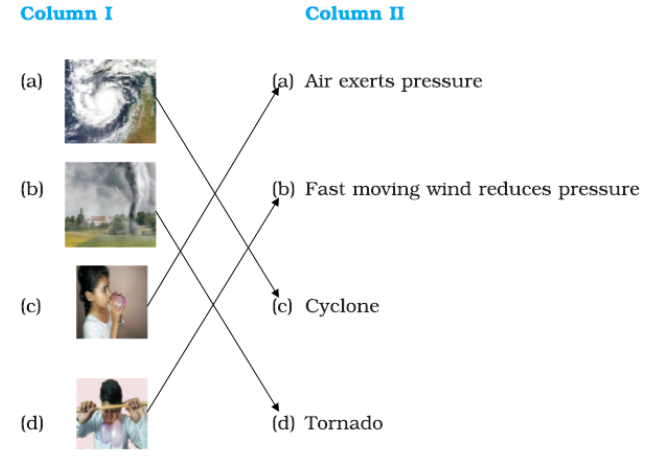
4- Match The Columns:
5- Very Short Answer Type Questions.
Question. Which property of air is described by the inflated balloon?
Answer- Air exerts pressure.
Question. Which is lighter, Cold air or Hot air?
Answer- Hot air.
Question. Which region of earth gets maximum heat from the Sun?
Answer- Region near the equator.
Question. Which winds bring rain in India?
Answer- The Monsoon winds.
Question. Name the instrument used for measuring the speed of wind.
Answer- Anemometer.
6- Short Answer Type Questions.
Question. Why are the holes made in hanging banners and hoardings?
Answer- Holes in the banners and hoardings help air to pass through it. Hence banner can withstand the pressure of the air.
Question. In which situation does the uneven heating of the earth produces winds?
Answer- (1) Uneven heating of regions near equator and Poles, (2) Uneven heating of land and water bodies.
Question. Which winds blow from ocean to land in summer? What is their significance?
Answer- The Monsoon winds blow from ocean to land in summer in India. These winds cause rains in India.Most of the agricultural activities in India are based on these winds.
Question. What is the difference between a thunderstorm and a cyclone?
Answer- A thunderstorm is a strong wind blowing with heavy rainfall along with thunder and lightning A Cyclone is a huge revolving storm, in which strong winds blow around a central area of low pressure.
Question. State effective measures to be taken in areas vulnerable to cyclones.
Answer- (1) Coastal areas should
be thickly planted with tall and indigenous species of plants, which checks the speed of wind.
(2) Cyclone shelters should be constructed in cyclone vulnerable areas.
(3) In coastal areas, ponds should be built to absorb excess of water.
(4) An efficient forecast measure should be adopted and the warnings should be communicated in advance.
Question. What is Tornado? Give two safety measures.
Answer- A Tornado is a violent storm, with strong rotating winds in funnel shaped clouds. Safety measures:
(1) Take shelter inside a room in the house without windows.
(2) If a person is in vehicle, he should get out of it and lie in a low-lying area.
(3) Whenever you face Tornado you can save yourself by bending your knees and putting your arms around your head and neck.
7- Long Answer Type Questions.
Question. Explain why does a tin can get crushed when water is boiled in it after closing it cold water is poured on it?
Answer- On boiling water in a tin, air gets out it as air expands on heating. So when we pour cold water on tin after closing, small air inside the tin gets contracted. Hence tin get crushed as pressure inside the tin is lower than atmospheric pressure.
Question. Explain with an activity that air expands on heating.
Answer- Fix a balloon tightly over the neck of the boiling test tube. As we place this test tube in hot water, balloon gets inflated. This proves that air expands on heating.
Question. How is a cyclone formed? Describe how a cyclone caused widespread destruction in Odisha in 1999.
Answer- When water changes to water vapours to form clouds, it absorbs heat from the surroundings. When water vapours cool down and condense to form water drops (rain), they lose the absorbed heat. This heat warms the surrounding air. The warm air being lighter rises up, creating a low pressure area. Fast wind starts
blowing around this area with thick clouds forming cyclone.
In India, Odisha was affected by a very strong cyclone in 1999. It destroyed 45000 houses making 70000 people homeless. High speed of wind accompanied by 9 meter high waves hitted the coastal area. Many people lost their lives and property worth of crores was destroyed.
More Question
<1M>
1.Tornado is a dark funnel shaped cloud that reaches from-
(A) Sky to the ground.
(B) Ground to the sky.
(C) Land to Ocean.
(D) Ocean to Land.
2.Air around us exerts-
(A) Pressure.
(B) Temperature.
(C) Expansion.
(D) Contraction.
3.In a cyclone hit area, which of the following should not be done?
(A) Don't store drinking water for emergencies.
(B) Don't touch wet switches.
(C) Don't touch fallen power lines.
(D) Don't ignore warnings issued by the meteorological department.
4.What happens to the pressure of the wind if its speed is increased?
5.How can we predict about the cyclones in advance?
6.Name the device by help of which we can measure the speed of wind?
7.What do you mean by "calm area"?
8.In winters, the direction of wind is-
(A) Reversed from that of summers.
(B) Same as in summer.
(C) Both from ocean to land and land to oceans.
(D) Can't be said.
9.Winds near the Equator blow because-
(A) Equator gets maximum heat from the Sun causing warming up of regions around the Equator.
(B) Warm air rises and the cooler air from 0 - 30 degrees latitude belt on either side of the equator moves in.
(C) These winds blow from the North and the South towards the equator.
(D) All of these.
10.What is the main cause of wind movement?
11.Why bicycle tube burst when they are overfilled?
12.What is tornado.
13.Which is lighter: a warm air, or a cold air?
14.A cloud region of about 150 km in size surrounds the eye of the storm. This region has ____________ winds and thick clouds with heavy rain.
(A) High speed
(B) Rotating
(C) Slow
(D) None of these
15.The center of the cyclone is a calm area called the eye of the storm, which varies from _____________ in diameter.
(A) 300 - 400 km
(B) 3 - 10 km
(C) 10 - 30 km
(D) 300 - 400 m
16.Air expands on-
(A) Cooling.
(B) Heating.
(C) Both (a) and (b).
(D) None of these.
17.Increased wind speed is accompanied by-
(A) Increased pressure.
(B) Increased moisture.
(C) Reduced pressure.
(D) Reduced moisture.
18.Air moves from the region where the air pressure is high to the region where-
(A) The pressure is low.
(B) The pressure is higher.
(C) Ever it feels like.
(D) None of these.
19.Warm air is-
(A) Heavier than cold air.
(B) Lighter than cold air.
(C) Neither heavier nor lighter than cold air.
(D) Stronger than cold air.
20.Monsoon winds blow from-
(A) Lands to oceans.
(B) Oceans to lands.
(C) Lands to mountains.
(D) All of these.
21.Monsoon winds carry rains because-
(A) In summer, lands warm up faster than the water of the oceans.
(B) The air above the lands is warmer than the air over the water causing the wind to flow from the oceans towards the land.
(C) These winds carry moisture and are known as the monsoon winds.
(D) All of these.
22.Factors contributing to the development of cyclones are- (A) Wind speed. (B) Wind direction. (C) Temperature and humidity. (D) All of these.
23.A cyclone is also known by the names-
(A) Hurricane in America.
(B) Typhoon in Japan and Philippines.
(C) Both(1) and (2).
(D) Tornado in Russia.
24.During a storm, wind speed gradually ___________ beyond the cloud region.
(A) Increases
(B) Decreases
(C) Rises
(D) None of these.
25.Storms are considered dangerous because the low pressure in the eye of a storm lifts water surface as high as ___________ in the center.
(A) 10 m
(B) 3 - 12 m
(C) 3 km
(D) 300 m
26.Storms make the seawater enter coastal areas causing extensive damages to-
(A) Soil.
(B) Life.
(C) Property.
(D) All of the above.
27.The storm is accompanied by ___________ aggregating the loss.
(A) Heavy rainfall
(B) Strong winds
(C) Hail
(D) Snow fall
28.A violent tornado can travel at speed of about-
(A) 100 km/h.
(B) 200 km/h.
(C) 400 km/h.
(D) 300 km/h.
29.Safety measures taken by the authorities to minimize the damage by cyclones in coastal areas include:
(A) Cyclone forecast and warning service with rapid communication.
(B) Construction of cyclone shelters in cyclone prone areas.
(C) Arrangements to move people fast to safer places.
(D) All of these.
30.Select correct alternatives from the following that the public is expected to avoid / not to do in case of a cyclone:
(i) Ignore warnings;
(ii) Make necessary arrangements to shift essential households, animals and vehicles
(iii) Driving on flooded roads;
(iv) Have phone numbers of emergency services;
(v) Take food and water lying around;
(vi) Contact with wet electrical switches and fallen power lines;
(vii) Start demanding all sort of things from the authorities; (viii) Cooperate with neighbours and friends.
(A) (ii), (iv), (viii)
(B) (i), (iii), (v), (vi), (vii)
(C) (i), (ii), (iv), (vi)
(D) (ii), (v), (vii), (viii)
31.In America, cyclone is known as-
(A) Typhoon. (B) Cyclone. (C) Hurricane. (D) Tornado.
32.Typhoon is another name for- (A) Thunderstorm. (B) Cyclone. (C) Tornado. (D) Earthquake.
33.An anemometer measures the-
(A) Wind pressure. (B) Wind speed. (C) Water pressure. (D) Water speed.
34.The center of a cyclone is a - (A) Violent area. (B) Calm area. (C) Hot area. (D) Cool area.
35.A car or a bus is a safe place to take shelter from-
(A) Cyclone. (B) Thunderstorm. (C) Tornado. (D) Hurricane.
<2M>
36.Where do thunderstorms develop?
37.Explain why holes are made in hanging banners and hoardings?
38.Suggest two methods to find the wind direction at a given place
39.Would you prefer to buy a house having windows but no ventilators? Give reason.
40.What happens when we blow over a thin, long paper strip held between forefinger and thumb? Why?
41.What are the factors that contribute to the formation of cyclone?
<3M>
42.Explain why a hot can (or bottle) gets distorted when water is poured over them?
43.How will you help your neighbours in case cyclone approaches your village/town?
44.Explain why a paper kept at the mouth of a bottle does't go inside if we blow air on the mouth of the bottle?
45.What is a tornado shelter? How can you protect yourself from a tornado?
46.Explain an activity to show that air exerts to pressure.
47.What are the safety measures that can be taken by the government during cyclone?
48.How is advanced technology helpful during natural calamities?
<5M>
49.What precautions should you take when you are staying in a cyclone hit area?
50.How are cyclones formed?
51.Explain the two situations when wind currents are generated.
Fill in the blanks:
1. _____________________ around us exerts pressure.
2. Difference of temperature between two regions sets ___________ in air.
3. Increased wind speed is accompanied by __________ air pressure.
4. Air moves from the region where the air pressure is _________ to the region where the pressure is _______________.
5. Air _______________on heating and __________ on cooling.
6. The warm air is ____________ than the cold air.
7. Uneven heating on the earth is the main cause of ______________
8. Winds carrying ______________ bring rain.
9. The word monsoon is derived from the Arabic word ___________ which means season.
10. The monsoon winds carry ____________ and it rains.
11. Falling water droplets along with rising air create lightning and sound and is known as _______________
12. High speed winds and air pressure difference can cause ________________________
13. The calm area in the centre of a cyclone is called __________
14. A cyclone is called a _______________ in the American continent and _____________in Japan and Philippines.
Name the following
1. A dark funnel shaped cloud that reaches from the sky to the ground.
2. The instrument that measures the wind speed
3. Two modern technologies that help us to monitor cyclones.
4. The coastline of India that is more vulnerable to cyclones.
Define the following :
1. Cyclone
2. Tornado
3. Thunderstorm
Choose the correct answer:
1. In India, monsoon wind blows in south west direction in (summer/winter).
2. In winter, the direction of wind is from (land to ocean/ocean to land).
3. A cyclone watch is issued ( 24/48 ) hours in advance of any expected storm.
4. (Thunderstorms/tornadoes) are frequent in India.
Free study material for Science
Chapter 08 Winds Storms and Cyclones Printable Worksheets and Exercises for Class 7 Science
Download Chapter Worksheets: Class 7 Science
Access structured practice worksheets for Chapter 08 Winds Storms and Cyclones aligned with the 2026 CBSE curriculum. These downloadable exercises for Class 7 Science help students build accuracy and reinforce core concepts for upcoming school tests.
Concept Clarification for Chapter 08 Winds Storms and Cyclones
Built using official NCERT guidelines for Class 7 Science, these practice sheets provide reliable academic support. Cross-reference your completed work with our detailed solutions to learn standard answer-writing formats for CBSE exams.
Effective Revision Strategies for School Exams
Wrap up your chapter revision by testing your knowledge against standard objective question formats. Explore our full library of free, up-to-date printable assignments to maximize your academic results in upcoming CBSE evaluations.
FAQs
You can download the latest chapter-wise printable worksheets for Class 7 Science Chapter 08 Winds Storms and Cyclones for free from StudiesToday.com. These have been made as per the latest CBSE curriculum for this academic year.
Yes, Class 7 Science worksheets for Chapter 08 Winds Storms and Cyclones focus on activity-based learning and also competency-style questions. This helps students to apply theoretical knowledge to practical scenarios.
Yes, we have provided solved worksheets for Class 7 Science Chapter 08 Winds Storms and Cyclones to help students verify their answers instantly.
Yes, our Class 7 Science test sheets are mobile-friendly PDFs and can be printed by teachers for classroom.
For Chapter 08 Winds Storms and Cyclones, regular practice with our worksheets will improve question-handling speed and help students understand all technical terms and diagrams.