

Download Class 7 Science Practice Worksheets
Review targeted academic worksheets with the CBSE Class 7 Science Soil Worksheet Set 02. Built according to official educational standards for the 2026-27 term, these downloadable Class 7 Science resources support effective daily practice and detailed self-evaluation for Chapter 09 Soil.
Access Chapter 09 Soil Practice Papers and Solutions
View or download the dedicated CBSE Class 7 Science Soil Worksheet Set 02 resource below. Engaging with these practice papers under focused study conditions ensures continuous academic progress and mastery of the 2026-27 curriculum for Chapter 09 Soil.

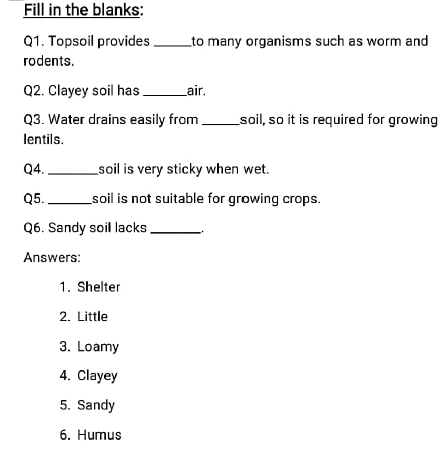
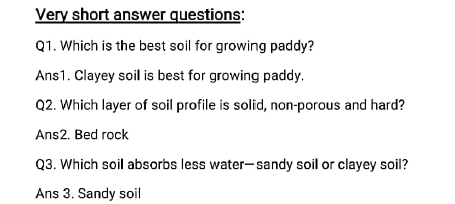
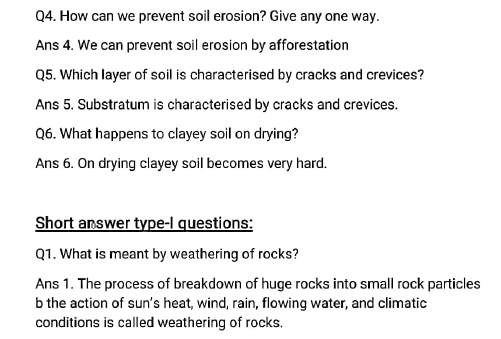
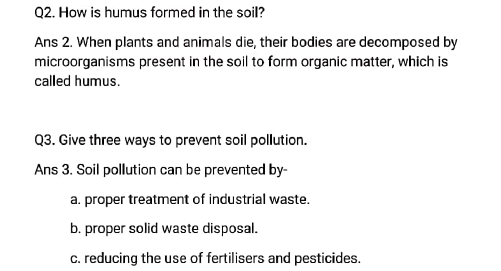


I. Fill in the Blanks
Question 1. Soil is our __________ resource.
Answer: natural
In simple words: Soil is an important gift from nature that supports life on Earth.
Exam Tip: "Natural" is the standard textbook term, though "precious" or "vital" also describe soil accurately.
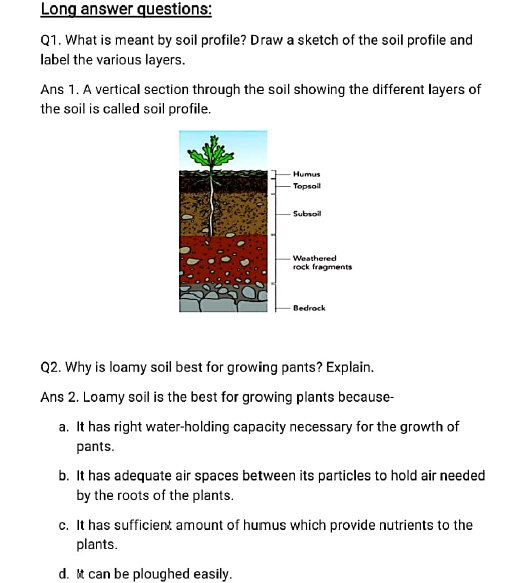
Question 2. __________ is a section through different layers of soil.
Answer: Soil profile
In simple words: A vertical cut showing all the different soil layers is called a soil profile.
Exam Tip: Remember that each distinct layer in a soil profile is known as a horizon.
Question 3. The removal of top soil due to wind and running water is called __________.
Answer: soil erosion
In simple words: When wind or flowing water carries away the top layer of earth, it is called soil erosion.
Exam Tip: Plant roots anchor the soil and are the most effective natural defense against soil erosion.
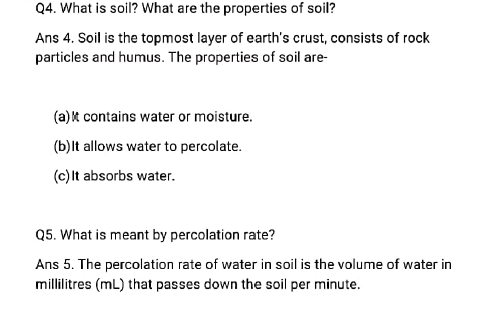
Question 4. The rotting dead matter in the soil is called __________.
Answer: humus
In simple words: Decayed leaves and dead insects that turn into rich dark plant food are called humus.
Exam Tip: Humus is found mainly in the topmost A-horizon and makes the ground fertile.
Question 5. The type of soil used by the potters to make pots is called __________.
Answer: clayey soil
In simple words: Potters use sticky clayey soil because it holds water and can be shaped easily into pots and toys.
Exam Tip: Clayey soil is preferred by potters due to its very fine particles and excellent stickiness when wet.
II. True or False
Question 1. Clayey soil is good for the growth of plants. ( )
Answer: True
In simple words: Clayey soil is rich in minerals and holds water well, making it suitable for crops like wheat and gram.
Exam Tip: Although loamy soil is the best overall, clayey soil is specifically well-suited for water-loving crops such as paddy.
Question 2. The soil which contains humans is called clayey soil. ( )
Answer: False
In simple words: Soil contains decayed plant matter called humus, not humans, so this statement is incorrect.
Exam Tip: Do not confuse the word "humus" (decayed organic matter) with the word "human".
Question 3. Capacity to hold water is much in sandy soil than clayey soil.( )
Answer: False
In simple words: Sandy soil has large spaces between its particles, so water drains right through it instead of being stored.
Exam Tip: Clayey soil has tiny spaces that hold water tightly, giving it a much higher water-holding capacity than sandy soil.
Question 4. Cotton is grown in sandy loam soil.( )
Answer: True
In simple words: Cotton plants need soil that drains excess water quickly and holds plenty of air, like sandy loam.
Exam Tip: Sandy loam and black soil are both widely used for cultivating cotton in India.
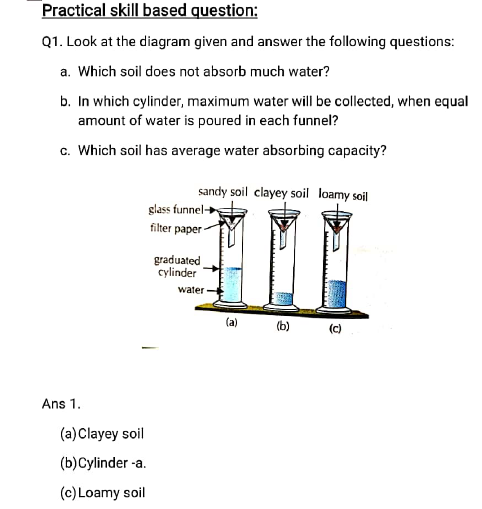
Question 5. Percolation rate is highest in the clayey soil. ( )
Answer: False
In simple words: Water trickles down most slowly in clayey soil, while it passes fastest through sandy soil.
Exam Tip: Percolation rate is highest in sandy soil and lowest in clayey soil.
III. Answer the Following Questions in One or Two Lines
Question 1. How is soil formed?
Answer: Soil is created through the breaking down of large rocks by the continuous action of wind, water, and climate. This natural breakdown of rocks over long periods is called weathering.
In simple words: Rocks break into tiny bits over many years because of wind and rain to create soil.
Exam Tip: Always include the key scientific term "weathering" along with the agents: wind, water, and climate.
Question 2. What is a clayey soil?
Answer: Clayey soil is a type of soil that has a much higher proportion of fine, tiny particles compared to large grains. These tiny particles pack closely together, leaving little space for air but holding plenty of water.
In simple words: Clayey soil is made of very fine particles that stick together and trap a lot of water.
Exam Tip: Key characteristics to mention are fine particle size, low aeration, and high water-holding capacity.
Question 3. Name the different types of soil?
Answer: Based on the size of their particles, the three major classes of soil are:
1. Sandy soil
2. Clayey soil
3. Loamy soil
In simple words: The three main soil kinds are sandy, clayey, and loamy soil.
Exam Tip: Classify soils into sandy, clayey, and loamy based on the proportion of large and fine particles.
Question 4. What is a loamy soil?
Answer: Loamy soil is a balanced mixture of sand, clay, and silt particles along with humus. It has the right amount of air space and holds just enough moisture for healthy root development.
In simple words: Loamy soil is an even blend of sand, silt, and clay that has plenty of nutrients for crops.
Exam Tip: Mention that loam contains silt particles, which have a size between those of sand and clay.
Question 5. Which is the best soil for the production of crops?
Answer: Loamy soil is the best soil for growing agricultural crops. It combines good drainage with adequate water retention and contains rich humus needed for plant nourishment.
In simple words: Loamy soil is ideal for crops because it balances moisture, air, and plant food.
Exam Tip: State "loamy soil" and explain that its proper aeration and moisture balance make it the top choice for farming.
Question 6. What is soil erosion? What do you mean by soil texture?
Answer: Soil erosion is the washing or blowing away of the fertile topsoil by wind, rain, or flowing rivers.
Soil texture refers to the relative proportions and sizes of different mineral particles (sand, silt, and clay) that give the soil its rough, smooth, or sticky feel.
In simple words: Erosion is the loss of top dirt from wind or rain, while texture describes how coarse or smooth the soil feels.
Exam Tip: Keep the two parts distinct by writing one clear sentence for erosion and one for texture.
IV. Answer in Two or Three Sentences
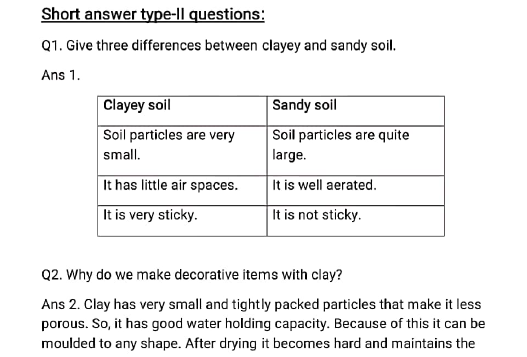
Question 1. List the difference between clayey soil and sandy soil?
Answer: Sandy soil contains mostly large particles with wide air gaps, so water drains through it very quickly. In contrast, clayey soil consists of very fine particles that pack tightly together with little air. As a result, clayey soil holds a large amount of water and turns sticky when wet, whereas sandy soil stays dry and loose.
In simple words: Sandy soil has big grains that let water pass fast, while clayey soil has tiny grains that hold water and feel sticky.
Exam Tip: Compare them on at least two clear points: particle size and water-retention ability.
Question 2. How can we conserve soil?
Answer: We can conserve soil by planting more trees and grass, as roots bind the ground firmly against wind and water. On hilly land, practicing terrace farming slows down water runoff and protects topsoil. Preventing overgrazing by cattle also keeps the natural green cover intact.
In simple words: We can protect soil by planting trees, avoiding overgrazing, and making step-like terraces on hills.
Exam Tip: Use standard conservation terms such as "afforestation", "terrace farming", and "checking overgrazing".
Question 3. How can we prevent soil erosion and soil pollution?
Answer: Soil erosion can be stopped by planting trees on open land and building barriers along riverbanks. Soil pollution can be prevented by reducing the use of chemical sprays and fertilizers, switching to organic compost instead. Furthermore, treating factory chemicals before disposal and banning non-biodegradable polythene bags keeps toxic substances out of the ground.
In simple words: Grow more plants to stop erosion, and avoid dumping plastic or harsh chemicals to stop pollution.
Exam Tip: Address erosion prevention (planting vegetation) and pollution prevention (reducing chemicals and plastics) in separate points.
Question 4. Mohammad conducted an expirement in the field related to the rate of percolation.He observed that it took 20 min for 100ml water to percolate through the soil sample.Calculate the rate of percolation?
Answer: Given data:
Volume of water = \( 100\text{ ml} \)
Time taken for percolation = \( 20\text{ min} \)
The formula for calculating percolation rate is:
\[ \text{Rate of percolation (ml/min)} = \frac{\text{Amount of water (ml)}}{\text{Percolation time (min)}} \]
Substituting the given values:
\[ \text{Rate of percolation} = \frac{100\text{ ml}}{20\text{ min}} = 5\text{ ml/min} \]
The percolation rate of the given soil sample is \( 5\text{ ml/min} \).
In simple words: Divide the water amount (100 ml) by the time (20 minutes) to find that 5 ml of water drains every minute.
Exam Tip: Always state the formula and include the correct unit (\(\text{ml/min}\)) with your final answer.
Question 5. What are the factors that influence the formation of soil?
Answer: Soil formation depends on five main factors:
1. Parent Rock: Decides the initial minerals, texture, and color of the soil.
2. Climate: Temperature changes, frost, and rainfall control how fast rocks weather.
3. Living Organisms: Microbes, earthworms, and plants decay to add fertile humus.
4. Topography: The slope of the land determines how easily water washes dirt away or lets it settle.
5. Time: Long periods allow soil layers to mature and develop greater depth.
In simple words: Soil is shaped by the parent rock, weather conditions, plants, animals, the slope of the land, and time.
Exam Tip: Mention the five primary factors: parent rock, climate, organic activity, topography (relief), and time.
Free study material for Science
Free CBSE Practice Worksheets: Class 7 Science Chapter 09 Soil
Daily Practice Questions for Class 7 Science
Explore reliable practice questions for Chapter 09 Soil tailored for Class 7 Science learners. Use these structured worksheets to evaluate exam preparedness and strengthen problem-solving skills throughout the 2026 academic session.
Detailed Answers for Class 7 Science Chapter 09 Soil
Designed around the official curriculum for Class 7 Science, these practice sheets guarantee standard compliance. Reviewing step-by-step solutions after completion sharpens your accuracy and clarifies complex sub-topics within Chapter 09 Soil.
Complete Your Chapter Revision
Consistent engagement with these exercises builds familiarity with recurring exam themes. If specific areas within Chapter 09 Soil cause trouble, utilize our dedicated NCERT solutions for Class 7 Science to clear up doubts immediately.
FAQs
You can download the latest chapter-wise printable worksheets for Class 7 Science Chapter 09 Soil for free from StudiesToday.com. These have been made as per the latest CBSE curriculum for this academic year.
Yes, Class 7 Science worksheets for Chapter 09 Soil focus on activity-based learning and also competency-style questions. This helps students to apply theoretical knowledge to practical scenarios.
Yes, we have provided solved worksheets for Class 7 Science Chapter 09 Soil to help students verify their answers instantly.
Yes, our Class 7 Science test sheets are mobile-friendly PDFs and can be printed by teachers for classroom.
For Chapter 09 Soil, regular practice with our worksheets will improve question-handling speed and help students understand all technical terms and diagrams.