

Chapter-wise Worksheets for Class 5 Environmental Studies: Chapter 03 From Tasting to Digesting
Review targeted academic worksheets with the CBSE Class 5 EVS From Tasting To Digesting Worksheet. Built according to official educational standards for the 2026-27 term, these downloadable Class 5 Environmental Studies resources support effective daily practice and detailed self-evaluation for Chapter 03 From Tasting to Digesting.
Practice Class 5 Environmental Studies Worksheets: Chapter 03 From Tasting to Digesting
View or download the dedicated CBSE Class 5 EVS From Tasting To Digesting Worksheet resource below. Engaging with these practice papers under focused study conditions ensures continuous academic progress and mastery of the 2026-27 curriculum for Chapter 03 From Tasting to Digesting.
Question. In the human body, which of the following removes waste from the blood?
(a) Large intestines
(b) Heart
(c) Small intestines
(d) Kidneys
Answer : D
Question. Which of the following is from an animal source and rich in fat and protein?
(a) Bread
(b) Cheese
(c) Curd
(d) Nuts
Answer : B
Question. Which of the following is LOW in proteins, carbohydrates as well as fat?
(a) Cabbage
(b) Potato
(c) Carrot
(d) Beetroot
Answer : A
Question. The time food takes to travel through different parts of the body during digestion is shown in the figure below. Answer the question based on the figure.
Identify the organ where the process of digestion takes 5 hours.

(a) Large intestine
(b) Small intestine
(c) Kidney
(d) Stomach
Answer : B
Question. The time food takes to travel through different parts of the body during digestion is shown in the figure below. Answer the question based on the figure.
The total time taken for the above process to complete is about:

(a) 12 hours approx
(b) 17 hours approx
(c) 20 hours approx
(d) 26 hours approx
Answer : C
Question. Suresh wants to participate in his school annual sports competition. Which of the meals A, B, C or D should he eat regularly during the training period to build up his muscles?
(a) Green salad dal butter roti dahi gulab jamun
(b) French fries burger green salad coke ice cream
(c) Tomato soup garlic bread cheese pizza pepsi ice cream
(d) Vegetable soup fried rice raita potato chips ice cream
Answer : A
Question. Which of these transports food, water, oxygen and minerals to every cell of the human body?
(a) Muscles
(b) Nerves
(c) Blood
(d) Skin
Answer : C
Question. Which organ is made up of air-carrying tubes and tiny sacs?

Answer : C
Question. If a person eats more food than he uses, then
(a) the extra food becomes stored fat
(b) the rate of breathing increases
(c) he loses weight all of a sudden
(d) he is unable to walk properly
Answer : A
Question. See the symbols 1 and 2 shown here:Symbol 1 appears on: a packet of potato chips, a bottle of fruit juice Symbol 2 appears on: a packet of frozen chicken, a box of cake Neither symbol appears on: a T-shirt Which of these best describes what symbol 1 probably stands for?

(a) item got from nature
(b) vegetarian food
(c) milk product
(d) contains Vitamin C
Answer : B
Question. Where does our body get the water it needs?
(a) From the water that we drink.
(b) From other liquids that we drink
(c) From the food that we eat.
(d) From all the above.
Answer : D
Question. Which of these is caused by drinking unclean water?
(a) Malaria
(b) Typhoid
(c) Chicken pox
(d) Measles
Answer : B
Question. In Rahul's lunch bag, which of these items would get spoilt most quickly?
(a) Frooty" cold drink"
(b) Apple pieces
(c) Rice
(d) Curry
Answer : B
Question. Study this information on a packet of Garam Masala. Till which date can it be safely consumed?

(a) 6th April, 2004
(b) 6th April, 2005
(c) 30th June, 2005
(d) 30th April, 2006
Answer : C
Question. Kajol and her mother go to buy vegetables. The shopkeeper places an empty basket in one of the pans of the balance, which goes down as shown in the figure. What should the shopkeeper do now before placing the weights and vegetables in the pans?

(a) Add weights to pan N to bring the needle to the middle.
(b) Add weights to pan M to bring the needle to the middle.
(c) Add equal weights to both pans to adjust the needle.
(d) Not do anything as the measurement will be okay as it is.
Answer : A
Question. To distinguish different tastes we have -----on our tongues.
(a) lines
(b) layers
(c) thin bumps
(d) cracks
Answer : C
Question. Where do you think food must be going after you put in your mouth and swallowed?
(a) Kidneys
(b) Lungs
(c) Stomach
(d) Gall Bladder
Answer : C
Question. What is the nature of food juice , inside our stomach?
(a) Acidic
(b) Base
(c) Alkaline
(d) Catalyst
Answer : A
Question. State whether true or false.
1. Dr. Beaumount made a hole in Martain’s stomach for research.
2. Digestive juice in our stomach is icy in nature .
3. Doctors give iron drips to patients for gaining quick strength.
Answer : 1 . False 2 . False 3 .False
Question. Answer in one word.
1. From which district is rice sent to the other states?
2. Which drip do doctors give to patients for regaining strength quickly?
Answer : 1. Kalahandi 2.Glucose
Question. Fill in the blanks.
1. Dr. Beaumont took some liquid out of the………..
2. One can identify different tastes of food by tasting and …………
Answer : 1.Stomach 2. Smelling
I. Name any 2 food items with the following tastes
1. sweet - Sugar, Honey
2. salty - Salt, Chips
3. sour - Lemon, Tamarind
4. bitter - Bitter gourd, Neem leaves
5. spicy - Green chilli, Black pepper
Answer: Sweet items include sugar and honey; salty items include salt and potato chips; sour items include lemon and tamarind; bitter items include bitter gourd and neem; spicy items include green chilli and black pepper.
In simple words: Different food items have different tastes like sweet, salty, sour, bitter, or spicy.
Exam Tip: Remember common examples for each primary taste to answer quickly in exams.
II. Describe the tastes of these food items
1. Mango chutney - Sweet and sour
2. Amla - Sour and astringent
3. Maggi - Spicy and salty
4. Ice cream - Sweet and cold
5. Roasted chana - Earthy and nutty
Answer: Mango chutney tastes sweet and sour, amla is sour, Maggi noodles taste spicy and salty, ice cream is sweet, and roasted chana has a nutty and earthy taste.
In simple words: Each food item has a unique combination of tastes that our tongue can detect.
Exam Tip: Observe the ingredients used in processed or natural food items to describe their exact taste.

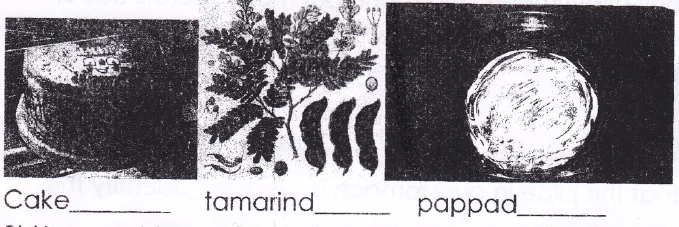
Work Sheet Unit 3 - From tasting to digesting
1. How do these following food items taste?
Cake - Sweet
Tamarind - Sour
Pappad - Salty
Answer: Cake tastes sweet, tamarind tastes sour, and pappad tastes salty.
In simple words: Cake is sweet, tamarind is sour, and pappad is salty.
Exam Tip: Associate common food items directly with their primary taste buds sensation.
2. Unscramble the letters to get the names of three things needed to taste the food.
Tnogeu -> Tongue
Neos -> Nose
slivaa -> Saliva
Answer: Tongue, Nose, Saliva
In simple words: We need our tongue to taste, our nose to smell, and saliva to wet the food so we can taste it better.
Exam Tip: Unscramble word puzzles by identifying common vowels and consonant clusters.
3. Given below are the names of food items. Select and fill in the plate with food items which would make a balanced diet.
Dal, rice, noodles, roti, sabzi, chips, burger, pizza, salad, milk, fruits
Answer: Balanced diet plate items: Dal, rice, roti, sabzi, salad, milk, fruits.
In simple words: A balanced diet contains healthy home-cooked food items like dal, rice, roti, vegetables, milk, and fruits, while junk food is avoided.
Exam Tip: Choose nutritious whole foods and exclude processed junk foods like chips, burgers, and noodles when forming a balanced diet.
4. What would happen if you take junk food?
Answer: Eating junk food regularly can lead to health problems such as obesity, stomachaches, lack of energy, and nutritional deficiencies because junk food lacks essential vitamins, minerals, and fibers.
In simple words: Junk food is unhealthy and can make us sick or overweight if eaten too often.
Exam Tip: State both the immediate effect (stomach upset) and long-term effect (obesity) for complete credit.
Free CBSE Practice Worksheets: Class 5 Environmental Studies Chapter 03 From Tasting to Digesting
Daily Practice Questions for Class 5 Environmental Studies
Review targeted practice exercises for Class 5 Environmental Studies Chapter 03 From Tasting to Digesting. Curated to match official CBSE guidelines, these printable problem sets support daily revision and improve overall test readiness.
Detailed Answers for Class 5 Environmental Studies Chapter 03 From Tasting to Digesting
Designed around the official curriculum for Class 5 Environmental Studies, these practice sheets guarantee standard compliance. Reviewing step-by-step solutions after completion sharpens your accuracy and clarifies complex sub-topics within Chapter 03 From Tasting to Digesting.
Complete Your Chapter Revision
Wrap up your chapter revision by testing your knowledge against standard objective question formats. Explore our full library of free, up-to-date printable assignments to maximize your academic results in upcoming CBSE evaluations.
FAQs
You can download the latest chapter-wise printable worksheets for Class 5 Environmental Studies Chapter 03 From Tasting to Digesting for free from StudiesToday.com. These have been made as per the latest CBSE curriculum for this academic year.
Yes, Class 5 Environmental Studies worksheets for Chapter 03 From Tasting to Digesting focus on activity-based learning and also competency-style questions. This helps students to apply theoretical knowledge to practical scenarios.
Yes, we have provided solved worksheets for Class 5 Environmental Studies Chapter 03 From Tasting to Digesting to help students verify their answers instantly.
Yes, our Class 5 Environmental Studies test sheets are mobile-friendly PDFs and can be printed by teachers for classroom.
For Chapter 03 From Tasting to Digesting, regular practice with our worksheets will improve question-handling speed and help students understand all technical terms and diagrams.