

Class 5 Environmental Studies Practice Sheet: CBSE Class 5 EVS Sunita In Space Worksheet
Explore structured practice materials through the CBSE Class 5 EVS Sunita In Space Worksheet. Tailored for Class 5 learners, utilizing these Environmental Studies worksheets ensures thorough preparation and strengthens problem-solving accuracy before final school evaluations.
Download Chapter 11 Sunita in Space Worksheet PDF with Answers
Access the complete worksheet PDF for Class 5 Environmental Studies below. Regular practice with these targeted academic tasks builds familiarity with standard question patterns and helps secure higher marks in final school examinations.
I) OBSERVATION -
Fill in the blanks:-
Question 1. Sunita spent more than ___________ months in space.
Answer: 6
In simple words: Sunita Williams stayed in space for over 6 months during her space mission.
Exam Tip: Remember key numerical facts and durations related to space missions.
Question 2. _______________ part on the globe is sea.
Answer: Blue
In simple words: The blue areas on a globe represent water bodies or seas.
Exam Tip: Associate the color blue on maps and globes with water.
Question 3. _______________ was the first man to walk on the moon.
Answer: Neil Armstrong
In simple words: Neil Armstrong was the first astronaut to step onto the lunar surface in 1969.
Exam Tip: Memorize historical milestones in space exploration.
Question 4. Sunita set a new _______________ for the longest space flight by a woman.
Answer: record
In simple words: She created a new record for staying in space continuously as a female astronaut.
Exam Tip: Pay attention to achievements and records set by astronauts.
II) Explain the following terms:-
Question 1. Globe :-
Answer: A globe is a spherical model of the Earth that shows continents, countries, oceans, and seas in their correct relative positions and shapes.
In simple words: A globe is a small round model of our planet Earth.
Exam Tip: Keep definitions concise, highlighting that a globe is a 3D model of the Earth.
Question 2. Space:-
Answer: Space is the boundless three-dimensional extent in which objects and events have relative position and direction, existing beyond the Earth's atmosphere where stars, planets, and galaxies reside.
In simple words: Space is the vast emptiness outside the Earth where stars and planets are found.
Exam Tip: Define space as the region beyond Earth's atmosphere.
Question 3. Spaceship:-
Answer: A spaceship is a vehicle or machine designed to fly in outer space for exploration, transporting astronauts, or carrying equipment.
In simple words: A spaceship is a special vehicle used to travel through outer space.
Exam Tip: Mention that it is designed specifically for travel outside Earth.
II) IDENTIFICATION:-
I) Find out the meaning of the following terms:-
Question 1. Astronomy :-
Answer: Astronomy is the scientific study of celestial objects such as stars, planets, comets, galaxies, and phenomena that originate outside the Earth's atmosphere.
In simple words: Astronomy is the science of studying stars, planets, and space.
Exam Tip: Use the keyword 'scientific study' when defining scientific disciplines.
Question 2. Astronomers :-
Answer: Astronomers are scientists who study astronomy, observing and researching stars, planets, and the universe using telescopes and other advanced instruments.
In simple words: Astronomers are scientists who study the universe and stars.
Question. Which option shows the items correctly in the ascending order of their distances from you:
(a) Stars, the sun, clouds, the moon, a flying crow.
(b) A flying crow, clouds, the moon, the sun, stars.
(c) A flying crow, the moon, clouds, stars, the sun.
(d) Clouds, a flying crow, the moon, stars, the sun
Answer : B
Question. Why are nights cooler than days?
(a) The Earth is further away from the Sun during that time.
(b) The place having night is on a part tilted away from the Sun.
(c) The place having night is on a part not facing the Sun.
(d) The place having night is cooled by night winds.
Answer : C
Question. The graph shows the distance in billions of kilometers between the sun and 4 planets. Which table shows the same information that is shown on the graph?
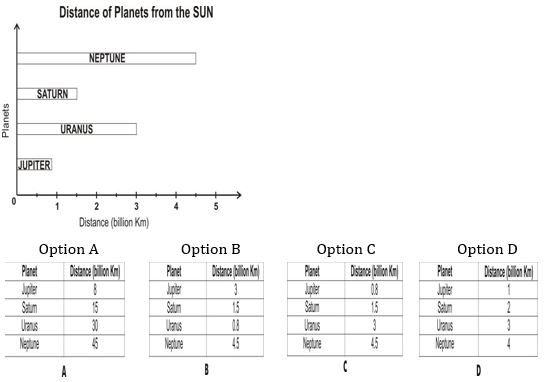
Answer : C
Question. Can a pair of binoculars be used to see the surface of the moon?
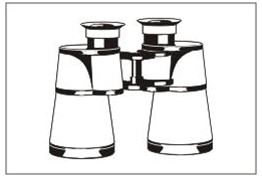
(a) No, it is not possible as the image will be upside-down.
(b) Yes, it is possible if the binoculars are powerful enough.
(c) No, only nearby objects can be seen through binoculars.
(d) Yes, it is possible with any binoculars, even cheap ones.
Answer : B
Question. A marble is shot into a circular groove from point P as shown.It leaves the groove at Q. Which picture shows how the marble will move when it leaves the groove at Q?
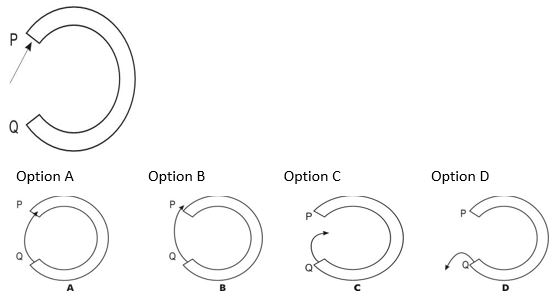
Answer : D
Question. The moon takes different shapes as shown in the figure below.About how many days pass between a new moon and a full moon?
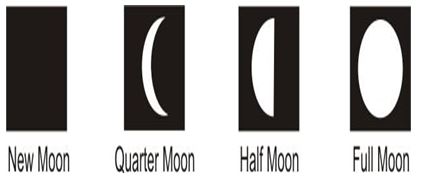
(a) 7 days
(b) 15 days
(c) 30 days
(d) 60 days
Answer : B
Question. Which hemisphere of the earth is being seen in this picture?
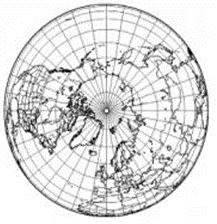
(a) Western
(b) Northern
(c) Southern
(d) Eastern
Answer : B
Question. Among the following which is the largest?
(a) The sun
(b) The earth
(c) The moon
(d) Jupiter
Answer : A
Question. The four figures below show the 24-hour period in January, April, July and October in New Delhi. Which figure could represent January?
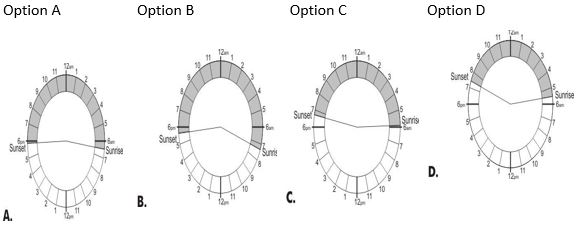
Answer : B
Question. The items in the table below have been put into two categories. Which set of headings is MOST suitable for the two categories?
| Group 1 | Group 2 |
| Rivers | Bulbs |
| Bananas | Windows |
| Seashells | Table |
| Clouds | Road roller |
(a) Group 1: Living; Group 2: Non-living
(b) Group 1: Not used at home; Group 2: Used at home
(c) Group 1: Not man-made; Group 2: Man-made
(d) Group 1: Not transparent; Group 2: Transparent
Answer : C
Question. Mrs. Sharma gives a pack of 50 playing cards to 4 students, and challenges them to find out the thickness of each card. Which of these shows the correct first step?
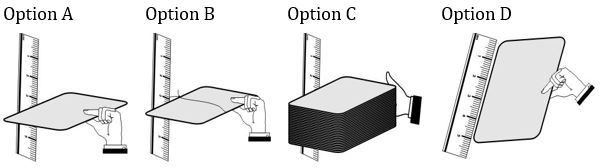
Answer : C
Question. Figure 1 shows the shadow of a stick at a particular time of the day, and figure 2 shows the shadow of the SAME stick (at the same place) two hours later.
Which of these could have been the time when the shadow was as shown in figure 1?
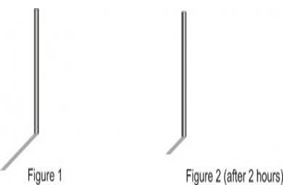
(a) 9:00 AM
(b) 11:00 AM
(c) 3:00 PM
(d) 5:00 PM
Answer : A
Question. Study the table shown.
(For example, the first cell tells us that in the air we breathe, about 21% or 21 parts out of 100 is oxygen).What can we conclude from the table?
| Gas | Inhaled air | Exhaled air |
| Oxygen | 21% | 15% |
| Carbon dioxide | 0.04% | 4% |
(a) We breathe in pure oxygen and breathe out pure carbon dioxide.
(b) The air we breathe in contains more carbon dioxide than oxygen.
(c) The air we breathe out has more carbon dioxide than the air we breathe in.
(d) The human body produces oxygen during the breathing process.
Answer : C
Question. A wind vane's tail is slightly heavier than its head. To make a wind vane, Vikas needs to balance the vane. Which among the following represents the BEST way to balance it?
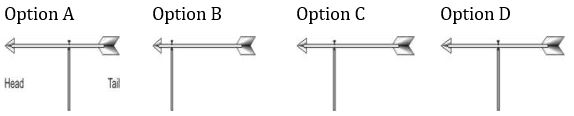
Answer : A
Question. Which of these statements is true about the SHADOW of any object?
(a) The shadow cannot be larger than the object itself.
(b) The shadow cannot lie between the object and the source of light causing it.
(c) The shadow always forms on a flat surface.
(d) The larger the size of the source of light, the larger the shadow.
Answer : B
Question. Translucent objects are those that allow a little light to pass through them. Which of these objects is an example of these?
(a) Magnifying lens
(b) Mirror
(c) Tracing paper
(d) Glass of water
Answer : C
Question. If a man walks from P to Q what will be the MINIMUM number of regions he will have to cross(including the ones containing P and Q) to reach his destination?
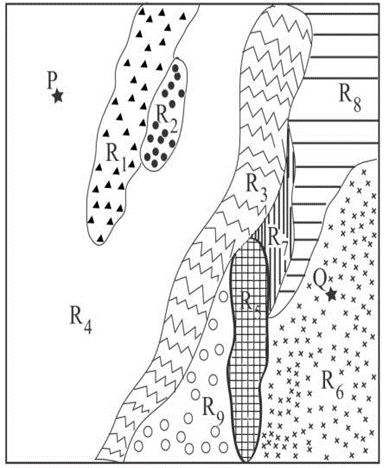
(a) 7
(b) 5
(c) 4
(d) 6
Answer : C
Question. 25th of June was a full moon day. From the calendar of June and July identify the date of the next full moon?
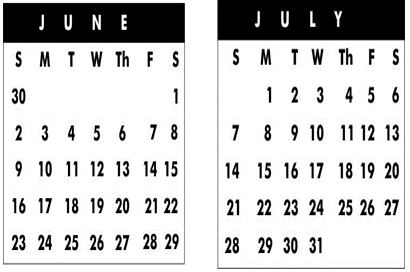
(a) 30th June
(b) 1th July
(c) 9 th July
(d) 24th July
Answer : D
Question. The handle and frame of a magnifying glass was removed and the magnifying glass was viewed from its side. How would the glass look like?
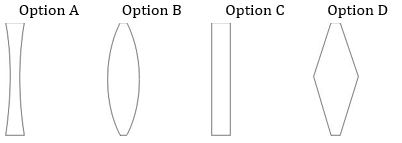
Answer : B
Question. After how much time will a person at point P see the Sun at the same position in the sky?

(a) 6 hours
(b) 12 hours
(c) 24 hours
(d) 30 days
Answer : C
Question. On a sunny, clear day, the shadow cast by a tree at different times of the day is given below. Which of the figures would BEST represent the shadow of the tree at 12 noon?
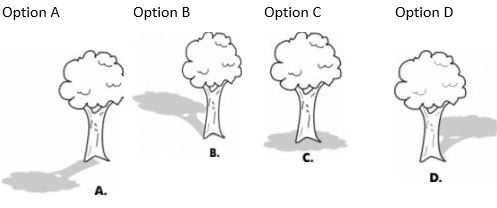
Answer : C
Question. Sometimes, after a rain, a rainbow can be seen. Other than rain, what else is needed for the rainbow to form?
(a) Fog
(b) Clouds
(c) Snow
(d) Sunshine
Answer : D
Question. The graph shows the time taken in hours for rotation by 4 planets of the solar system. Which row of the table shows the same information that is shown on the graph?
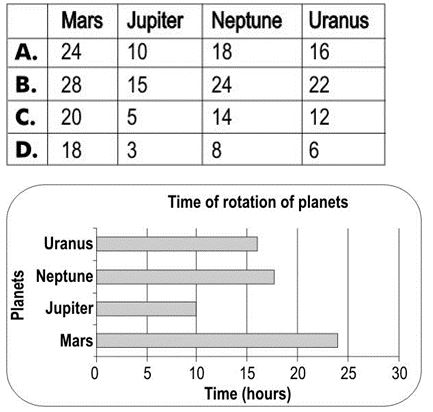
(a) Row A
(b) Row B
(c) Row C
(d) Row D
Answer : A
Question. Why do we not see any stars (other than the Sun) in the daytime?
(a) The stars are not in the sky, they are facing the other side of the earth.
(b) The stars rise only with the moon and set with the moon.
(c) The sunlight is too bright and hence we cannot see the stars.
(d) The stars are very small compared to the Sun and clouds.
Answer : C
Question. Amala saw the shape of the moon as given below in the sky on April 8th 2005.
Karunya saw the moon on April 11th.
Which of these could be the shape of the moon that Karunya saw?
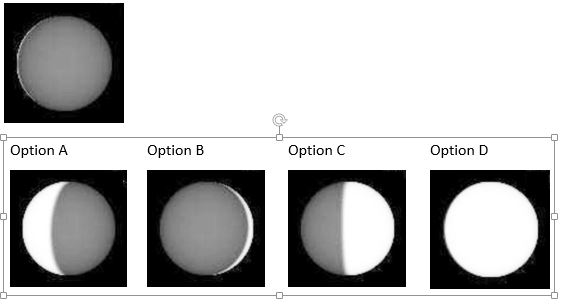
Answer : B
Question. A picture of the Republic Day Parade is shown here. It has been taken from
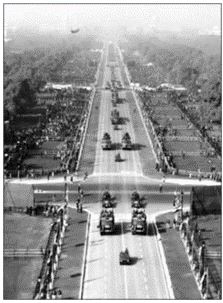
(a) a helicopter
(b) a satellite
(c) the base of India Gate
(d) the front of the parade
Answer : A
Question. At which of these times would the shadow of the stick be SHORTER than it was AN HOUR EARLIER?
(a) 10:00 AM
(b) 1:00 PM
(c) 3:00 PM
(d) 4:00 PM
Answer : A
Question. What can we say from this about the length of the shadow at different times of the day?
(a) The length of the shadow is shortest early in the morning and then keeps getting longer.
(b) The length of the shadows gradually decreases from morning till evening.
(c) The length of the shadow stays almost the same throughout the day.
(d) The length of the shadow is shortest at noon – it is longer in the morning and evening.
Answer : D
Question. On Diwali, a solar eclipse can occur. Which of the following phases of the moon is possible on a Diwali day?
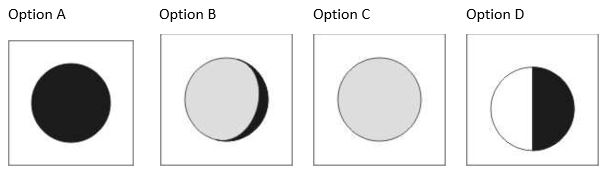
Answer : A
Question. Which is the spherical model of the Earth ?
(a) Map
(b) Moon
(c) Globe
(d) Compass
Answer : C
Question. If we throw an orange up in the sky it will -----
(a) go up
(b) come down
(c) stay in the air
(d) none of the above
Answer : B
Question. We all are fascinated to visit space. In which vehicle do the astronauts go into the space?
(a) Helicopter
(b) Fighter jet
(c). Aeroplane
(d) Space ship
Answer : D
Question. Which one is also called a shooting star?
(a) Planet
(b) Satellite
(c) Asteroid
(d) Meteroite
Answer : D
Question. Fill in the blanks
1. ----was the first man to walk on the moon.
2. Movement of the earth around the Sun is called----'
3. Sunita spent more than----- months in space
4. ___set a new record for the largest phase flight by a woman
Answer : 1. Neil Armstrong 2. Revolution 3. Four months 4. Christina Koch
Question. Answer in one word
1. Name a festival that is related to moon.____
Answer : 1. Gurupurnima/ Eid/ Karwachauth
Question. State whether true or false
1. Moon changes its phase every night.
Answer : 1. True
Free study material for Environmental Studies
Chapter 11 Sunita in Space Printable Worksheets and Exercises for Class 5 Environmental Studies
Daily Practice Questions for Class 5 Environmental Studies
Explore reliable practice questions for Chapter 11 Sunita in Space tailored for Class 5 Environmental Studies learners. Use these structured worksheets to evaluate exam preparedness and strengthen problem-solving skills throughout the 2026 academic session.
Detailed Answers for Class 5 Environmental Studies Chapter 11 Sunita in Space
Each worksheet draws directly from authorized standard textbooks to maintain academic accuracy. Evaluating your finished exercises against expert-verified solutions helps master the formal presentation standards expected in school evaluations.
Complete Your Chapter Revision
Consistent engagement with these exercises builds familiarity with recurring exam themes. If specific areas within Chapter 11 Sunita in Space cause trouble, utilize our dedicated NCERT solutions for Class 5 Environmental Studies to clear up doubts immediately.
FAQs
You can download the latest chapter-wise printable worksheets for Class 5 Environmental Studies Chapter 11 Sunita in Space for free from StudiesToday.com. These have been made as per the latest CBSE curriculum for this academic year.
Yes, Class 5 Environmental Studies worksheets for Chapter 11 Sunita in Space focus on activity-based learning and also competency-style questions. This helps students to apply theoretical knowledge to practical scenarios.
Yes, we have provided solved worksheets for Class 5 Environmental Studies Chapter 11 Sunita in Space to help students verify their answers instantly.
Yes, our Class 5 Environmental Studies test sheets are mobile-friendly PDFs and can be printed by teachers for classroom.
For Chapter 11 Sunita in Space, regular practice with our worksheets will improve question-handling speed and help students understand all technical terms and diagrams.