

Download Class 5 Environmental Studies Practice Worksheets
Explore structured practice materials through the CBSE Class 5 EVS What If It Finishes Worksheet. Tailored for Class 5 learners, utilizing these Environmental Studies worksheets ensures thorough preparation and strengthens problem-solving accuracy before final school evaluations.
Access Chapter 12 What if it Finishes ...? Practice Papers and Solutions
Access the complete worksheet PDF for Class 5 Environmental Studies below. Regular practice with these targeted academic tasks builds familiarity with standard question patterns and helps secure higher marks in final school examinations.
Observation
Question 1. Match the picture of the vehicle with the fuel used by it. (Vehicles shown: motorcycle, car, scooter, van, truck, tractor; fuels listed: Petrol, Diesel, LPG)
Answer: Motorcycle - Petrol
Car - Petrol / Diesel
Scooter - Petrol
Van - Petrol / Diesel / LPG
Truck - Diesel
Tractor - Diesel
In simple words: Smaller vehicles like motorcycles and scooters run on petrol, while heavy vehicles like trucks and tractors run on diesel.
Exam Tip: Remember that light motor vehicles use petrol or CNG/LPG, whereas heavy transport vehicles and agricultural machinery use diesel because they need high power.
Question 2. Which would you prefer to take to reduce the traffic congestion while going places?
(a) Bus
(b) car
(c) auto
(d) local train
(e) van
Answer: (a) and (d) Bus and local train
Public transport like buses and local trains carry many people at once, which significantly reduces the number of private vehicles on the road.
In simple words: Using public transport helps decrease traffic jams and pollution.
Exam Tip: When asked about reducing traffic congestion, always choose mass public transport options.
Question 3. What does this picture show? Locate the states where oil fields are found in India.
Answer: The pictures show a map of India highlighting oil-bearing regions and an offshore oil drilling rig (oil extraction platform). Major states in India where oil fields are found include Assam, Gujarat, Rajasthan, and Maharashtra (Mumbai High off the coast of Maharashtra).
In simple words: The picture shows where crude oil is found and extracted in India.
Exam Tip: Memorize Assam (Digboi) as the oldest oil field and Mumbai High as the major offshore oil field in India.
Question 4. Draw a mode of transport which doesn't emit smoke and at the same time gives good exercise to your body.
Answer: A bicycle. Walking is another non-polluting option that provides good physical exercise.
In simple words: A bicycle does not cause pollution and keeps our body fit and healthy.
Exam Tip: Cycling and walking are eco-friendly modes of transport.
Question 5. Why LPG or cooking gas has such a strong smell?
Answer: Liquefied Petroleum Gas (LPG) is naturally odorless. A strong-smelling chemical called ethyl mercaptan is intentionally added to it so that any gas leakage can be easily detected by smell, preventing accidents.
In simple words: A special chemical is added to cooking gas so we can smell if it is leaking.
Exam Tip: Mention 'ethyl mercaptan' or 'odorant' to score full marks in this question.
Identification
Question 6. Which source of energy is being used in the pictures below? (a. Aeroplane/Jet, b. Chulha/Stove with cowdung cakes or wood, c. Hydroelectric dam, d. Car, e. LPG Gas stove, f. Pressure stove / Kerosene stove)
Answer: (a) Aviation fuel / Petroleum
(b) Firewood / Biomass (cowdung cakes, wood)
(c) Water energy / Hydroelectricity
(d) Petrol / Diesel (Petroleum)
(e) LPG (Liquefied Petroleum Gas)
(f) Kerosene
In simple words: Different appliances and vehicles use different sources of energy like petrol, electricity, gas, wood, and water.
Exam Tip: Observe each picture carefully to identify whether it uses fossil fuels, renewable energy, or traditional biomass.
Discovery of facts
Question 7. Sources of energy used here is _____. Show which is solar light, solar cooker, solar water heater.
Answer: The source of energy used in all these devices is Solar Energy (Sunlight).
- Solar light: Shown by the solar street light with a photovoltaic panel on top.
- Solar cooker: Shown by the box-like device with a glass cover used for cooking food using sunlight.
- Solar water heater: Shown by the cylindrical tank connected to flat collector panels used to heat water.
In simple words: All these devices run directly on heat and light coming from the sun.
Exam Tip: Solar energy is a clean and inexhaustible renewable source of energy.
Question 8. Will the earth's sources of energy last forever? (Options: No / Yes)
Answer: No
In simple words: Fossil fuels like coal and petroleum will eventually get exhausted if we keep using them rapidly.
Exam Tip: Non-renewable sources of energy are limited in stock.
Question 9. Is wind a renewable form of energy? (Options: Yes / No)
Answer: Yes
In simple words: Wind energy never runs out because wind blows naturally and continuously.
Exam Tip: Renewable energy sources replenish naturally and do not get depleted.
Question 10. Give examples of Energy from waste materials.
Answer: 1. Biogas (Gobar gas) produced from animal dung and organic kitchen waste.
2. Electricity generated from municipal solid waste in waste-to-energy incineration plants.
3. Biofuels produced from agricultural and plant waste.
In simple words: We can generate useful energy and fuel by recycling organic waste materials.
Exam Tip: Biogas is the most common example of energy derived from waste materials studied at the primary level.
Question. From which of these is LPG, a common fuel used in homes, obtained?
a. cooking oil
b. coal
c. petroleum
d. Wood
Answer : C
Question. Garbage that can become manure is put into a compost pit. Which of the following may be put in a compost pit?
a. dried leaves
b. old newspapers
c. glass bottles
d. polythene bags
Answer : A
Question. What is the basis of classifying the items into groups 1 and 2 as shown below
| Group 1 | Group 2 | |
| A | Got from below the soil | Got from above the soil |
| B | Have distinct Smell | Do not have distinct smell |
| C | Cannot be eaten | Can be eaten |
| D | Are not White in colour | Are white in colour |
| Group 1 | Group 2 |
| Petrol | Drinking water |
| Diesel | Common Salt |
| Coffee powder | Mustard seeds |
| Jasmine flowers | Vessel |
a. A
b. B
c. C
d. D
Answer : B
Question. Which of the following fibers is man-made?
a. cotton
b. wool
c. nylon
d. pure silk
Answer : C
Question. Identify the vehicle to which this wheel belongs.
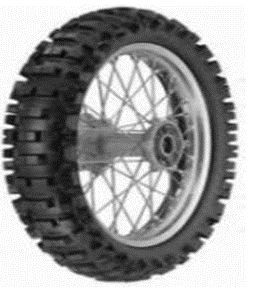
a. A scooter
b. A motor cycle
c. An auto-rickshaw
d. A car
Answer : B
Question. Sources of energy are sometimes classified as 'renewable' and 'non-renewable'. Renewable sources are those that can be replaced over a period of time. Which of the following is an example of a renewable source of energy being used?
a. Aeroplane used to transport people
b. Windmills used to pump water
c. Coal being used to heat water
d. Kerosene used to light lamps
Answer : B
Question. Which of these items belongs to BOTH these lists?

a. Cotton
b. Silk
c. Wool
d. Mustard
Answer : A
Question. Many cycles have a bulb which glows when the cycle moves. There is no battery or cell. Where does the energy for the bulb to glow come from?
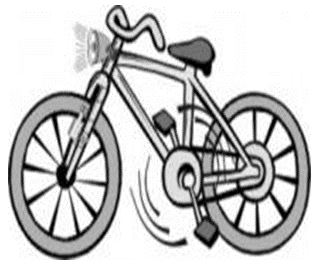
a. Energy is not required for the bulb to glow
b. From the sunlight falling on the bulb.
c. The bulb is charged at home and so it glows.
d. The bulb is charged at home and so it glows.
Answer : C
Question. Recycling (reusing) which of these objects will help us save more trees on earth?
a. Newspaper
b. Aluminium cans
c. Glass bottles
d. Iron grills
Answer : A
Question. The items in the table below have been put into two categories. Which set of headings is MOST suitable for the two categories?
| Group 1 | Group 2 |
| Rivers | Bulbs |
| Bananas | Windows |
| Seashells | Table |
| Clouds | Road roller |
a. Group 1: Living; Group 2: Non-living
b. Group 1: Not used at home; Group 2: Used at home
c. Group 1: Not man-made; Group 2: Man-made
d. Group 1: Not transparent; Group 2: Transparent
Answer : C
Question. Sources of energy are sometimes classified as 'renewable' and 'non-renewable'. Renewable sources are those that can be replaced over a period of time. Which of the following is an example of a renewable source of energy being used?
a. Aeroplane used to transport people
b. Windmills used to pump water
c. Coal being used to heat water
d. Kerosene used to light lamps
Answer : D
Question. Large quantities of metal like iron and aluminium are found in
a. sea water
b. coal
c. dead trees
d. Rocks
Answer : D
Question. In London, in order to reduce the air pollution due to the too many vehicles on the roads, the British government has started charging a tax on PRIVATE vehicles that cause pollution. Which of the following vehicles will have to pay this tax?
a. Petrol cars
b. Bicycles
c. Electric vehicles
d. Buses
Answer : A
Question. A cardboard is coated with vaseline and cut into four equal pieces. Each of these cards is hung at four different locations (as shown by the arrows in the figure below) for 2 days. Which piece would have the maximum soot/dirt particles on it?
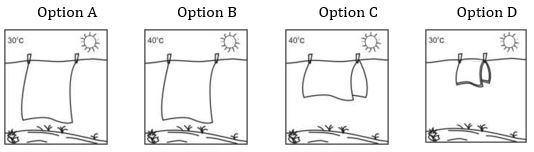
Answer : B
Question. The hardness of four different rocks was tested by trying to scratch a sample of each with the others. The results are shown in the table. Arrange the rocks in DECREASING order of hardness.
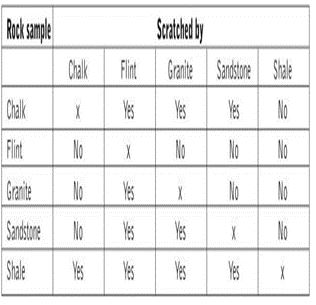
a. Chalk, Flint, Granite, Sandstone, Shale
b. Flint, Chalk, Granite, Shale, Sandstone
c. Flint, Granite, Sandstone, Chalk, Shale
d. Sandstone, Shale, Granite, Chalk, Flint
Answer : C
Question. Which of these is a NATURAL RESOURCE?
(a) Coal
(b) Plastic
(c) Cloth
(d) Brick
Answer : A
Question. The capacity of a petrol tank of a car would be measured in___________.
(a) seconds (s)
(b) kilograms (kg)
(c) liters (l)
(d) meters (m)
Answer : C
Question. What is the fuel used in a steam engine?
(a) Water
(b) Petrol
(c) Kerosene
(d) Coal
Answer : D
Question. Arrange these modes of transportation in the order of their invention from the EARLIEST to the MOST RECENT.

(a) Boat, train, horse-carriage, aeroplane
(b) Boat, horse-carriage, train, aeroplane
(c) Train, boat, horse-carriage, aeroplane
(d) Aeroplane, train, boat, horse-carriage
Answer : B
Question. Which letter will be a match for coal?
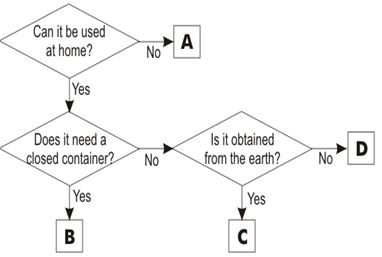
(a) A
(b) B
(c) C
(d) D
Answer : C
Question. Which of these sources of energy can be considered the LEAST polluting?
(a) Coal
(b) Natural gas
(c) Wind
(d) Pine wood
Answer : C
Question. Which of the following is obtained from Petroleum?
a. Wax
b. LPG
c. Coal Tar
d. All of these
Answer : D
Question. After petroleum is taken from the ground it is sent to the ____for cleaning.
a .Factory
b. Petrol pump
c .Refinery
d. All the above
Answer : C
Question. It is very important to conserve or save oil because ___
a. oil is dangerous substance
b. our scientists want to find new uses of it
c. oil isn't going to last for ever and we must use it without wasting it
d. none of the above
Answer : C
Question. Answer in one word
1. Name the mode of transport that does not cause pollution.
2. Name any one renewable source of energy
3. From where do we get petroleum?
Answer : 1. bicycle. 2. Solar energy/wind energy 3. Underground reservoir
Question. Fill in the blanks
1. Vehicles stop at a ____ for fuel.
2. Diesel is ____ than petrol.
Answer : 1. Petrol pump 2. Cheaper
Question. State whether true or false
1. Crude oil is used to make several things like plastics and paints.
2. Oil is formed naturally and quickly.
Answer : 1. True 2. True
Please refer to attached file for CBSE Class 5 EVS Revision Worksheet- What if it finishes
Free study material for Environmental Studies
Chapter 12 What if it Finishes ...? Printable Worksheets and Exercises for Class 5 Environmental Studies
Download Chapter Worksheets: Class 5 Environmental Studies
Explore reliable practice questions for Chapter 12 What if it Finishes ...? tailored for Class 5 Environmental Studies learners. Use these structured worksheets to evaluate exam preparedness and strengthen problem-solving skills throughout the 2026 academic session.
Concept Clarification for Chapter 12 What if it Finishes ...?
Designed around the official curriculum for Class 5 Environmental Studies, these practice sheets guarantee standard compliance. Reviewing step-by-step solutions after completion sharpens your accuracy and clarifies complex sub-topics within Chapter 12 What if it Finishes ...?.
Effective Revision Strategies for School Exams
Consistent engagement with these exercises builds familiarity with recurring exam themes. If specific areas within Chapter 12 What if it Finishes ...? cause trouble, utilize our dedicated NCERT solutions for Class 5 Environmental Studies to clear up doubts immediately.
FAQs
You can download the latest chapter-wise printable worksheets for Class 5 Environmental Studies Chapter 12 What if it Finishes ...? for free from StudiesToday.com. These have been made as per the latest CBSE curriculum for this academic year.
Yes, Class 5 Environmental Studies worksheets for Chapter 12 What if it Finishes ...? focus on activity-based learning and also competency-style questions. This helps students to apply theoretical knowledge to practical scenarios.
Yes, we have provided solved worksheets for Class 5 Environmental Studies Chapter 12 What if it Finishes ...? to help students verify their answers instantly.
Yes, our Class 5 Environmental Studies test sheets are mobile-friendly PDFs and can be printed by teachers for classroom.
For Chapter 12 What if it Finishes ...?, regular practice with our worksheets will improve question-handling speed and help students understand all technical terms and diagrams.