

Download Class 5 Environmental Studies Practice Worksheets
Access comprehensive chapter-wise worksheets for Chapter 05 Seeds and Seeds using the CBSE Class 5 EVS Seeds And Seeds Worksheet Set 02. Designed to align with the 2026-27 academic syllabus for Class 5 Environmental Studies, these printable practice sets help students reinforce key concepts and improve their overall exam readiness.
Access Chapter 05 Seeds and Seeds Practice Papers and Solutions
Navigate directly to the solved Environmental Studies worksheets using the digital viewer below. Each practice set includes detailed step-by-step solutions, allowing students to instantly cross-check their work and identify areas requiring further revision.
Question. Green plants make their own food using the energy from the __________.
(a) Sun
(b) Soil
(c) Air
(d) Water
Answer : A
Question. Nine bean plants were grown in varying amounts of light. Their heights were measured after some time. What conclusion can be drawn from the graph?
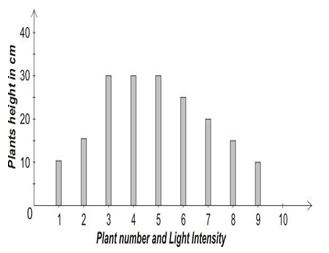
(a) Bean plants grow best in low light.
(b) Bean plants grow best in high light.
(c) Bean plants grow best in moderate light.
(d) Bean plants grow the same in all light.
Answer : C
Question. From which part of the plant does the FRUIT develop?
(a) Leaf
(b) Root
(c) Stem
(d) Flower
Answer : D
Question. Which of the following does the root absorb from the soil?
(a) Oxygen and nitrogen
(b) Water and minerals
(c) Seeds and insects
(d) Sunlight and air
Answer : B
Question. The experiment shown below was performed by a group of students using three identical sets of seeds. What were they probably trying to check?
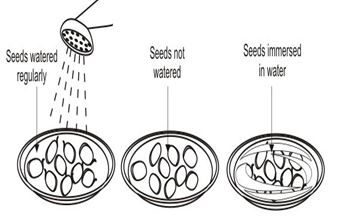
(a) Whether light is required for seed germination.
(b) Whether and how much water is required for seed germination.
(c) Whether air is required for seed germination.
(d) How long seeds take to germinate.
Answer : B
Question. Some examples of plant roots that we eat are turnip, carrot and ___________.
(a) Potato
(b) Spinach
(c) Radish
(d) Lady's finger
Answer : C
Question. The products listed above come from the same type of source. This source is_________.
Silk Wool Milk
(a) the sea
(b) plants
(c) rocks
(d) animals
Answer : D
Question. Among the following seeds which CANNOT be dispersed by the action of wind?
(a) Mango
(b) Cotton
(c) Coriander
(d) Mustard
Answer : A
Question. In which of these situations is the soil most likely to be blown away by the wind?
(a) where annual rainfall is high
(b) where the land is covered with grass
(c) where the land is covered by forests
(d) where annual rainfall is low
Answer : D
Question. The classification table below shows how some plants are grouped according to their usefulness
Which one of the following plants should be put in the space marked X?
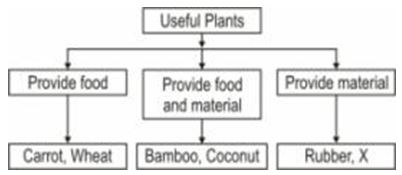
(a) Potatoes
(b) Bananas
(c) Sugarcane
(d) Teak
Answer : D
Question. If all the flowers and buds of a plant are plucked out (including new ones that appear) the plant will have no new:
(a) leaves
(b) stem
(c) seeds
(d) Roots
Answer : C
Question. Arun wants to do an experiment to check how temperature affects seed germination. He sets up five trays each having bean seeds as shown belowOnly some of the trays are really useful as far as Arun's experiment is concerned. Which ones?
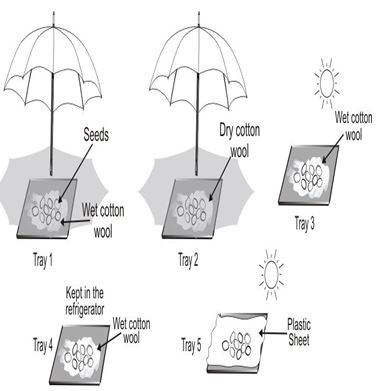
(a) Trays 1, 2, 3 and 4.
(b) Trays 2 and 5.
(c) Trays 1, 3 and 4.
(d) Trays 2, 4 and 5.
Answer : C
Question. Ravi plants a seed on September 1st and notes the increase in the growing plant's height every few days. Study the table and answer What was the height of the plant on September 15th?
| Date | Height increase over previous reading (cm) |
| September 3 | 2 |
| September 7 | 2 |
| September 11 | 2 |
| September 15 | 2 |
(a) 2 cm
(b) 6 cm
(c) 8 cm
(d) 30 cm
Answer : C
Question. Ravi plants a seed on September 1st and notes the increase in the growing plant's height every few days. Study the table and answer If the plant continued to grow at the same rate, what would be the height of the plant on September 23rd?
| Date | Height increase over previous reading (cm) |
| September 3 | 2 |
| September 7 | 2 |
| September 11 | 2 |
| September 15 | 2 |
(a) 10 cm
(b) 12 cm
(c) 22 cm
(d) 48 cm
Answer : B
Question. Identify this plant which is known for its large leaves and also its fruit
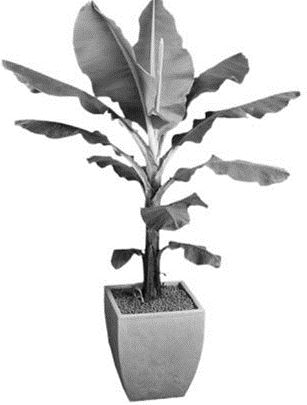
(a) Banana
(b) Mango
(c) Coconut
(d) PALM
Answer : A
Question. St. Mary's Convent organised a tree plantation ceremony to celebrate World Environment Day. Which of these is the MOST IMPORTANT benefit of planting trees?
(a) cleaning up the ground water.
(b) improving fertility of the soil.
(c) providing good and clean air.
(d) increasing greenery in the surroundings.
Answer : C
Question. Rahul wants to find out whether plants need water to grow. He takes 2 pots with identical plants. What should he do for the next few days
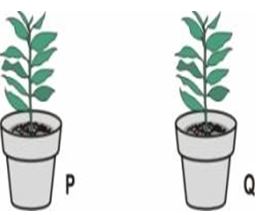
(a) water P more and Q less
(b) water only P and not Q
(c) water both P and Q equally
(d) not water either P or Q
Answer : B
Question. The table below shows which parts of certain plants are eaten by Man. For one of the plants, the part eaten is incorrectly put. Which one is it?
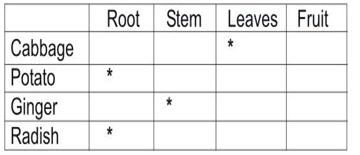
(a) Cabbage
(b) Potato
(c) Ginger
(d) Radish
Answer : B
Question. Where do aquatic (water) plants get the carbon dioxide needed for photosynthesis?
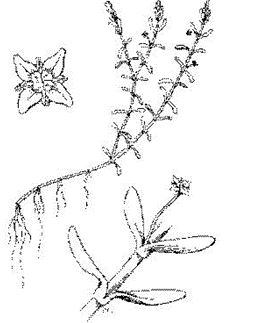
(a) From the carbon dioxide in air
(b) From the carbon dioxide dissolved in wate
(c) Aquatic plants do not make their own food
(d) Aquatic plants do not need carbon dioxide to make food
Answer : B
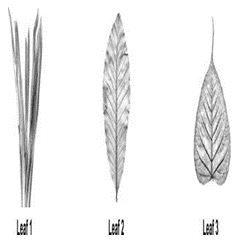
Question. Four friends look at the figures of 3 different kinds of leaves as shown in the figure and discuss which among the leaves is bigger.
Ashok: Leaf 1 is bigger because it is longer
Maya: Leaf 2 is bigger because it has more area
Nandini: Leaf 3 is bigger because it is broader
Chhaya: I cannot say until you specify what you mean by bigger
(a) Ashok is right.
(b) Maya is right.
(c) Nandini is right.
(d) Chhaya is right.
Answer : D
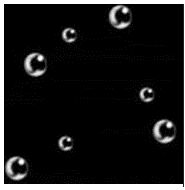
Question. The figure shows soap bubbles. It has gas in it.Which gas is used by the plants to make their food?
(a) Oxygen
(b) Carbon dioxide
(c) Nitrogen
(d) Hydrogen
Answer : B
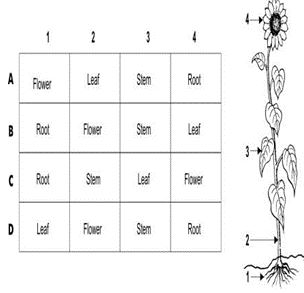
Question. Identify the parts of the plant shown in the figure:
(a) A
(b) B
(c) C
(d) D
Answer : C
Question 1. Encircle the name of seeds from the given block-
| M | O | O | N | G |
| U | C | Y | Z | V |
| S | H | P | U | R |
| T | A | E | H | W |
| A | N | A | T | B |
| R | A | J | M | A |
| D | S | F | U | R |
Answer: The names of seeds hidden in the letter block are:
1. MOONG (Top horizontal row: M-O-O-N-G)
2. RAJMA (Bottom-middle horizontal row: R-A-J-M-A)
3. MUSTARD (Vertical column 1 from top to bottom: M-U-S-T-A-R-D)
In simple words: The letter grid contains three hidden seed names: Moong, Rajma, and Mustard.
Exam Tip: Scan letter grids horizontally, vertically, and diagonally to find hidden words quickly.
Question 2. How will you identify the given seeds -
| Name of seeds | Colour | Shape (Draw) | Texture |
|---|---|---|---|
| Rajma | Reddish brown | Kidney-shaped | Smooth |
| Chana | Brown / Light brown | Beak-shaped / Round with a small pointed tip | Rough |
| Moong | Green | Small, oval / cylindrical | Smooth |
| Mustard | Dark brown / Black / Yellowish | Tiny, spherical / round | Smooth |
Answer: Seeds can be identified based on their distinct physical characteristics such as colour, shape, size, and texture.
In simple words: Different seeds have unique colours, shapes, and textures that help us identify them.
Exam Tip: Remember common physical traits of pulses and grains like Chana and Rajma for identification questions.
Question 3. What are the essential conditions for germination of a seed?
Germination of a seed → Water + Air (Oxygen) + Suitable Temperature (Warmth)
Answer: The essential conditions required for the germination of a seed are:
1. Water (Moisture) - to soften the seed coat and activate enzymes.
2. Air (Oxygen) - for respiration and energy release.
3. Suitable Temperature (Warmth) - for proper metabolic activities and growth.
In simple words: A seed needs water, air, and warmth to grow into a new plant.
Exam Tip: Always mention water, air, and warmth when asked about seed germination requirements.
Question 4. Study the figures given below and write your observations.
| Bean Seed | Maize Seed |
|---|---|
| 1) It is a dicotyledonous seed (has two cotyledons). | 1) It is a monocotyledonous seed (has one cotyledon). |
| 2) During germination, the cotyledons usually come out above the soil (epigeal germination). | 2) During germination, the cotyledon usually remains under the soil (hypogeal germination). |
| 3) The radicle grows downward to form roots and the plumule grows upward to form the shoot with broad leaves. | 3) The radicle forms the root system and the plumule grows upward to form narrow, grass-like leaves. |
Answer: Observations show the step-by-step developmental stages of seedling growth from a bean seed and a maize seed, highlighting differences in cotyledon structure and early leaf formation.
In simple words: Bean and maize seeds sprout differently because beans have two seed leaves while maize has one.
Exam Tip: Distinguish between monocot seeds (like maize) and dicot seeds (like bean) based on cotyledon count and germination type.
Free study material for Environmental Studies
CBSE Class 5 Environmental Studies Worksheets for Chapter 05 Seeds and Seeds
Daily Practice Questions for Class 5 Environmental Studies
Explore reliable practice questions for Chapter 05 Seeds and Seeds tailored for Class 5 Environmental Studies learners. Use these structured worksheets to evaluate exam preparedness and strengthen problem-solving skills throughout the 2026 academic session.
Detailed Answers for Class 5 Environmental Studies Chapter 05 Seeds and Seeds
Built using official NCERT guidelines for Class 5 Environmental Studies, these practice sheets provide reliable academic support. Cross-reference your completed work with our detailed solutions to learn standard answer-writing formats for CBSE exams.
Complete Your Chapter Revision
Wrap up your chapter revision by testing your knowledge against standard objective question formats. Explore our full library of free, up-to-date printable assignments to maximize your academic results in upcoming CBSE evaluations.
FAQs
You can download the latest chapter-wise printable worksheets for Class 5 Environmental Studies Chapter 05 Seeds and Seeds for free from StudiesToday.com. These have been made as per the latest CBSE curriculum for this academic year.
Yes, Class 5 Environmental Studies worksheets for Chapter 05 Seeds and Seeds focus on activity-based learning and also competency-style questions. This helps students to apply theoretical knowledge to practical scenarios.
Yes, we have provided solved worksheets for Class 5 Environmental Studies Chapter 05 Seeds and Seeds to help students verify their answers instantly.
Yes, our Class 5 Environmental Studies test sheets are mobile-friendly PDFs and can be printed by teachers for classroom.
For Chapter 05 Seeds and Seeds, regular practice with our worksheets will improve question-handling speed and help students understand all technical terms and diagrams.