

Download Class 11 Economics Practice Worksheets
Access comprehensive chapter-wise worksheets for Indian Economic Development Chapter 08 Infrastructure in India using the CBSE Class 11 Economics Infrastructure in India Worksheet. Designed to align with the 2026-27 academic syllabus for Class 11 Economics, these printable practice sets help students reinforce key concepts and improve their overall exam readiness.
Access Indian Economic Development Chapter 08 Infrastructure in India Practice Papers and Solutions
Navigate directly to the solved Economics worksheets using the digital viewer below. Each practice set includes detailed step-by-step solutions, allowing students to instantly cross-check their work and identify areas requiring further revision.
Case Study Questions Infrastructure in India Class 11 Economics
India is now the fourth largest and one of the fastest growing economy in the world. However, it faces both a tremendous backlog and a growing demand for infrastructure. The Indian economy expanded significantly in fiscal year 2006.
According to advance estimates released by the central statistical organisation, the economy recorded a Gross Domestic Product (GDP) growth rate (at factor cost) of 9.2% at constant prices, compared with 9% in the previous year.
The increase in growth rates in recent years is reflected in the 11th five-year plan (FY 2007–FY 2012) average annual growth target of 9%
compared with the 10th plan target of 8%.
High quality infrastructure is essential to harness the growth impulses in the economy. The planning commission (equivalent to a ministry of planning) has observed that poor infrastructure is India’s ‘‘Achilles’ heel’’ which is estimated to cost India 3-4% of lost GDP a year. The planning commission has estimated that India needs to increase its spending on infrastructure from 4-5% to 9% of GDP, if it is to achieve its growth targets.
Question: ……… is not a component of economic infrastructure.
(a) Energy
(b) Education
(c) Communication
(d) Transport
Answer: B
Question: Which of the following are advantages of a sound infrastructure in India?
(a) Cost effectiveness
(b) Attracts foreign capital
(c) Improves growth process
(d) All of the above
Answer: D
Question: Infrastructural development in India has been a responsibility of government sector only. Private sector has not been actively involved in infrastructural development. Which of the following is/are the reason(s) for the same?
(a) Huge cost involvement
(b) Long gestation period
(c) Less profitability
(d) All of these
Answer: D
Question: GDP, growth and infrastructure are …………proportionate.
(a) directly
(b) increasing
(c) indirectly
(d) declining
Answer: A
Question: Who is an ANM?
(a) Auxiliary Nursing Midwife
(b) Auxiliary National Medication
(c) Auxiliary Neuropathic Medicine
(d) Auxiliary Nursing Method
Answer: A
Question: Assertion (A) India is a case of an ‘over-urbanised’country.
Reason (R) Most of the large cities in India do nothave adequate infrastructure.
Alternatives
(a) Both Assertion (A) and Reason (R) are true and Reason (R) is the correct explanation of Assertion (A).
(b) Both Assertion (A) and Reason (R) are true, but Reason (R) is not the correct explanation of Assertion (A).
(c) Assertion (A) is false, but Reason (R) is true
(d) Both the statements are false
Answer: A
Infrastructure is often called as the lifeline of the economy of a nation. It comprises of a well established and well knit network of power, telecom, ports, airports, roads, civil aviation, railways and road transport in a country. Countries need adequate infrastructure so that various economic activities in an economy are executed efficiently, smoothly and above all in time.
The deficiencies in the infrastructural needs of a nation cannot be made up through imports rather the best approach is that it must be created within the domestic economy to put it on through the higher growth trajectory.
However,building of infrastructure requires large and lumpy investment and has a relatively long gestation period.
Due to this fact, infrastructural facilities are either built or run by the government and public sector enterprises and if private sector is permitted to make investment and run infrastructural projects,they must be regulated in order to ensure quality infrastructure to one and all in the society.
Question: The demand-supply gap of major infrastructural facility like power, transport can be met through .......... .
(a) active role of public and private sector
(b) active role of public sector only
(c) active role of private sector only
(d) None of the above
Answer: A
Question: Identify the main category of infrastructure mentioned in the above paragraph.
(a) Social
(b) Economic
(c) Personal
(d) Financial
Answer: B
Question: Infrastructure enhances economic growth through
(a) improved health and educational status
(b) bridging regional development
(c) provision of employment opportunities
(d) All of the above
Answer: D
Question: ‘Infrastructure is often called as the lifeline of the economy of a country,as it helps in increasing the productivity of the factors of production and enhancing the quality of life’.
(a) True
(b) False
(c) Partially true
(d) Partially false
Answer: A
Question: Match the following 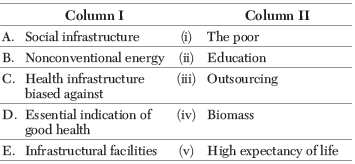
Codes
A B C D E
(a) (ii) (iv) (i) (v) (iii)
(b) (i) (ii) (iii) (iv) (v)
(c) (iii) (iv) (i) (iii) (v)
(d) (v) (iv) (iii) (ii) (i)
Answer: A
Question: Assertion (A) Infrastructure is the basic fundamental structure of economics development of a country.
Reason (R) Economic impact has a direct bearing withthe production activity of an economy.
Alternatives
(a) Both Assertion (A) and Reason (R) are true and Reason (R) is the correct explanation of Assertion (A)
(b) Both Assertion (A) and Reason (R) are true, but Reason (R) is not the correct explanation of Assertion (A)
(c) Assertion (A) is true, but Reason (R) is false
(d) Assertion (A) is false, but Reason (R) is true
Answer: B
I. Choose the correct alternative.
Question. Which of the following statement is not true for a worker?
(a) A worker contributes to the GDP.
(b) Workers may temporarily abstain from work due to illness.
(c) Self-employed are not workers.
(d) Those who help the main workers are also workers.
Answer: (c)
Question. What is the distribution of the workforce in rural and urban areas?
(a) 75 : 25
(b) 60 : 40
(c) 50 : 50
(d) 40 : 60
Answer: (a)
Question. Which of the following is the correct definition of self-employed?
(a) Not able to find jobs during some months of the year
(b) Own and operate their own enterprises
(c) Receive wages on a regular basis by the employer
(d) Casually engaged in other individuals enterprises
Answer: (b)
Question. What percent of urban workers are casual labourers?
(a) 54 percent
(b) 41 percent
(c) 39 percent
(d) 18 percent
Answer: (d)
Question. Which of the following workers is a regular salaried employee?
(a) Owner of a saloon
(b) Rickshaw puller
(c) Cashier in State Bank of India
(d) Vegetable vendor
Answer: (c)
Question. Which of the following is a primary sector activity?
(a) Mining and Quarrying
(b) Construction
(c) Trade
(d) Transport and Storage
Answer: (a)
Question. What proportion of the urban workforce is engaged in the secondary sector?
(a) Half
(b) One-third
(c) One-fourth
(d) One-fifth
Answer: (b)
Question. What was the average rate of growth of employment during 1950-2010?
(a) 1 percent
(b) 2 percent
(c) 5 percent
(d) 10 percent
Answer: (b)
Question. Which of the following is not a feature of organised sector?
(a) Job Security
(b) Social security benefits
(c) Irregular payment
(d) Fixed working hours
Answer: (c)
Question. Which of the following is not an employment generation programme?
(a) Rural Employment Generation Programme (REGP)
(b) Prime Minister’s Rozgar Yojana (PMRY)
(c) National Food for Work Programme (NFWP)
(d) Valmiki Ambedkar Awas Yojana
Answer: (d)
II. Fill in the blanks with the correct answer.
Question. Economic activities contribute to the ________ of the country.
Answer: GDP
Question. Worker-population ratio analyses the situation of ______ in the country.
Answer: employment
Question. Activities performed by women for the household are not recognized as ______ work.
Answer: productive
Question. Workers who own and operate an enterprise to earn their livelihood are known as ________
Answer: self-employed
Question. Among regular salaried employment, ___________ workers are found to be so engaged in greater proportion.
Answer: male
Question. Enterprises in _______ areas require workers on a regular basis.
Answer: urban
Question. The ________ sector gives employment to about one-third of the urban workforce.
Answer: secondary
Question. ______ sector covers those enterprises or places of work where the terms of employment are regular and therefore, people have assured work.
Answer: Organised
Question. In _______ unemployment, people are not able to find jobs during some months of the year.
Answer: seasonal
Question. NREGA 2005 promises ________ of guaranteed wage employment to all rural households who volunteer to do unskilled manual work.
Answer: 100 days
III. State whether the following statements are true or false.
Question. Workers do not include those who help the main workers in their activities.
Answer: False
Question. Urban people have a variety of employment opportunities.
Answer: True
Question. Self-employed and casual wage labourers are found more in rural areas.
Answer: True
Question. Casual wage work is the major source for both men and women.
Answer: False
Question. In the course of the economic development of a country, workers migrate from rural to urban areas.
Answer: True
Question. There has hardly been any change in the distribution of the workforce across various industries since the 1970s.
Answer: False
Question. The Indian economy has been able to produce more goods and services due to growth in employment opportunities.
Answer: False
Question. Employment is not secure in organised sector.
Answer: False
Question. The Indian government has initiated the modernisation of informal sector enterprises and the provision of social security measures to informal sector workers.
Answer: True
Question. Newly emerging jobs are found mostly in the service sector.
Answer: True
IV. Match the following.
Question.
Column-I
1. Rural unemployment
2. Urban unemployment
3. Participation rate
4. Number of persons unemployed
5. Unemployment due to economic fluctuations
Column-II
(A) Educated unemployment
(B) Cyclical unemployment
(C) Disguised unemployment
(D) \( \frac{\text{Workforce}}{\text{Total population}} \times 100 \)
(E) Labour force – workforce
Answer:
1. Rural unemployment — (C) Disguised unemployment
2. Urban unemployment — (A) Educated unemployment
3. Participation rate — (D) \( \frac{\text{Workforce}}{\text{Total population}} \times 100 \)
4. Number of persons unemployed — (E) Labour force – workforce
5. Unemployment due to economic fluctuations — (B) Cyclical unemployment
Free study material for Economics
Indian Economic Development Chapter 08 Infrastructure in India Printable Worksheets and Exercises for Class 11 Economics
Practice Exercises for Class 11 Economics Indian Economic Development Chapter 08 Infrastructure in India
Access structured practice worksheets for Indian Economic Development Chapter 08 Infrastructure in India aligned with the 2026 CBSE curriculum. These downloadable exercises for Class 11 Economics help students build accuracy and reinforce core concepts for upcoming school tests.
Step-by-Step Solutions and Practice Guidelines
Designed around the official curriculum for Class 11 Economics, these practice sheets guarantee standard compliance. Reviewing step-by-step solutions after completion sharpens your accuracy and clarifies complex sub-topics within Indian Economic Development Chapter 08 Infrastructure in India.
Enhance Speed with Online Practice
Consistent engagement with these exercises builds familiarity with recurring exam themes. If specific areas within Indian Economic Development Chapter 08 Infrastructure in India cause trouble, utilize our dedicated NCERT solutions for Class 11 Economics to clear up doubts immediately.
FAQs
You can download the latest chapter-wise printable worksheets for Class 11 Economics Indian Economic Development Chapter 08 Infrastructure in India for free from StudiesToday.com. These have been made as per the latest CBSE curriculum for this academic year.
Yes, Class 11 Economics worksheets for Indian Economic Development Chapter 08 Infrastructure in India focus on activity-based learning and also competency-style questions. This helps students to apply theoretical knowledge to practical scenarios.
Yes, we have provided solved worksheets for Class 11 Economics Indian Economic Development Chapter 08 Infrastructure in India to help students verify their answers instantly.
Yes, our Class 11 Economics test sheets are mobile-friendly PDFs and can be printed by teachers for classroom.
For Indian Economic Development Chapter 08 Infrastructure in India, regular practice with our worksheets will improve question-handling speed and help students understand all technical terms and diagrams.