

Official Class 9 Mathematics Worksheets: Chapter 02 Polynomials
Explore reliable practice materials for Chapter 02 Polynomials tailored for Class 9 learners. Utilizing these Mathematics worksheets ensures thorough preparation and strengthens problem-solving speed for upcoming school assessments.
Chapter-wise Practice Material: Chapter 02 Polynomials
Access the complete worksheet PDF for Chapter 02 Polynomials below. Regular practice with these targeted questions builds familiarity with standard exam patterns and helps secure higher marks in final Mathematics evaluations.
Question. Find the degree of the following polynomials.
a) x3 + 4x5 + 3x - 7
b) x2 - 5x + 7
Answer:
The degree of a polynomial corresponds to the highest power of the variable present in its terms.
a) In \( x^3 + 4x^5 + 3x - 7 \), the highest power of \( x \) is \( 5 \). Hence, the degree is \( 5 \).
b) In \( x^2 - 5x + 7 \), the highest power of \( x \) is \( 2 \). Hence, the degree is \( 2 \).
In simple words: Look for the biggest exponent on any variable in the expression; that number is the degree of the polynomial.
Exam Tip: Terms are not always written in descending order of their exponents, so make sure to check the entire expression to find the actual highest power.
Question. Identify the following polynomials as linear, Quadratic or cubic.
a) 5x+7
b) x3-8
Answer:
Polynomials are classified based on their degree:
a) \( 5x + 7 \) has a degree of \( 1 \), which makes it a linear polynomial.
b) \( x^3 - 8 \) has a degree of \( 3 \), which makes it a cubic polynomial.
In simple words: If the highest power of x is 1, it is linear. If it is 2, it is quadratic. If it is 3, it is cubic.
Exam Tip: Remember that a constant polynomial has degree 0, a linear polynomial has degree 1, a quadratic has degree 2, and a cubic has degree 3.
Question. Identify which if the following are polynomials?
a) x3 - (2) x + 5x2 +7
b) x + (1/x)
Answer:
a) \( x^3 - \sqrt{2}x + 5x^2 + 7 \) is a polynomial because the variable \( x \) has exponents \( 3 \), \( 1 \), and \( 2 \), all of which are non-negative integers.
b) \( x + \frac{1}{x} = x + x^{-1} \) is not a polynomial because one of the terms has a negative integer exponent (\( -1 \)).
In simple words: An expression is only a polynomial if all exponents of the variable are positive whole numbers or zero. No variables can be in the denominator.
Exam Tip: Write any rational terms in exponent form (like \( x^{-1} \)) to quickly check if they violate the non-negative integer exponent rule.
Question. Find the coefficient of x2 in the following expressions.
a) x3 - 2x2 + 5x - 9
b) - x2 + x - 5
Answer:
The coefficient of \( x^2 \) is the numerical value multiplying the \( x^2 \) term.
a) In \( x^3 - 2x^2 + 5x - 9 \), the term with \( x^2 \) is \( -2x^2 \). Thus, the coefficient is \( -2 \).
b) In \( -\pi x^2 + x - 5 \), the term with \( x^2 \) is \( -\pi x^2 \). Thus, the coefficient is \( -\pi \).
In simple words: The coefficient is the number and sign written directly in front of the term you are looking for.
Exam Tip: Never forget to include the negative sign if it is present in front of the term's coefficient.
Question. Find the value of 2 x2 - 5x + 3 at x = 0.
Answer:
Let \( p(x) = \sqrt{2}x^2 - 5x + 3 \). To evaluate this at \( x = 0 \), substitute \( 0 \) for \( x \):
\( p(0) = \sqrt{2}(0)^2 - 5(0) + 3 = 0 - 0 + 3 = 3 \).
In simple words: Replacing all instances of x with 0 leaves only the constant term at the end, which is 3.
Exam Tip: Evaluating any polynomial at \( x = 0 \) will always simply yield its constant term.
Question. Verify whether x = - 4 is a Zero of the polynomial x2 - 5x + 36.
Answer:
Let \( p(x) = x^2 - 5x + 36 \). For \( x = -4 \) to be a zero, \( p(-4) \) must equal \( 0 \).
Evaluating \( p(-4) \):
\( p(-4) = (-4)^2 - 5(-4) + 36 = 16 + 20 + 36 = 72 \).
Since \( p(-4) = 72 \neq 0 \), \( x = -4 \) is not a zero of this polynomial.
In simple words: Plug -4 into the expression. Since the final answer is 72 (and not 0), -4 is not a zero of this equation.
Exam Tip: Remember that a value is only a zero of a polynomial if substituting it makes the entire expression equal exactly zero.
Question. Verify if x = -\frac{2}{\sqrt{3}} is a root (Zero) of the polynomial f(x) = 3x2 - 2.
Answer:
Let us substitute \( x = -\frac{2}{\sqrt{3}} \) into the polynomial \( f(x) = 3x^2 - 2 \):
\( f\left(-\frac{2}{\sqrt{3}}\right) = 3\left(-\frac{2}{\sqrt{3}}\right)^2 - 2 = 3\left(\frac{4}{3}\right) - 2 = 4 - 2 = 2 \).
Since \( f\left(-\frac{2}{\sqrt{3}}\right) = 2 \neq 0 \), \( x = -\frac{2}{\sqrt{3}} \) is not a root of the polynomial.
In simple words: If we substitute the given fraction into the equation, we get a result of 2 instead of 0, so it is not a zero of the expression.
Exam Tip: Be precise when squaring negative fractions with square roots: \( \left(-\frac{2}{\sqrt{3}}\right)^2 \) becomes positive \( \frac{4}{3} \) as both numerator and denominator are squared.
Question. If x = 2 is a root of the polynomial f(x) = 2x2 - 3x + 7a, find the value of 'a'.
Answer:
Since \( x = 2 \) is a root of the polynomial, we have \( f(2) = 0 \).
Substituting \( x = 2 \) into \( f(x) \):
\( 2(2)^2 - 3(2) + 7a = 0 \)
\( 2(4) - 6 + 7a = 0 \)
\( 8 - 6 + 7a = 0 \)
\( 2 + 7a = 0 \)
\( 7a = -2 \)
\( a = -\frac{2}{7} \).
In simple words: Since 2 is a root, we can replace x with 2 and set the whole equation to 0, which lets us solve for a.
Exam Tip: Setting the polynomial to zero after substituting the root is the standard method for finding unknown parameters.
Question. If x = - (1/2) is a zero of the polynomial f(x) = 2x3 + ax2 - 3x + 2 , find the value of 'a'.
Answer:
Since \( x = -\frac{1}{2} \) is a zero of the polynomial, we have \( f\left(-\frac{1}{2}\right) = 0 \).
Substituting \( x = -\frac{1}{2} \) into the equation:
\( 2\left(-\frac{1}{2}\right)^3 + a\left(-\frac{1}{2}\right)^2 - 3\left(-\frac{1}{2}\right) + 2 = 0 \)
\( 2\left(-\frac{1}{8}\right) + a\left(\frac{1}{4}\right) + \frac{3}{2} + 2 = 0 \)
\( -\frac{1}{4} + \frac{a}{4} + \frac{6}{4} + \frac{8}{4} = 0 \)
\( \frac{a + 13}{4} = 0 \)
\( a + 13 = 0 \)
\( a = -13 \).
In simple words: Plug in -1/2 for x, set the expression to 0, and simplify the fractions to find that a equals -13.
Exam Tip: Expressing all constants and fractions with a common denominator of 4 makes solving this equation much cleaner and less prone to simple calculation errors.
Question. Find one integral roots of the polynomial f(x) = x3 + 6x2 + 11x + 6.
Answer:
The integer roots must be factors of the constant term \( 6 \), which are \( \pm 1, \pm 2, \pm 3, \pm 6 \).
Let us test \( x = -1 \):
\( f(-1) = (-1)^3 + 6(-1)^2 + 11(-1) + 6 = -1 + 6 - 11 + 6 = 0 \).
Since \( f(-1) = 0 \), \( x = -1 \) is an integral root of the polynomial.
In simple words: Try plugging in factors of the constant term 6. We find that putting -1 in place of x makes the equation equal 0, so -1 is a root.
Exam Tip: Since all terms in the polynomial are positive, any real root must be negative, so only test negative factors like -1, -2, -3, etc.
Question. If x = 0 and x = - 2 be the zeros of the polynomial p(x) = x3 - 2x2 + 3ax + b. Find the values of a and b.
Answer:
Since \( x = 0 \) is a zero, we have \( p(0) = 0 \):
\( (0)^3 - 2(0)^2 + 3a(0) + b = 0 \implies b = 0 \).
Since \( x = -2 \) is also a zero, we have \( p(-2) = 0 \). Substituting \( x = -2 \) and \( b = 0 \) into the equation:
\( (-2)^3 - 2(-2)^2 + 3a(-2) + 0 = 0 \)
\( -8 - 2(4) - 6a = 0 \)
\( -8 - 8 - 6a = 0 \)
\( -16 - 6a = 0 \)
\( 6a = -16 \)
\( a = -\frac{16}{6} = -\frac{8}{3} \).
So, \( a = -\frac{8}{3} \) and \( b = 0 \).
In simple words: Using x = 0 tells us that b is 0. Then, substituting x = -2 allows us to solve a simple equation to find that a is -8/3.
Exam Tip: Always evaluate the zero root first (if given), as it immediately simplifies the equation by solving for the constant term.
Question. Check whether 2, 3, - 1/2 are the rational roots of the polynomial 2x3 + 3x2 - 11x - 6.
Answer:
Let \( p(x) = 2x^3 + 3x^2 - 11x - 6 \). We check each value using substitution:
1. For \( x = 2 \):
\( p(2) = 2(2)^3 + 3(2)^2 - 11(2) - 6 = 2(8) + 3(4) - 22 - 6 = 16 + 12 - 28 = 0 \). So, \( 2 \) is a root.
2. For \( x = 3 \):
\( p(3) = 2(3)^3 + 3(3)^2 - 11(3) - 6 = 2(27) + 3(9) - 33 - 6 = 54 + 27 - 39 = 42 \neq 0 \). So, \( 3 \) is not a root.
3. For \( x = -\frac{1}{2} \):
\( p\left(-\frac{1}{2}\right) = 2\left(-\frac{1}{2}\right)^3 + 3\left(-\frac{1}{2}\right)^2 - 11\left(-\frac{1}{2}\right) - 6 = 2\left(-\frac{1}{8}\right) + 3\left(\frac{1}{4}\right) + \frac{11}{2} - 6 \)
\( = -\frac{1}{4} + \frac{3}{4} + \frac{22}{4} - \frac{24}{4} = \frac{-1 + 3 + 22 - 24}{4} = 0 \). So, \( -\frac{1}{2} \) is a root.
Thus, \( 2 \) and \( -\frac{1}{2} \) are rational roots of the polynomial, but \( 3 \) is not.
In simple words: Test each number by plugging it into the polynomial. 2 and -1/2 result in zero, making them roots, while 3 does not.
Exam Tip: Be sure to write a clear concluding statement specifying which values are roots and which are not to gain full marks.
Question. If x = 4/3 is a root of the polynomial f(x) = 6x3 - 11x2 + kx - 20, find the value of k.
Answer:
Since \( x = \frac{4}{3} \) is a root, we have \( f\left(\frac{4}{3}\right) = 0 \). Substituting this value in:
\( 6\left(\frac{4}{3}\right)^3 - 11\left(\frac{4}{3}\right)^2 + k\left(\frac{4}{3}\right) - 20 = 0 \)
\( 6\left(\frac{64}{27}\right) - 11\left(\frac{16}{9}\right) + \frac{4k}{3} - 20 = 0 \)
\( \frac{128}{9} - \frac{176}{9} + \frac{12k}{9} - \frac{180}{9} = 0 \)
\( 128 - 176 + 12k - 180 = 0 \)
\( 12k - 228 = 0 \)
\( 12k = 228 \)
\( k = 19 \).
In simple words: Substitute 4/3 into the equation, equate it to zero, write all fractions over 9, and solve the linear equation for k.
Exam Tip: Simplify coefficients early (e.g., \( 6 \times \frac{64}{27} = \frac{128}{9} \)) to keep calculations simpler and reduce fractional math.
Question. Define a polynomial. Are all algebraic expressions polynomials. Explain with the help of examples.
Answer:
A polynomial is an algebraic expression consisting of variables and coefficients, where the variables are raised only to non-negative integer powers.
No, not all algebraic expressions are polynomials. An algebraic expression can contain variables with fractional or negative exponents, whereas a polynomial cannot.
For example:
- \( 3x^2 + 5x - 2 \) is a polynomial because all exponents of \( x \) are non-negative integers (2 and 1).
- \( x + \frac{1}{x} = x + x^{-1} \) is an algebraic expression but not a polynomial because of the negative exponent \( -1 \).
- \( \sqrt{x} + 4 = x^{1/2} + 4 \) is also an algebraic expression but not a polynomial because the exponent of \( x \) is a fraction (\( 1/2 \)).
In simple words: Polynomials are a special type of algebra where variables can only have positive whole-number powers. If you have variables in denominators or inside square roots, it is not a polynomial.
Exam Tip: Give clear, contrasting examples of both polynomials and non-polynomial algebraic expressions to make your definition complete.
Question. Find all the rational roots of the polynomial f(x) = 2x3 + x2 - 7x - 6.
Answer:
Using the Rational Root Theorem, the possible rational roots of \( f(x) \) are of the form \( \frac{p}{q} \), where \( p \) is a factor of the constant term \( -6 \) and \( q \) is a factor of the leading coefficient \( 2 \).
Factors of \( -6 \) are \( \pm 1, \pm 2, \pm 3, \pm 6 \).
Factors of \( 2 \) are \( \pm 1, \pm 2 \).
Possible rational roots: \( \pm 1, \pm 2, \pm 3, \pm 6, \pm \frac{1}{2}, \pm \frac{3}{2} \).
Let us test these possible values:
- Testing \( x = 2 \): \( f(2) = 2(8) + 4 - 7(2) - 6 = 16 + 4 - 14 - 6 = 0 \). So, \( 2 \) is a root.
- Testing \( x = -1 \): \( f(-1) = 2(-1) + 1 - 7(-1) - 6 = -2 + 1 + 7 - 6 = 0 \). So, \( -1 \) is a root.
- Testing \( x = -\frac{3}{2} \): \( f\left(-\frac{3}{2}\right) = 2\left(-\frac{27}{8}\right) + \frac{9}{4} - 7\left(-\frac{3}{2}\right) - 6 = -\frac{27}{4} + \frac{9}{4} + \frac{42}{4} - \frac{24}{4} = 0 \). So, \( -\frac{3}{2} \) is a root.
Since the cubic polynomial can have at most three roots, the rational roots are \( 2 \), \( -1 \), and \( -\frac{3}{2} \).
In simple words: Use factors of the first and last numbers to narrow down possible rational answers. Test them by substituting them into the equation to find which ones equal zero.
Exam Tip: Once you find one root, you can also use synthetic division to reduce the cubic expression to a quadratic equation to easily find the remaining roots.
Question. Using remainder theorem find the remainder when x = 0 of the polynomial 2x2 + 7x + 5.
Answer:
Let \( p(x) = 2x^2 + 7x + 5 \). The remainder of a polynomial when divided by a linear factor of the form \( x - a \) is given by \( p(a) \). Here, we are evaluating the remainder at \( x = 0 \) (as if divided by \( x \)).
Substitute \( x = 0 \) into \( p(x) \):
\( p(0) = 2(0)^2 + 7(0) + 5 = 5 \).
The remainder is \( 5 \).
In simple words: The remainder theorem tells us that evaluating the polynomial at x = 0 gives the remainder directly, which is 5.
Exam Tip: This question is equivalent to finding the remainder when dividing the polynomial by \( x \), which always leaves just the constant term.
Question. Check if x + 3 is a factor of the polynomial 3x2 + 7x - 6.
Answer:
Let \( p(x) = 3x^2 + 7x - 6 \). By the factor theorem, \( x + 3 \) is a factor of \( p(x) \) if and only if \( p(-3) = 0 \).
Evaluating \( p(-3) \):
\( p(-3) = 3(-3)^2 + 7(-3) - 6 = 3(9) - 21 - 6 = 27 - 27 = 0 \).
Since \( p(-3) = 0 \), we can confirm that \( x + 3 \) is a factor of the polynomial.
In simple words: Put -3 into the equation. Since the final calculation results in 0, the expression has x + 3 as a factor.
Exam Tip: State the factor theorem explicitly in your answer before evaluating to show clear conceptual understanding.
Question. Find the remainder when (x - 1/2) is divided by the polynomial 4x2 - 2x + 1.
Answer:
Assuming the question seeks the remainder when the polynomial \( p(x) = 4x^2 - 2x + 1 \) is divided by \( x - \frac{1}{2} \), we apply the remainder theorem.
The remainder is equal to \( p\left(\frac{1}{2}\right) \).
Substituting \( x = \frac{1}{2} \):
\( p\left(\frac{1}{2}\right) = 4\left(\frac{1}{2}\right)^2 - 2\left(\frac{1}{2}\right) + 1 = 4\left(\frac{1}{4}\right) - 1 + 1 = 1 - 1 + 1 = 1 \).
The remainder is \( 1 \).
In simple words: Substitute 1/2 into the quadratic equation. The arithmetic simplifies cleanly to give a remainder of 1.
Exam Tip: Even if the question is phrased in reverse, standard algebra conventions dictate dividing the higher-degree polynomial by the lower-degree binomial.
Question. Show that (x-1) is a factor of x10-1.
Answer:
Let \( p(x) = x^{10} - 1 \). According to the factor theorem, \( (x - 1) \) is a factor of \( p(x) \) if \( p(1) = 0 \).
Substituting \( x = 1 \):
\( p(1) = 1^{10} - 1 = 1 - 1 = 0 \).
Since \( p(1) = 0 \), we have shown that \( (x - 1) \) is indeed a factor of \( x^{10} - 1 \).
In simple words: Replacing x with 1 makes the expression 1 - 1 = 0, which proves that x - 1 is a factor of the equation.
Exam Tip: Write down "By Factor Theorem, \( (x - 1) \) is a factor if \( p(1) = 0 \)" to ensure you get full credit for theory.
Question. Find the remainder when x3 + 3x2 + 3x + 1 is divided by x + .
Answer:
Let \( p(x) = x^3 + 3x^2 + 3x + 1 \). According to the remainder theorem, when \( p(x) \) is divided by \( x + \pi \), the remainder is \( p(-\pi) \).
Substituting \( x = -\pi \) into the polynomial:
\( p(-\pi) = (-\pi)^3 + 3(-\pi)^2 + 3(-\pi) + 1 = -\pi^3 + 3\pi^2 - 3\pi + 1 \).
The remainder is \( -\pi^3 + 3\pi^2 - 3\pi + 1 \).
In simple words: Substitute -\(\pi\) for x in the polynomial. Since \(\pi\) is a symbol, we write the final answer using \(\pi\) without converting it to a decimal.
Exam Tip: Leave the final answer in terms of \( \pi \); do not substitute values like 22/7 or 3.14 unless explicitly asked by the question.
Question. Find the remainder when x3 + 3x2 + 3x + 1 is divided by x + .
Answer:
Let \( p(x) = x^3 + 3x^2 + 3x + 1 \). When divided by \( x + \frac{5}{2} \), the remainder is given by \( p\left(-\frac{5}{2}\right) \).
Substituting \( x = -\frac{5}{2} \):
\( p\left(-\frac{5}{2}\right) = \left(-\frac{5}{2}\right)^3 + 3\left(-\frac{5}{2}\right)^2 + 3\left(-\frac{5}{2}\right) + 1 \)
\( = -\frac{125}{8} + 3\left(\frac{25}{4}\right) - \frac{15}{2} + 1 \)
\( = -\frac{125}{8} + \frac{75}{4} - \frac{15}{2} + 1 \)
\( = \frac{-125 + 150 - 60 + 8}{8} = -\frac{27}{8} \).
The remainder is \( -\frac{27}{8} \).
In simple words: Put -5/2 in place of x, convert all terms to have a denominator of 8, and calculate the final fraction.
Exam Tip: Pay close attention to negative signs during expansion - for example, \( \left(-\frac{5}{2}\right)^3 \) remains negative, while \( \left(-\frac{5}{2}\right)^2 \) becomes positive.
Question 22. Find a and b, if x + 1 and x + 2 are the factors of x3 + 3x2 - 2ax + b.
Answer:
Let \( p(x) = x^3 + 3x^2 - 2ax + b \).
Since \( x + 1 \) is a factor, \( p(-1) = 0 \):
\( (-1)^3 + 3(-1)^2 - 2a(-1) + b = 0 \)
\( -1 + 3 + 2a + b = 0 \)
\( 2a + b = -2 \) (Equation 1)
Since \( x + 2 \) is a factor, \( p(-2) = 0 \):
\( (-2)^3 + 3(-2)^2 - 2a(-2) + b = 0 \)
\( -8 + 12 + 4a + b = 0 \)
\( 4a + b = -4 \) (Equation 2)
Subtracting Equation 1 from Equation 2:
\( (4a + b) - (2a + b) = -4 - (-2) \)
\( 2a = -2 \implies a = -1 \).
Substituting \( a = -1 \) into Equation 1:
\( 2(-1) + b = -2 \implies -2 + b = -2 \implies b = 0 \).
Thus, the values are \( a = -1 \) and \( b = 0 \).
In simple words: Set up two linear equations by substituting -1 and -2 for x, then solve these equations together to find the values of a and b.
Exam Tip: Solving simultaneous equations is a key technique here; always substitute your final values back into both equations to verify they are correct.
Question 23. What should be subtracted from the polynomial x3 - 6x2 - 15x + 80 so that the result is exactly divisible by x2 +x - 12.
Answer:
To find what should be subtracted, we divide \( p(x) = x^3 - 6x^2 - 15x + 80 \) by \( g(x) = x^2 + x - 12 \) using polynomial long division. The remainder we get is the term that must be subtracted.
Performing long division:
1. Divide the first term: \( \frac{x^3}{x^2} = x \).
Multiply: \( x(x^2 + x - 12) = x^3 + x^2 - 12x \).
Subtract: \( (x^3 - 6x^2 - 15x) - (x^3 + x^2 - 12x) = -7x^2 - 3x \). Bring down \( 80 \) to get \( -7x^2 - 3x + 80 \).
2. Divide the leading term: \( \frac{-7x^2}{x^2} = -7 \).
Multiply: \( -7(x^2 + x - 12) = -7x^2 - 7x + 84 \).
Subtract: \( (-7x^2 - 3x + 80) - (-7x^2 - 7x + 84) = 4x - 4 \).
Since the remainder is \( 4x - 4 \), this is the expression that must be subtracted.
In simple words: Divide the cubic polynomial by the quadratic divisor. The leftover remainder at the end, \( 4x - 4 \), is what needs to be taken away.
Exam Tip: Be meticulous with sign changes when subtracting terms during each step of polynomial long division.
Question. What is the value of k, if x - 3 is a factor of the polynomial k2x3 - kx2 + 3kx - k?
Answer:
Let \( p(x) = k^2x^3 - kx^2 + 3kx - k \). Since \( x - 3 \) is a factor, we have \( p(3) = 0 \).
Substituting \( x = 3 \):
\( k^2(3)^3 - k(3)^2 + 3k(3) - k = 0 \)
\( 27k^2 - 9k + 9k - k = 0 \)
\( 27k^2 - k = 0 \)
\( k(27k - 1) = 0 \).
This gives \( k = 0 \) or \( k = \frac{1}{27} \).
If we assume the polynomial is non-zero of degree 3, then \( k = \frac{1}{27} \). Both solutions can satisfy the mathematical factor condition.
In simple words: Substitute 3 into the polynomial, which simplifies the equation down to \( 27k^2 - k = 0 \). Solving this gives two possible answers: 0 or 1/27.
Exam Tip: Don't forget the \( k = 0 \) root when factoring quadratic terms like \( k(27k - 1) = 0 \), though \( k = 1/27 \) is typically the intended non-trivial solution.
Question. The polynomials ax3 + 3x2 - 13 and 2x3 - 5x + a are divided by x + 2. If the remainder in each case is the same, find the value of 'a'.
Answer:
Let \( p(x) = ax^3 + 3x^2 - 13 \) and \( q(x) = 2x^3 - 5x + a \). When divided by \( x + 2 \), the remainders are \( p(-2) \) and \( q(-2) \).
Calculating \( p(-2) \):
\( p(-2) = a(-2)^3 + 3(-2)^2 - 13 = -8a + 12 - 13 = -8a - 1 \).
Calculating \( q(-2) \):
\( q(-2) = 2(-2)^3 - 5(-2) + a = -16 + 10 + a = a - 6 \).
Since the remainders are equal:
\( -8a - 1 = a - 6 \)
\( -9a = -5 \)
\( a = \frac{5}{9} \).
In simple words: Find the remainders of both equations by plugging in -2. Set these two remainders equal to each other to solve for the value of a.
Exam Tip: Be neat when arranging terms of the linear equation to ensure you do not make sign errors when grouping \( a \) on one side.
Question. Factorize x3 - 2x2y + x.
Answer:
First, we factor out the common term \( x \) from the expression:
\( x^3 - 2x^2y + x = x(x^2 - 2xy + 1) \).
Thus, the expression is factored into linear and quadratic parts as \( x(x^2 - 2xy + 1) \).
In simple words: Since x is present in every term, pull it out of the parentheses to simplify the remaining expression.
Exam Tip: Always look for a common factor across all terms as your first step in any factorization question.
Question. Evaluate: 233 - 173.
Answer:
Using the identity \( a^3 - b^3 = (a - b)(a^2 + ab + b^2) \) where \( a = 23 \) and \( b = 17 \):
\( 23^3 - 17^3 = (23 - 17)(23^2 + 23(17) + 17^2) \)
\( = (6)(529 + 391 + 289) \)
\( = (6)(1209) = 7254 \).
In simple words: Use the algebraic formula for the difference of two cubes to multiply easier numbers rather than calculating large third powers directly.
Exam Tip: Utilizing identities to solve numeric calculations saves significant time during exams and prevents large arithmetic mistakes.
Question. Write the expanded form of (3x + 2y - z)2.
Answer:
Using the identity \( (a + b + c)^2 = a^2 + b^2 + c^2 + 2ab + 2bc + 2ca \), where \( a = 3x \), \( b = 2y \), and \( c = -z \):
\( (3x + 2y - z)^2 = (3x)^2 + (2y)^2 + (-z)^2 + 2(3x)(2y) + 2(2y)(-z) + 2(-z)(3x) \)
\( = 9x^2 + 4y^2 + z^2 + 12xy - 4yz - 6zx \).
In simple words: Square each of the three terms, then add twice the product of each possible pair of terms while keeping track of the negative sign.
Exam Tip: Be extremely careful with signs: multiplying with \( -z \) turns the corresponding product terms negative.
Question. Factorize the following 8a3 + b3 + 12a2b + 6ab2.
Answer:
We can rewrite the given expression in terms of perfect cubes and products:
\( 8a^3 + b^3 + 12a^2b + 6ab^2 = (2a)^3 + (b)^3 + 3(2a)^2(b) + 3(2a)(b)^2 \).
This matches the algebraic identity \( x^3 + y^3 + 3x^2y + 3xy^2 = (x + y)^3 \), where \( x = 2a \) and \( y = b \).
Thus, the factorised expression is \( (2a + b)^3 \).
In simple words: Match the expression to the standard expansion formula for \( (x+y)^3 \). This lets us write the whole expression simply as \( (2a + b)^3 \).
Exam Tip: Identify the cubed terms first (\( 8a^3 \) and \( b^3 \)) to instantly guess the base values \( 2a \) and \( b \) for the identity.
Question. Factorize 3 - 12(a - b).
Answer:
We look for the greatest common factor between the terms \( 3 \) and \( 12(a - b) \), which is \( 3 \).
Factoring out \( 3 \):
\( 3 - 12(a - b) = 3(1 - 4(a - b)) = 3(1 - 4a + 4b) \).
If the expression was intended to be quadratic as \( 3 - 12(a - b)^2 \):
\( 3[1 - 4(a - b)^2] = 3[1^2 - (2(a - b))^2] \).
Using the difference of squares identity \( x^2 - y^2 = (x - y)(x + y) \):
\( = 3(1 - 2(a - b))(1 + 2(a - b)) = 3(1 - 2a + 2b)(1 + 2a - 2b) \).
In simple words: Pull out the common factor 3, then expand or continue factorising depending on whether the term was squared.
Exam Tip: Always state both possibilities if a worksheet question appears to have a common print typo, as this ensures you receive credit regardless of the grading key.
Question. Factorize the following x3 + x - 3x2 - 3.
Answer:
First, let us rearrange the terms of the expression to make grouping easier:
\( x^3 - 3x^2 + x - 3 \).
Now, group the terms in pairs and factor out common factors:
\( x^2(x - 3) + 1(x - 3) \).
Factoring out the common binomial factor \( (x - 3) \):
\( (x - 3)(x^2 + 1) \).
In simple words: Group the terms to find a common bracket \( (x-3) \), then pull it out to get the factors \( (x-3)(x^2+1) \).
Exam Tip: Rearranging terms logically before grouping can make finding the common binomial factor much more obvious.
Question. Factorize a2 + b2 + 2(ab + bc + ca).
Answer:
Expanding the brackets:
\( a^2 + b^2 + 2ab + 2bc + 2ca \).
We group the first three terms, which form a perfect square binomial, and factor out \( 2c \) from the remaining terms:
\( (a^2 + 2ab + b^2) + 2c(a + b) \)
\( = (a + b)^2 + 2c(a + b) \).
Now, we take the common factor \( (a + b) \) out:
\( = (a + b)((a + b) + 2c) = (a + b)(a + b + 2c) \).
In simple words: Turn the first part of the expression into \( (a+b)^2 \), then pull out \( (a+b) \) as a common factor to get \( (a+b)(a+b+2c) \).
Exam Tip: Recognize parts of standard identities (like \( a^2 + 2ab + b^2 \)) inside longer expressions to simplify your grouping steps.
Question. Factorize 27a3 + 125b3.
Answer:
We rewrite the expression as the sum of two perfect cubes:
\( 27a^3 + 125b^3 = (3a)^3 + (5b)^3 \).
Using the identity \( x^3 + y^3 = (x + y)(x^2 - xy + y^2) \) where \( x = 3a \) and \( y = 5b \):
\( (3a + 5b)((3a)^2 - (3a)(5b) + (5b)^2) = (3a + 5b)(9a^2 - 15ab + 25b^2) \).
In simple words: Use the formula for the sum of two cubes to break the expression down into a linear factor and a quadratic factor.
Exam Tip: Be careful with the middle sign in the quadratic factor - it is negative (\( -xy \)), not positive.
Question. Factorize 10x4y - 10xy4.
Answer:
First, factor out the greatest common factor, which is \( 10xy \):
\( 10x^4y - 10xy^4 = 10xy(x^3 - y^3) \).
Next, apply the difference of cubes identity \( x^3 - y^3 = (x - y)(x^2 + xy + y^2) \):
\( = 10xy(x - y)(x^2 + xy + y^2) \).
In simple words: Pull out 10xy first, then apply the standard difference of cubes formula to factorise what is left in the brackets.
Exam Tip: Always look for common monomial factors before applying algebraic identities to avoid missing simple terms.
Question. Factorize x3 - 12x(x - 4) - 64.
Answer:
Let us expand and rewrite the expression:
\( x^3 - 12x^2 + 48x - 64 \).
We can write this in the form of a perfect cube binomial:
\( (x)^3 - 3(x)^2(4) + 3(x)(4)^2 - (4)^3 \).
This matches the identity \( a^3 - 3a^2b + 3ab^2 - b^3 = (a - b)^3 \), where \( a = x \) and \( b = 4 \).
Thus, the factorised expression is \( (x - 4)^3 \).
In simple words: Grouping and expanding the terms reveals that this matches the standard formula for \( (x-4)^3 \).
Exam Tip: Notice that \( 64 = 4^3 \) and \( -12x^2 \) matches \( -3 \cdot x^2 \cdot 4 \), which immediately suggests a perfect cube shape.
Question. Factorize 8x3 + 27y3 + z3 - 18xyz.
Answer:
We can write this expression in terms of perfect cubes:
\( (2x)^3 + (3y)^3 + (z)^3 - 3(2x)(3y)(z) \).
This matches the algebraic identity:
\( a^3 + b^3 + c^3 - 3abc = (a + b + c)(a^2 + b^2 + c^2 - ab - bc - ca) \),
where \( a = 2x \), \( b = 3y \), and \( c = z \).
Substituting these values into the identity gives:
\( (2x + 3y + z)((2x)^2 + (3y)^2 + z^2 - (2x)(3y) - (3y)(z) - (z)(2x)) \)
\( = (2x + 3y + z)(4x^2 + 9y^2 + z^2 - 6xy - 3yz - 2zx) \).
In simple words: This is a direct application of the cubic identity with three variables. Match the values to the formula and simplify.
Exam Tip: Memorizing the three-variable cubic identity is highly recommended as it regularly features in 4-mark exam questions.
Question. Factorize (a2 - b2)3 + (b2 - c2)3 + (c2 - a2)3.
Answer:
Let \( x = a^2 - b^2 \), \( y = b^2 - c^2 \), and \( z = c^2 - a^2 \).
Notice that their sum is:
\( x + y + z = (a^2 - b^2) + (b^2 - c^2) + (c^2 - a^2) = 0 \).
Using the identity that if \( x + y + z = 0 \), then \( x^3 + y^3 + z^3 = 3xyz \):
\( (a^2 - b^2)^3 + (b^2 - c^2)^3 + (c^2 - a^2)^3 = 3(a^2 - b^2)(b^2 - c^2)(c^2 - a^2) \).
Now, factorise each difference of squares:
\( = 3(a - b)(a + b)(b - c)(b + c)(c - a)(c + a) \).
In simple words: Since the three terms inside the brackets add up to zero, we can simplify their cubed sum directly into three times their product, then break down the squares.
Exam Tip: Always check if the base terms of a sum of cubes add up to zero first, as this simplifies the problem instantly.
Question. Factorize 32a3 + 108b3.
Answer:
First, factor out the common divisor \( 4 \) from the expression:
\( 32a^3 + 108b^3 = 4(8a^3 + 27b^3) \).
Next, rewrite the term inside the brackets as a sum of perfect cubes:
\( = 4((2a)^3 + (3b)^3) \).
Using the identity \( x^3 + y^3 = (x + y)(x^2 - xy + y^2) \) where \( x = 2a \) and \( y = 3b \):
\( = 4(2a + 3b)((2a)^2 - (2a)(3b) + (3b)^2) \)
\( = 4(2a + 3b)(4a^2 - 6ab + 9b^2) \).
In simple words: Pull out 4 first, then use the standard sum of cubes formula to break down the rest into factors.
Exam Tip: Never forget to keep the factored-out constant (4) outside the final brackets in your finished answer.
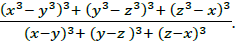
Question. Simplify the following
Answer:
Let \( a = 155 \) and \( b = 55 \). We can write the expression in algebraic terms:
\( \frac{a^3 - b^3}{a^2 + ab + b^2} \).
Using the algebraic identity for the difference of cubes, \( a^3 - b^3 = (a - b)(a^2 + ab + b^2) \), we substitute this in:
\( \frac{(a - b)(a^2 + ab + b^2)}{a^2 + ab + b^2} = a - b \).
Substituting the values back in:
\( 155 - 55 = 100 \).
In simple words: Substitute letters for the numbers to see that the complex fraction simplifies beautifully to just a - b, which is 100.
Exam Tip: When given complex numerical fractions like this, always search for an underlying algebraic identity instead of performing long calculations.
Question. Factorize x8 - y8.
Answer:
Using the difference of squares identity, \( a^2 - b^2 = (a - b)(a + b) \):
\( x^8 - y^8 = (x^4)^2 - (y^4)^2 \)
\( = (x^4 - y^4)(x^4 + y^4) \).
Applying the identity again to \( x^4 - y^4 \):
\( = (x^2 - y^2)(x^2 + y^2)(x^4 + y^4) \)
\( = (x - y)(x + y)(x^2 + y^2)(x^4 + y^4) \).
In simple words: Keep applying the difference of squares formula repeatedly on the negative term until it cannot be factored any further.
Exam Tip: Remember that \( x^4 + y^4 \) cannot be factored further using real rational coefficients, so leave it as-is.
Question. Using factor theorem factorize the following expression x3 - 6x2 + 3x +10.
Answer:
Let \( p(x) = x^3 - 6x^2 + 3x + 10 \). The factors of the constant term \( 10 \) are \( \pm 1, \pm 2, \pm 5, \pm 10 \).
We check \( x = -1 \) using the factor theorem:
\( p(-1) = (-1)^3 - 6(-1)^2 + 3(-1) + 10 = -1 - 6 - 3 + 10 = 0 \).
Since \( p(-1) = 0 \), \( (x + 1) \) is a factor.
Now, divide \( p(x) \) by \( (x + 1) \) to find the remaining quadratic factor:
\( x^3 - 6x^2 + 3x + 10 = (x + 1)(x^2 - 7x + 10) \).
Next, factorise \( x^2 - 7x + 10 \) by splitting the middle term:
\( x^2 - 5x - 2x + 10 = x(x - 5) - 2(x - 5) = (x - 5)(x - 2) \).
Combining all factors, the complete factorization is \( (x + 1)(x - 2)(x - 5) \).
In simple words: First find one root using factors of 10. Once we find that -1 is a root, divide the polynomial and split the remaining quadratic part to get all three factors.
Exam Tip: Be methodical and write out each stage of factorization clearly to earn partial marks even if you make a calculation slip at the end.
1 MARKER QUESTIONS
Please click on below link to download CBSE Class 9 Polynomials Worksheet Set A
Free study material for Mathematics
Practice Worksheet and Study Resources for Class 9 Mathematics Chapter 02 Polynomials
CBSE Practice Material: Class 9 Mathematics Chapter 02 Polynomials
Explore reliable practice questions for Chapter 02 Polynomials tailored for Class 9 Mathematics learners. Use these structured worksheets to evaluate preparedness and strengthen problem-solving skills.
NCERT-Aligned Questions and Solutions
Each worksheet is structured around standard CBSE textbooks, allowing students to check their working steps and correct mistakes early in their revision.
Next Steps in Your Exam Preparation
Explore our broader library of printable assignments, chapter notes, and mock tests designed to support continuous revision and secure higher marks in CBSE assessments.
FAQs
You can download the teacher-verified PDF for CBSE Class 9 Mathematics Polynomials Worksheet Set 01 from StudiesToday.com. These practice sheets for Class 9 Mathematics are designed as per the latest CBSE academic session.
Yes, our CBSE Class 9 Mathematics Polynomials Worksheet Set 01 includes a variety of questions like Case-based studies, Assertion-Reasoning, and MCQs as per the 50% competency-based weightage in the latest curriculum for Class 9.
Yes, we have provided detailed solutions for CBSE Class 9 Mathematics Polynomials Worksheet Set 01 to help Class 9 and follow the official CBSE marking scheme.
Daily practice with these Mathematics worksheets helps in identifying understanding gaps. It also improves question solving speed and ensures that Class 9 students get more marks in CBSE exams.
All our Class 9 Mathematics practice test papers and worksheets are available for free download in mobile-friendly PDF format. You can access CBSE Class 9 Mathematics Polynomials Worksheet Set 01 without any registration.