

Practice Worksheets for Class 9 Mathematics: Chapter 04 Linear Equations In Two Variables
Review targeted practice sets for Class 9 Mathematics Chapter 04 Linear Equations In Two Variables. Built according to official educational guidelines for the 2026-27 academic year, these downloadable worksheets support daily revision and core concept reinforcement.
Practice Chapter 04 Linear Equations In Two Variables Worksheets for Class 9 Mathematics
Access the complete worksheet PDF for Chapter 04 Linear Equations In Two Variables below. Regular practice with these targeted questions builds familiarity with standard exam patterns and helps secure higher marks in final Mathematics evaluations.
Question. Represent the linear equation in two variables in its standard form. 2y – 3 + 2x =5
Answer: The standard form for a linear equation in two variables is represented as \( ax + by + c = 0 \).
Let's rearrange the given equation, \( 2y - 3 + 2x = 5 \):
First, group the \( x \) and \( y \) terms together on the left side:
\( 2x + 2y - 3 = 5 \)
Next, shift the constant \( 5 \) from the right side over to the left side by subtracting it:
\( 2x + 2y - 3 - 5 = 0 \)
\( 2x + 2y - 8 = 0 \)
We can also divide the entire equation by 2 to write it in its simplest form:
\( x + y - 4 = 0 \)
In simple words: We rearrange the terms so x is first, y is second, the plain number is third, and 0 is on the right side.
Exam Tip: Ensure that the right side of your equation is always simplified to 0 to write it correctly in standard form.
Question. What is the value of a, b, c in the given equation 3x – 5= 2y
Answer: Let us first write the equation \( 3x - 5 = 2y \) in standard form \( ax + by + c = 0 \) by moving the \( y \) term to the left-hand side:
\( 3x - 2y - 5 = 0 \)
By comparing this rearranged equation to the general form \( ax + by + c = 0 \), we can identify each of the constants:
- \( a = 3 \)
- \( b = -2 \)
- \( c = -5 \)
In simple words: Move everything to one side first. The number in front of x is a, the number in front of y is b, and the plain number is c.
Exam Tip: Don't forget to keep the negative sign with the values of b and c when writing down your final answer.
Question. Find the value of b and c in the equation 3x= 15
Answer: To find the constants, let's rearrange the equation \( 3x = 15 \) into standard two-variable form \( ax + by + c = 0 \). Since there is no \( y \) term present, we write its coefficient as 0:
\( 3x + 0y - 15 = 0 \)
Comparing this directly with the standard format \( ax + by + c = 0 \) yields the constant values:
- \( a = 3 \)
- \( b = 0 \)
- \( c = -15 \)
Therefore, \( b = 0 \) and \( c = -15 \).
In simple words: Since there is no y in the equation, its coefficient b is 0, and moving 15 to the other side makes c equal to -15.
Exam Tip: When a variable is missing, always set its coefficient to zero in standard form instead of omitting it.
Question. Check whether (4,0) is a solution of the equation2x+3y =8
Answer: Let us test the point \( (4,0) \) by substituting \( x = 4 \) and \( y = 0 \) into the left-hand side (LHS) of the given equation \( 2x + 3y = 8 \):
\( \text{LHS} = 2(4) + 3(0) \)
\( \text{LHS} = 8 + 0 \)
\( \text{LHS} = 8 \)
Now, let us look at the right-hand side (RHS) of the equation:
\( \text{RHS} = 8 \)
Since \( \text{LHS} = \text{RHS} \), the coordinates satisfy the equation.
Therefore, \( (4,0) \) is a valid solution.
In simple words: Put 4 in place of x and 0 in place of y. Since the calculation equals 8, the point is indeed a solution.
Exam Tip: For verify-type questions, clearly state whether LHS equals RHS at the end to get full marks.
Question. Find if \( \sqrt{2}, -1 \) is a solution of the equation x + 3y =1
Answer: Let us check if the coordinates \( (\sqrt{2}, -1) \) satisfy the equation by substituting \( x = \sqrt{2} \) and \( y = -1 \) into the left-hand side (LHS) of \( x + 3y = 1 \):
\( \text{LHS} = \sqrt{2} + 3(-1) \)
\( \text{LHS} = \sqrt{2} - 3 \)
Since \( \sqrt{2} \approx 1.414 \), we have:
\( \text{LHS} \approx 1.414 - 3 = -1.586 \)
The right-hand side is:
\( \text{RHS} = 1 \)
Since \( \text{LHS} \neq \text{RHS} \), the coordinates do not satisfy the equation.
Therefore, \( (\sqrt{2}, -1) \) is not a solution.
*(Note: If the point was meant to be \( (4, -1) \), substituting \( x=4, y=-1 \) would give \( 4 + 3(-1) = 1 \), making it a solution.)*
In simple words: When we plug the numbers into the left side, we get a value that does not equal 1, so this point does not fit.
Exam Tip: Keep radical expressions like \( \sqrt{2} \) in their exact form during algebraic checks unless a decimal approximation is specifically requested.
Question. Form an equation in two variables with the given information: the number of ducks is three more than three times number of hens, and the total of all hens and ducks is 156.
Answer: Let the total number of hens be \( x \) and the total number of ducks be \( y \).
According to the first statement, "the number of ducks is three more than three times the number of hens":
\( y = 3x + 3 \)
\( \implies 3x - y + 3 = 0 \)
According to the second statement, "the total number of hens and ducks is 156":
\( x + y = 156 \)
\( \implies x + y - 156 = 0 \)
Thus, the situation is represented by the following system of linear equations in two variables:
\( y = 3x + 3 \) and \( x + y = 156 \).
In simple words: Let x be hens and y be ducks. "Ducks are three more than three times hens" means y = 3x + 3, and "total is 156" means x + y = 156.
Exam Tip: Clearly define your variables (what x and y represent) at the beginning of your response.
Question. Find four solutions of the given equations 3x – y=4
Answer: Let us rewrite the equation to express \( y \) explicitly in terms of \( x \):
\( y = 3x - 4 \)
Now, we can find four different solutions by choosing four different values for \( x \):
1. If \( x = 0 \):
\( y = 3(0) - 4 = -4 \)
So, \( (0, -4) \) is the first solution.
2. If \( x = 1 \):
\( y = 3(1) - 4 = -1 \)
So, \( (1, -1) \) is the second solution.
3. If \( x = 2 \):
\( y = 3(2) - 4 = 2 \)
So, \( (2, 2) \) is the third solution.
4. If \( x = 3 \):
\( y = 3(3) - 4 = 5 \)
So, \( (3, 5) \) is the fourth solution.
In simple words: Change the formula to y = 3x - 4. Pick simple numbers for x like 0, 1, 2, and 3 to calculate the matching y values.
Exam Tip: Presenting your final coordinates clearly as ordered pairs like (x, y) makes it very easy for the examiner to award full marks.
Question. Find the value of k, when x = -1 and y =2 in the equation 3x –7y = 3k .
Answer: Let us substitute the given values \( x = -1 \) and \( y = 2 \) directly into the equation \( 3x - 7y = 3k \):
\( 3(-1) - 7(2) = 3k \)
\( -3 - 14 = 3k \)
\( -17 = 3k \)
\( k = -\frac{17}{3} \)
Thus, the value of \( k \) is \( -\frac{17}{3} \).
In simple words: Replace x with -1 and y with 2. Solve the simple equation to find that k equals -17/3.
Exam Tip: Be careful with signs during multiplication, especially when dealing with negative values like \( 3(-1) \).
Question. Find two solutions for each of the following equations:
(i) 4x + 3y =12
(ii) 2x + 5y = 0
Answer: Let us calculate two unique solution sets for each equation:
**(i) For the equation \( 4x + 3y = 12 \):**
- Let us set \( x = 3 \):
\( 4(3) + 3y = 12 \implies 12 + 3y = 12 \implies 3y = 0 \implies y = 0 \)
Thus, \( (3, 0) \) is a solution.
- Let us set \( y = 4 \):
\( 4x + 3(4) = 12 \implies 4x + 12 = 12 \implies 4x = 0 \implies x = 0 \)
Thus, \( (0, 4) \) is a solution.
**(ii) For the equation \( 2x + 5y = 0 \):**
- Let us set \( x = 0 \):
\( 2(0) + 5y = 0 \implies 5y = 0 \implies y = 0 \)
Thus, \( (0, 0) \) is a solution.
- Let us set \( x = 5 \):
\( 2(5) + 5y = 0 \implies 10 + 5y = 0 \implies 5y = -10 \implies y = -2 \)
Thus, \( (5, -2) \) is a solution.
In simple words: Choose simple whole numbers for one letter and find what the other letter must be.
Exam Tip: If an equation has no constant term (like 2x + 5y = 0), the origin point (0, 0) is always one of its solutions.
Question. Express the following linear equations in the form ax + by + c = 0 and find the values of a , b, c.In the equation \( x - \frac{1}{5}y = -9.\overline{35} \)
Answer: To express \( x - \frac{1}{5}y = -9.\overline{35} \) in the standard format \( ax + by + c = 0 \), let's bring the constant term over to the left-hand side:
\( 1x - \frac{1}{5}y + 9.\overline{35} = 0 \)
Now we can match this directly with the general form \( ax + by + c = 0 \):
- \( a = 1 \)
- \( b = -\frac{1}{5} \) (or \( -0.2 \))
- \( c = 9.\overline{35} \)
In simple words: Move the number from the right side to the left side so the equation equals zero. Then identify the values of a, b, and c.
Exam Tip: Keep repeating decimals exactly as written with their bar symbols; do not round them off when stating the value of c.
Question. Write the following as linear equation in two variables.2x = 15 and –3y –4 =0
Answer: To write a single-variable equation in the standard two-variable form \( ax + by + c = 0 \), we add the missing variable with a coefficient of \( 0 \):
**First, for \( 2x = 15 \):**
Rearrange by moving the constant to the left side:
\( 2x - 15 = 0 \)
Now, insert the \( y \) term with a zero coefficient:
\( 2x + 0y - 15 = 0 \)
**Second, for \( -3y - 4 = 0 \):**
Insert the \( x \) term with a zero coefficient:
\( 0x - 3y - 4 = 0 \)
In simple words: Since there is a missing letter, we write it in the equation with a 0 in front of it.
Exam Tip: Ensure you include the signs (+ or -) correctly when presenting your final linear expressions.
Question. Write five solutions of the given equation: \( \pi x + y = 7 \).
Answer: Let us write the given equation as:
\( y = 7 - \pi x \)
We can find five solutions by substituting different values for \( x \):
1. If \( x = 0 \):
\( y = 7 - \pi(0) = 7 \). Solution: \( (0, 7) \)
2. If \( x = 1 \):
\( y = 7 - \pi(1) = 7 - \pi \). Solution: \( (1, 7 - \pi) \)
3. If \( x = 2 \):
\( y = 7 - \pi(2) = 7 - 2\pi \). Solution: \( (2, 7 - 2\pi) \)
4. If \( x = -1 \):
\( y = 7 - \pi(-1) = 7 + \pi \). Solution: \( (-1, 7 + \pi) \)
5. If \( x = \frac{7}{\pi} \):
\( y = 7 - \pi\left(\frac{7}{\pi}\right) = 7 - 7 = 0 \). Solution: \( \left(\frac{7}{\pi}, 0\right) \)
In simple words: Put simple numbers like 0, 1, or 2 in place of x to find the corresponding values of y.
Exam Tip: Leave \( \pi \) as a symbol in your coordinates instead of converting it to 3.14 unless the question specifically asks for an approximate value.
Question. Write the four solutions of the equation (2x - 1)/(3y - 5) = 1/3.
Answer: Let's simplify the fractional equation first by cross-multiplying:
\( 3(2x - 1) = 1(3y - 5) \)
\( 6x - 3 = 3y - 5 \)
\( 6x - 3y - 3 + 5 = 0 \)
\( 6x - 3y + 2 = 0 \)
\( \implies 3y = 6x + 2 \implies y = 2x + \frac{2}{3} \)
Now, let's find four different solutions by choosing values for \( x \):
1. If \( x = 0 \):
\( y = 2(0) + \frac{2}{3} = \frac{2}{3} \). Solution: \( (0, \frac{2}{3}) \)
2. If \( x = 1 \):
\( y = 2(1) + \frac{2}{3} = \frac{8}{3} \). Solution: \( (1, \frac{8}{3}) \)
3. If \( x = -1 \):
\( y = 2(-1) + \frac{2}{3} = -\frac{4}{3} \). Solution: \( (-1, -\frac{4}{3}) \)
4. If \( x = 2 \):
\( y = 2(2) + \frac{2}{3} = \frac{14}{3} \). Solution: \( (2, \frac{14}{3}) \)
In simple words: First cross-multiply to make it a simple equation, then pick four different values for x to calculate y.
Exam Tip: Simplifying the equation first before choosing coordinates prevents calculation mistakes with fractions.
Question. Write the solution of the equation x +y =4
Answer: A linear equation in two variables has an infinite number of solutions. We can express the general solution as:
\( y = 4 - x \)
For any real number \( x \), the ordered pair is \( (x, 4 - x) \).
Let us list some of these points as examples:
- If \( x = 0 \), then \( y = 4 \). Point: \( (0, 4) \)
- If \( x = 4 \), then \( y = 0 \). Point: \( (4, 0) \)
- If \( x = 2 \), then \( y = 2 \). Point: \( (2, 2) \)
- If \( x = 1 \), then \( y = 3 \). Point: \( (1, 3) \)
In simple words: There are endless pairs of numbers that add up to 4, like (0,4), (4,0), and (2,2).
Exam Tip: Unless a specific number of coordinates is requested, writing 2 or 3 distinct solutions is standard practice.
Question. Lata and Gautami together contributed Rs. 100 for a donation camp. Represent this situation graphically.
Answer: Let Lata's donation be represented by Rs. \( x \) and Gautami's donation be represented by Rs. \( y \). Since their total contribution is Rs. 100, we write:
\( x + y = 100 \)
To plot this relationship, let us find a few points:
- If \( x = 0 \), then \( y = 100 \). Point: \( (0, 100) \)
- If \( x = 100 \), then \( y = 0 \). Point: \( (100, 0) \)
- If \( x = 50 \), then \( y = 50 \). Point: \( (50, 50) \)
Since money contributions cannot be negative, we plot this line in the first quadrant:
In simple words: The equation is x + y = 100. We draw a straight line that connects 100 on the vertical axis to 100 on the horizontal axis.
Exam Tip: Since donations cannot be negative, do not extend your line into the second, third, or fourth quadrants.
Question. The taxi fare in a city is as follows: For the first km, the fare is Rs.8 and for every subsequent Km it is Rs. 5. Taking the distance traveled as x and the total fare as y, represent the equation graphically.
Answer: Let the total distance covered be \( x \) km and the total fare be Rs. \( y \).
For the first kilometer, the charge is Rs. 8.
For the rest of the trip, which is \( (x - 1) \) kilometers, the fare is Rs. 5 per kilometer.
This gives us the total charge equation:
\( y = 8 + 5(x - 1) \)
\( y = 8 + 5x - 5 \)
\( y = 5x + 3 \) (for \( x \ge 1 \))
Let's find some coordinate points to plot this line:
- If \( x = 1 \), then \( y = 5(1) + 3 = 8 \). Point: \( (1, 8) \)
- If \( x = 2 \), then \( y = 5(2) + 3 = 13 \). Point: \( (2, 13) \)
- If \( x = 3 \), then \( y = 5(3) + 3 = 18 \). Point: \( (3, 18) \)
We plot these coordinates to draw the graph:
In simple words: The first kilometer costs Rs. 8, and each extra kilometer adds Rs. 5. This makes the total cost equation y = 5x + 3.
Exam Tip: Since a taxi ride must start at a minimum distance, begin your solid graph line from the coordinate (1, 8) rather than the origin.
Question. Represent the equation 2 + 3y = 7x graphically.
Answer: Let us rearrange the equation \( 2 + 3y = 7x \) to express \( y \) in terms of \( x \):
\( 3y = 7x - 2 \)
\( y = \frac{7x - 2}{3} \)
Let's find some integer coordinate pairs to plot:
- If \( x = 2 \), then \( y = \frac{7(2) - 2}{3} = \frac{12}{3} = 4 \). Point: \( (2, 4) \)
- If \( x = -1 \), then \( y = \frac{7(-1) - 2}{3} = \frac{-9}{3} = -3 \). Point: \( (-1, -3) \)
- If \( x = 5 \), then \( y = \frac{7(5) - 2}{3} = \frac{33}{3} = 11 \). Point: \( (5, 11) \)
Here is the graphical display of this line:
In simple words: We rearrange the formula to calculate y easily. Plotting points like (2, 4) and (-1, -3) allows us to draw our line.
Exam Tip: Try to choose inputs for x that result in clean integer values for y, which makes drawing on graph paper much more accurate.
Question. Form an equation for the statement: The sum of cost of pens and twice the cost of pencils is Rs. 6 and represent the situation graphically.
Answer: Let the price of a pen be represented by Rs. \( x \), and the price of a pencil be represented by Rs. \( y \).
Based on the statement, "the sum of cost of pens and twice the cost of pencils is Rs. 6", we form the equation:
\( x + 2y = 6 \)
To draw this on a coordinate plane, let's determine some coordinate points:
- If \( x = 0 \), then \( 2y = 6 \implies y = 3 \). Point: \( (0, 3) \)
- If \( y = 0 \), then \( x = 6 \). Point: \( (6, 0) \)
- If \( x = 2 \), then \( 2 + 2y = 6 \implies 2y = 4 \implies y = 2 \). Point: \( (2, 2) \)
Now, let's display the graph:
In simple words: Let x be the pen cost and y be the pencil cost. The equation is x + 2y = 6. This forms a straight downward line on the graph.
Exam Tip: Since costs cannot be negative values, terminate the graph line at the axes where \( x = 0 \) and \( y = 0 \).
Question. Form the graph of the equation y = 2x
Answer: Let us find some points to plot for the linear equation \( y = 2x \):
- If \( x = 0 \), then \( y = 2(0) = 0 \). Point: \( (0, 0) \)
- If \( x = 1 \), then \( y = 2(1) = 2 \). Point: \( (1, 2) \)
- If \( x = -1 \), then \( y = 2(-1) = -2 \). Point: \( (-1, -2) \)
- If \( x = 2 \), then \( y = 2(2) = 4 \). Point: \( (2, 4) \)
Using these points, we construct the graph of the equation:
In simple words: The equation y = 2x means y is always twice as big as x. The line passes directly through the origin (0, 0).
Exam Tip: Any linear equation in the form y = mx has no constant term, meaning its graph will always pass directly through the origin (0,0).
Question. Plot the graph of the equation y – 2x = 4
Answer: Let us rearrange the equation \( y - 2x = 4 \) as:
\( y = 2x + 4 \)
Now, let us find a few coordinate points to define the line:
- If \( x = 0 \), then \( y = 2(0) + 4 = 4 \). Point: \( (0, 4) \)
- If \( y = 0 \), then \( 0 = 2x + 4 \implies 2x = -4 \implies x = -2 \). Point: \( (-2, 0) \)
- If \( x = 1 \), then \( y = 2(1) + 4 = 6 \). Point: \( (1, 6) \)
Plotting these values allows us to construct the line:
In simple words: The equation can be written as y = 2x + 4. It crosses the vertical axis at 4 and the horizontal axis at -2.
Exam Tip: Finding where the line intersects both axes (the x-intercept and y-intercept) is the most efficient way to sketch a linear graph.
Question. Express y =4 as linear equation in two variables.
Answer: To represent the single-variable equation \( y = 4 \) as a linear equation in two variables, we insert the missing \( x \) variable with a coefficient of \( 0 \):
\( 0 \cdot x + 1 \cdot y = 4 \)
Written in the standard standard form \( ax + by + c = 0 \), it becomes:
\( 0x + y - 4 = 0 \)
In simple words: Since there is no x in the equation, we write it with a 0 in front: 0x + y - 4 = 0.
Exam Tip: Be sure to keep the coefficient of y as 1 and write the zero coefficient for x explicitly when converting.
Question. Give the representation of 2x +9 =0 as an equation in
a) One variable
b) Two variable
Answer: Let us represent the given equation \( 2x + 9 = 0 \) in both formats:
**a) Representation in one variable:**
Solving the equation for \( x \):
\( 2x = -9 \)
\( x = -\frac{9}{2} = -4.5 \)
In one variable, this represents a unique point on the number line at \( -4.5 \).
**b) Representation in two variables:**
We express the equation by adding a \( y \) term with a zero coefficient:
\( 2x + 0y + 9 = 0 \)
On the 2D Cartesian plane, this equation represents a vertical line parallel to the y-axis, crossing through \( (-4.5, 0) \).
In simple words: In one variable, x = -4.5 is just a point on a line. In two variables, 2x + 0y + 9 = 0 is a vertical line on a grid.
Exam Tip: Be ready to explain the geometric difference: a one-variable solution is a point, whereas a two-variable solution represents an entire line.
Question. The temperature in degree Celsius is given by the following formula F = (9/5) C + 32
Answer the following questions
a. What will be the temperature in degree Celsius if the temperature is 45 °F?
b. If the temperature is 0 °C, what is the temperature in Fahrenheit?
c. Is there a temperature, which is numerically the same in both Fahrenheit and Celsius? If yes, find it.
Answer: Let us solve each part of the temperature conversion question using the given formula \( F = \frac{9}{5}C + 32 \):
**a. Find the temperature in Celsius if the temperature is 45 °F:**
Substitute \( F = 45 \) into the conversion formula:
\( 45 = \frac{9}{5}C + 32 \)
\( 45 - 32 = \frac{9}{5}C \)
\( 13 = \frac{9}{5}C \)
\( C = 13 \times \frac{5}{9} \)
\( C = \frac{65}{9} \approx 7.22 \text{ }^{\circ}\text{C} \)
**b. Find the temperature in Fahrenheit if the temperature is 0 °C:**
Substitute \( C = 0 \) into the formula:
\( F = \frac{9}{5}(0) + 32 \)
\( F = 0 + 32 \)
\( F = 32 \text{ }^{\circ}\text{F} \)
**c. Find if there is a temperature that is numerically identical in both scales:**
Let \( x \) be the temperature value where both scales are equal, so \( F = C = x \). Substitute \( x \) for both variables in the formula:
\( x = \frac{9}{5}x + 32 \)
Multiply the entire equation by 5 to clear the fraction:
\( 5x = 9x + 160 \)
\( 5x - 9x = 160 \)
\( -4x = 160 \)
\( x = \frac{160}{-4} \)
\( x = -40 \)
Yes, \( -40^{\circ} \) is numerically the same value on both the Celsius and Fahrenheit temperature scales.
In simple words: We plug the given numbers into the formula to solve each part. We find that -40 is the special temperature where both scales show the exact same number.
Exam Tip: Showing the complete algebraic derivation in part (c) is critical to receiving full marks instead of just writing down the final value of -40.
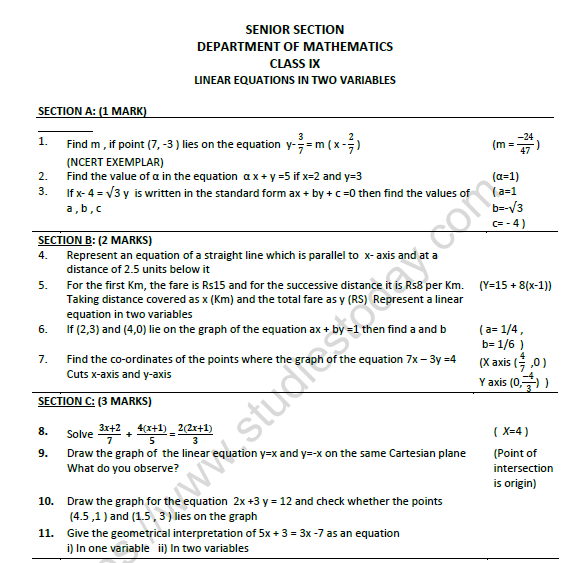
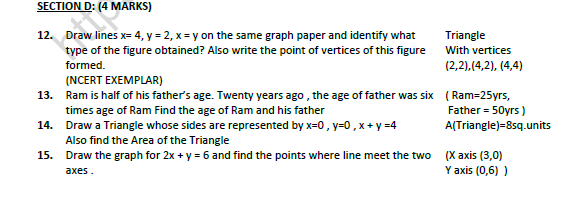
Please click on below link to download CBSE Class 9 Mathematics Linear Equations in two variables Worksheet Set A
Free study material for Mathematics
Chapter 04 Linear Equations In Two Variables Practice Sheet and Solutions for Class 9 Mathematics
Chapter 04 Linear Equations In Two Variables Printable Worksheet for Class 9 Mathematics
Review targeted practice exercises for Class 9 Mathematics Chapter 04 Linear Equations In Two Variables. Curated to match official CBSE guidelines, these downloadable PDF sheets support daily revision and core concept reinforcement.
How to Use These Practice Sheets
Built using the official NCERT book for Class 9 Mathematics, these practice materials provide reliable academic guidance. Pair your practice with our recommended NCERT solutions to master optimal problem-solving approaches.
Enhance Speed with Online Practice
Explore our broader library of printable assignments, chapter notes, and mock tests designed to support continuous revision and secure higher marks in CBSE assessments.
FAQs
You can download the teacher-verified PDF for CBSE Class 9 Mathematics Linear Equations in two variables Worksheet Set 01 from StudiesToday.com. These practice sheets for Class 9 Mathematics are designed as per the latest CBSE academic session.
Yes, our CBSE Class 9 Mathematics Linear Equations in two variables Worksheet Set 01 includes a variety of questions like Case-based studies, Assertion-Reasoning, and MCQs as per the 50% competency-based weightage in the latest curriculum for Class 9.
Yes, we have provided detailed solutions for CBSE Class 9 Mathematics Linear Equations in two variables Worksheet Set 01 to help Class 9 and follow the official CBSE marking scheme.
Daily practice with these Mathematics worksheets helps in identifying understanding gaps. It also improves question solving speed and ensures that Class 9 students get more marks in CBSE exams.
All our Class 9 Mathematics practice test papers and worksheets are available for free download in mobile-friendly PDF format. You can access CBSE Class 9 Mathematics Linear Equations in two variables Worksheet Set 01 without any registration.