

Step-by-Step Textbook Solutions for Class 10 English Chapter 09 Not Marble nor the Gilded Monuments
Review structured textbook solutions for Class 10 English Chapter 09 Not Marble nor the Gilded Monuments. Built according to NCERT guidelines for the 2026-27 academic year, these downloadable answers support daily revision and problem-solving accuracy.
Download Chapter 09 Not Marble nor the Gilded Monuments Textbook Solutions PDF
Access the complete solution PDF for Class 10 English below. Regular practice with these targeted textbook answers builds familiarity with standard question patterns and helps secure higher marks in final school evaluations.
NCERT Solutions for Class 10 English Communicative Poem Not Marble nor the Gilded Monuments
1. Look at the following picture carefully.
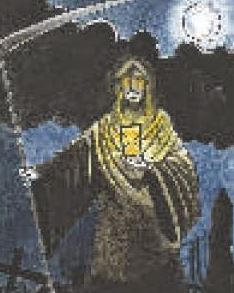
Time has been portrayed as an emperor because it rules over everything. It is more powerful than a mighty king. It controls everything. It is a great destroyer.
(b) What are the other symbols associated with Time?
Answer
'Time is a 'giant wheel' revolves around incessantly. 'Time' is a 'thunderous tide' or 'wave' which sweeps everything in its way. 'Time' is an 'uncontrollable horse' which runs relentlessly.
6. On the basis of your understanding of Shakespeare's sonnet, answer the following questions by ticking the correct options.
(a) The rich and powerful got ornate monuments made in order to _______________
i. show off their wealth
ii. display their power
iii. show their artistic talent
iv. be remembered till posterity
Answer
iv. be remembered till posterity
(b) The poet addresses his sonnet to _________________
i. time
ii. war
iii. the person he loves
iv. powerful rulers
Answer
iii. the person he loves
(c) In the line 'The living record of your memory', living record refers to ____________
i. the sonnet the poet has written for his friend
ii. an existing statue of his friend
iii. his friend who lives in the poet's memory
iv. the autobiography of the poet's friend
Answer
i. the sonnet the poet has written for his friend
(d) The poet's tone in the poem is _________________
i. despairing
ii. optimistic
iii. loving
iv. admiring
Answer
iii. loving
(e) The poem is set in _______________________
i. the place where the poet meets his friend
ii. a battlefield where Mars is fighting a battle
iii. a city ravaged by war
iv. the poet's study where he is writing
Answer
iv. the poet's study where he is writing.
7. Answer the following questions briefly.
(a) Why do you think the rich and powerful people get monuments and statues erected in their memory?
Answer
The rich and powerful people want to be remembered till posterity so they erect monuments and statues in their memory.
(b) Describe how the monuments and statues brave the ravages of time.
Answer
Statues are made of strong metals or stones. They are covered with gold to decorate them and to make them look splendid. In the same way, monuments are made of strong marbles. They are designed and polished in such a way that can protect them for a long time. Thus, statues and monuments are protected to brave the ravages of time. They do not get corroded easily by wind, rain or sunshine.
(c) Why does the poet refer to Time as being sluttish?
Answer
The poet refers to the time as being sluttish as it changes suddenly and unexpectedly. Its habits and behaviour are unpredictable. It turns favourite circumstances into adverse circumstances. It neither waits nor cares for anyone. It spares no one. Nobody can understand its changing mood.
(d) The poet says that neither forces of nature nor wars can destroy his poetry. In fact, even godly powers of Mars will not have a devastating effect on his rhyme. What quality of the poet is revealed through these lines?
Answer
The Poet believes that his poetry can not not be destroyed by the forces of nature or wars. It will be read by coming generations. It will be remembered till posterity. It can not be forgotten. Even Godly powers of Mars will not have a devastating effects on his rhymes. It will survive in the hearts of its lovers. In this way, the poet is quite sure of the immortality of his poetry.
The poet’s extreme optimism and deep faith in the power of love is revealed in these lines.
8. Shakespeare's sonnet has been divided into three quatrains of 4 lines each followed by a rhyming couplet. Each quatrain is a unit of meaning. Read the poem carefully and complete the following table on the structure of the poem
|
Rhyme Scheme
|
Theme
|
|
|
Quatrain 1
|
Comparison between poetry and monuments.
|
|
|
Quatrain 2
|
Ravages of time on monuments contrasted with ___________________.
|
|
|
Quatrain 3
|
The recorded memory of ____________ posterity.
|
|
|
Quatrain 4
|
Poetry immortalizes friend.
|
Answer
|
Rhyme Scheme
|
Theme
|
|
|
Quatrain 1
|
ABAB
|
Comparison between poetry and monuments.
|
|
Quatrain 2
|
CDCD
|
Ravages of time on monuments contrasted with living record of the poet’s beloved’s memory.
|
|
Quatrain 3
|
EFEF
|
The recorded memory of his beloved shall find room even in the eyes ofposterity.
|
|
Quatrain 4
|
GG
|
Poetry immortalizes friend.
|
9.
(a) The poet uses alliteration to heighten the musical quality of the sonnet. Working in pairs, underline the examples of alliteration in the poem.
Answer
A few instances of alliteration in the poem are:
Unswept stone besmear’d with sluttish time;
When wasteful war;
Nor Mars his sword nor war’s;
Praise shall still;
Lover’s eyes.
(b) Identify Shakespeare's use of personification in the poem.
Answer
“The living record of your memory” has been personified here in the sonnet as a man. He shall pace forth against death, bereavement, etc. He shall live life even in the eyes of all posterity.
Free study material for English
English Class 10 Curriculum Solutions: Chapter 09 Not Marble nor the Gilded Monuments
Textbook Solutions for Class 10 English Chapter 09 Not Marble nor the Gilded Monuments
Explore reliable textbook solutions for Chapter 09 Not Marble nor the Gilded Monuments tailored for Class 10 learners. Utilizing these complete exercise answers ensures your preparation aligns exactly with official NCERT standards for English.
Mastering Theoretical and Practical Questions
Each solution includes detailed reasoning to foster genuine comprehension of Chapter 09 Not Marble nor the Gilded Monuments concepts. Reviewing these step-by-step breakdowns allows learners to master both analytical and descriptive questions expected in school evaluations.
Effective Self-Study and Homework Assistance
Frequent review of these structured answers builds strong analytical capabilities and response efficiency. Maximize your academic readiness by combining these textbook solutions with our curated study materials and mock evaluations for Class 10 English.
FAQs
The complete and updated NCERT Solutions Class 10 English Chapter 9 Not Marble nor the Gilded Monuments is available for free on StudiesToday.com. These solutions for Class 10 English are as per latest NCERT curriculum.
Yes, our experts have revised the NCERT Solutions Class 10 English Chapter 9 Not Marble nor the Gilded Monuments as per 2026 exam pattern. All textbook exercises have been solved and have added explanation about how the English concepts are applied in case-study and assertion-reasoning questions.
Toppers recommend using NCERT language because NCERT marking schemes are strictly based on textbook definitions. Our NCERT Solutions Class 10 English Chapter 9 Not Marble nor the Gilded Monuments will help students to get full marks in the theory paper.
Yes, we provide bilingual support for Class 10 English. You can access NCERT Solutions Class 10 English Chapter 9 Not Marble nor the Gilded Monuments in both English and Hindi medium.
Yes, you can download the entire NCERT Solutions Class 10 English Chapter 9 Not Marble nor the Gilded Monuments in printable PDF format for offline study on any device.