

Multiple Choice Questions (MCQs) for Class 12 Chemistry: Unit 10 Biomolecules
Access targeted multiple-choice questions for Unit 10 Biomolecules designed to align with the latest CBSE academic syllabus for Class 12 Chemistry. These objective practice sets help students evaluate their conceptual understanding and improve exam readiness.
Practice Unit 10 Biomolecules MCQs for Class 12 Chemistry
Access the complete set of multiple-choice questions for Unit 10 Biomolecules below. This focused format allows students to isolate specific topics for thorough review and uninterrupted practice alongside official CBSE textbooks.
Question. Match the following Columns.

A B C D E
(a) 3 4 5 2 1
(b) 3 4 5 1 2
(c) 4 5 1 3 2
(d) 3 5 4 2 2
(e) 4 5 3 1 2
Answer : C
Question. Match the following Columns.
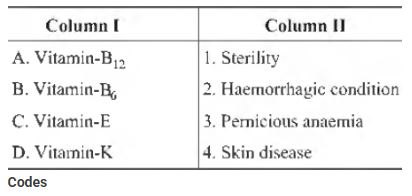
A B C D
(a) 1 2 3 4
(b) 2 3 4 1
(c) 3 4 1 2
(d) 3 4 2 1
Answer : C
Question. The function of enzymes in the living system is to
(a) catalyse biochemical reactions
(b) provide energy
(c) transport oxygen
(d) provide immunity.
Answer : A
Question. Deficiency of vitamin B1 causes the disease
(a) convulsions
(b) beri-beri
(c) cheilosis
(d) sterility.
Answer : B
Question. The difference between amylose and amylopectin is
(a) amylopectin have 1 → 4 a-linkage and 1 → 6 a-linkage
(b) amylose have 1 → 4 a-linkage and 1 → 6 b-linkage
(c) amylopectin have 1 → 4 a-linkage and 1 → 6 b-linkage
(d) amylose is made up of glucose and galactose.
Answer : A
Question. Which one of the following bases is not present in DNA?
(a) Quinoline
(b) Adenine
(c) Cytosine
(d) Thymine
Answer : A
Question. In biological systems, the RNA molecules direct the synthesis of specific proteins which are characteristics of each kinds of organism. This process is known as
(a) transcription
(b) mutation
(c) replication
(d) translation
(e) flocculation
Answer : D
Question. Night-blindness may be caused by the deficiency of vitamin
(a) A
(b) B
(c) C
(d) D
Answer : A
Question. Sanger’s method is used to identify
(a) C-terminal amino acid
(b) N-terminal amino acid
(c) side chain
(d) molecular weight protein
Answer : D
Question. Helical structure of protein is stablilised by
(a) peptide bond
(b) hydrogen bond
(c) van der Waals’ force
(d) dipole association
Answer : B
Question. The hormone that helps in the conversion of glucose to glycogen is
(a) cortisone
(b) bile acids
(c) adrenaline
(d) insulin.
Answer : D
Question. The cell membranes are mainly composed of
(a) fats
(b) proteins
(c) phospholipids
(d) carbohydrates.
Answer : C
Question. In a protein molecule various amino acids are linked together by
(a) peptide bond
(b) dative bond
(c) a-glycosidic bond
(d) b-glycosidic bond.
Answer : A
Question. Which of the statements about 'Denaturation' given below are correct?
(1) Denaturation of proteins causes loss of secondary and tertiary structures of the protein.
(2) Denaturation leads to the conversion of double strand of DNA into single strand.
(3) Denaturation affects primary structure which gets distorted.
(a) (2) and (3)
(b) (1) and (3)
(c) (1) and (2)
(d) (1), (2) and (3)
Answer : C
Question. On hydrolysis of starch, we finally get
(a) glucose
(b) fructose
(c) both (a) and (b)
(d) sucrose.
Answer : A
Question. Enzymes take part in a reaction and
(a) decrease the rate of a chemical reaction
(b) increase the rate of a chemical reaction
(c) both (a) and (b)
(d) none of these.
Answer : B
Question. Cellulose is polymer of
(a) glucose
(b) fructose
(c) ribose
(d) sucrose.
Answer : A
Question. Which of the following gives positive Fehling solution test?
(a) Sucrose
(b) Glucose
(c) Fats
(d) Protein
Answer : B
Question. The pyrimidine bases present in DNA are
(a) cytosine and adenine
(b) cytosine and guanine
(c) cytosine and thymine
(d) cytosine and uracil
Answer : C
Question. There are 20 naturally occurring amino acids.The maximum number of tripeptides that can be obtained is
(a) 8000
(b) 6470
(c) 7465
(d) 5360
Answer : A
Question. The a-D-glucose and b-D-glucose differ from each other due to difference in carbon atom with respect to its
(a) number of OH groups
(b) size of hemiacetal ring
(c) conformation
(d) configuration.
Answer : D
Question. Chemically considering digestion is basically
(a) anabolism
(b) hydrogenation
(c) hydrolysis
(d) dehydrogenation.
Answer : C
Question. Which of the following is a basic amino acid?
(a) Serine
(b) Alanine
(c) Tyrosine
(d) Lysine
Answer : D
Question. The non-essential amino acid among the following is
(a) lysine
(b) valine
(c) leucine
(d) alanine.
Answer : D
Question. Which structure(s) of proteins remain(s) intact during denaturation process?
(a) Both secondary and tertiary structures
(b) Primary structure only
(c) Secondary structure only
(d) Tertiary structure only
Answer : B
Question. Which of the following is not present in a nucleotide?
(a) Cytosine
(b) Guanine
(c) Adenine
(d) Tyrosine
Answer : D
Question. Which of the following compounds can form a zwitter ion?
(a) Aniline
(b) Acetanilide
(c) Benzoic acid
(d) Glycine
Answer : D
Question. Which functional group participates in disulphide bond formation in proteins?
(a) Thioester
(b) Thioether
(c) Thiol
(d) Thiolactone
Answer : C
Question. In both DNA and RNA, heterocylic base and phosphate ester linkages are at
(a) C’5 and C’1 respectively of the sugar molecule
(b) C’1 and C’5 respectively of the sugar molecule
(c) C’2 and C’5 respectively of the sugar molecule
(d) C’5 and C’2 respectively of the sugar molecule
Answer : A
Question. How many hydrogen bonds are present between pair of thymine and adenine in DNA ?
(a) 1-hydrogen bond
(b) 2-hydrogen bonds
(c) 3-hydrogen bonds
(d) No bonds occur
Answer : B
Free study material for Chemistry
Multiple Choice Questions (MCQs) for Class 12 Chemistry Unit 10 Biomolecules
Download Multiple Choice Questions: Unit 10 Biomolecules (Class 12 Chemistry)
Review structured objective questions for Class 12 Chemistry Unit 10 Biomolecules. Built according to official CBSE guidelines, these MCQ sets support daily revision and core concept reinforcement.
Concept Clarification for Unit 10 Biomolecules
Cross-reference your completed choices with comprehensive NCERT solutions for Class 12 Chemistry to ensure absolute clarity across all sub-topics in this chapter.
Additional Study Resources for Class 12 Chemistry
Follow up your worksheet practice by attempting the interactive online Chemistry MCQ test for this chapter to evaluate your execution speed. All platform resources are free to access.
FAQs
You can get most exhaustive CBSE Class 12 Chemistry Biomolecules MCQs Set 02 for free on StudiesToday.com. These MCQs for Class 12 Chemistry are updated for the 2026-27 academic session as per CBSE examination standards.
Yes, our CBSE Class 12 Chemistry Biomolecules MCQs Set 02 include the latest type of questions, such as Assertion-Reasoning and Case-based MCQs. 50% of the CBSE paper is now competency-based.
By solving our CBSE Class 12 Chemistry Biomolecules MCQs Set 02, Class 12 students can improve their accuracy and speed which is important as objective questions provide a chance to secure 100% marks in the Chemistry.
Yes, Chemistry MCQs for Class 12 have answer key and brief explanations to help students understand logic behind the correct option as its important for 2026 competency-focused CBSE exams.
Yes, you can also access online interactive tests for CBSE Class 12 Chemistry Biomolecules MCQs Set 02 on StudiesToday.com as they provide instant answers and score to help you track your progress in Chemistry.