

Refer to CBSE Class 10 English A Tiger in the Zoo HOTS. We have provided exhaustive High Order Thinking Skills (HOTS) questions and answers for Class 10 English First Flight Chapter 02 A Tiger in the Zoo. Designed for the 2026-27 exam session, these expert-curated analytical questions help students master important concepts and stay aligned with the latest CBSE, NCERT, and KVS curriculum.
First Flight Chapter 02 A Tiger in the Zoo Class 10 English HOTS with Solutions
Want to boost your grades in English? Solving Class 10 English HOTS Questions is a great way to build strong logic. Review the step-by-step answers below to increase your speed and feel fully ready for your Class 10 exams.
Get First Flight Chapter 02 A Tiger in the Zoo HOTS PDF for Class 10 English
Extract-Based Questions
Q. 1. He should be lurking in shadow,
Sliding through long grass
Near the water hole
Where plump deer pass.
Question. According to the extract, the poet wishes for the tiger to be ‘sliding’ through the foliage as this would
(a) assist in keeping the prey unsuspecting of the predator’s sound.
(b) aid in camouflaging the presence of the predator before it rushes in.
(c) help the predator pounce on the prey comfortably without getting tired.
(d) Support the predator’s vision as it eyes its prey.
Answer : A
Question. ‘shadow’ here, refers to the shadow of
(a) the tiger.
(b) long grass.
(c) water hole.
(d) deer
Answer : B
Question. Which fact DOES NOT connect with the significance of the water hole for the tiger?
(a) Many tigers chase prey into the water and holds the victim’s head under water until it drowns.
(b) Prey feed in the water on water-lilies, and often wander into the middle of the water hole, where they are vulnerable and easy for the tiger to kill.
(c) Prey that has quenched its thirst ensures consumption of hydrated meat for the tiger.
(d) Chasing the panicked prey from shallow to deep water where the tiger grabs it.
Answer : C
Question. Pick the phrase that DOES NOT suggest that the forest in the extract is lush.
(a) long grass
(b) the water hole
(c) plump deer
(d) lurking in shadow
Answer : D
Question. Pick the option that DOES NOT use ‘lurking’ correctly to fill in the blank.
(a) The thug was ______ in the alley late evening, for unsuspecting passers-by.
(b) The hyena was ______ in its den after a good meal.
(c) The detective cautioned her team about the ______ dangers likely to impact the case.
(d) The prejudices ______ beneath the surface create misunderstandings.
Answer : B
Q. 2. But he’s locked in a concrete cell,
His strength behind bars,
Stalking the length of his cage,
Ignoring visitors.
He hears the last voice at night,
The patrolling cars,
Question. Choose the image that best describes the condition of the tiger based on the given extract.
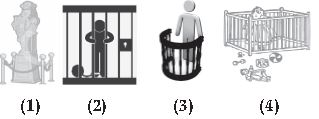
(a) Option (1)
(b) Option (2)
(c) Option (3)
(d) Option (4)
Answer : B
Question. The main contrasting idea suggested by the extract is that of
(a) strength and weakness.
(b) nature and culture.
(c) beasts and mortals.
(d) confinement and freedom.
Answer : D
Question. Which option identifies a patrolling car correctly?

(a) Option 1
(b) Option 2
(c) Option 3
(d) Option 4
Answer : B
Question. Which option correctly lists the reason for the tiger ‘stalking the length of his cage’?
(a) Animals tend to cover large distances and burn a lot of their energy by hunting for prey, in their natural habitat. Zoos deprive them of such stimulation and they are restless and bored.
(b) Animals are scared of visitors gazing at them in their unnatural surroundings. Zoos are places where animals are far removed from the privacy of their natural habitat.
(c) Animals dislike human noises in the city and react to them aggressively. Zoos are often located in cities or outskirts.
(d) Animals require human love and care and miss this when in captivity. Zoos are places where they walk around mechanically to attract human attention.
Answer : A
Question. Choose the option listing the most likely reason for the tiger to ignore visitors, according to the extract.
(a) He is scared of their constant stares.
(b) The visitors don’t provide him with any food.
(c) He knows that none would help him out of captivity.
(d) The visitors don’t speak to him kindly.
Answer : C
Very Short Answer Type Questions
Question. How does the poem point to the cruelty of animals in captivity?
Answer : Through the poem, the poet wants to convey that it is cruel to keep the wild animals in small enclosures of the zoo, away from their natural habitat. They feel anger, helpless and unhappy and remember their life and environment in the forest.
Question. It is said that an animal’s eyes have the power to speak a great language. Explain with reference to the tiger.
Answer : The tiger in the cage ignores all those who come to the zoo to see him as entertainment. He shows his anger hatred and even defiance by walking about in rage in his cage.
Question. The poet celebrates the strength of the tiger in this poem. Counter the statement.
Answer : The caged tiger is not free. He is imprisoned and helpless whereas the same tiger when in forest is free. He walks in the tall grass and hunts the deer that pass near the water hole.
Short Answer Type Questions
Question. Do you think the tiger in the poem had lost its natural instinct due to captivity? Support your response with evidence from the poem.
Answer : The caged tiger walks in a proud manner. He walks quietly. But his eyes show that he is very angry at having been imprisoned in a cage. All his activities prove that the tiger in the poem had not lost its natural instinct due to captivity. He is still chivalric, confident and graceful.
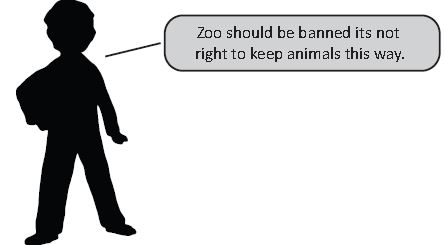
Question. Write the appropriate response comprising of at least two reasons to present a counter to the following :
You may begin this way: That's just one-sided. Zoos are beneficial too. Firstly, they.....(Continue).......
Answer : That’s just one sided. Zoos are beneficial too. Firstly, they save species from extinction and other dangers by providing natural environment to live in. Secondly, it includes the conservation education and research programs that are designed to preserve and protect wild populations of animals as well as educate the public about the threats that they face.
Question. What do you think the tiger would say to you, as a visitor?
You may begin like this: Please stop staring. You have no idea........................... (continue).......................
Answer : Please stop staring. You have no idea how uncomfortable and restless your stare is to me. I’m trying to ignore each one of you as I consider you humans to be devoid of feelings. None had ever tried to help me out to make me free from this cage. My freedom has been curtailed by you humans. I’m forced to live in a cage which is so small. I’m just fed up of this situation and these visitors.
Long Answer Type Questions
Question. Imagine the tiger writes a diary entry conveying how he feels helpless, angry and frustrated in the concrete cell. He writes about his desire to be free. Write that diary entry.
You may begin like this:
15 October 2020, Thursday 9:00 pm
I feel so vulnerable and annoyed at my state. I don’t know if I can ever be a free denizen of the forest.
Answer : 15 October, 2020, Thursday 9:00 P.M.
I feel so vulnerable and annoyed at my state. I don’t know if I can ever be a free denizer of the forest. As the most fearless and bravest animal of the jungle, I really feel horrible and frustrated to be inside the cage of the metal bars.
I feel more protective and secured to live in my domain where I can run, chase and prey on other animals and collect food for my family. Living inside this cage seems to be like hell, where I am void of freedom and happiness.
I feel like back to my heaven. It is my real green world where I can perform my regular’s activities without any fear of being trapped.
Question. The tiger in the poem ‘A Tiger in the Zoo’ presents a contrasting image with the tiger in the poem ‘How to Tell Wild Animals’. Compare and contrast the two tigers with reference to the manner in which they have been presented in both poems.
Answer : The tiger in ‘A Tiger in the zoo’ is a pathetic animal when he is locked in a concrete cell in the zoo. The mighty and ferocious animal is put behind the bars. There he stalks in ‘quite rage’ the length of his cage. He becomes just a piece of entertainment for visitor. But he ignores them. At night from behind the bars, he keeps staring at the brilliant stars which only intensifies his loss of freedom. On the contrary, the tiger on the poem, ‘How to tell wild animals’ is a very grand and impressive animal. His hide is yellowish. There are black strips all over his body. He is very agile. The moment he noticed someone, he will simply eat away that creature at once. He is free, confident, graceful and ferocious. He is ready to pounce upon its prey. He shows no mercy and jumps at its prey at once.
Thus, the former tiger is the example of confinement whereas the latter suggests the main contrasting idea of freedom.
Question. Imagine that Man has been accused by the tiger of cruelty in an animal court. What would be the tiger’s two major accusations and how would Man defend them? Present your answer in two paragraphs.
Answer : The tiger’s two major accusations would be as follows:
The tiger is a denizen of the forest. He loves to roam around freely in his natural habitat-the jungle. There, he is totally free with no restriction on his movements and activities but the humans make them captives and put them behind the cages. Not only this, the humans also destroy their natural habitat to satisfy their greed. A part from this, the humans are also indulged in illegal killing of the tigers.
Man’s Defense:
Keeping the tigers in the confined wall, save them from illegal poaching. At least this way, they all will not be killed and become extinct. Tigers hunt humans for food and we humans kill them to make money. It is, too, part of life cycle.
Free study material for English
Higher Order Thinking Skills (HOTS) for Class 10 English First Flight Chapter 02 A Tiger in the Zoo
Class 10 English Chapter First Flight Chapter 02 A Tiger in the Zoo Advanced Problem Sets
Explore rigorous problem-solving exercises for Class 10 English First Flight Chapter 02 A Tiger in the Zoo. These questions focus on advanced applications of core formulas, ensuring complete readiness for school tests and academic evaluations.
Step-by-Step Answers for First Flight Chapter 02 A Tiger in the Zoo
Each question in this set is mapped directly to the official NCERT book for Class 10. Review the detailed answer keys provided below each problem to verify your solution steps and correct mistakes early.
Complete Your Chapter Revision
To reinforce your revision after completing these HOTS, try our online English MCQ test for Class 10. All learning materials on our platform are completely free and updated for the current academic session.
FAQs
You can download the teacher-verified PDF for CBSE Class 10 English A Tiger in the Zoo HOTS from StudiesToday.com. These questions have been prepared for Class 10 English to help students learn high-level application and analytical skills required for the 2026-27 exams.
In the 2026 pattern, 50% of the marks are for competency-based questions. Our CBSE Class 10 English A Tiger in the Zoo HOTS are to apply basic theory to real-world to help Class 10 students to solve case studies and assertion-reasoning questions in English.
Unlike direct questions that test memory, CBSE Class 10 English A Tiger in the Zoo HOTS require out-of-the-box thinking as Class 10 English HOTS questions focus on understanding data and identifying logical errors.
After reading all conceots in English, practice CBSE Class 10 English A Tiger in the Zoo HOTS by breaking down the problem into smaller logical steps.
Yes, we provide detailed, step-by-step solutions for CBSE Class 10 English A Tiger in the Zoo HOTS. These solutions highlight the analytical reasoning and logical steps to help students prepare as per CBSE marking scheme.