

Read CBSE Class 10 English Animals HOTS below. Access comprehensive High Order Thinking Skills (HOTS) questions with answers for Class 10 English First Flight Chapter 06 Animals. Tailored for the 2026-27 exam session, these analytical problems help Class 10 students understand deep concepts based on the latest CBSE, NCERT, and KVS syllabus.
Download Class 10 English First Flight Chapter 06 Animals HOTS Practice
Practicing Class 10 English HOTS Questions is important for scoring high in English. Use the detailed answers provided below to improve your problem-solving speed and Class 10 exam readiness.
First Flight Chapter 06 Animals HOTS Solutions for Class 10 English
Read the given extracts to attempt the questions that follow:
1. They bring me tokens of myself,
They evince them plainly in their possession
I wonder where they get those tokens,
Did I pass that way huge times ago and negligently drop them?
A. Multiple Choice Questions
Question. How would you describe the tone of the poet?
1. melancholic, resigned
2. fanciful, noble
3. reflective, idealistic
4. fearful, gloomy
(a) 1
(b) 2
(c) 3
(d) 4
Answer. C
Question. Imagine you were asked to rename the poem. Column A lists titles of some famous poems.
Column B justifies how each of these titles may be appropriate for the above extract.
Choose the option that correctly lists the matching of Column A to Column B.
| Column A | Column B |
| I. ‘Paradise Lost’ | (1) This title is appropriate as the poet speaks about how man chose not to take the path of a simple, unaffected life as that of the animals. |
| II. ‘The Road Not Taken’ | (2) This title is appropriate as this is a commentary on the importance of living life by remaining close to our innate nature and qualities. |
| III. ‘The Deserted Temple’ | (3) This title is appropriate for the given extract as the poem laments the loss of a simpler and more harmonious life. |
| IV. ‘Nature’ | (4) This title is appropriate for the given extract as it reflects how man has abandoned his sacred bond of harmony with nature. |
(a) I – (1); II – (2); III – (3); IV – (4)
(b) I – (2); II – (3); III – (4); IV – (1)
(c) I – (3); II – (1); III – (4); IV – (2)
(d) I – (4); II – (1); III – (2); IV – (3)
Answer. C
Question. The word ‘evince’ means the same as:
(a) deactivate.
(b) devastate.
(c) deteriorate.
(d) demonstrate.
Answer. D
Question. In the extract, the inner qualities of humans are referred to as ‘tokens’. Which of these literary devices is used here?
(a) Metaphor
(b) Simile
(c) Synecdoche
(d) Hyperbole
Answer. A
B. Very Short Answer Questions
Question. Who are ‘they’ referred to in the extract?
Answer. ‘They’ are referred to animals in the above extract.
Question. Why is the poet deeply attached with animals?
Answer. Animals have impressed the poet with his noble qualities.
Question. What difference did the poet find between animals and him?
Answer. The poet found that animals have retained their noble qualities whereas he has forgotten it a long time ago.
Question. What are the biggest possessions of animals?
Answer. Peacefulness, independence, self-sufficiency and self-contentment are the greatest possessions of animals.
Question. What is the mind of the poet reflected in the above extract?
Answer. The poet is very sad because he has dropped the qualities held by animals a huge time ago.
A. Multiple Choice Questions
Question. Animals don’t feel:
(a) miserable at their condition.
(b) satisfied at their condition.
(c) happy at their condition.
(d) excited at their condition.
Answer. A
Question. Animals have:
(a) a disturbed sleep at night.
(b) a sound sleep at night.
(c) nightmares during their sleep.
(d) little sleep at night.
Answer. B
Question. If something wrong happens with animals, they:
(a) don’t show anger
(b) don’t show grief.
(c) Both (a) and (b)
(d) Neither (a) nor (b)
Answer. C
Question. Animals are very truthful because:
(a) they always boast of their good deeds.
(b) they never boast of their good deeds.
(c) they try to show their good deeds.
(d) they try to gain popularity.
Answer. B
Question. The poet is not irritated by animals because:
(a) they don’t do wrong to gain popularity.
(b) they stay happy with whatever they have.
(c) Both (a) and (b)
(d) Neither (a) nor (b)
Answer. C
B. Very Short Answer Questions
Question. How do animals react to their condition?
Answer. They never feel miserable at their condition but remain contented.
Question. Do animals enjoy a sound sleep at night?
Answer. Yes, they enjoy a sound sleep at night.
Question. What do humans do at night?
Answer. Human beings keep awake weeping over their sins and misdeeds.
Question. What do animals not complain about?
Answer. Unlike humans, animals don't complain of any missing.
Question. Why do humans stay awake till the late night?
Answer. Human stay awake till the late night crying in repentance for their wrong doing.
3. Not one is dissatisfied,
not one is demented with
the mania of owning things,
Not one kneels to another, nor to his kind that lived thousands of years ago,
Not one is respectable or unhappy over the whole earth.
A. Multiple Choice Questions
Question. The repetition of “not one” in the given extract signifies the poet’s
(a) effort to create a sense of continuity.
(b) attempt at musicality and rhythm.
(c) sense of disappointment and frustration.
(d) feelings of anger and vengeance.
Answer. C
Question. Which of the following sets of qualities does the poet attribute to animals in the given extract?
(a) discontented, furious, respectful
(b) fearless, materialistic, reputable
(c) contented, equal, non-acquisitive
(d) happy, self-serving, intelligent
(a) (i)
(b) (ii)
(c) (iii)
(d) (iv)
Answer. C
Question. Pick the option that completes the followingdementia:
demented :: mania: _______
(a) maniac
(b) manically
(c) manical
(d) maniacal
Answer. D
Question. Choose the option that contains a statement which CANNOT be conclusively inferred from the extract.
(a) Man is miserable.
(b) Man is materialistic.
(c) Man is power-hungry.
(d) Man is curious.
Answer. D
Question. Which of the following characterises the poet’s attitude towards animals in the given extract?
(a) admiration
(b) nostalgia
(c) jealousy
(d) enthusiasm
Answer. A
B. Very Short Answer Questions
Question. Are animals remain dissatisfied with their lot?
Answer. No, animals are always satisfied with their lot.
Question. What is the mania that humans are demented with? Do animals suffer from this mania?
Answer. Animals don’t suffer from the mania of collecting things like human beings.
Question. Do they kneel down to show respect to their ancestors?
Answer. No, they don’t kneel down to show respect to their ancestors.
Question. How are animals compared with human beings?
Answer. They don’t suffer from their inflated egos like human beings.
Question. Among animals not one is respectable but why do you think it is not so among humans?
Answer. Among humans, the rich people are given more respect than the poor ones.
Multiple Choice Questions
Question. What mania do human beings suffer from?
(a) Dragons
(b) Animals
(c) Dinosaurs
(d) None of the above
Answer. B
Question. Name the literary device used in the line "I think I could turn and live with animals".
(a) Similie
(b) Assonance
(c) Metaphor
(d) Alliteration
Answer. B
Question. What is the attitude of human about those who lived thousands of year ago?
(a) They kneel
(b) They stand
(c) They fly
(d) None of the above
Answer. A
Question. Who is the poet of the poem "Animals"?
(a) Leslie Norris
(b) Robert Frost
(c) Carolyn Wells
(d) Walt Whitman
Answer. D
Question. What do the men make the poet sick for?
(a) discussing their duty to God.
(b) discussing their wealth.
(c) discussing their health.
(d) None of the Above
Answer. A
Extract-Based Questions
Read the following extracts and answer the questions/complete the sentences that follow :
Q. 1. They bring me tokens of myself, they evince
them plainly in their possession
I wonder where they get those tokens,
Did I pass that way huge times ago and
negligently drop them ?
Question. Look at the images given below. Choose the option that does not reflect “tokens” referred to, by Whitman?
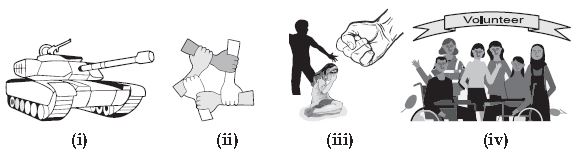
(a) (i) and (ii)
(b) (ii) and (iii)
(c) (i) and (iii)
(d) (i) and (iv)
Answer. C
(ii) How would you describe the tone of the poet?
(i) melancholic, resigned (ii) fanciful, noble
(iii) reflective, idealistic (iv) fearful, gloomy
(a) (i)
(b) (ii)
(c) (iii)
(d) (iv)
Answer. C
Question. Imagine you were asked to rename the poem. Column A lists titles of some famous poems.
Column B justifies how each of these titles may be appropriate for the above extract.
Choose the option that correctly lists the matching of Column A to Column B.
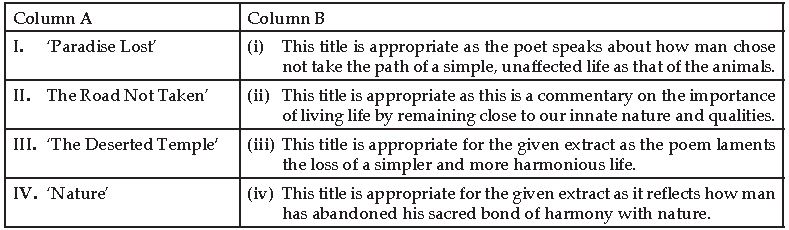
(a) I-(i); II-(ii); III - (iii); IV-(iv)
(b) I-(ii); II-(iii); III - (iv); IV - (i)
(c) I-(iii); II-(i); III - (iv); IV-(ii)
(d) I-(iv); II-(i); III-(ii); IV-(iii)
Answer. C
Question. The word ‘envince’ means the same as
(a) deactivate.
(b) devastate.
(c) deteriorate.
(d) demonstrate.
Answer. D
Q. 2. Not one is dissatisfied,
not one is demented with
the mania of owning things,
Not one kneels to another, nor to his kind that
lived thousands of years ago,
Not one is respectable or unhappy over the whole earth.
Question. The repetition of “not one” in the given extract signifies the poet’s
(a) effort to create a sense of continuity.
(b) attempt at musicality and rhythm.
(c) sense of disappointment and frustration.
(d) feelings of anger and vengeance.
Answer. C
Question. Which of the following set of qualities does the poet attribute to animals in the given extract?
(i) discontented, furious, respectful (ii) fearless, materialistic, reputable
(iii) contented, equal, non-acquisitive (iv) happy, self-serving, intelligent
(a) (i)
(b) (ii)
(c) (iii)
(d) (iv)
Answer. C
Question. Which of the following characterises the poet’s attitude towards animals in the given extract?
(a) admiration
(b) nostalgia
(c) jealousy
(d) enthusiasm
Answer. A
Question. Choose the option that contains a statement which CANNOT be conclusively inferred from the extract.
(a) Man is miserable
(b) Man is materialistic.
(c) Man is power-hungry.
(d) Man is curious.
Answer. D
Short Answers Type Questions
Question. What makes the poet sick?
Answer. The poet is sick of people who keep discussing their duty towards God. He does not like people who talk of their duties towards God but do nothing for God’s men.
Question. How does the poet look at the animals?
Answer. For the poet, the animals are more humane than the humans themselves. They have no bad qualities like humans. In their world, all are equal, happy and content. They do not complain about anything. They show their relations to the poet and he accepts them.
Question. What are the tokens that the animals give him?
Answer. The tokens that the animals give him are the qualities of innocence, simplicity and contentment. These are the qualities that man had but now has left them on his journey towards a materialistic world.
Question. Why don’t the animals lie awake at night?
Answer. Animals don’t commit any sins and are not involved in wrong doings. Hence, they don’t lose sleep over any of their actions and so do not lie awake at night.
Question. How are animals different from the humans about owning things or kneeling to one another?
Answer. Animals are quite different from the humans. They do not act crazy about possessing things while humans, are simply crazy for material things. The animals do not kneel to another as the humans do.
For them, all are equal.
Question. Why does the poet want to ‘turn and live with animals’?
Answer. The poet talks about animals with love and affection.
He says that he found the animals very peaceful and self-contained. The animals do not complaint about their condition. They don’t weep for their sins. In short, they are not like human beings and are better to live with.
I think I could turn and live with animals,
they are so placid and self-contain’d,
I stand and look at them long and long.
(a) Why does the poet want to live with Animals?
(b) Why does the poet want to take a ‘turn’?
Answer. (a) The poet feels that it is better to live with animals as they display kindness and goodness. Animals are peaceful, self-contained and happy. They show values that lack in human beings. Animals do not complain about their lives or cry over their sins.
(b) The poet is fed up living in the world of humans.
They are always confused, arrogant. They don’t have clear conscience and weep over their sins throughout the night. On the other hand, animals are contented, calm and possess all the ‘tokens’of virtue that humans have given up. So, he wants to exchange places and live with animals.
They do not sweat and whine about their condition,
They do not lie awake in the dark and weep for their sins,
They do not make me sick discussing their duty to God,
Not one is dissatisfied, not one is demented with the mania of owning things,
(a) Why is the poet speaking in favour of the animals?
(b) What is the difference between animals and humans regarding their attitude to their condition,
sins and God?
Answer. (a) The poet speaks in favour of the animals because the animals never complain about their sins, and they never hold grudges, unlike human beings.
The poet thus prefers animals to humans.
(b) Humans beings crib and whine about their condition. They lie awake at night in the dark and weep for their sins. They make the poet sick by discussing their duty about God. But animals do not do any of these things. That is why the poet likes animals.
Free study material for English
Advanced HOTS Questions with Solutions: Class 10 English First Flight Chapter 06 Animals
About First Flight Chapter 06 Animals HOTS for Class 10 English
Master core concepts in First Flight Chapter 06 Animals with these targeted Higher Order Thinking Skills (HOTS) problems. Built for Class 10 English students following the CBSE curriculum, these exercises challenge analytical thinking and improve problem-solving speed.
Step-by-Step Answers for First Flight Chapter 06 Animals
Each question in this set is mapped directly to the official NCERT book for Class 10. Review the detailed answer keys provided below each problem to verify your solution steps and correct mistakes early.
Complete Your Chapter Revision
Wrap up your chapter revision by testing your speed with our interactive English quizzes. Access all curriculum-aligned study resources online without any restrictions.
FAQs
You can download the teacher-verified PDF for CBSE Class 10 English Animals HOTS from StudiesToday.com. These questions have been prepared for Class 10 English to help students learn high-level application and analytical skills required for the 2026-27 exams.
In the 2026 pattern, 50% of the marks are for competency-based questions. Our CBSE Class 10 English Animals HOTS are to apply basic theory to real-world to help Class 10 students to solve case studies and assertion-reasoning questions in English.
Unlike direct questions that test memory, CBSE Class 10 English Animals HOTS require out-of-the-box thinking as Class 10 English HOTS questions focus on understanding data and identifying logical errors.
After reading all conceots in English, practice CBSE Class 10 English Animals HOTS by breaking down the problem into smaller logical steps.
Yes, we provide detailed, step-by-step solutions for CBSE Class 10 English Animals HOTS. These solutions highlight the analytical reasoning and logical steps to help students prepare as per CBSE marking scheme.