

Check out CBSE Class 10 English HOTs The Ball Poem right here. Get complete High Order Thinking Skills (HOTS) questions and answers for Class 10 English First Flight Chapter 03 The Ball Poem. Created for the 2026-27 exam session, these analytical practice problems help learners master core ideas while following guidelines from CBSE, NCERT, and KVS.
First Flight Chapter 03 The Ball Poem Class 10 English HOTS with Solutions
Every Class 10 English student should practice these HOTS Questions to tackle difficult exam problems. Use the provided solutions to improve your critical thinking and boost your overall performance in Class 10.
Download HOTS: First Flight Chapter 03 The Ball Poem (Class 10 English)
Extract-Based Questions
Q. 1. What is the boy now, who has lost his ball,
What, what is he to do ? I saw it go
Merrily bouncing, down the street, and then
Merrily over — there it is in the water!
Question. The poem begins with a question. Based on your reading of the poem, the speaker
(a) wants the boy to answer the question.
(b) expects the passers-by to respond.
(c) is looking for answers in a self-help book.
(d) is thinking to himself.
Answer : C
Question. The extract suggests that the poet is
(a) an onlooker observing
(b) a parent recounting the incident
(c) the boy talking about himself
(d) imagining the incident
Answer : A
Question. Choose the situation that corresponds to the emotion behind the exclamation mark in the poem.
(1) Hey ! Hey! That’s no way to dispose off the garbage. Have you no community sense? Please but it in the bin.
(2) I knew it! I knew he’ll fare well in his auditions for ‘Young Chef. Now, we prepare for the semi-finals.
(3) I dont know where I’ve placed my ID-card. Let me check the bag once more. Ah, finally!
(4) I’ve been trying to call mom for the past 20 minutes and can’t get through. I don’t know how...Aarrgh! Again!
(a) option 1
(b) option 2
(c) option 3
(d) option 4
Answer : C
Question. The poet seems to have indicated the merry bouncing of the ball to
(a) create a sense of rhythm in these lines.
(b) support the happiness of the experience of playing.
(c) contrast with the dejected feeling of the boy.
(d) indicate the cheerful mood of the boy.
Answer : C
Question. Alliteration is a literary device that occurs with the same letter or sound at the beginning of adjacent or closely connected words.
Pick the option that showcases an example of alliteration from the extract.
(a) What is the boy now
(b) who has lost his ball
(c) I saw it go
(d) and then/ Merrily over
Answer : B
Q. 2. An ultimate shaking grief fixes the boy
As he stands rigid, trembling, staring down
All his young days into the harbour where
His ball went. I would not intrude on him;
Question. Why does the speaker choose not to intrude? This is so because the poet
(a) knows that it would embarrass the boy in his moment of grief.
(b) feels that it’s important that the boy learn an important life lesson, undisturbed.
(c) realises that he doesn’t have sufficient funds to purchase a new ball for the boy.
(d) experiences a sense of distress himself, by looking at the boy’s condition.
Answer : B
Question. The poet uses the word ‘ultimate’ to describe the boy’s reaction.
Pick the meaning that DOES NOT display what, ‘ultimate’ means in the context given.
(a) consequent
(b) final
(c) conclusive
(d) fateful
Answer : C
Question. Pick the option that lists the boy’s thoughts, matching with the line-As he stands rigid, trembling, staring down.
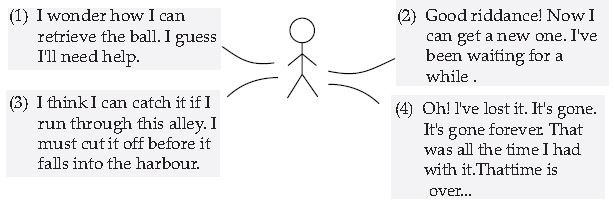
(a) Option 1
(b) Option 2
(c) Option 3
(d) Option 4
Answer : D
Question. Choose the option that lists the meaning of ‘harbour’ as used in the extract.
Noun:
(1) a place on the coast where ships may moor in shelter.
(2) a place of refuge.
Verb:
(3) keep (a thought or feeling, typically a negative one) in one’s mind, especially secretly.
(4) shelter or hide (a criminal or wanted person).
(a) Option 1
(b) Option 2
(c) Option 3
(d) Option 4
Answer : A
Question. The boy is very young in this poem. As a mature, balanced grown-up, he might look back and think that his reaction of ‘ultimate shaking grief was
(1) disproportionate to the loss.
(2) pretension to procure a new toy.
(3) according to his exposure and experience then.
(4) a reaction to the failure of retrieving the toy.
(5) justified and similar to what it would be currently.
(a) 5 & 2
(b) 1 & 3
(c) 2 & 4
(d) 3 & 5
Answer : B
Very Short Answer Type Questions
Question. Do you think the ‘I’ in the poem is the poet or an observer? Give a reason for your choice of response.
Answer : The ‘I’ in the poem, is the poet as in a few lines the poet says that he doesn’t want to intrude on the inconsolable boy. Instead he wants to leave the boy alone to develop a new sense of responsibility.
Question. A popular quote states: Responsibility is self-taught. How does the poem address this thought?
Answer : The responsibility referred in the poem is how to stand up or bear the loss through self-understanding and trying to console oneself on his own as the boy who lost his ball was trying to do.
Question. If you were the poet, which toy would you use, instead of a ball. Give a reason for your response.
Answer : If I were a poet, I would use a doll as a girl and a toy car as a boy as I’m extremely obsessed with the two toys have a very special place in the lives of children.
Short Answer Type Questions
Question. What feelings do you think, might be experienced, at the loss of a mobile phone, for a youngster today? Explain how these would be different from those felt by the boy in the poem.
Answer : The youngsters today suffer from ‘No Mobile Phone Phobia’. Such people may become depressed due to the loss of their mobile phone. It is quite different from the grief experienced by the boy in the poem because the boy in the poem is not addicted to the ball. But today’s generation is so much addicted to phone.
Question. When we think of losses, we generally think of people or possessions. Time is considered a very precious commodity. Explain why time can probably be one of the things people bitterly regret losing/wasting.
Answer : A stitch on time saves nine’. ‘The time that flies, comes back never’. So we should not waste our precious time because time doesn’t work according to us best we need to work according to time we should utilize the present fully because we can’t do anything about the time that has passed and the future is uncertain.
Question. Suggest a suitable by-line for “The Ball Poem” with a reason for your choice.
Answer : The by-line can be ‘Loss growing up and Transformation, This is something of a coming of age that is seen through the lens of loss and suffering. The child comes to understand the world better when he understands that he is never going to get his lost ball back. It is gone for good and there is nothing anyone can do about it.
The child undergoes a transformation.
Long Answer Type Questions
Question. The poem deals with a child understanding loss for the first time. Matches and championships too, deal with a different sense of loss. Explain how games and sports are a good way to train children to take losses in their stride.
Answer : Research has shown that losing games is helpful for children because it teaches them to show empathy and cope with experience of losing. They need to practice losing a competition in front of their peers. Children who do not experience losing can grow up to be anxious, because they start seeing the possibility of not wining and they cannot deal with situations that do not go their way. Losing a game is the only way for children to learn from their mistakes and think about strategies to improve when children improve their skills and win the next time, they do not only get better at the sport or game, but they also learn something new. Learning new things increase children’s confidence and their self-belief and they start to be proud of their ability.
Question. If the Buddha were to summarise the life lesson of “The Ball Poem’, what would that sermon be? Think and create this address for people of your age.
Answer : Losses are integral part of life. We must look at them in totality. First of all, we must always keep in mind that life’s each and everything is God’s gift for which we must be thankful. The things which God has given can be taken back anything. We must not be attached with these gifts. Once these attached gifts are taken away, we become sad we feel the lost thing is irreplaceable with any other things.
The lost ball stands for the general losses a human being suffers as he grows old. The losses may be the loss of a personal possession or the death of a dear one or separation from a beloved one. As long as there is life, there will be many types of losses; what each one has to learn is bearing those losses.
Free study material for English
CBSE Class 10 English First Flight Chapter 03 The Ball Poem HOTS Questions and Answers
Challenging Questions for Class 10 English First Flight Chapter 03 The Ball Poem
Download high-level analytical questions for First Flight Chapter 03 The Ball Poem. Designed in alignment with the latest CBSE syllabus for Class 10 English, these problem sets test deep conceptual understanding and prepare students for complex exam questions.
Verified Solutions for Better Concept Clarity
Pair these practice sets with our comprehensive NCERT solutions for Class 10 English to clear up doubts. Checking your working against our detailed explanations guarantees absolute mastery over this chapter.
Additional Revision and Practice Tests
Looking for more practice? Explore our complete library of Class 10 English worksheets, chapter notes, and online mock tests. Everything is provided free of charge to support your academic goals.
FAQs
You can download the teacher-verified PDF for CBSE Class 10 English HOTs The Ball Poem from StudiesToday.com. These questions have been prepared for Class 10 English to help students learn high-level application and analytical skills required for the 2026-27 exams.
In the 2026 pattern, 50% of the marks are for competency-based questions. Our CBSE Class 10 English HOTs The Ball Poem are to apply basic theory to real-world to help Class 10 students to solve case studies and assertion-reasoning questions in English.
Unlike direct questions that test memory, CBSE Class 10 English HOTs The Ball Poem require out-of-the-box thinking as Class 10 English HOTS questions focus on understanding data and identifying logical errors.
After reading all conceots in English, practice CBSE Class 10 English HOTs The Ball Poem by breaking down the problem into smaller logical steps.
Yes, we provide detailed, step-by-step solutions for CBSE Class 10 English HOTs The Ball Poem. These solutions highlight the analytical reasoning and logical steps to help students prepare as per CBSE marking scheme.