Class 7 Science Electric Current and its Circuits Notes

Download the latest Class 7 Science Electric Current and its Circuits Notes in PDF format. These Class 7 Science revision notes are carefully designed by expert teachers to align with the 2025-26 syllabus. These notes are great daily learning and last minute exam preparation and they simplify complex topics and highlight important definitions for Class 7 students.

Chapter-wise Revision Notes for Class 7 Science Chapter 14 Electric Current and its Effects

To secure a higher rank, students should use these Class 7 Science Chapter 14 Electric Current and its Effects notes for quick learning of important concepts. These exam-oriented summaries focus on difficult topics and high-weightage sections helpful in school tests and final examinations.

Chapter 14 Electric Current and its Effects Revision Notes for Class 7 Science


Electric Current and its Circuits
 
4.1 Introduction
 
Electricity is important in our daily life. Our household contains television, fan, AC, tubelights etc. These all appliances need electricity to work.
 
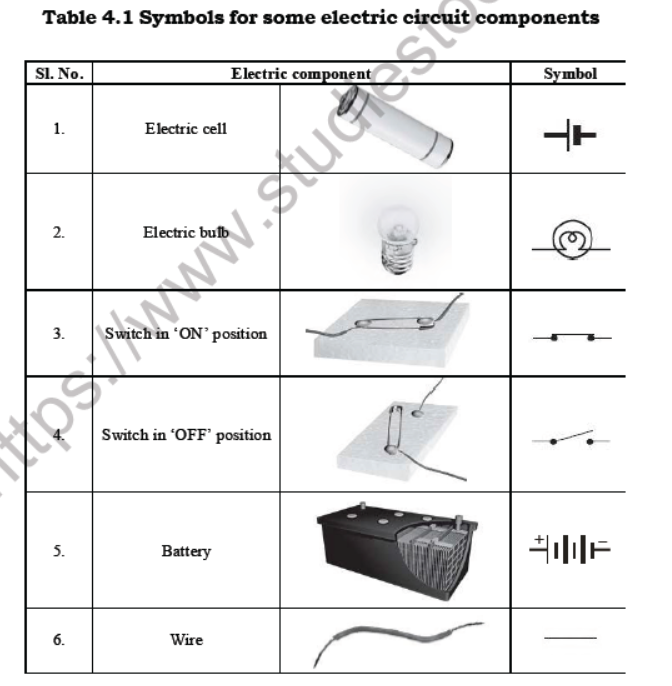
4.2 Symbols of Electric Components Some common electric components can be represented by symbols. In Table 4.1 some electric components and their symbols are shown. An electric cell has a positive terminal and a negative terminal. In the symbol of the electric cell, the longer line represents the positive terminal and the thicker, shorter line represents the negative terminal.
 
For a switch the ‘ON’ position and the ‘OFF’ position are represented by the symbols as shown. The wires used to connect the various components in a circuit are represented by lines.
Class 7 Science Electric Current and its Circuits Advanced Notes
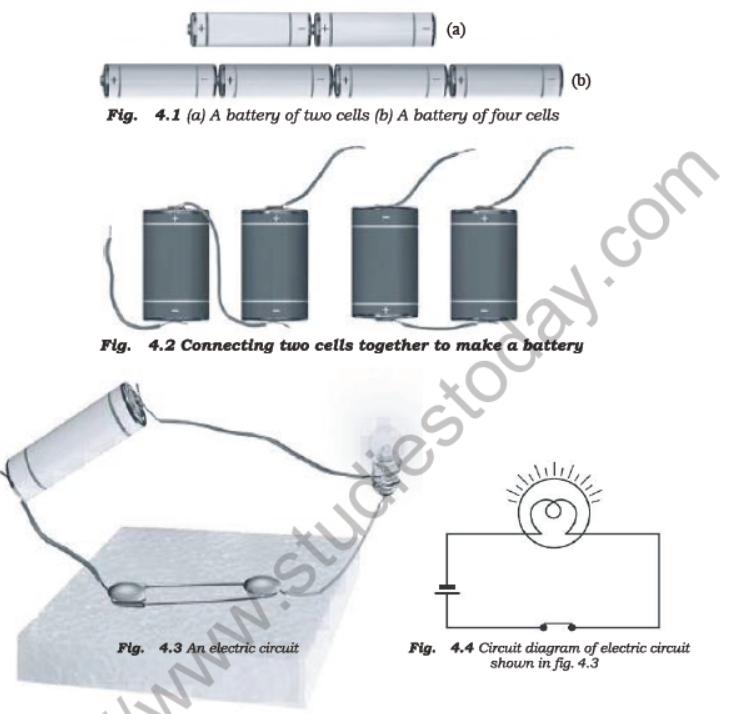
Notice that the positive terminal of one cell is connected to the negative terminal of the next cell. Such a combination of two or more cells is called a battery.
Class 7 Science Electric Current and its Circuits Advanced Notes
In the bulb there is a thin wire, called the filament which glows when an electric current passes through it. When the bulb gets fused, its filament is broken.
 
4.3 Electrical circuit : Electrical circuit is an electrical network which provides an electrical path for the flow electrical current and electrical charge.
 
An electrical circuit generally consists of various electrical components and electrical load.
Class 7 Science Electric Current and its Circuits Advanced Notes
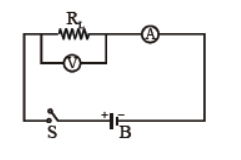
In the above figure, various electrical components have been shown.
 
(i) Battery/Cell (B) : A cell or battery acts as the source of charge/current in an electrical circuit.
 
(ii) Electrical switch (S) : An electrical switch is a device which is used to either make or break the path for the flow of current.
 
(iii) Electrical load (RL) : The external element or object across which all the electrical measurements or calculation are made. This is the chief element which is used for the conversion of the electrical energy into the required form of energy for use. Example : bulb, heater, etc.
 
(iv) Voltmeter (V) : This is an electrical instrument that is used to measure the potential difference between the two points in an electrical circuit. It is to be noted that voltmenter is always connected in parallel to the two points, across which the potential difference is to be calculated.
 
(v) Ammeter (A) : This is an electrical instrument that is used to measure the electrical current flowing through a load or electrical path. An ammeter is always connected in series with the
electrical path through the electrical current is to be measured.
 
Note :–
(i) In a battery, the positive terminal is considered to be the starting point of charge/current while negative terminal as the ending point.
 
(ii) Outside the battery current flows from positive to negative terminal whereas the direction is reversed inside the battery.
 
(iii) The switch may be in ‘ON’ or ‘OFF’ state depending on whether it is closed or open.
 
(iv) Whether the current/charge will flow through the electrical load or not, is decided by the topology of the elecrical circuit and position of electrical switch.
 
4.4 (i) Electric Charge : Electric charge can be defined as the physical factor that arives due to deficiency or excess of electrons in a substance. This factor is responsible for the electrical effects.
 
     (ii) Electric Current : The electric current is defined as rate of flow of charge. Mathematically, Electric current,
                                                     I  = Charge (Q) / Time (t)
 
Electric current is scalar quantity. Its unit is Ampere (A).
 
4.5 Electrical Potential Difference : The electrical potential difference between two points is the compelling force which causes the electrical charges and hence the electric current to flow through
an electrical path. Theoretically, it is defined as the amount of work done in moving a unit positive charge between two points without imparting any kinetic energy in it.
 
i.e., VA VB WAB /q  ; where, VA – VB = Potential difference between two points A and B q = unit positive charge, WAB = Amount of work done in moving the charge between the point A
and B.
S.I. unit of electrical potential difference in volt (V).
 
Electrical potential : The electric potential at a point is defined as the amount of work done in bringing a unit positive charge from infinity to the point of consideration. S.I. unit of electric potential is same as that of potential difference i.e., Volt (V).
 
Note :
(i) Electrical potential difference is a practical term whereas the electric potential is a referential term in which one of the pont is considered to be as infinity.
 
(ii) Electric current and positive charges flows from the high potential to low potential in an electrical circuit, outside the battery.
 
(iii) Electrons (negative charge) flows from low potential to high potential. Therefore, the direction of flow of current is taken to be opposite to the direction of flow of electrons.

4.6 Ohm’ Law :

Class 7 Science Electric Current and its Circuits Advanced Notes_1

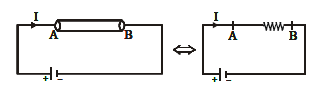
Ohm’s law states that at constant physical condition (i.e., at constant temperature), the electrical current flowing through a conductor is directly proportional to the electrical potential difference between the two ends of the conductor.

i.e., I ∝ (VA - VB)(where VA - VB = V)

or I ∝  V

or , I = V/R

Where R is the constant of proportionality called electrical resistance of the conductor.

Electrical Resistance : Electrical resistance is the material property which obstructs the flow of current/charge through the material.

(i) It depends on the nature of the material

(ii) It also depends on the temperature.

The SI unit of resistance is Ohm. Symbol of Ohm in Ω.

Note:- Ohm’s law is defined at constnat temperature because resistance of a mateiral changes with the change in temperature and hence affects the flow of current though the conductor.

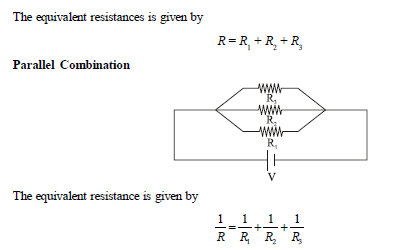
4.7 Combination of Resistances

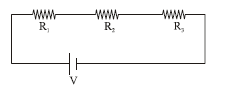
We can combine resistances in two ways. The first combination is called series combination and second combination is called parallel combination.

Series Combination
Class 7 Science Electric Current and its Circuits Advanced Notes_2

Class 7 Science Electric Current and its Circuits Advanced Notes_3

4.8 Heating effect of current

The wire gets hot when an electric current passes through it. This is called heating effect of the electric current. You might have seen an electric room heater or an electric heater used for cooking. All these contain a coil of wire. This coil of wire is called an element.

Wires made from some special materials melt quickly and break when large electric currents are passed through them. These wires are used for making electric fuses. In all building fuses are inserted in all electrical circuits. There is a maximum limit on the current which can safely flow through a circuit. If by accident the current exceeds this safe limit, the wires may become overheated and may cause fire. If a proper fuse is there in the circuit, it will blow off and break the circuit. A fuse is thus a safety device which prevents damages to electrical circuits and possible fires.

Class 7 Science Electric Current and its Circuits Advanced Notes_4

4.9 Magnetic effect of electric current

Take the cardboard tray from inside a discarded matchbox. Wrap an electric wire a few times around the cardboard tray. Place a small compass needle inside it. Now connect the free ends of this wire to an electric cell through a switch.

 
Please click the link below to download Class 7 Science Electric Current and its Circuits Advanced Notes

CBSE Class 7 Science Chapter 14 Electric Current and its Effects Notes

Students can use these Revision Notes for Chapter 14 Electric Current and its Effects to quickly understand all the main concepts. This study material has been prepared as per the latest CBSE syllabus for Class 7. Our teachers always suggest that Class 7 students read these notes regularly as they are focused on the most important topics that usually appear in school tests and final exams.

NCERT Based Chapter 14 Electric Current and its Effects Summary

Our expert team has used the official NCERT book for Class 7 Science to design these notes. These are the notes that definitely you for your current academic year. After reading the chapter summary, you should also refer to our NCERT solutions for Class 7. Always compare your understanding with our teacher prepared answers as they will help you build a very strong base in Science.

Chapter 14 Electric Current and its Effects Complete Revision and Practice

To prepare very well for y our exams, students should also solve the MCQ questions and practice worksheets provided on this page. These extra solved questions will help you to check if you have understood all the concepts of Chapter 14 Electric Current and its Effects. All study material on studiestoday.com is free and updated according to the latest Science exam patterns. Using these revision notes daily will help you feel more confident and get better marks in your exams.

Where can I download the latest PDF for Class 7 Science Electric Current and its Circuits Notes?

You can download the teacher prepared revision notes for Class 7 Science Electric Current and its Circuits Notes from StudiesToday.com. These notes are designed as per 2025-26 academic session to help Class 7 students get the best study material for Science.

Are these Science notes for Class 7 based on the 2026 board exam pattern?

Yes, our Class 7 Science Electric Current and its Circuits Notes include 50% competency-based questions with focus on core logic, keyword definitions, and the practical application of Science principles which is important for getting more marks in 2026 CBSE exams.

Do these Class 7 notes cover all topic-wise concepts for Science?

Yes, our Class 7 Science Electric Current and its Circuits Notes provide a detailed, topic wise breakdown of the chapter. Fundamental definitions, complex numerical formulas and all topics of CBSE syllabus in Class 7 is covered.

How can I use Class 7 Science Electric Current and its Circuits Notes for quick last-minute revision?

These notes for Science are organized into bullet points and easy-to-read charts. By using Class 7 Science Electric Current and its Circuits Notes, Class 7 students fast revise formulas, key definitions before the exams.

Is there any registration required to download Class 7 Science notes?

No, all study resources on StudiesToday, including Class 7 Science Electric Current and its Circuits Notes, are available for immediate free download. Class 7 Science study material is available in PDF and can be downloaded on mobile.