Class 7 Science Motion and Time Notes

Download the latest Class 7 Science Motion and Time Notes in PDF format. These Class 7 Science revision notes are carefully designed by expert teachers to align with the 2025-26 syllabus. These notes are great daily learning and last minute exam preparation and they simplify complex topics and highlight important definitions for Class 7 students.

Chapter-wise Revision Notes for Class 7 Science Chapter 13 Motion and Time

To secure a higher rank, students should use these Class 7 Science Chapter 13 Motion and Time notes for quick learning of important concepts. These exam-oriented summaries focus on difficult topics and high-weightage sections helpful in school tests and final examinations.

Chapter 13 Motion and Time Revision Notes for Class 7 Science


Motion and Time
 
3.1 Introduction
 
In our daily life, we see various objects in motion. The walking man, the running cars, the water flowing in lakes, flying aeroplanes etc. are all examples of objects in motion.
 
- A body is said to be in motion if it changes its position with respect to a reference point.
 
- Motion and rest are relative terms for e.g. If A and B are sitting in a moving car and a third person C is standing outside than A and B are at rest w.r.t. each other but in motion w.r.t. C. - Speed is defined as distance travelled per unit time i.e. speed = distance/time
 
–Uniform motion – A body is said to have uniform motion if it moves with constant speed in same direction.
 
- Non uniform motion – A body is said to have non uniform motion if either speed or direction of the moving body changes.
 
- Average speed = total distance travelled /total time taken (for non-uniform motion)
 
-S.I unit of speed is m/s.
 
- Speed = distance/time
 
- Distance = speed x time
 
- Time = distance / speed
 
MEASUREMENT OF TIME-
 
- All of the clocks make use of some periodic motion. One of the most well-known periodic motions is that of a simple pendulum.
 
- The to and fro motion of a simple pendulumis an example of oscillatory motion which is a periodic motion.
 
- The time taken by a pendulum to complete one oscillation is called its time period.
 
- The basic unit of time is second.
 
3.2 Rest and Motion
 
Rest: A body is said to be in rest if it does not change its position with respect to time with respect to another body. Example-A book lying on a table.
 
Motion: A body is said to be in motion if it changes its position with respect to time with respect to another body. Example-A train moving on rails, a man walking on road.
3.3 Physical quantities
 
Physical quantity : The quantity which can be measured is called physical quantity. In Physics, we study about physical quantity.
 
Types of physical quantity
 
i) Fundamental physical quantity
 
ii) Derived physical quantity
 
Fundamental physical quantity : The physical quantities which are independent of other physical quantities are called fundamental physical quantities. Example : Lenth, Mass, Time etc.
 
Derived physical quantity: The physical quantities which depend on fundamental physical quantities are called derived physical quantities. Example : Speed, Energy etc.
 
All physical quantities can be categorised into scalars and vectors.
 
Scalars: The quantities which have magnitude only are called scalars. Example : Distance, Speed, Energy etc.
 
Vectors: The quantities which have magnitude as well as directions both are called vectors.
 
Examples : Displacement, Velocity, Force etc. A vector is represented by putting an arrow over symbol of the phycal quantity like velocity is represented as v r , force is represented as F , etc r
 
3.4 Speed
 
We know that some vehicles move faster than others. The distance moved by objects in a given interval of time can help us to decide which one is faster or slower.
 
Speed can be defined as the distance covered by an object in a unit time. Thus
 
Speed = Total distance covered / Total time taken
 
The S.I. unit of speed is m/s and it is a scalar quantity.
 
3.5 Velocity
 
The velocity of an object is the ratio of total displacement to the total time taken. Thus Velocity = Total displacement /Total time taken
 
The S.I. unit of velocity is similar to that of speed as m/s but velocity is a vector quantity, because it also determines the direction of motion.
 
3.5 Acceleration
 
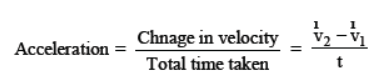
The acceleration of a moving object is defined as the rate of change in its velocity with time. Thus 
Class 7 Science Motion and Time Advanced Notes
 
The S.I. unit of acceleration is m/s2 and it is a vector quantity.
 
3.6 Types of motion :
 
(a) Uniform Motion : If an object is moving along a straighty line with constant speed/velocity, it is said to be in uniform motion.
 
for Uniform motion : Velocity = constan
Class 7 Science Motion and Time Advanced Notes
So, for uniform motion acceleration is 0.
 
Equation of motion for uniform motion :
 
Distance/Displacement = speed × time = velocity × time
 
Note: For uniform motion along a straight line, speed and velocity are same. Similary, distance and displacement are also same for the above mentioned case.
 
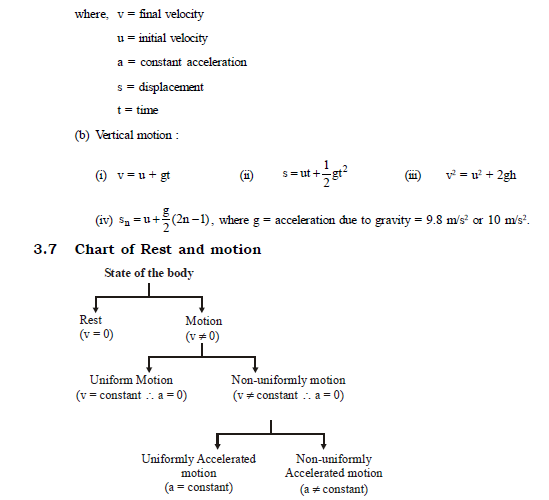
(b) Non-uniform motion : If the velocity of an object keeps on changing with time, the motion is said to be non-uniform. Since, the velocity of the object is not constant, therefore, it possesses acceleration. So, depending on the acceleration, motion can be further of two types:
 
(i) Uniformly accelerated motion : Where the acceleration of the body remains constant.
 
(ii) Non-uniformly accelerated miotion : Where the acceleration of the body keeps on changing with time.
 
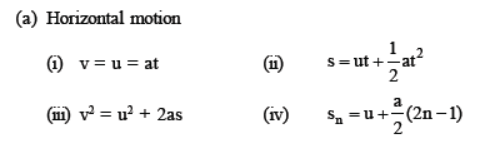
Equations of motion for uniformly accelerated body :
Class 7 Science Motion and Time Advanced Notes
Class 7 Science Motion and Time Advanced Notes_1

3.8 Distance time graph

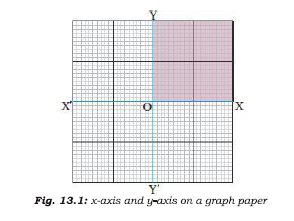
The distance-time graph is a line graph. Let us learn to make such a graph. Take a sheet of graph paper. Draw two lines perpendicular to each other on it, as shown in figure given below:
Class 7 Science Motion and Time Advanced Notes_2

Mark the horizontal line as XOX’. It is known as the x-axis. Similarly mark the vertical line YOY’. It is called the y-axis. The point of intersection of XOX’ and YOY’ is known as the origin O. You can make the graph by following steps given below:

Draw two perpendicular lines to represent the two axes and mark them as OX and OY as in given figure. Decide the quantity to be shown along the x-axis and that to be shown along the y-axis. In this case we show the time along the x-axis and the distance along the y-axis. Choose a scale to represent the distance and another to represent the time on the graph. For the motion of the car scales could be

Time : 1 min = 1 cm. Distance: 1 km = 1 cm. Mark values for the time and the distance on the respective axes according to the scale you have chosen. Now you have to mark the points on the graph paper to represent each set of values for distance and time. The corresponding figure shows the set of points on the graph corresponding to positions of the car at various times.

Class 7 Science Motion and Time Advanced Notes_3

Joint all the points on the graph. This is the distnace time graph for the motion of the car. If the distance-time graph is a straight line, it indicates that the object is moving with a constant speed. However, if the speed of the object keeps changing, the graph can be of any shape.


Please click the link below to download pdf file for Class 7 Science Motion and Time Advanced Notes

CBSE Class 7 Science Chapter 13 Motion and Time Notes

Students can use these Revision Notes for Chapter 13 Motion and Time to quickly understand all the main concepts. This study material has been prepared as per the latest CBSE syllabus for Class 7. Our teachers always suggest that Class 7 students read these notes regularly as they are focused on the most important topics that usually appear in school tests and final exams.

NCERT Based Chapter 13 Motion and Time Summary

Our expert team has used the official NCERT book for Class 7 Science to design these notes. These are the notes that definitely you for your current academic year. After reading the chapter summary, you should also refer to our NCERT solutions for Class 7. Always compare your understanding with our teacher prepared answers as they will help you build a very strong base in Science.

Chapter 13 Motion and Time Complete Revision and Practice

To prepare very well for y our exams, students should also solve the MCQ questions and practice worksheets provided on this page. These extra solved questions will help you to check if you have understood all the concepts of Chapter 13 Motion and Time. All study material on studiestoday.com is free and updated according to the latest Science exam patterns. Using these revision notes daily will help you feel more confident and get better marks in your exams.

Where can I download the latest PDF for Class 7 Science Motion and Time Notes?

You can download the teacher prepared revision notes for Class 7 Science Motion and Time Notes from StudiesToday.com. These notes are designed as per 2025-26 academic session to help Class 7 students get the best study material for Science.

Are these Science notes for Class 7 based on the 2026 board exam pattern?

Yes, our Class 7 Science Motion and Time Notes include 50% competency-based questions with focus on core logic, keyword definitions, and the practical application of Science principles which is important for getting more marks in 2026 CBSE exams.

Do these Class 7 notes cover all topic-wise concepts for Science?

Yes, our Class 7 Science Motion and Time Notes provide a detailed, topic wise breakdown of the chapter. Fundamental definitions, complex numerical formulas and all topics of CBSE syllabus in Class 7 is covered.

How can I use Class 7 Science Motion and Time Notes for quick last-minute revision?

These notes for Science are organized into bullet points and easy-to-read charts. By using Class 7 Science Motion and Time Notes, Class 7 students fast revise formulas, key definitions before the exams.

Is there any registration required to download Class 7 Science notes?

No, all study resources on StudiesToday, including Class 7 Science Motion and Time Notes, are available for immediate free download. Class 7 Science study material is available in PDF and can be downloaded on mobile.