

Download Class 7 Science Concept Summaries: Class 7 Science Weather Climate Adaptations of Animals to Climate Notes
Explore reliable concept summaries and revision materials through the Class 7 Science Weather Climate Adaptations of Animals to Climate Notes. Tailored for Class 7 learners, utilizing these notes for Science Chapter 07 Weather, Climate and Adaptations of Animals to Climate ensures thorough preparation and strengthens core academic definitions before final evaluations.
Access Chapter 07 Weather, Climate and Adaptations of Animals to Climate Notes and Study Material
Navigate directly to the revision notes for Chapter 07 Weather, Climate and Adaptations of Animals to Climate using the digital viewer below. Each summary is structured to highlight high-weightage sections, allowing students to instantly access critical definitions and focus on core exam topics.

3. Humid sub-tropical climate group:
Area: The foothills of the Himalayas, Punjab, Haryana plains adjacent to the Himalayas, Rajasthan
(East of the Aravali ranges), Uttar Pradesh, Bihar and Northern part of West Bengal and Assam.
Characteristics: Mainly dry winter, but frost occurs for a few weeks in winter. Hot summers with temperatures soaring upto 46°C, May and June are the hottest months. Most of the rainfall is received during summers.
4. Mountain Climate: In the Himalayan mountains, the temperatures falls by 0.6°C for every 100 meters rise in altitude. This gives rise to a variety of climates, from near-tropical in the foothills to tundra type above the snow line.
India is mainly a tropical country, but due to great altitudinal variations, almost all climatic conditions from hot deserts to cold desert are found here. There are four seasons:
i) Winter (December - February) ii) Summer (March - June)
iii) South - West monsoon season (July - Sept.) iv) Post - monsoon season (October - November)
SEASON
The twelve months of a year can be divided into different climatic pattern. This we call the season such as spring, summer, autumn and winter.
It is important to understand that the seasons in the Northern and Southern hemisphere are reversed. When it is summer in the Northern hemisphere, it is winter in the Southern hemisphere. This is again because of the earth’s permanent inclination of its axis and earth’s revolutions around the sun.
CLIMATIC ADAPTATIONS OF ANIMALS
Climate is the most important element of the natural environment. The types of organisms and where they are found depends on it. All living organisms have adapted in different ways to the climates in which they live.
The effect of climate on the adaptations of animals living in polar regions and in the tropical rainforest are given below:
Polar regions constitute the Arctic and the Antarctic regions. Some countries belonging to this region are Greenland, Alaska Finland, Siberia and the entire of Antarctica continent. The tropical rainforests as the name suggests are the regions in the tropics. India, Malaysia, Indonesia, Brazil and Kenya are example of some of the countries where these forests are found.
The Polar Regions
These are the world’s coldest, driest, iciest and windiest regions. The coldest temperature recorded in the inland regions of Antractica was as low as –89°C in winter, going up to –30° in summer. There is no permanent settlement in Antarctica. The Arctic region is sparsely populated and people live on the highlands along the sea coast. Normal winter temperature are as low as –40° while the warmest month of June has a temperature of about 10°. Due to the tilt of Earth’s axis while it is orbiting the sun, the polar regions do not get any sunshine for some months of the year.
ANIMAL LIFE
There is very little vegetation in the Polar region. The population of animal life is also very small. As these regions have very lone temperature, the animals have adapted themselves well. This makes them compete for food, protect themselves from predators and breed. Some adaptations as in birds is to migrate to warm climates thus avoiding, the harsh months of winters. Birds fly thousands of kilometers to warmer climates and breed. Siberian crane is one such example that migrates to different parts of India like Haryana, Rajasthan and Bihar during winter months.
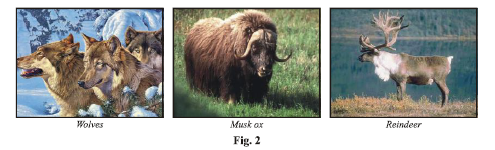
Large warm-blooded animals like Polar bear, Reindeer, Musk ox and Wolves can survive harsh winter. They lose less heat since they have a small surface as compared to their large size. They are also well insulated by a thick layer of fat and dense fur. Whales, Seal and Walrus living in the sea also have protective layers of fat.
Adaptations of Polar Bear
i) The dense fur made of keratin keeps the polar bear warm and dry. The white fur merges with the snowy background and hence protects them from predator
ii) Polar bears have thick layer of fat under their skin called blubber. They are as thick as 11 cm. T his p r ovides comp let e ins u la t ion from cold.
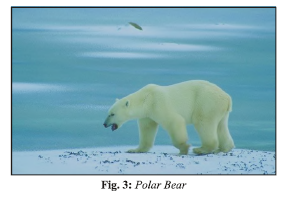
iii) Ears are short to prevent heat loss.
iv) The feet has soft bumps which provide traction on ice and short tough claws grip the ice. v) Polar bears are strong swimmers and are known to swim at a speed of 100 km/hour
vi) Their nostrils can remain closed underwater for over two minute They can catch fish. Their front paws propel them through water while hind feet act like rudders.
The keratin fur of polar bear is transparent with a hollow core. It absorbs the UV light of sun which provides it with extra warmth.
Polar bears have a unique thermoregulation system. They are so well protected against cold, that they can often get over heated. They cool down by moving slowly, resting and dropping in cold water. Heat is also released from areas where there is thin fur coat as nose, ear, foot pad and inner thigh.
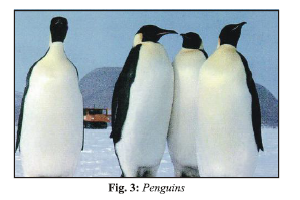
Adaptations of Penguins
Penguins are birds most closely identified with the Antarctic regions, their unique features are:
1. They are birds, but designed for life in the sea. They cannot fly but are very good swimmer
2. A coat of fat which is upto 3 cm thick helps them to survive in freezing conditions.
3. Their feathers are stiff and very lightly packed which act like a water proof coat.
4. The dark plumage absorbs heat.
5. On land, most penguins walk upright on their hind feet. They can rest on their heel and tail, thereby reducing contact with cold ice.
6. Penguins have a unique social behaviour. They live in huge clusters and also huddle close together to keep warm.
7. Unlike the flying birds, they have heavy solid bones which allow them to stay underwater effortlessly.
8. Their wing-shaped “flippers” make them “fly underwater” at speed of 14-15 km/hour.
9. Their streamlined body and webbed feet make them good swimmer
Penguins are the only birds that migrate hundreds of kilometers by swimming. They can drink salty water without any ill effects. They have much better vision underwater. On land, they are almost short sighted.
Free study material for Science
Study Material and Revision Notes for Class 7 Science Chapter 07 Weather, Climate and Adaptations of Animals to Climate
Quick Revision Notes: Chapter 07 Weather, Climate and Adaptations of Animals to Climate (CBSE)
Explore reliable chapter overviews for Chapter 07 Weather, Climate and Adaptations of Animals to Climate tailored for Class 7 learners. Use these structured points to grasp difficult themes and ensure solid preparation for upcoming assessments.
Expert Study Material for Class 7 Science
Built using the official NCERT book for Class 7 Science, these notes provide reliable academic guidance. Pair your summary review with our recommended NCERT solutions to master optimal problem-solving approaches.
Complete Your Chapter Revision
Wrap up your chapter revision by testing your knowledge against standard question formats. Everything on our platform is provided free of charge.
FAQs
You can download the teacher prepared revision notes for Class 7 Science Weather Climate Adaptations of Animals to Climate Notes from StudiesToday.com. These notes are designed as per 2026-27 academic session to help Class 7 students get the best study material for Science.
Yes, our Class 7 Science Weather Climate Adaptations of Animals to Climate Notes include 50% competency-based questions with focus on core logic, keyword definitions, and the practical application of Science principles which is important for getting more marks in 2026 CBSE exams.
Yes, our Class 7 Science Weather Climate Adaptations of Animals to Climate Notes provide a detailed, topic wise breakdown of the chapter. Fundamental definitions, complex numerical formulas and all topics of CBSE syllabus in Class 7 is covered.
These notes for Science are organized into bullet points and easy-to-read charts. By using Class 7 Science Weather Climate Adaptations of Animals to Climate Notes, Class 7 students fast revise formulas, key definitions before the exams.
No, all study resources on StudiesToday, including Class 7 Science Weather Climate Adaptations of Animals to Climate Notes, are available for immediate free download. Class 7 Science study material is available in PDF and can be downloaded on mobile.