

Official Class 7 Science Revision Material: Class 7 Science Respiration in Plants and Animals Notes
Review targeted revision notes for Class 7 Science with the Class 7 Science Respiration in Plants and Animals Notes. Built according to official educational guidelines for the 2026-27 academic year, these downloadable summaries for Chapter 10 Respiration in Organisms support daily study and last-minute exam readiness.
Chapter-wise Concept Summaries: Chapter 10 Respiration in Organisms
Navigate directly to the revision notes for Chapter 10 Respiration in Organisms using the digital viewer below. Each summary is structured to highlight high-weightage sections, allowing students to instantly access critical definitions and focus on core exam topics.


The process of breathing is aided by the rhythmic expansion and contraction of the thoracic cavity. It is the intercostal muscles between the ribs and the diaphragm that make this possible. Breathing involves two steps:
1. Inspiration or Inhalation
2. Expiration or Exhalation
Inspiration: Breathing in or the entry of air from the atmosphere to the lungs is called inspiration. During inspiration, intercostal muscles contract and push the ribs u pwar ds a nd ou twar ds, making t he cone - s ha ped diaphragm flat. This causes an increase in the air pressure inside the alveoli. The atmospheric air, which is at higher pressure, rushes in through the respiratory tract to equalize the pressure. Finally, the exchange of air takes place in the alveoli surrounded by fine blood capillary. Oxygen is taken up by haemoglobin of RBCs of blood and carbon dioxide is given up by blood to the alveoli.
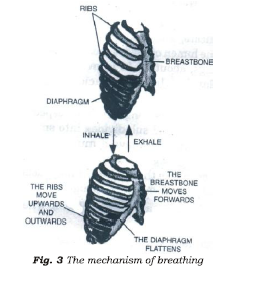
Expiration: The process of breathing out or expelling carbon dioxide and water from the lungs through the respiratory tract is called expiration. During expiration intercostal muscles relax, the ribs, move inward and the diaphragm becomes cone – shaped again. The volume of the chest cavity decreases and the air pressure inside the alveoli increases. Thus air is pushed out under increased pressure through the respiratory tract.
Cellular Respiration
In inhalation, there is more oxygen in the atmospheric air in the alveoli than in the blood capillaries. So the oxygen moves from the air to the blood. Here it combines with the haemoglobin (the red coloured pigment of Red blood cells) to form oxyhaemoglobin (Fig, 4).
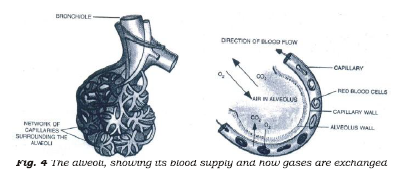
The oxygenated blood goes from lungs to the blood vessels and returns to the heart. The heart pumps this blood throughout the body through the arteries. The arteries further subdivide many times to form capillaries which supply the cells of the body, the oxygen they need to breakdown food (glucose) and release energy. Carbondioxide and water are produced as waste products during cellular respiration, which need to be eliminated from the body. This carbondioxide is now absorbed by the blood in the blood capillaries which combine to form veins. This carbondioxide is exchanged with oxygen in the alveoli. The carbondioxide is then expelled from the body through exhalation or expiration.
Respiration in Other Animals
We have lungs for respiration. But all animals do not have lungs. Frogs, snakes, crocodiles, birds and mammals possess lungs. They have nostrils (not the nose) to inhale air. However, primitive animals like earthworm cockroach, mosquito, snail and fish are without lungs. Their respiratory organs are much different.
Respiration in Earthworm
Worms breathe through their skin, as they don’t have any lungs or nose. The mouth is used for eating organic and rotting material along with soil. Breathing through their skin allows them to stay underground for long periods. They also don’t have any eyes or ears but rather sense their way along with chemical and light sensitive cells.
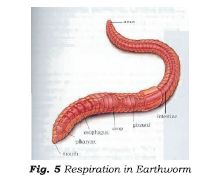
The skin’s moisture plays a key role in how oxygen travels into the worm. The worm exposes itself to oxygen by either lying out in the open or burrowing into the soil. Oxygen meets the dampness of the skin and breaks down to be obsorbed through the small tiny blood vessels called capillaries just under the skins surface. The oxygen then travels through these blood streams and is pushed throughout the body with their five larger blood vessels that resemble hearts. Once through t he body, t he ca pilla ries pus h the wast e of carbondioxide back out the same capillaries through the skin and away from the worm.
Please click the link below to download pdf file for Class 7 Science Respiration in Plants and Animals Advanced Notes.pdf
Free study material for Science
Chapter 10 Respiration in Organisms Concepts and Summary for Class 7 Science
Quick Revision Notes: Chapter 10 Respiration in Organisms (CBSE)
Review targeted chapter notes for Class 7 Science Chapter 10 Respiration in Organisms. Built according to official CBSE guidelines, these summaries highlight high-yield topics frequently tested in school evaluations.
Expert Study Material for Class 7 Science
Cross-reference your comprehension with comprehensive NCERT solutions for Class 7 to ensure absolute clarity across all sub-topics in this chapter.
Complete Your Chapter Revision
Follow up your revision by attempting the interactive online Science MCQ test and practice worksheets for this chapter to verify your mastery. All platform resources are free to access.
FAQs
You can download the teacher prepared revision notes for Class 7 Science Respiration in Plants and Animals Notes from StudiesToday.com. These notes are designed as per 2026-27 academic session to help Class 7 students get the best study material for Science.
Yes, our Class 7 Science Respiration in Plants and Animals Notes include 50% competency-based questions with focus on core logic, keyword definitions, and the practical application of Science principles which is important for getting more marks in 2026 CBSE exams.
Yes, our Class 7 Science Respiration in Plants and Animals Notes provide a detailed, topic wise breakdown of the chapter. Fundamental definitions, complex numerical formulas and all topics of CBSE syllabus in Class 7 is covered.
These notes for Science are organized into bullet points and easy-to-read charts. By using Class 7 Science Respiration in Plants and Animals Notes, Class 7 students fast revise formulas, key definitions before the exams.
No, all study resources on StudiesToday, including Class 7 Science Respiration in Plants and Animals Notes, are available for immediate free download. Class 7 Science study material is available in PDF and can be downloaded on mobile.