

Science Concept Notes for Class 7: Chapter 15 Light
Review targeted revision notes for Class 7 Science with the Class 7 Science Light Notes. Built according to official educational guidelines for the 2026-27 academic year, these downloadable summaries for Chapter 15 Light support daily study and last-minute exam readiness.
Download Chapter 15 Light Revision Notes PDF
Navigate directly to the revision notes for Chapter 15 Light using the digital viewer below. Each summary is structured to highlight high-weightage sections, allowing students to instantly access critical definitions and focus on core exam topics.
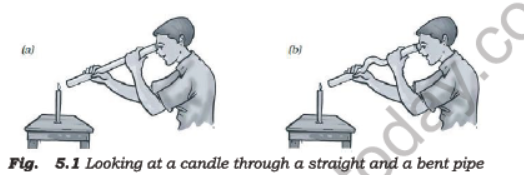
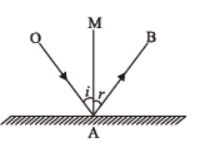


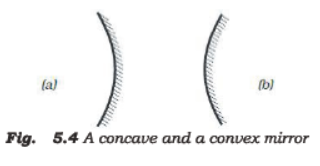
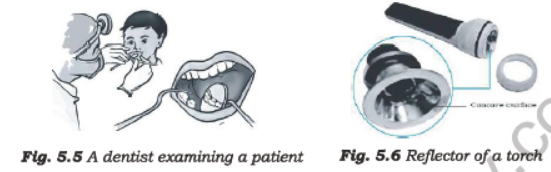
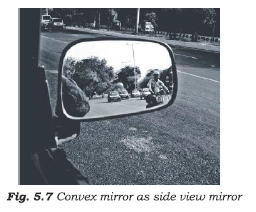
Image formed by convex mirrors are virtual, erect and smaller in size. Can you recognise the mirrors used as side mirrors in scooters? These are convex mirrors. Convex mirrors can form images of objects spread over a large area. So, these help the drivers to see the traffic behind them.
5.6 Terms related to Spherical Mirrors
Consider a spherical mirror as shown in the given figure.
i) Centre of Curvature: The centre of the sphere of which mirror is a part is called centre of curvature. In the diagram, C is the centre of curvature.
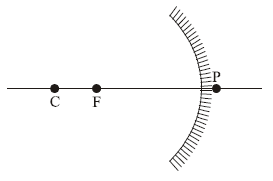
ii) Radius of curvature: The radius of the sphere of which mirror is a part is called radius of curvature. In the diagram, PC is called radius of curvature.
iii) Pole: The centre of the reflecting surface of the mirror is called pole. In the diagram, P is called pole of the mirror.
iv) Focus: The point where all rays meet or appears to meet after reflection is called Foc In the diagram, F is called focus.
v) Focal length: The distance between Pole to the focus is called focal length. In the diagram, PF is called focal length.
5.7 Mirror Equation
The mirror equation is given by
1 + 1 = 1
1/v + 1/u = 1/f
v is called image distance
u is called object distance
f is called focal length
5.8 Lenses
Lens is an optical device used for refracting and transmitting light.
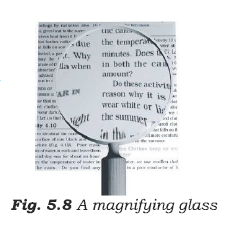
You might have seen a magnifying glass. It is used to read very small print. The magnifying glass is actually a type of lens. Lenses are widely used in spectacles, telescopes and microscopes.
Types of lenses:
i) Concave Lens: Concave lens is thinner at middle.
ii) Convex lens: Convex lens is thicker at middle.
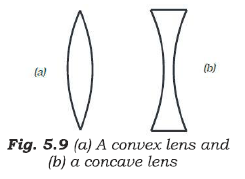
A convex lens converges (bends inward) the light generally falling on it. Therefore, it is called a converging lens. On the other hand, a concave lens diverges (bends outward) the light and is called a diverging lens.
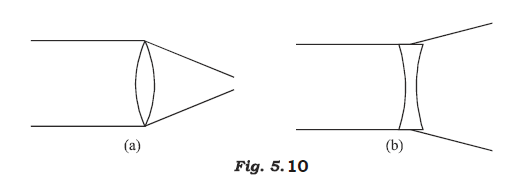
A convex lens forms magnified image.
A concave lens forms virtual, erect and diminished image.
5.9 Rainbow
There are seven colours in a rainbow, though it may not be easy to distinguish all of them. These are
— red, orange, yellow, green, blue, indigo and violet.
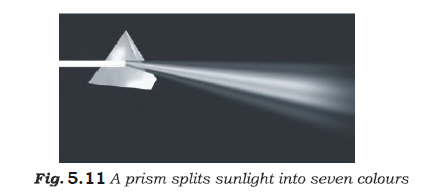
The prism splits sunlight into seven colours. The process of splitting of white light into seven colours is called dispersion.
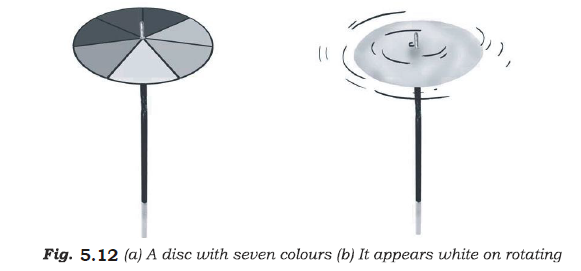
5.10 Newton’s Disc
Take a circular cardboard disc of about 10 cm diameter. Divide this disc into seven segments. Paint the seven rainbow colours on these segments as shown in figure. 15.11. Make a small hole at the centre of the disc. Fix the disc loosely on the tip of a refill of a ball pen. Ensure that the disc rotates freely. Rotate the disc in the daylight. When the disc is rotated fast, the colours get mixed together and the disc appears to be whitish. Such a disc is popularly known as Newton’s disc.
Free study material for Science
Study Material and Revision Notes for Class 7 Science Chapter 15 Light
Download Chapter Summary: Class 7 Science Chapter 15 Light
Explore reliable chapter overviews for Chapter 15 Light tailored for Class 7 learners. Use these structured points to grasp difficult themes and ensure solid preparation for upcoming assessments.
Concept Clarification for Chapter 15 Light
Built using the official NCERT book for Class 7 Science, these notes provide reliable academic guidance. Pair your summary review with our recommended NCERT solutions to master optimal problem-solving approaches.
Additional Study Resources for Class 7 Science
Follow up your revision by attempting the interactive online Science MCQ test and practice worksheets for this chapter to verify your mastery. All platform resources are free to access.
FAQs
You can download the teacher prepared revision notes for Class 7 Science Light Notes from StudiesToday.com. These notes are designed as per 2026-27 academic session to help Class 7 students get the best study material for Science.
Yes, our Class 7 Science Light Notes include 50% competency-based questions with focus on core logic, keyword definitions, and the practical application of Science principles which is important for getting more marks in 2026 CBSE exams.
Yes, our Class 7 Science Light Notes provide a detailed, topic wise breakdown of the chapter. Fundamental definitions, complex numerical formulas and all topics of CBSE syllabus in Class 7 is covered.
These notes for Science are organized into bullet points and easy-to-read charts. By using Class 7 Science Light Notes, Class 7 students fast revise formulas, key definitions before the exams.
No, all study resources on StudiesToday, including Class 7 Science Light Notes, are available for immediate free download. Class 7 Science study material is available in PDF and can be downloaded on mobile.