

Revision Notes for Class 9 Science: Chapter 12 Improvement In Food Resources
Access comprehensive revision notes for Chapter 12 Improvement In Food Resources using the CBSE Class 9 Science Improvement In Food Resources Notes Set 02. Designed to align with the 2026-27 academic syllabus for Class 9 Science, these concept summaries help students streamline their exam preparation and review complex topics efficiently.
Review Chapter 12 Improvement In Food Resources for Class 9 Science
Access the complete concept summary PDF for Chapter 12 Improvement In Food Resources below. Regular review of these targeted notes builds familiarity with complex Class 9 Science themes and helps secure higher marks in final school evaluations.
1. Food Resources: Cereals (Wheat, rice, maize, millets and sorghum) provide us carbohydrates; Pulses (Grams, pea and lentil) provide us proteins; Oil seeds (Soya bean, ground nut, sesame, and castor) provide us fats; Vegetables, spices and fruits provide us a range of minerals, nucleic acids and vitamins.
In addition to these food crops, fodder crops like berseem, oats or sudan grass are raised as food for the livestock are called as fodder crops.
2. The Kharif crops: The crops grown in rainy season are called as Kharif crops (Paddy, Soya bean, pigeon pea and maize). They are grown from June to October.
3. The Rabi crops: The crops grown in winter season are called Rabi crops (Wheat, gram, peas, and mustard). They are grown November to April.
Compare Kharif crops and Rabi crops:

4. The Green Revolution: Food supplies are generally as proteins, carbohydrates, fats, minerals, nucleic acids and vitamins in all living organisms. Indian population is growing enormously. Green Revolution is the need of the hour to increase food-grain production.
5. Sustainable Practices: For sustained livelihood, one should undertake mixed farming, inter cropping, and integrated farming practices, for example, combining agriculture with livestock/ poultry/ fisheries/bee-keeping. The major group of activities for improving crop yield can be classified as: Crop varietal improvement, Crop production improvement, Crop protection improvement
6. The Crop varietal improvement:
a) Hybridization: It refers to crossing between genetically dissimilar plants;It is all to get higher yield, improved quality, biotic and abiotic resistance, change in maturity duration, wider adaptability and desirable agronomic characteristics.
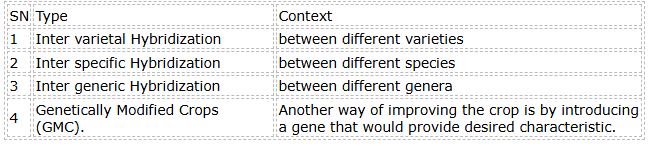
7. The Crop production improvement: They include” no cost production”,” low cost production” or “high cost production” practices.
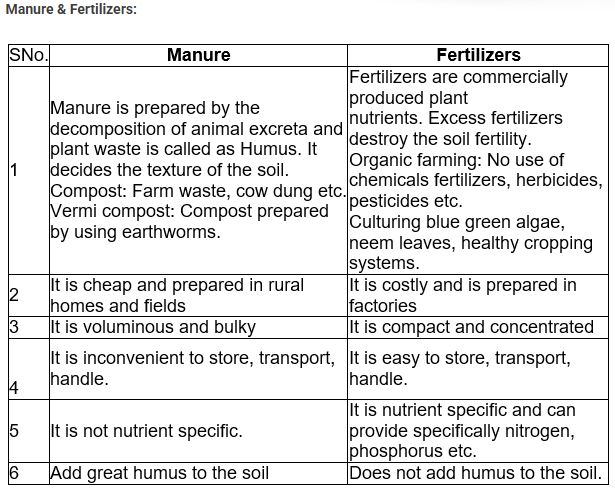
Nutrients (Sixteen elements are required for growth are called as essential elements Carbon, oxygen, hydrogen+ Macro nutrients & Micronutrients. They increase the yield)

3. Irrigation: India has variety of water resources: Wells, canals, river lift system, tanks, rainwater harvesting, water shedding management to increase in ground water levels and to check the water flowing away to the sea. Planning to reduce soil erosion.
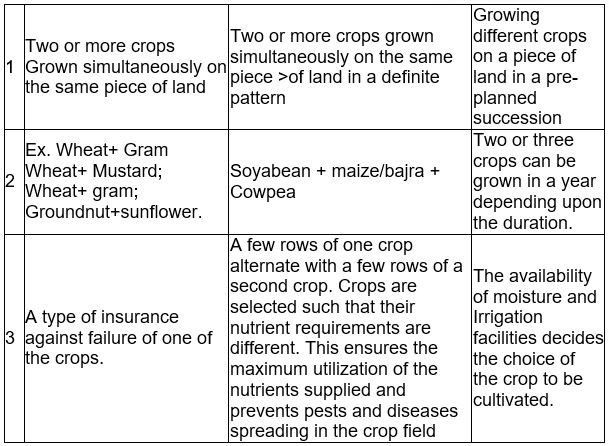
4. Cropping patterns:
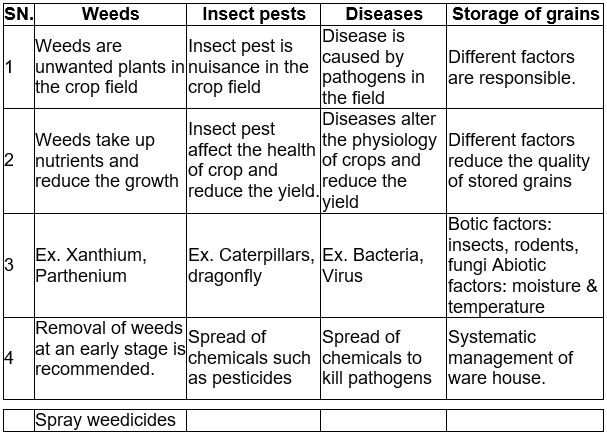
8. Crop protection improvement/ management: Field crops are infested by large number of weeds, insects pests, diseases & storage of grains
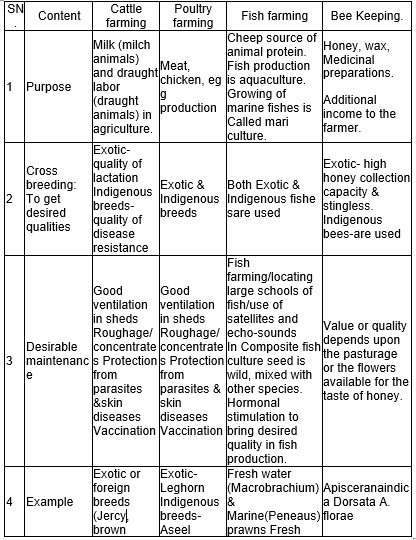
9. Animal Husbandry: It is a scientific management of animal livestock, includes feeding, breeding and diseases control. Animal-based farming includes cattle farming, Poultry farming, fish farming, and bee Keeping.

Free study material for Science
Study Material and Revision Notes for Class 9 Science Chapter 12 Improvement In Food Resources
Download Chapter Summary: Class 9 Science Chapter 12 Improvement In Food Resources
Access structured revision notes for Chapter 12 Improvement In Food Resources designed in alignment with the latest CBSE curriculum for Class 9 Science. These summaries help clarify core themes and support effective daily study.
Concept Clarification for Chapter 12 Improvement In Food Resources
Each chapter summary is structured around standard CBSE textbooks, allowing students to check their understanding and clarify complex ideas early in their revision.
Additional Study Resources for Class 9 Science
Follow up your revision by attempting the interactive online Science MCQ test and practice worksheets for this chapter to verify your mastery. All platform resources are free to access.
FAQs
You can download the teacher prepared revision notes for CBSE Class 9 Science Improvement In Food Resources Notes Set 02 from StudiesToday.com. These notes are designed as per 2026-27 academic session to help Class 9 students get the best study material for Science.
Yes, our CBSE Class 9 Science Improvement In Food Resources Notes Set 02 include 50% competency-based questions with focus on core logic, keyword definitions, and the practical application of Science principles which is important for getting more marks in 2026 CBSE exams.
Yes, our CBSE Class 9 Science Improvement In Food Resources Notes Set 02 provide a detailed, topic wise breakdown of the chapter. Fundamental definitions, complex numerical formulas and all topics of CBSE syllabus in Class 9 is covered.
These notes for Science are organized into bullet points and easy-to-read charts. By using CBSE Class 9 Science Improvement In Food Resources Notes Set 02, Class 9 students fast revise formulas, key definitions before the exams.
No, all study resources on StudiesToday, including CBSE Class 9 Science Improvement In Food Resources Notes Set 02, are available for immediate free download. Class 9 Science study material is available in PDF and can be downloaded on mobile.