

Class 11 Physics Solved Question Papers: CBSE Class 11 Physics Question Paper Set 26 Solved
Explore authentic exam materials through the CBSE Class 11 Physics Question Paper Set 26 Solved. Tailored for Class 11 learners, utilizing these Physics previous year papers ensures thorough preparation and strengthens time management skills before final CBSE evaluations.
Download Class 11 Physics Question Paper PDF
Access the complete question paper PDF for Class 11 Physics below. Regular practice with these targeted exam papers builds familiarity with standard question patterns and helps secure higher marks in final evaluations.
SECTION A
1 Define instantaneous acceleration of a body.
2 Is light year a unit of time? Define light year.
3 State Newton’s second law of motion.
4 The resistance R = V/I where V = (100±5) V and I = (10±0.2) A. Find the percentage error in R.
5 Two objects are dropped from different heights h1 and h2 simultaneously. Find the ratio of times at which they touch the ground in terms of heights.
SECTION B
6 (i) Give any two limitations of dimensional analysis.
(ii) Can a quantity have units but still be dimensionless? Give one example.
7 (i) A body is released from an aeroplane. Is it a projectile? Explain.
(ii) A body of mass ‘m’ is thrown with a velocity ‘u’ at an angle of 300. Another body is thrown with the same velocity but angle of projection is 600. What is the ratio of horizontal range of the two bodies?
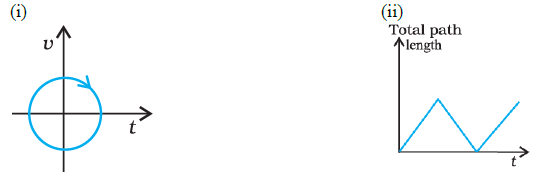
8 State, with reasons, whether the following three graphs represent one-dimensional motion of a particle.
9 Brakes are applied to a car travelling at 30m/s. Its velocity is reduced to 20m/s in 5 seconds. Calculate the retardation produced by the brakes. Also calculate the distance covered in those 5 seconds.
10 A mass of 6kg is suspended by a rope of 2m from a ceiling. A force of 50N in the horizontal direction is applied at the midpoint of the rope. What is the angle the rope makes with the vertical in equilibrium?
11 Derive an equation for distance travelled in the nth second for a uniformly accelerated motion of the particle.
12 (i) Can a bomb at rest explode into three pieces which fly in mutually perpendicular directions?
(ii) Carts with rubber tyres are easier to ply than those with iron wheels. Why?
SECTION C
13 (i) Which is the most accurate clock?
(ii) Check the correctness of the relation F=mv2 / r where ‘m’ is the mass of the body, ‘v’ its speed and ‘r’ the radius of the circular path by dimensional method.
14 A car accelerates from rest at constant rate ‘α ’for sometime after which it decelerates at a constant rate’ β ’to come to rest. If the total time elapsed is ‘ t ‘second, calculate (i) the maximum velocity reached and (ii) the total distance travelled.
On a two-lane road, car A is travelling with a speed of 36 km/h. Two cars B and C approach car A in opposite directions with a speed of 54 km/h each. At a certain instant, when the distance AB is equal to AC, both being 1 km, B decides to overtake A before C does. What minimum acceleration of car B is required to avoid an accident?
15 (i) Give two conditions necessary for a given quantity to be a vector.
(ii) Two vectors, both equal in magnitude, have their resultant equal in magnitude of the either.
Find the angle between the two vectors.
16 (i) Why are shockers used in cars, scooters and motor cycles?
(ii) Define impulse and obtain the relation between impulse and momentum.
17 (i) A wooden block of mass 2 kg rests on a soft horizontal floor. When an iron cylinder of mass 25 kg is placed on top of the block, the floor yields steadily and the block and the cylinder together go down with an acceleration of 0.1 m/s2. What is the action of the block on the floor (a) before and (b) after the floor yields?
(ii) What are concurrent forces?
18 (i) Draw position – time graph of two objects moving along a straight line when their relative velocity is zero.
(ii) What does the slope of velocity –time graph represent?
(iii) The velocity- time graph of two objects make angles of 30o and 60o with the time axis. Find the ratio of their accelerations.
19 Draw velocity-time graph for the motion of a body moving with uniform acceleration. From this graph, obtain an expression v = u + at .
20 The frequency of vibration (υ) of a string depends upon the length ( l) of the string, tension (T) in the string and mass per unit length (m) of the string. Use method of dimensions for establishing the formula for the frequency.
21 Draw a neat free body diagram to show various forces acting on a body moving down the incline with uniform acceleration and derive an expression for the acceleration.
22 Define the angle of friction and angle of repose. Derive a relation between them.
23 (i) Friction is a necessary evil. Comment on the statement.
(ii) Tyres are provided with irregular projections over their surfaces. Why?
24 Derive an expression for centripetal acceleration of an object in uniform circular motion. What will be its direction at any instant
SECTION D
25 (i) Describe a method to determine the diameter of moon.
(ii) Give any two advantages of defining standard metre in terms of wavelength of light.
(iii) State principle of homogeneity of dimensions.
OR
(i) Write any four advantages of SI system over other system of units.
(ii) Name the physical quantities represented by the following dimensional formulae:
(a) [M L2 T -2] (b) [ ML-3 T 0] (c) [ ML T-1] (d) [M0 L0 T-1]
(iii) If x= a+ bt + ct 2, where x is in metres and t in seconds, find the unit of b.
26 (i) Which is easier, pushing or pulling a lawn mower? Explain with the help of free body diagrams.
(ii) Determine the maximum acceleration of the train in which a box lying on its floor will remain stationary, given that the co-efficient of static friction between the box and the train’s floor is 0.15.
OR
(i) State and prove law of conservation of linear momentum.
(ii) A stream of water flowing horizontally with a speed of 15m/s gushes out of a tube of cross sectional area 10 -2 m2 and hits at a vertical wall nearby. What is the force exerted on the wall by the impact of water, assuming it does not rebound?
27 i) Show that the path followed by a projectile is a parabola when it is projected at an angle θ with the horizontal.
ii) A projectile can have the same range R for two angles of projections. If T1 and T2 are the times of flight in the two cases, show that the product of the two times of flight is directly proportional to R?
OR
i) Derive expressions for a) time of flight b) maximum height and c) horizontal range attained by an oblique projectile.
ii) Prove that the maximum horizontal range is four times the maximum height attained by a projectile which is fired along the required oblique direction.
Please click on below link to download CBSE Class 11 Physics Question Paper Set Z Solved
Free study material for Physics
CBSE Class 11 Physics Question Paper Set 26 Solved & Previous Year Question Papers for Class 11 Physics
Download CBSE Class 11 Physics Question Paper Set 26 Solved for Class 11 Physics
Explore downloadable past papers for Class 11 Physics. Utilizing the CBSE Class 11 Physics Question Paper Set 26 Solved ensures complete preparedness by offering clear insights into historical question styles and marking expectations.
Master Marking Schemes and Time Management
Regular simulation of exam environments using past question documents builds crucial pacing abilities and eliminates last-minute test anxiety during Class 11 Physics assessments.
Offline Revision & Comprehensive Study Material
Pair your past paper revision with our official Class 11 Physics sample papers and online practice modules to achieve total curriculum mastery.
FAQs
The CBSE Class 11 Physics Question Paper Set 26 Solved is available for download on StudiesToday.com. It includes complete set with all sections so that Class 11 students can practice with the exact same paper that came in the CBSE exams.
Yes, the solutions for CBSE Class 11 Physics Question Paper Set 26 Solved are prepared by subject matter experts as per official marking scheme. Class 11 students will understand the structure of answers and 'step-marks' methodology Physics.
Solving previous year papers like CBSE Class 11 Physics Question Paper Set 26 Solved is important to understand repeat themes and question difficulty levels of Physics. It helps Class 11 students to test their time management skills too.
Yes, where applicable, CBSE Class 11 Physics Question Paper Set 26 Solved is available in both English and Hindi mediums. All students from Class 11 can access Physics study material in their preferred language.
No, all previous year question papers on StudiesToday, including CBSE Class 11 Physics Question Paper Set 26 Solved, are provided free of charge in mobile-friendly PDF.