

Class 9 Social Science Practice Sheet: CBSE Class 9 Civics Working Of Institutions Worksheet
Review targeted academic worksheets with the CBSE Class 9 Civics Working Of Institutions Worksheet. Built according to official educational standards for the 2026-27 term, these downloadable Class 9 Social Science resources support effective daily practice and detailed self-evaluation for Democratic Politics I Chapter 04 Working of Institutions.
Download Democratic Politics I Chapter 04 Working of Institutions Worksheet PDF with Answers
Navigate directly to the solved Social Science worksheets using the digital viewer below. Each practice set includes detailed step-by-step solutions, allowing students to instantly cross-check their work and identify areas requiring further revision.
CBSE Class 9 Civics Worksheet - Working of Institutions
MCQ Questions for NCERT Class 9 Social Science Working Of Institutions
Questions: What do the Civil Servants do?
(A) They take important Policy decisions.
(B) They Implement the Ministers’ Decisions.
(C) They settle the Disputes.
(D) None of the above.
Answer: B
Questions: Which body acts as the Guardian of Fundamental Rights?
(A) District Courts
(B) Supreme Court
(C) Election Commission
(D) Legislature
Answer: B
Questions: Study the given Picture carefully : 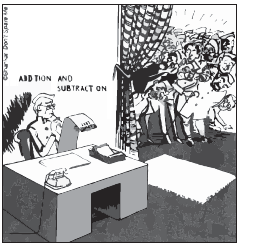
This picture is related to which of the following :
(A) 1956 election
(B) 1962 election
(C) 1967 election
(D) 1972 election
Answer: B
Questions: Once the Lok Sabha passes the Budget of the Government or any Other Money Related Law, the Rajya Sabha cannot reject it. The Rajya Sabha can only delay it by :
(A) 14 days
(B) 15 days
(C) 16 days
(D) 17 days
Answer: A
Questions: Why does a Minister take the final say although the Advisors and Experts working in the Department may be more qualified?
(A) He is finally answerable to the people for all the consequences of his decision.
(B) The Minister is an Elected Representative of the People and thus, Empowered to exercise the will of the People on their behalf.
(C) The Minister decides the overall framework and objectives in which decisions on Policy should be made.
(D) All of the above.
Answer: D
Questions: What is meant by Coalition Government?
(A) A Government formed by an Alliance of two or more Political Parties when no Single Party enjoys majority support.
(B) A Government formed by Absolute Majority.
(C) A Government formed by an Alliance of only two Political Parties when no Single party enjoys majority support.
(D) A Government formed by an Alliance of two or more Social Groups.
Answer: A
Questions: Who is the Head of the State and the Highest Formal Authority in the Country?
(A) The Prime Minister
(B) The President
(C) Speaker of Lok Sabha
(D) Home Minister
Answer: B
Question. If you are elected as the President of India which of the following decision can you take on your own?
(a) Select the person you like as Prime Minister.
(b) Dismiss a Prime Minister who has a majority in Lok Sabha.
(c) Ask for reconsideration of a bill passed by both the Houses.
(d) Nominate the leaders of your choice to the Council of Ministers.
Answer: C
Question. Who among the following is a part of the political executive?
(a) District Collector
(b) Secretary of the Ministry of Home Affairs
(c) Home Minister
(d) Director General of Police
Answer: C
Question. Which of the following statements about the judiciary is false?
(a) Every law passed by the Parliament needs approval of the Supreme Court
(b) Judiciary can strike down a law if it goes against the spirit of the Constitution
(c) Judiciary is independent of the Executive
(d) Any citizen can approach the courts if her rights are violated
Answer: B
Question. Which of the following institutions can make changes to an existing law of the country?
(a) The Supreme Court
(b) The President"
(c) The Prime Minister
(d) The Parliament
Answer: D
Question. Why is the Prime Minister in India not directly elected by the people? Choose the most appropriate answer and give reasons for your choice.
(a) In a Parliamentary democracy only the leader of the majority party in the Lok Sabha can become the Prime Minister.
(b) Lok Sabha can remove the Prime Minister and the Council of Ministers even before the expiry of their term.
(c) Since the Prime Minister is appointed by the President there is no need for it.
(d) Direct election of the Prime Minister will involve lot of expenditure on election.
Answer: A
Question. Match the ministry with the news that the ministry may have released: exercises
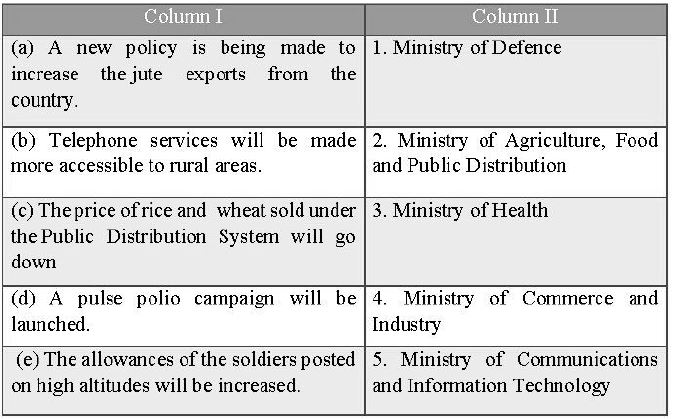
Question. Of all the institutions that we have studied in this chapter, name the one that exercises the powers on each of the following matters.
(a) Decision on allocation of money for developing infrastructure like roads, irrigation etc. and different welfare activities for the citizens
(b) Considers the recommendation of a Committee on a law to regulate the stock exchange
(c) Decides on a legal dispute between two state governments
(d) Implements the decision to provide relief for the victims of an earthquake.
Answer: (a) Cabinet
(b) Parliament
(c) Supreme Court
(d) Permanent Executive
Question.
Three friends went to watch a film that showed the hero becoming Chief Minister for a day and making big changes in the state. Imran said this is what the country needs. Rizwan said this kind of a personal rule without institutions is dangerous. Shankar said all this is a fantasy. No minister can do anything in one day. What would be your reaction to such a film?
Answer: While it may look quite appealing in a movie; the real life is strikingly different. Governance in a democracy is all about taking everyone along with you. Moreover, in a large and diverse country like India, it is not possible to take decision on the whims of an individual. Implementation of a decision needs to coordination among various organs of the government and a minister is just a part of that system.
Question. A teacher was making preparations for a mock parliament. She called two students to act as leaders of two political parties. She gave them an option: Each one could choose to have a majority either in the mock Lok Sabha or in the mock Rajya Sabha. If this choice was given to you, which one would you choose and why?
Answer: would choose to have a majority in the Lok Sabha. The leader of the Lok Sabha is directly answerable to the public and hence it can be quite challenging for him.
Question. After reading the example of the reservation order, three students had different reactions about the role of the judiciary. Which view, according to you, is a correct reading of the role of judiciary?
(a) Srinivas argues that since the Supreme Court agreed with the government, it is not independent.
(b) Anjaiah says that judiciary is independent because it could have given a verdict against the government order. The Supreme Court did direct the government to modify it.
(c) Vijaya thinks that the judiciary is neither independent nor conformist, but acts as a mediator between opposing parties. The court struck a good balance between those who supported and those who opposed the order.
Answer: (c) Judiciary is independent because it could have given a verdict against the government order. The Supreme Court did direct the government to modify it.
Case Study Questions Working Of Institutions Class 9 Social Science
Read the following text and answer the following questions on the basis of the same:
Prime Minister is the most important Political Institution in the Country. Yet there is no Direct Election to the post of the Prime Minister. The
President appoints the Prime Minister. But the President cannot appoint anyone he likes. The President appoints the Leader of the Majority
Party or the Coalition of Parties that Commands a Majority in the Lok Sabha as Prime Minister. In case No Single Party or Alliance gets a Majority, the President appoints the person most likely to secure a Majority Support. The Prime Minister does not have a fixed tenure. He continues in power so long as he remains the Leader of the Majority Party or Coalition.
Questions: Who is the Head of the Government and exercises All Governmental Powers?
(A) The Prime Minister
(B) The President
(C) The Speaker
(D) Head of the Ruling Party
Answer: A
Questions: What is meant by Political Executive?
(A) The Speaker
(B) Political Leaders who are elected by the People for a specific term.
(C) Only those Political Leaders who are in the Ruling Party.
(D) Only those Political Leaders who are in the Opposition Party.
Answer: B
Questions: Who among the following is a part of the Political Executive?
(A) Home Minister
(B) District Collector
(C) Secretary of the Ministry of Home Affairs
(D) Director General of Police
Answer: A
Questions: Directions : In the following question, a statement of Assertion (A) is followed by a statement of Reason (R). Mark the correct choice as :
(A) Both (A) and (R) are true and (R) is the correct explanation of (A).
(B) Both (A) and (R) are true but (R) is not the correct explanation of (A).
(C) (A) is true, but (R) is false.
(D) (A) is false, but (R) is true.
Assertion(A) : The Prime Minister has a fixed tenure of five years.
Reason(R) : He continues in power so long as he remains the Leader of the Majority Party or Coalition.
Answer: D
Questions: What is the Government formed by an Alliance of two or more Political Parties called?
(A) Cooperation Government
(B) Coalition Government
(C) Consensus Government
(D) Cooperative Government
Answer: B
Short Answer Type Questions
Questions: “The Lok Sabha controls the Council of Ministers.” Justify this statement.
Answer: (i) Only a person who enjoys the support of the Majority of the Members in the Lok Sabha is appointed as the Prime Minister.
(ii) If the Majority of the Lok Sabha Members say they have “No Confidence” in the Council of Ministers, then all the Ministers including the Prime Minister have to quit.
Questions: ‘‘The Indira Sawhney and others Versus Union of India Case’’, was filed in which concern? Describe it.
Answer: (i) The Second Backward Classes Commission in India was established in 1979 by the Janata Party Government under the then Prime Minister Morarji Desai. It was headed by Indian Parliamentarian B.P. Mandal. Hence, it was popularly known as the Mandal Commission.
(ii) The Commission was asked to determine the criteria to identify the Socially and Educationally Backward Classes in India and recommend steps for their advancement.
(iii) The Commission gave its report in 1980 and made many recommendations. One of these was that 27% of Government Jobs be Reserved for the Socially and Economically Backward classes (SEBC).
The Reservation issue was very strongly protested after the implementation of the Commission Report in 1990. People reacted vehemently because this decision affected thousands of Job Opportunities.
(iv) Some people felt that Reservations were necessary to Balance the inequality among people of different castes in India. Others felt that Reservations were unfair and would deny equal Opportunities to those who did not belong to Backward Communities.
Following the Nation-wide outrage against the order and protest, a Court case was filed against the Order.
These cases were grouped together by the Supreme Court and called the ‘Indira Sawhney and others Versus the Union of India Case’.
Questions: Describe the Role played by the Contemporary Prime Minister of India in the Implementation of the Mandal Commission Report.
Answer: (i) The Prime Minister informed the Parliament about the decision through a Statement in both the Houses of Parliament.
(ii) The decision of the Cabinet was sent to the Department of Personnel and Training.
(iii) The Senior Officers of the Department drafted an order in Line with the Cabinet decision and took the Minister’s approval.
Questions: Why does the Political Executive have more powers than the Permanent Executive? Give any three reasons.
Answer: (i) Every Minister is the Representative of the People and empowered to exercise the Will of the People on their Behalf.
(ii) She/He is finally answerable to the People for all the decisions.
(iii) The Ministers take the advice of the Experts on All Technical Matters and decides according to the Overall Objective.
Questions: What is a Coalition Government? Why the Prime Minister of a Coalition Government cannot take decisions as he likes?
OR
What is a Coalition Government? Mention any two Limitations of a Coalition Government.
Answer: Coalition Government is formed by an Alliance of two or more Political Parties usually when no Single Party enjoys Majority support of the Members in the Legislature.
Limitations:
(i) The Prime Minister has to accommodate different Groups and Sections in his Party as well as among his Alliance Partners.
(ii) He also has to heed to the views and positions of Coalition Partners and Other Parties, on whose support the Survival of the Government depends.
Questions: Write about the Process of Appointment and Removal of a Judge of the Supreme Court. A
Answer: The Judges of the Supreme Court and the High Courts are appointed by the President on the Advice of the Prime Minister and in Consultation with the Chief Justice of India. In practice the Senior Judges of the Supreme Court select the New Judges of the Supreme Court.
A Judge can be removed only by an Impeachment Motion passed separately by Two-third Members of the Two Houses of the Parliament.
Questions: What is meant by the Independence of the Judiciary? Explain.
Answer: Independence of the Judiciary :
(i) Judiciary is not under the control of the Legislature or the Executive.
(ii) The Judges do not act on the Direction of the Government or according to the wishes of the Party in Power.
(iii) The Constitution of India provides the Security to the Service of the Judges. Once appointed by the President, their service cannot be terminated by will or by any authority whatever.
(iv) There is a Security of pay and allowances of the Judges. Their Salaries cannot be reduced.
(v) The Supreme Court and the High Courts are free to decide their own Procedure of Work and Establishment.
(vi) Judges are not allowed to practice after Retirement so that they cannot influence Judgements of the Court.
Long Answer Type Questions
Question: Analyse the reaction of the people after the implementation of Mandal Commission Report. A
Answer: It led to widespread protests, some of which were violent. People reacted strongly because this decision affected thousands of Job Opportunities.
(i) The people felt this would give fair opportunity to those Communities who had not been represented in Government Employment.
(ii) Some felt that this was unfair as it would deny equality of opportunity to those who did not belong to Backward Communities.
(iii) They would be denied jobs even if they were qualified.
(iv) Some felt that this would arouse Caste feelings.
(v) Others felt that this situation would lead to Social Division and weaker National Unity.
Question: Explain the need of Political Institutions.
Answer: (i) Security of its Citizens.
(ii) Law and order.
(iii) Justice.
(iv) Welfare activities.
(v) Various decisions are taken and implemented for the Welfare of the People by the Institutions.
Question: Describe the Election Procedure of the Two Houses of Indian Parliament. List three areas where Lok Sabha enjoys Supreme Powers.
OR
In which three ways is the Lok Sabha more powerful than the Rajya Sabha?
OR
How does the Lok Sabha exercise Supreme Power over the Rajya Sabha? Explain.
OR
Which House of the Parliament is More Powerful in India and why? Give any three reasons to justify your answer.
OR
Compare the powers of Lok Sabha and Rajya Sabha.
Answer: Election Procedure of the Two Houses of Parliament:
(i) The Lok Sabha is Directly Elected by the People and enjoys real power on behalf of the People.
(ii) The Rajya Sabha is Elected Indirectly and mainly looks after the Interest of the regions or Federal Units.
The Lok Sabha enjoys Supreme Powers :
(i) If there is a Joint Session of the Two Houses then the Will of the Lok Sabha prevails due to its Numerical Supremacy.
(ii) In Money Matters, the Lok Sabha is Supreme as the Rajya Sabha can only delay a Money Bill for 14 days or give suggestions.
(iii) The Lok Sabha controls the Council of Ministers through ‘No-confidence Motion’.
Question: Differentiate between Political Executive and Permanent Executive. Which Executive is more Powerful?
Answer: Political Executive:
(i) It is Elected by the People for a specified period.
(ii) Political Executive is more Powerful than Permanent Executive.
(iii) The Ministers of Political Executives are elected by the People, so they are answerable to the people for their work. That’s why, the Ministers take all the Final decisions.
Permanent Executive:
(i) In the second category, people are appointed on a long-term basis, who are called Permanent Executives.
(ii) Officials working in Civil Services are called Civil Servants. They are also called Bureaucrats.
(iii) They remain in Office even when the Ruling Party changes. These Officers work under the Political Executive and assist them in carrying out day to day Administration.
Thus, a Political Executive is more powerful.
1. Name the three
1. Name the three
1. Name the three main democratic institutions that play a key role in major decisions.
2. Who is the head of the state?
3. Who is the head of the government?
4. Which events preceded the Government order of 13th August, 1990?
5. Why did PM V.P.Singh have to implement Mandal Commission recommendations?
6. What reasons were given in support of the Government order?
7. Why was the order dated 13th August, 1990 opposed?
8. What was Supreme Court judgement on Government Order of 13th August, 1990?
9. What is the need for political institutions in a democracy?
10. What is Parliament?
11. Why do we need a Parliament?
12. Why is Parliament needed?
13. Is President of India a part of the Parliament? To which house does he belong?
14. What are the main differences in the composition of two houses of Parliament?
15. Give examples to show that on most matters the Lok Sabha exercises supreme power.
16. What is the difference between political and permanent executive?
17. Why does the political executive have more power than the non-political executive?
18. How is the PM appointed?
19. Which body is called Council of Ministers? What is the usual strength of it?
20. Explain three categories of ministers of Council of Ministers.
21. Who appoints Council of Ministers?
22. Who assists the cabinet?
23. What is the role of PM in a democracy?
24. What are the limitations on the PM of a coalition Government?
25. How is the President elected?
26. What are the powers of the President?
27. What is judiciary? What kinds of disputes are solved by Supreme Court?
28. What do you mean by independence of judiciary?
29. What is public interest litigation?
30. What is Judicial Review?
Free study material for Social Science
CBSE Class 9 Social Science Worksheets for Democratic Politics I Chapter 04 Working of Institutions
Practice Exercises for Class 9 Social Science Democratic Politics I Chapter 04 Working of Institutions
Explore reliable practice questions for Democratic Politics I Chapter 04 Working of Institutions tailored for Class 9 Social Science learners. Use these structured worksheets to evaluate exam preparedness and strengthen problem-solving skills throughout the 2026 academic session.
Step-by-Step Solutions and Practice Guidelines
Built using official NCERT guidelines for Class 9 Social Science, these practice sheets provide reliable academic support. Cross-reference your completed work with our detailed solutions to learn standard answer-writing formats for CBSE exams.
Enhance Speed with Online Practice
Wrap up your chapter revision by testing your knowledge against standard objective question formats. Explore our full library of free, up-to-date printable assignments to maximize your academic results in upcoming CBSE evaluations.
FAQs
You can download the latest chapter-wise printable worksheets for Class 9 Social Science Democratic Politics I Chapter 04 Working of Institutions for free from StudiesToday.com. These have been made as per the latest CBSE curriculum for this academic year.
Yes, Class 9 Social Science worksheets for Democratic Politics I Chapter 04 Working of Institutions focus on activity-based learning and also competency-style questions. This helps students to apply theoretical knowledge to practical scenarios.
Yes, we have provided solved worksheets for Class 9 Social Science Democratic Politics I Chapter 04 Working of Institutions to help students verify their answers instantly.
Yes, our Class 9 Social Science test sheets are mobile-friendly PDFs and can be printed by teachers for classroom.
For Democratic Politics I Chapter 04 Working of Institutions, regular practice with our worksheets will improve question-handling speed and help students understand all technical terms and diagrams.