

Chapter-wise Worksheets for Class 9 Social Science: Democratic Politics I Chapter 02 Constitutional Design
Explore structured practice materials through the CBSE Class 9 Civics Constitutional Design Worksheet. Tailored for Class 9 learners, utilizing these Social Science worksheets ensures thorough preparation and strengthens problem-solving accuracy before final school evaluations.
Practice Class 9 Social Science Worksheets: Democratic Politics I Chapter 02 Constitutional Design
Navigate directly to the solved Social Science worksheets using the digital viewer below. Each practice set includes detailed step-by-step solutions, allowing students to instantly cross-check their work and identify areas requiring further revision.
Question : Here are some false statements. Identify the mistake in each case and rewrite these correctly based on what you have read in this chapter.
(a) Leaders of the freedom movement had an open mind about whether the country should be democratic or not after independence.
Answer: This is a true statement.
(b) Members of the Constituent Assembly of India held the same views on all provisions of the Constitution.
Answer: Members of the Constituent Assembly of India had different opinions on various provisions of the constitution.
(c) A country that has a constitution must be a democracy.
Answer: This cannot be said with surety; in the context of information given in this chapter.
(d) Constitution cannot be amended because it is the supreme law of a country.
Answer:: Constitution can be amended to keep up with the changes in aspirations of the society.
Question : Which of these was the most salient underlying conflict in the making of a democratic constitution in South Africa?
(a) Between South Africa and its neighbours
(b) Between men and women
(c) Between the white majority and the black minority
(d) Between the coloured minority and the black majority
Answer: (d) Between the coloured minority and the black majority
Question. Which of these is a provision that a democratic constitution does not have?
(a) Powers of the head of the state
(b) Name of the head of the state
(c) Powers of the legislature
(d) Name of the country
Answer: (b) Name of the head of the state
Question. Match the following leaders with their roles in the making of the Constitution:
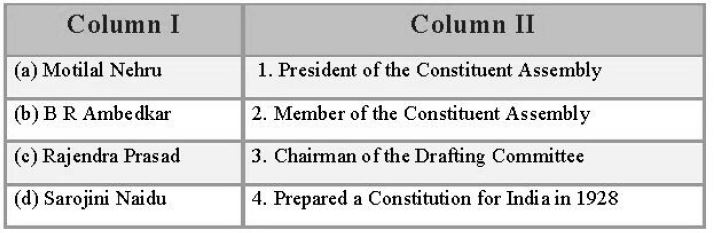
Answer: (a) - 4, (b) - 3, (c) - 1, (d) - 2
Question. Read again the extracts from Nehru’s speech ‘Tryst with Destiny’ and answer the following:
(a) Why did Nehru use the expression “not wholly or in full measure” in the first sentence?
Answer: The task of building a nation is a gargantuan task which cannot be fulfilled in one’s lifetime. Hence Nehru had used the expression, “not wholly or in full measure, but substantially”.
(b) What pledge did he want the makers of the Indian Constitution to take?
Answer: He wanted them to take the pledge of building a nation in which there would not be a single person with tears in his eyes. He wanted them to understand the huge responsibility which destiny had thrust upon them.
(c) “The ambition of the greatest man of our generation has been to wipe every tear from every eye”. Who was he referring to?
Answer: He was referring to Mahatma Gandhi.
Question. Here are some of the guiding values of the Constitution and their meaning. Rewrite them by matching them correctly.

Answer: (a) - 2, (b) - 3, (c) - 4, (d) - 1
Question. A friend from Nepal has written you a letter describing the political exercises situation there. Many political parties are opposing the rule of the king. Some of them say that the existing constitution given by the monarch can be amended to allow more powers to elected representatives. Others are demanding a new Constituent Assembly to write a republican constitution. Reply to your friend giving your opinions on the subject.
Answer: Both the options are plausible. If the existing constitution is proper then it can be amended to include more powers to elected representatives. If the existing constitution is full of loopholes, then a new constitution should be drafted. For this, a Constituent Assembly should be formed by including the elected representatives and they should collectively decide about a particular option.
Question. Here are different opinions about what made India a democracy. How much importance would you give to each of these factors?
(a) Democracy in India is a gift of the British rulers. We received training to work with representative legislative institutions under the British rule.
Answer: The importance of this fact cannot be ignored. We should acknowledge that we learnt many good things from the British rulers and democracy was one of them.
(b) Freedom Struggle challenged the colonial exploitation and denial of different freedoms to Indians. Free India could not be anything but democratic.
Answer: Freedom struggle was important in spreading the idea of nationalism in India and inculcating the practice of making decisions by consensus.
(c) We were lucky to have leaders who had democratic convictions. The denial of democracy
in several other newly independent countries shows the important role of these leaders.
Answer: We were indeed lucky that we did not have leaders who were autocratic. India’s freedom struggle is the only example of a bloodless freedom struggle in the contemporary history. This could be possible because our nationalist leaders had the maturity to listen to others’ views.
Question. Read the following extract from a conduct book for ‘married women’, published in 1912. ‘God has made the female species delicate and fragile both physically and emotionally, pitiably incapable of self-defence. They are destined thus by God to remain in male protection – of father, husband and son – all their lives. Women should, therefore, not despair, but feel obliged that they can dedicate themselves to the service of men’. Do you think the values expressed in this para reflected the values underlying our constitution? Or does this go against the constitutional values?
Answer: The constitution treats every citizen equally irrespective of gender distinction. Hence this paragraph does not reflect the underlying value in our constitution.
Question 10: Read the following statements about a constitution. Give reasons why each of these is true or not true.
(a) The authority of the rules of the constitution is the same as that of any other law.
(b) Constitution lays down how different organs of the government will be formed.
(c) Rights of citizens and limits on the power of the government are laid down in the constitution.
(d) A constitution is about institutions, not about values.
Answer: (a) This is not a true statement since the authority of the rules of the Constitution is much more than that of any other law.
(b) No, it is not correct because our Constitution lays down how different organs of the Government will be formed.
(c) This is a correct statement since in our Constitution rights of citizens and limits on the power of the government have been clearly laid down.
(d) A constitution is about institutions through which different values are being inculcated.
VERY SHORT ANSWERS
Question. When was the constitution of India passed by the Constituent Assembly?
Answer. 26th November, 1949.
Question. When was the constitution of India adopted?
Answer. 26th November, 1949.
Question. When was the constitution of India enforced?
Answer. 26th January, 1950.
Question. In which year reorganization of states on linguistic basis becomes a reality?
Answer. 1956.
Question. Who was H.P. Modi?
Answer. He represented the Parsee Community in the constituent Assembly.
Question. What is Clouse?
Answer. A distinct section of a document.
Question. How many members are there in the Constituent Assembly that wrote the Indian Constitution?
Answer. 299 members.
Question. Who are called black in South Africa?
Answer. The native people of South Africa are black.
Question. Who was Nelson Mandela?
Answer. He was the leader of African national Congress. He was the main leader of nationalist struggle. He remained in jail for 28 years.
Question. What is Apartheid?
Answer. The official policy of racial discrimination and till treatment of blacks followed by the government of South Africa between the years of 1948 to 1989.
SHORT ANSWERS
Question. ‘The authority of the rules of the constitution is the same as that of any other law’.Explain.
Answer. It is true that the constitution is the supreme law of a country. It is the foundation of a democratic entity.The rules laid down in the constitution are basis on which all the other laws are framed.It follows that the constitutional rules have the same authority, perhaps even greater, as any other law of a country.
Question. What do understand by constitutional amendment?
Answer. The constitution of India is long and detailed documents. It needs to be amended quit regularly to keep it updated.The makers of the constitution felt that it has to be in accordance with people’s aspirations and changes in society.They did not see it as a scared, static and unalterable law.So it is the provision of change in constitution made by the supreme legislative body in a country.
Question. Mention the main point of Nehru’s famous speech that he made to the Constituent Assembly?
Answer. To dedicate oneself to the service of India and her people.To understand that freedom and power mean responsibility to remove the suffering of the people.Understand that the service of India means service of the millions who suffer. It means ending their poverty, ignorance, disease and inequality of opportunity.
LONG ANSWERS
Question. State any five ways by which the blacks were discriminated in South Africa.
Answer. The apartheid system was particularly oppressive for the blacks.They were forbidden from living in white areas.
They could work in white areas only if they had a permit.
Trains, buses, taxis, hotels, hospital, schools and colleges, libraries, cinema halls, theaters,beaches, swimming pool, public toilets were all separate for the whites and blacks. This was called segregation.
They could not even visit the churches where whites worshipped.
Blacks could not form association or protest against the terrible treatment.
Question. “The South African Constitution inspires democrats all over the world”. Comment.
Answer. The South African constitution inspires democrats all over the world.A state denounced by the entire world till recently as the most undemocratic one is now seen as a model of democracy.
What made this change possible was the determination of the South African people to work together, to transform bitter experience into the binding glue of a rainbow nation.
They agreed that everybody should become part of the solution, whatever they might have done or represented in the past.The preamble to the South African constitution sums up the spirit.
Free study material for Social Science
Democratic Politics I Chapter 02 Constitutional Design Printable Worksheets and Exercises for Class 9 Social Science
Download Chapter Worksheets: Class 9 Social Science
Review targeted practice exercises for Class 9 Social Science Democratic Politics I Chapter 02 Constitutional Design. Curated to match official CBSE guidelines, these printable problem sets support daily revision and improve overall test readiness.
Concept Clarification for Democratic Politics I Chapter 02 Constitutional Design
Each worksheet draws directly from authorized standard textbooks to maintain academic accuracy. Evaluating your finished exercises against expert-verified solutions helps master the formal presentation standards expected in school evaluations.
Effective Revision Strategies for School Exams
Follow up your worksheet practice by attempting the interactive online MCQ tests for Democratic Politics I Chapter 02 Constitutional Design to evaluate your execution speed. All printable assignments and revision sheets on our platform are updated for the 2026 session and available free of charge.
FAQs
You can download the latest chapter-wise printable worksheets for Class 9 Social Science Democratic Politics I Chapter 02 Constitutional Design for free from StudiesToday.com. These have been made as per the latest CBSE curriculum for this academic year.
Yes, Class 9 Social Science worksheets for Democratic Politics I Chapter 02 Constitutional Design focus on activity-based learning and also competency-style questions. This helps students to apply theoretical knowledge to practical scenarios.
Yes, we have provided solved worksheets for Class 9 Social Science Democratic Politics I Chapter 02 Constitutional Design to help students verify their answers instantly.
Yes, our Class 9 Social Science test sheets are mobile-friendly PDFs and can be printed by teachers for classroom.
For Democratic Politics I Chapter 02 Constitutional Design, regular practice with our worksheets will improve question-handling speed and help students understand all technical terms and diagrams.