CBSE Class 2 EVS Air Around Us Worksheet

Read and download the CBSE Class 2 EVS Air Around Us Worksheet in PDF format. We have provided exhaustive and printable Class 2 Environmental Studies worksheets for Air Around Us, designed by expert teachers. These resources align with the 2025-26 syllabus and examination patterns issued by NCERT, CBSE, and KVS, helping students master all important chapter topics.

Chapter-wise Worksheet for Class 2 Environmental Studies Air Around Us

Students of Class 2 should use this Environmental Studies practice paper to check their understanding of Air Around Us as it includes essential problems and detailed solutions. Regular self-testing with these will help you achieve higher marks in your school tests and final examinations.

Class 2 Environmental Studies Air Around Us Worksheet with Answers

AIR
 
 Introduction
We live in an ocean of air. Air is all around us. The envelope of air around our Earth is called the atmosphere. The atmosphere extends up to a height of 40 kilo meter from the surface of the Earth. About 99% of air presents in this region. Clouds, rain and snow are formed up to 16 kilometers only.
 
Composition of Air
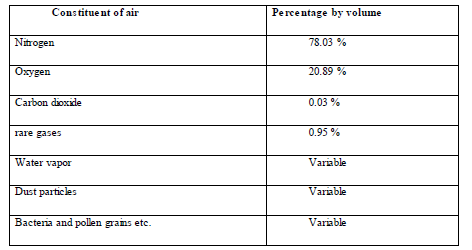
Air is a mixture of many gases and dust particles. Gas particles are Nitrogen, oxygen, carbon dioxide, water vapor and dust particles.The composition of air is given in table 2.1
Table 2.1 percentage composition of Air.
Grade 6 General Science 2
 
Pollution of Air
The ocean of air we live in can be polluted for several reasons. The release of harmful gases smoke and dust particles in to the atmosphere causes harm to human health or animals or to their natural environment. Air can get polluted at home, school, cities, continents and global level. Smoke and dust particles from factories and vehicles cause serious air pollution in big cities
 
Causes of Air pollution
The cause of air pollution can be natural processes or man-made activities. Natural processes like volcanic eruption, forest fire, Earth quake and climatic changes can release harmful gases and dust particles into the atmosphere that cause air pollution. Air pollution due to natural processes is not beyond the holding capacity of the atmosphere. The major causes of air pollution are industrial (man-made) activities. Factories and vehicles release smoke into the atmosphere. Different kinds of harmful gases enter the atmosphere with smoke and cause air pollution.
 
 Air pollutants
Air pollutants are substances that cause air pollution. An air pollutant can be a gas or dust particle that enters into the atmosphere to cause pollution.
 
Sources of Air pollutants
Air pollutants can be released from various sources. The following table summarizes air pollutants and their sources.
Grade 6 General Science 3
 
Effects of Air pollution
The gaseous and particulate materials added to the atmosphere by activities of man have a number of effects on human health, plants, animals and materials.
 
Effects of Air pollution on man
Air pollution causes many respiratory disorders like bronchitis asthmas and lung infection. It also causes irritation of eyes.
 
Effects of Air pollution on vegetation
Impurities and dust particles in air fall on leaves of plants and block stomata. It affects breathing of plants. The dust particles falls on the surface of leaves affecting energy exchange.
 
Effects of Air pollution on materials
Air pollutants can cause damages to the surface of vehicles, buildings and monuments.
 
Effects of Air pollution on animals
Air pollutants also affect the health of animals.
 
 Environmental impacts of Air pollution
Air pollution has a number of impacts on the natural environment. Global warming, Acid Rain and Ozone depletion are the major environmental problems resulting from air pollution.
 
1. Global Warming
Air pollutants such as carbon dioxide, methane, chlorofluoro carbons (CFCs) have the ability to raise the surface temperature of our Earth. These gases are called greenhouse gases. The increase in the concentration of greenhouse gases due to human activities is the major cause of global warming.
 
1.1. Impacts of Global Warming
Global warming phenomenon has a number of effects on earth climate, ecosystem and biological organisms
a) Rise of sea level
Small change in the surface temperature of our Earth due to increase in green house gases in the atmosphere results in sea level rise. This is due to the melting of mountain glacier, green land ice sheet and Antarctic ice sheet. The melting of this ice can cause the flooding of coastal cities of the world.
b) Human Health
Global warming can result in the wide spread of major tropical diseases like malaria, schistosomiasis. African sleeping sickness, yellow fever & onchocerciasis.
 
2. ACID RAIN
 
The sulfur oxides and nitrogen oxides released from industries mix with water vapor in air and form two strong acids –sulfuric and nitric acids. Finally, these acids fall back to the earth surface as acid rain /acid deposition/.
 
2.1 Impacts of Acid Rain
Acid rain can cause serious damages to both living and non-living things. Acid rain increases the acidity of lakes and this result in the death of fishes and other aquatic organisms. Moreover, acid rain affects plants and animals due to its lower PH value. It also destroys buildings and monuments by dissolving them out.
 
3. Depletion of Ozone layer
Ozone layer is the layer of gaseous ozone in the upper part of the atmosphere that protects life on the Earth by filtering out harmful solar radiation. Thus, ozone shields us against harmful solar radiations. If theses harmful solar radiations reach the Earth surface, they will increase skin cancer. Chlorofluoro carbons are a group of chemicals which are commonly used as solvents, aerosol
propellants and refrigerator coolants. These chemicals cause ozone depletion when released to the atmosphere. Ozone depletion/ozone hole/ has already observed over the entire Antarctic and beyond it. The Montreal protocol was agreed in 1987 for the staged control of ozone depleting chemicals.
 
3.1 Consequences of ozone depletion
Ozone depletion increases the incidence of skin cancer due to harmful solar radiation coming to the earth.
 
2.5. PREVENTION OF AIR POLLUTION
 
As long as we continue to use fossil fuels for vehicles and industries continue their production at current rate air pollution exists. Thus, stopping air pollution at once is very difficult. However, it is possible to reduce air pollution through various ways. Air pollution can be reduced in several ways. These are
 
1.Prevention of air pollution at source
The best method of preventing air pollution is prevention at source. This is because mitigating air pollution is difficult and costive. Researches are going on to replace production industries with those free from air pollutants. For example, care industries are being carrying out research to replace fossil fuel utilizing vehicles with alternative energy forms free from air pollution.
 
2.Treating Air pollutants before release into air
Air pollution can be reduced by converting air pollutants into harmless substances before released the atmosphere. For example, using catalytic converter we can change car exhaustion to harmless substances. This method is costive.
 
3.Reducing indoor air pollution
Reducing air pollution at home can greatly contribute to the prevention of out door air pollution. Smoke from cigarette& firing wood can cause indoor air pollution. Control of indoor air pollution enables us to stay health.

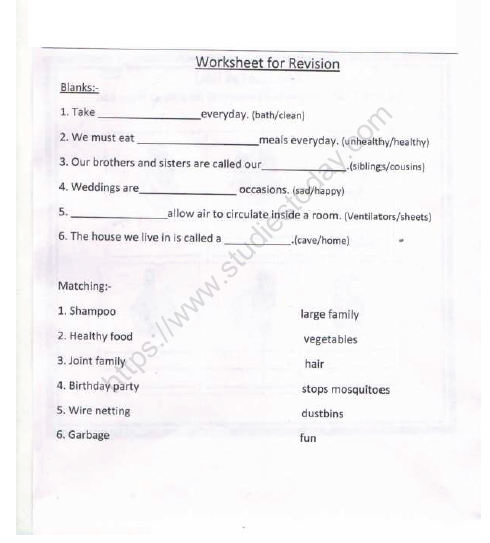
CBSE Class 2 EVS Practice Worksheets (71) - Revision 1

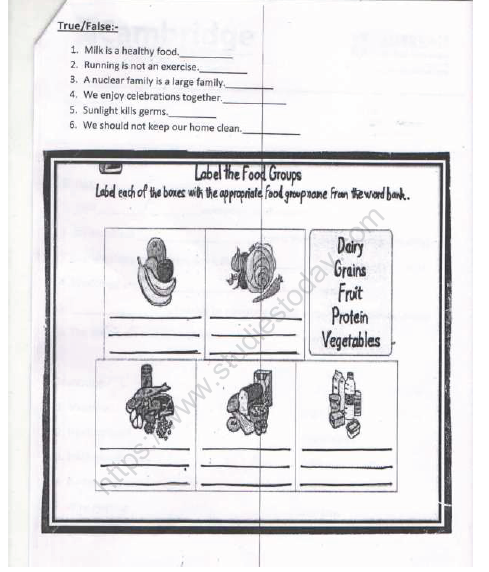
CBSE Class 2 EVS Practice Worksheets (71) - Revision 2

Q.1 Match the following:-
1. Eyes     Ten    3
2. Nose     Two   1
3. Fingers  One  2

Q.2 Tick the correct answer:-

Question. Heart pumps blood to our whole body.
(a) Brain 
(b) Heart
(c) Lungs
Answer: A

Question. We have two legs.
(a) Two
(b) Three
(c) Four
Answer: A

Question. We have 32 teeth.
 (a) 30
(b) 34 
(c) 32
Answer: B

Q.3 My favourite:-
 1. Colour Write your favourite colour
 2. Sport Write your favourite sport

QI. Question and Answer: -

Question. What is the main source of water?
Answer:
Rain is the main source of water.

Question. Give four uses of water.
Answer:
We use water for bathing, drinking, cooking and washing clothes.

Question. Name some sources of water.
Answer:
The lakes, ponds, streams and rivers are the sources of water.

Question. How do we get water from under the ground?
Answer:
We dig wells, tubewells and handpumps to get underground water.

Question. What is a river?
Answer:
A river has flowing water. It starts from the mountains and flows down in the plains.

Question. Why cannot we drink sea water?
Answer:
We cannot drink sea water as it is very salty.

Question. How can we kill germs present in water?
Answer:
We must either boil or filter the water to kill the germs of water.

Question. How do we store water?
Answer:
We store water in tanks, pots and vessels.

Question. How can we keep water clean?
Answer:
We can keep water clean by boiling or filtering it.

CBSE Environmental Studies Class 2 Air Around Us Worksheet

Students can use the practice questions and answers provided above for Air Around Us to prepare for their upcoming school tests. This resource is designed by expert teachers as per the latest 2026 syllabus released by CBSE for Class 2. We suggest that Class 2 students solve these questions daily for a strong foundation in Environmental Studies.

Air Around Us Solutions & NCERT Alignment

Our expert teachers have referred to the latest NCERT book for Class 2 Environmental Studies to create these exercises. After solving the questions you should compare your answers with our detailed solutions as they have been designed by expert teachers. You will understand the correct way to write answers for the CBSE exams. You can also see above MCQ questions for Environmental Studies to cover every important topic in the chapter.

Class 2 Exam Preparation Strategy

Regular practice of this Class 2 Environmental Studies study material helps you to be familiar with the most regularly asked exam topics. If you find any topic in Air Around Us difficult then you can refer to our NCERT solutions for Class 2 Environmental Studies. All revision sheets and printable assignments on studiestoday.com are free and updated to help students get better scores in their school examinations.

Where can I download the 2025-26 CBSE printable worksheets for Class 2 Environmental Studies Chapter Air Around Us?

You can download the latest chapter-wise printable worksheets for Class 2 Environmental Studies Chapter Air Around Us for free from StudiesToday.com. These have been made as per the latest CBSE curriculum for this academic year.

Are these Chapter Air Around Us Environmental Studies worksheets based on the new competency-based education (CBE) model?

Yes, Class 2 Environmental Studies worksheets for Chapter Air Around Us focus on activity-based learning and also competency-style questions. This helps students to apply theoretical knowledge to practical scenarios.

Do the Class 2 Environmental Studies Chapter Air Around Us worksheets have answers?

Yes, we have provided solved worksheets for Class 2 Environmental Studies Chapter Air Around Us to help students verify their answers instantly.

Can I print these Chapter Air Around Us Environmental Studies test sheets?

Yes, our Class 2 Environmental Studies test sheets are mobile-friendly PDFs and can be printed by teachers for classroom.

What is the benefit of solving chapter-wise worksheets for Environmental Studies Class 2 Chapter Air Around Us?

For Chapter Air Around Us, regular practice with our worksheets will improve question-handling speed and help students understand all technical terms and diagrams.