

Official Class 2 Environmental Studies Worksheets: Cleanliness
Review targeted academic worksheets with the CBSE Class 2 EVS Cleanliness Worksheet. Built according to official educational standards for the 2026-27 term, these downloadable Class 2 Environmental Studies resources support effective daily practice and detailed self-evaluation for Cleanliness.
Solved Practice Worksheets for Environmental Studies
Access the complete worksheet PDF for Class 2 Environmental Studies below. Regular practice with these targeted academic tasks builds familiarity with standard question patterns and helps secure higher marks in final school examinations.
Lesson: Cleanliness
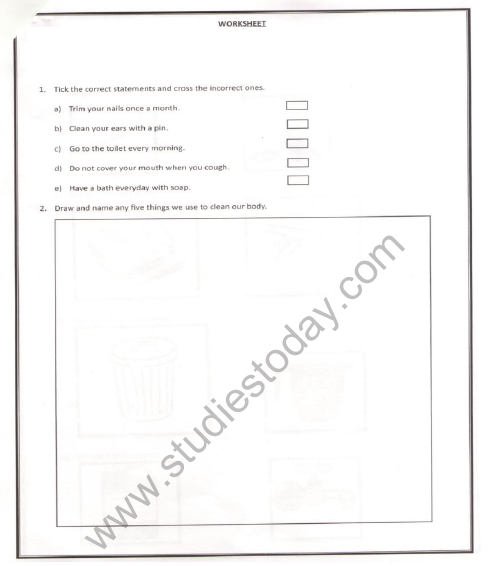
Topic: Cleanliness of body
Question 1. Tick the correct statements and cross the incorrect ones.
a) Trim your nails once a month.
b) Clean your ears with a pin.
c) Go to the toilet every morning.
d) Do not cover your mouth when you cough.
e) Have a bath everyday with soap.
Answer:
a) Trim your nails once a month. - False (X) [Nails should be trimmed weekly to prevent dirt accumulation.]
b) Clean your ears with a pin. - False (X) [Sharp objects like pins can damage the eardrum and should never be used.]
c) Go to the toilet every morning. - True (✓) [Regular bowel habits help keep the digestive system healthy.]
d) Do not cover your mouth when you cough. - False (X) [You must always cover your mouth with a handkerchief when coughing to prevent spreading germs.]
e) Have a bath everyday with soap. - True (✓) [Bathing daily keeps the body clean, fresh, and free from germs.]
In simple words: Good hygiene habits like bathing and trimming nails keep us healthy, while unsafe habits like using pins can harm us.
Exam Tip: Remember safe hygiene practices versus unsafe habits as they frequently appear in true/false questions.
Question 2. Draw and name any five things we use to clean our body.
Answer:
Five things we use to clean our body are:
1. Soap (used for washing skin and removing dirt)
2. Shampoo (used for washing hair)
3. Toothbrush and Toothpaste (used for cleaning teeth)
4. Towel (used for drying the body after a bath)
5. Nail clipper (used for trimming fingernails and toenails)
In simple words: We use different objects like soap, shampoo, and towels to keep our body parts clean.
Exam Tip: Be ready to list or draw common bathroom and hygiene items when asked about personal cleanliness.
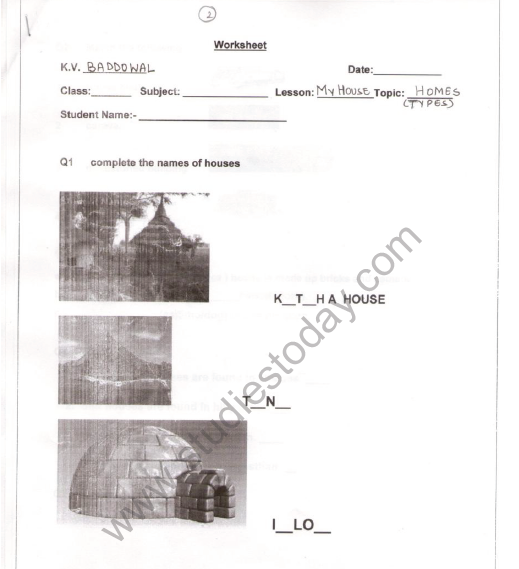
Lesson: My House
Topic: Homes (Types)
Question 1. Complete the names of houses.
a) K_T_HA HOUSE
b) C_R_AV_N
c) I_LO_
Answer:
a) KUTCHA HOUSE
b) CARAVAN
c) IGLOO
In simple words: Fill in the missing letters to complete the types of houses: Kutcha house, Caravan, and Igloo.
Exam Tip: Memorize the spellings of different types of houses such as kutcha, pucca, caravan, igloo, and tent.
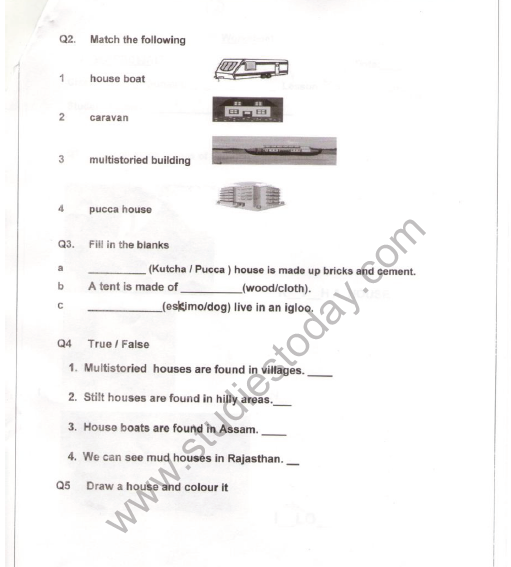
Question 2. Match the following.
1. house boat
2. caravan
3. multistoried building
4. pucca house
Answer:
1. House boat - Matches with a boat fitted with a house that floats on water.
2. Caravan - Matches with a house on wheels that can be moved from place to place.
3. Multistoried building - Matches with a tall building containing many separate apartments or floors.
4. Pucca house - Matches with a strong permanent house made of bricks, cement, and iron.
In simple words: Match each special or permanent type of house to its correct description or picture.
Exam Tip: Understand the distinctive feature of each house type - wheels for caravan, water for houseboat, bricks for pucca house.
Question 3. Fill in the blanks.
a) _____ (Kutcha / Pucca) house is made up bricks and cement.
b) A tent is made of _____ (wood/cloth).
c) _____ (eskimo/dog) live in an igloo.
Answer:
a) Pucca
b) cloth
c) Eskimo
In simple words: Pucca houses use bricks and cement, tents use cloth, and Eskimos live in igloos.
Exam Tip: Pay attention to building materials: Kutcha uses mud/straw, Pucca uses bricks/cement.
Question 4. True / False
1. Multistoried houses are found in villages.
2. Stilt houses are found in hilly areas.
3. House boats are found in Assam.
4. We can see mud houses in Rajasthan.
Answer:
1. Multistoried houses are found in villages. - False (They are found in cities and towns.)
2. Stilt houses are found in hilly areas. - False (They are found in areas with heavy rainfall or water accumulation.)
3. House boats are found in Assam. - False (They are famously found in Kashmir and Kerala.)
4. We can see mud houses in Rajasthan. - True (Mud houses help keep interiors cool in hot desert regions.)
In simple words: Houses are built according to the climate and geography of the place.
Exam Tip: Learn regional associations: Kashmir/Kerala for houseboats, Rajasthan for mud houses.
Question 5. Draw a house and colour it.
Answer:
[Draw a simple house featuring a roof, walls, a door, and windows, and color it with bright crayons.]
In simple words: Draw a neat picture of a basic house with geometric shapes like a triangle roof and square walls.
Exam Tip: Keep drawings neat, well-proportioned, and neatly colored within the borders.
Lesson: Means of Communication
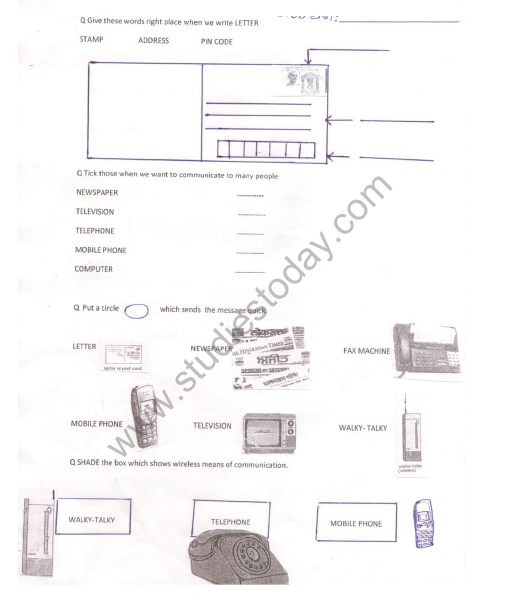
Question 1. Give these words right place when we write LETTER: STAMP, ADDRESS, PIN CODE
Answer:
- STAMP: Placed at the top right corner of the envelope.
- ADDRESS: Written in the middle/center of the envelope.
- PIN CODE: Written at the bottom part of the address section.
In simple words: An envelope needs a stamp at the top right, the recipient's address in the middle, and the pin code at the bottom.
Exam Tip: Practice labeling the parts of an addressed envelope correctly for postal questions.
Question 2. Tick those when we want to communicate to many people.
NEWSPAPER
TELEVISION
TELEPHONE
MOBILE PHONE
COMPUTER
Answer:
Mass communication means (communication with many people at the same time):
- NEWSPAPER (✓)
- TELEVISION (✓)
- TELEPHONE (X - used for one-to-one conversation)
- MOBILE PHONE (X - used for personal calls/messages, unless broadcasting)
- COMPUTER / Internet (✓ - used to reach many people through websites/social media)
In simple words: Newspapers and televisions reach a large public audience at once, unlike a private telephone call.
Exam Tip: Differentiate between personal communication (phone, letter) and mass communication (newspaper, television, radio).
Question 3. Put a circle which sends the message quick.
LETTER, NEWSPAPER, FAX MACHINE, MOBILE PHONE, TELEVISION, WALKIE-TALKY
Answer:
Circled items for quickest messaging: MOBILE PHONE, FAX MACHINE, WALKIE-TALKY.
In simple words: Electronic devices like mobile phones and fax machines send messages instantly compared to traditional mail.
Exam Tip: Electronic and digital gadgets provide the fastest means of communication.
Question 4. SHADE the box which shows wireless means of communication.
WALKY-TALKY, TELEPHONE, MOBILE PHONE
Answer:
Shaded boxes: WALKY-TALKY and MOBILE PHONE (both operate without connecting wires).
In simple words: Wireless devices do not use physical telephone cords to transmit signals.
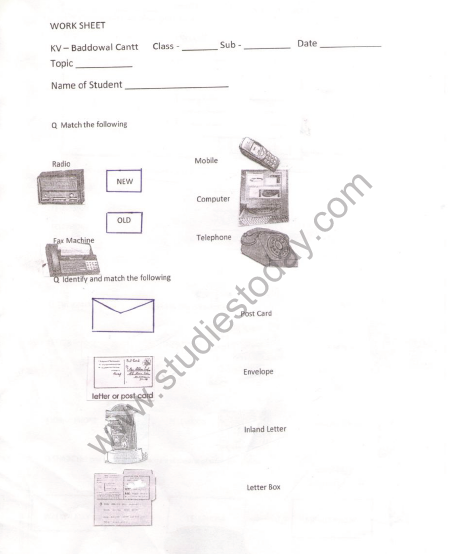
Question 5. Match the following.
Radio, Mobile, Computer, Fax Machine, Old / New categories
Answer:
- Radio: Old / Traditional audio communication
- Television: Mass entertainment and news
- Mobile / Computer: Modern electronic communication
- Letter / Post Card: Old postal communication
In simple words: Group communication devices into older traditional types and modern electronic types.
Exam Tip: Categorize communication tools correctly into old/traditional and modern/electronic.
Lesson: Plants
Question 1. Look at the things we get from plants. Complete the word ladder.
(Clues corresponding to PERFUME, WOOD, COTTON, MEDICINE, SUGAR, GUM, RUBBER)
Answer:
Completed words in the ladder based on plant products:
1. PERFUME
2. WOOD
3. COTTON
4. MEDICINE
5. SUGAR
6. GUM
7. RUBBER
In simple words: Plants give us many useful things like cotton for clothes, wood for furniture, and medicine.
Exam Tip: Learn common plant products such as rubber, gum, paper, and spices.
Question 2. Match the following.
a. Fibre - Lady finger / Cotton
b. Medicine - Coffee / Neem
c. Drink - Guava / Coffee
d. Fruit - Neem / Guava
e. Vegetable - Cotton / Lady finger
Answer:
a. Fibre - Cotton
b. Medicine - Neem
c. Drink - Coffee
d. Fruit - Guava
e. Vegetable - Lady finger
In simple words: Match each plant category to its correct plant example.
Exam Tip: Link plant categories (fibres, spices, beverages, medicines) to their respective plant sources.
Question 3. Match the following.
Big Plant - Herbs / Trees
Small Plants - Trees / Shrubs
Very Small Plants - Shrubs / Herbs
Answer:
- Big Plant - Trees
- Small Plants - Shrubs
- Very Small Plants - Herbs
In simple words: Big woody plants are trees, medium bushy plants are shrubs, and small tender plants are herbs.
Exam Tip: Remember plant sizes: Trees (big/strong), Shrubs (bushy/medium), Herbs (small/soft).
Question 4. Fill up blanks with these words given below: Furniture, Fresh, Live, Food, Cotton
A) Wheat, rice, vegetables & fruits are _____
B) We make _____ from wood.
C) _____ is used for making cloth.
D) Plants keep the air cool and _____
E) We cannot _____ without plants.
Answer:
A) Food
B) Furniture
C) Cotton
D) Fresh
E) Live
In simple words: Plants provide us food, furniture, clothing material, clean air, and the essentials needed to live.
Exam Tip: Always associate plants with oxygen (fresh air), food items, and raw materials like wood and cotton.
Question 5. Match the following with these pictures (Parts of a plant: Root, Fruit, Buds, Flower, Leaves, Stem).
Answer:
- Root: Absorbs water and minerals from the soil (underground part)
- Stem: Supports the plant and carries water
- Leaves: Make food for the plant using sunlight
- Flower: Colorful part that turns into a fruit
- Fruit: Contains seeds
In simple words: Every part of a plant has a specific job, like roots taking in water and leaves making food.
Exam Tip: Learn the functions of the main plant parts: roots, stem, leaves, flowers, and fruits.
Question 6. Colour the things we get from PLANTS among the given options.
Answer:
Items obtained from plants (to be colored): Tea, Apple, Cotton bag, Rubber eraser.
(Items like milk and leather items come from animals and are not plant products).
In simple words: Identify and color products that come directly from plants, such as fruits, tea leaves, and rubber.
Exam Tip: Distinguish clearly between plant-based products (fruits, vegetables, wood, cotton) and animal-based products (milk, leather, wool, eggs).
Lesson: Transport
Question 1. Write L for Land transport, W for water transport, A for air transport.
Answer:
- Aeroplane / Helicopter: A (Air transport)
- Ship / Boat: W (Water transport)
- Bus / Car / Truck / Train / Bullock cart: L (Land transport)
In simple words: Transport on roads is land transport, on water is water transport, and in the sky is air transport.
Exam Tip: Classify vehicles easily by where they travel: roads (land), water bodies (water), sky (air).
Question 2. Some means of transport are written below. Write them in right column: Train, Aeroplane, Boat, Helicopter, Motor Boat, Bus.
Columns: Air transport, Water transport, Land transport.
Answer:
- Air transport: 1. Aeroplane, 2. Helicopter
- Water transport: 1. Boat, 2. Motor Boat
- Land transport: 1. Train, 2. Bus
In simple words: Sort each vehicle into its correct transport category.
Exam Tip: Double-check vehicle names and their corresponding columns in classification tables.
Question 3. Six means of transport are hidden in the grid. Find them and write them in the space give below.
Grid letters containing words like TRUCK, BUS, CAR, TRAIN, BOAT.
Answer:
The six hidden means of transport in the grid are:
1. TRUCK
2. BUS
3. CAR
4. TRAIN
5. SHIP (or BOAT)
6. BOAT
In simple words: Look across and down the letter grid to find hidden vehicle names.
Exam Tip: Look carefully in horizontal and vertical directions when solving word search puzzles.
Lesson: Cleanliness of Surroundings
Question 1. Tick the correct.
a) We use it to clean the floor (Toothbrush / Broom)
b) We use it to dust things (Cloth / Wiper)
c) We use it to put the waste (Dustbin / Mug)
d) We use it to kill germs (Phenyl / Tap)
Answer:
a) Broom (✓)
b) Cloth (✓)
c) Dustbin (✓)
d) Phenyl (✓)
In simple words: Match cleaning tools to their correct uses, such as using a broom for floors and a dustbin for waste.
Exam Tip: Learn household cleaning items and their specific functions to keep homes hygienic.
Free study material for Environmental Studies
Free CBSE Practice Worksheets: Class 2 Environmental Studies Cleanliness
Daily Practice Questions for Class 2 Environmental Studies
Review targeted practice exercises for Class 2 Environmental Studies Cleanliness. Curated to match official CBSE guidelines, these printable problem sets support daily revision and improve overall test readiness.
Detailed Answers for Class 2 Environmental Studies Cleanliness
Designed around the official curriculum for Class 2 Environmental Studies, these practice sheets guarantee standard compliance. Reviewing step-by-step solutions after completion sharpens your accuracy and clarifies complex sub-topics within Cleanliness.
Complete Your Chapter Revision
Consistent engagement with these exercises builds familiarity with recurring exam themes. If specific areas within Cleanliness cause trouble, utilize our dedicated NCERT solutions for Class 2 Environmental Studies to clear up doubts immediately.
FAQs
You can download the latest chapter-wise printable worksheets for Class 2 Environmental Studies Cleanliness for free from StudiesToday.com. These have been made as per the latest CBSE curriculum for this academic year.
Yes, Class 2 Environmental Studies worksheets for Cleanliness focus on activity-based learning and also competency-style questions. This helps students to apply theoretical knowledge to practical scenarios.
Yes, we have provided solved worksheets for Class 2 Environmental Studies Cleanliness to help students verify their answers instantly.
Yes, our Class 2 Environmental Studies test sheets are mobile-friendly PDFs and can be printed by teachers for classroom.
For Cleanliness, regular practice with our worksheets will improve question-handling speed and help students understand all technical terms and diagrams.