

Class 11 Business Studies Practice Sheet: CBSE Class 11 Business Studies International Business Worksheet
Review targeted academic worksheets with the CBSE Class 11 Business Studies International Business Worksheet. Built according to official educational standards for the 2026-27 term, these downloadable Class 11 Business Studies resources support effective daily practice and detailed self-evaluation for Chapter 11 International Business.
Download Chapter 11 International Business Worksheet PDF with Answers
View or download the dedicated CBSE Class 11 Business Studies International Business Worksheet resource below. Engaging with these practice papers under focused study conditions ensures continuous academic progress and mastery of the 2026-27 curriculum for Chapter 11 International Business.
Very Short Answer Type Questions
Question. XYZ Co. (USA) acquires another Co. R. Ltd. situated at Geneva by investing100% in its equity. What will be the R. Ltd. Co. called?
Answer : R ltd will be called wholly owned subsidiary of XYZ Co. Wholly owned subsidiary is an entry mode of international business is preferred by companies which want to exercise full control over their overseas operations.
Question. Whose objective was to reconstruct the war defeated and under develop countries?
Answer : The International Bank for Reconstruction and Development (IBRD), commonly known as World Bank, was result of the Bretton Woods Conference. The main objectives were to aid the task of reconstruction of the war-affected economies of Europe and assist in the development of the underdeveloped nations of the world.
Question. Name the document containing guarantee of a bank to honour drafts drawn on it by an exporter’s bank
Answer : A letter of credit is a guarantee issued by the importer’s bank that it will honour payment up to a certain amount of export bills to the bank of the exporter
Question. What is a shipping bill?
Answer : Shipping bill is the main document on the basis of which the customs office gives the permission for export.
Question. Name the term when two businesses mutually agree to share each other trade secrets and technology?
Answer : There is mutual exchange of knowledge, technology and/or patents between the firms which is known as cross-licensing
Short Answer Type Questions
Question. List the codal formalities to obtain IEC No.
Answer : For obtaining the IEC number, a firm has to apply to the Director General for Foreign Trade (DGFT) with documents such as
1. exporter/importer profile
2. bank receipt for requisite fee
3. certificate from the banker on the prescribed form
4. two copies of photographs attested by the banker
5. details of the non-resident interest
6. declaration about the applicant’s non-association with caution listed firms
Question. Write note on Bill of lading, Bills of entry, Shipping advice.
Answer : Bill of Lading: It is a detailed list of a ship’s cargo in the form of a receipt given by the master of the ship to the person consigning the goods.
Bill of Entry: declaration by an importer or exporter of the exact nature, precise quantity and value of goods that have been landed or being shipped out. It is prepared by a qualified custom clerk or broker, it is examined by the custom authorities for its accuracy and conformity with the tariff and regulation.
Shipping advice: It is a commercial document which is issued by the exporter, who is the beneficiary of the letter of credit, in order to give shipment details to the importer who is the applicant of the letter of credit.
Question. It is not just a sale of trademark for a fee; also it abides the purchaser to follow strictly the rules of serving. Which mode of entry is this? Discuss any two limitations of it.
Answer : Licensing is a contractual arrangement in which one firm grants access to its patents, trade secrets or technology to another firm in a foreign country for a fee called royalty. There is mutual exchange of knowledge, technology and/or patents between the firms which is known as cross-licensing. Franchising applies to service business. Franchisers usually set strict rules and regulations as to how the franchisees should operate while running their business
Limitations:
- There is a danger that the licensee can start marketing an identical product under a slightly different brand name
- If not maintained properly, trade secrets can get divulged to others in the foreign markets
- Conflicts over maintenance of accounts, payment of royalty and non-adherence to norms relating to production of quality products
Question. List the formalities involved in getting an export license
Answer : Pre-requisites for getting an export licence:
1. Opening a bank account in any bank authorised by the Reserve Bank of India
2. Obtaining Import Export Code (IEC) number from the Directorate General Foreign Trade (DGFT) or Regional Import Export Licensing Authority. For obtaining the IEC number, a firm has to apply to the Director General for Foreign Trade (DGFT) with documents such as exporter/importer profile, bank receipt for requisite fee, certificate from the banker on the prescribed form, two copies of photographs attested by the banker, details of the non-resident interest and declaration about the applicant’s non association with caution listed firms
3. Registering with appropriate export promotion council.
4. Registering with Export Credit and Guarantee Corporation (ECGC) in order to safeguard against risks of non payments
5. It is obligatory for every exporter to get registered with the appropriate export promotion council
6. Registration with the ECGC is necessary in order to protect overseas payments from political and commercial risks
Question. State the reasons to have international business?
Answer :
- Countries cannot produce equally well or cheaply all that they need. This is because of the unequal distribution of natural resources among them or differences in their productivity levels
- Labour productivity and production costs differ among nations due to various socio-economic, geographical and political reasons
- Principle of territorial division of labour is applicable at the international level too. Most developing countries which are labour abundant, for instance, specialise in producing and exporting garments
- Firms too engage in international business to import what is available at lower prices in other countries, and export goods to other countries where they can fetch better prices for their products.
Long Answer Type Questions
Question. What is IMF? Write its objective and functions
Answer : The major idea underlying the setting up of the IMF is to evolve an orderly international monetary system, i.e., facilitating system of international payments and adjustments in exchange rates among national currencies
| Objectives | Functions |
| - To promote international monetary cooperation through a permanent institution, | - Acting as a short-term credit institution |
| - To facilitate expansion of balanced growth of international trade and to contribute promotion and maintenance of high level of employmet | - Providing machinery for the orderly adjustment of exchange rates |
| - To promote exchange stability with a view to maintain orderly exchange arrangements among member countries | - Acting as a reservoir of the currencies of all the member countries |
| - To assist in the establishment of a multilateral system of payments in respect of current transactions between members. | - Providing machinery for the orderly adjustment of exchange rates |
| - Determining the value of a country’s currency and altering it | - Acting as a reservoir of the currencies of all the member countries |
| - Providing machinery for international consultations | - Acting as a lending institution of foreign currency and current transaction |
Question. What is WTO. Write its objectives and Functions?
Answer : One of the key achievements of GATT negotiations was the decision to set up a permanent institution for looking after the promotion of free and fair trade amongst nations. The GATT was transformed into World Trade Organization (WTO) with effect from 1 January 1995. Headquarters of the WTO are situated at Geneva, Switzerland. It governs trade not only in goods, but also in services and intellectual property rights. The WTO is a permanent organisation created by an international treaty ratified by the governments and legislatures of member states. It is, moreover, a member-driven rule-based organisation in the sense that all the decisions are taken by the member governments on the basis of a general consensus. India is a founding member of WTO
| Objectives | Functions |
| - To ensure reduction of tariffs and other trade barriers imposed by different countries; | - Encouraging its member countries to come forward to WTO in mitigating their grievances |
| - To engage in such activities which improve the standards of living, create employment, increase income and effective demand and facilitate higher production and trade; | - Laying down a commonly accepted code of conduct with a view to reducing trade barriers, including tariffs and eliminating discriminations in international trade relations |
| - To facilitate the optimal use of the world’s resources for sustainable development | - Acting as a dispute settlement body |
| - To promote an integrated, more viable and durable trading system. | - Ensuring that all rules regulations prescribed in the Act are duly followed |
| - Holding consultations to bring better understanding and cooperation in global economic policy making | |
| - Supervising on a regular basis the operations of the revised Agreements and Ministerial declarations relating to goods, services and Trade Related Intellectual Property Rights (TRIPS) |
Question. Identify the documents highlighted in the following statements:
(i) This document is issued by the commanding officer of the ship to the exporter after cargo is loaded on the ship.
(ii) This document is prepared by shipping company to acknowledge the receipt of goods on ship and gives an undertaking to carry them to port of destination.
(iii) This document is the most appropriate and secure method of payment to settle international transactions.
(iv)On the basis of this document, customs office grants permission for the export.
(v) This document in prepared by the importer and it shows the details of goods imported
(vi)On the basis of this document imported goods are unloaded from the carrier. (import manifest)
Answer :
(i) This document is issued by the commanding officer of the ship to the exporter after cargo is loaded on the ship: Mate’s Receipt. A mate receipt is a receipt issued by the commanding officer of the ship when the cargo is loaded on board, and contains the information about the name of the vessel, berth, date of shipment, descripton of packages, marks and numbers, condition of the cargo at the time of receipt on board the ship, etc.
(ii) This document is prepared by shipping company to acknowledge the receipt of goods on ship and gives an undertaking to carry them to port of destination: Bill of lading. After receipt of the freight, the shipping company issues a bill of lading which serves as an evidence that the shipping company has accepted the goods for carrying to the designated destination
(iii) This document is the most appropriate and secure method of payment to settle international transactions: Bill of exchange. On receiving the bill of exchange, the importer releases the payment in case of sight draft or accepts the usance draft for making payment on maturity of the bill of exchange.
The exporter’s bank receives the payment through the importer’s bank and is credited to the exporter’s account. The exporter can get immediate payment from his/ her bank on the submission of documents by signing a letter of indemnity
(iv)On the basis of this document, customs office grants permission for the export: Shipping bill is the main document on the basis of which the customs office gives the permission for export
(v) This document in prepared by the importer and it shows the details of goods imported: The import order contains information about the price, quantity size, grade and quality of goods ordered and the instructions relating to packing, shipping, ports of shipment and destination, delivery schedule, insurance and mode of payment
(vi)On the basis of this document imported goods are unloaded from the carrier: import manifest. He provides the document called import general manifest. Import general manifest is a document that contains the details of the imported goods
Question. ABS Garment Company has received an order to export 2000 men’s trouser to XYZ Imports Ltd. located in Australia. Discuss the procedure that abs would need to go through for executing the export order.
Answer : ABS should follow the export procedure given below:
Export Procedure
1. Receipt of enquiry and sending quotations
- Exporters can be informed of such an enquiry even by way of advertisement in the press put in by the importer.
- The exporter sends a reply to the enquiry in the form of a quotation referred to as proforma invoice.
- The proforma invoice contains information about the price at which the exporter is ready to sell the goods and also provides information about the quality, grade, size, weight, mode of delivery, type of packing and payment terms
2. Receipt of order or indent
- Export price and other terms and conditions acceptable, it places an order for the goods to be despatched.
- This order, also known as indent, contains a description of the goods ordered, prices to &&be paid, delivery terms, packing and marking details and delivery instructions
3. Assessing the importer’s creditworthiness and securing a guarantee for payments
- Exporter makes enquiry about the creditworthiness of the importer
- To minimise such risks, most exporters demand a letter of credit from the importer.
- A letter of credit is a guarantee issued by the importer’s bank that it will honour payment up to a certain amount of export bills to the bank of the exporter
4. Obtaining export licence
- Export of goods in India is subject to custom laws which demand that the export firm must have an export licence before it proceeds with exports
- Pre-requisites for getting an export licence:
o Opening a bank account in any bank authorised by the Reserve Bank of India
o Obtaining Import Export Code (IEC) number from the Directorate General Foreign Trade (DGFT) or Regional Import Export Licensing Authority.
o Registering with appropriate export promotion council.
o Registering with Export Credit and Guarantee Corporation (ECGC) in order to safeguard against risks of non payments
- For obtaining the IEC number, a firm has to apply to the Director General for Foreign Trade (DGFT) with documents such as exporter/importer profile, bank receipt for requisite fee, certificate from the banker on the prescribed form, two copies of photographs attested by the banker, details of the non-resident interest and declaration about the applicant’s non association with caution listed firms.
- It is obligatory for every exporter to get registered with the appropriate export promotion council
- Registration with the ECGC is necessary in order to protect overseas payments from political and commercial risks
5. Obtaining pre-shipment finance
- Exporter approaches his banker for obtaining pre-shipment finance to undertake export production.
- Pre-shipment finance is the finance that the exporter needs for procuring raw materials and other components, processing and packing of goods and transportation of goods to the port of shipment.
6. Production or procurement of goods
- Exporter proceeds to get the goods ready as per the specifications of the importer.
Either the firm itself goes in for producing the goods or else it buys from the market
7. Pre-shipment Inspection
- Compulsory inspection of certain products by a competent agency as designated by the government
- The government has passed Export Quality Control and Inspection Act, 1963 for this purpose and has authorised some agencies to act as inspection agencies
- The pre-shipment inspection report is required to be submitted along with other export documents at the time of exports
- Inspection is not compulsory in case the goods are being exported by star trading houses, trading houses, export houses, industrial units setup in export processing zones/special economic zones (EPZs/SEZs) and 100 per cent export oriented units (EOUs
8. Excise clearance
- Excise duty is payable on the materials used in manufacturing goods. The exporter, therefore, has to apply to the concerned Excise Commissioner in the region with an invoice. If the Excise Commissioner is satisfied, he may issue the excise Clearance
- The refund of excise duty is known as duty drawback.
- This scheme of duty drawback is presently administered by the Directorate of Drawback under the Ministry of Finance which is responsible for fixing the rates of drawback for different products
9. Obtaining certificate of origin
- For availing trade concessions and other benefits, the importer may ask the exporter to send a certificate of origin.
- The certificate of origin acts as a proof that the goods have actually been manufactured in the country from where the export is taking place.
- This certificate can be obtained from the trade consulate located in the exporter’s country
10. Reservation of shipping space
- The exporting firm applies to the shipping company for provision of shipping space.
- It has to specify the types of goods to be exported, probable date of shipment and the port of destination.
- On acceptance of application for shipping, the shipping company issues a shipping order
11. Packing and forwarding
- The goods are then properly packed and marked with necessary details such as name and address of the importer, gross and net weight, port of shipment and destination, country of origin, etc.
- The exporter then makes necessary arrangement for transportation of goods to the port.
- On loading goods into the railway wagon, the railway authorities issue a ‘railway receipt’ which serves as a title to the goods.
- The exporter endorses the railway receipt in favour of his agent to enable him to take delivery of goods at the port of shipment
12. Insurance of goods
- Goods are insured with an insurance company y to protect against the risks of loss or damage of the goods due to the perils of the sea during the transit
13. Customs clearance
- The goods must be cleared from the customs before these can be loaded on the ship.
- For obtaining customs clearance, the exporter prepares the shipping bill.
- Shipping bill is the main document on the basis of which the customs office gives the permission for export
- Five copies of the shipping bill along with the following documents are then submitted to the Customs Appraiser at the Customs House:
o Export Contract or Export Order
o Letter of Credit
o Commercial Invoice
o Certificate of Origin
o Certificate of Inspection
o Marine Insurance Policy
- After submission of these documents, the Superintendent of the concerned port trust is approached for obtaining the carting order. Carting order is the instruction to the staff at the gate of the port to permit the entry of the cargo inside the dock
14. Obtaining mates receipt
- A mate receipt is a receipt issued by the commanding officer of the ship when the cargo is loaded on board, and contains the information about the name of the vessel, berth, date of shipment, descripton of packages, marks and numbers, condition of the cargo at the time of receipt on board the ship, etc.
- The port superintendent, on receipt of port dues, hands over the mate’s receipt to the C&F agent.
15. Payment of freight and issuance of bill of lading
- The C&F agent surrenders the mates receipt to the shipping company for computation of freight.
- After receipt of the freight, the shipping company issues a bill of lading which serves as an evidence that the shipping company has accepted the goods for carrying to the designated destination.
- In the case the goods are being sent by air, this document is referred to as airway bill.
16. Preparation of invoice
- The invoice states the quantity of goods sent and the amount to be paid by the importer. The C&F agent gets it duly attested by the customs.
17. Securing payment
- The importer needs various documents to claim the title of goods on their arrival at his/her country and getting them customs cleared.
- The documents that are needed in this connection include certified copy of invoice, bill of lading, packing list, insurance policy, certificate of origin and letter of credit
- Submission of the relevant documents to the bank for the purpose of getting the payment from the bank is called ‘negotiation of the documents’
- On receiving the bill of exchange, the importer releases the payment in case of sight draft or accepts the usance draft for making payment on maturity of the bill of exchange. The exporter’s bank receives the payment through the importer’s bank and is credited to the exporter’s account
- The exporter can get immediate payment from his/ her bank on the submission of documents by signing a letter of indemnity
- Having received the payment for exports, the exporter needs to get a bank certificate of payment
Mcq Questions for Ncert Class 11 Business Studies International Business
Question. The fundamental reason behind international business is that the countries cannot produce all the goods that they need, with respect to
(a) quality
(b) cost
(c) Both (a) and (b)
(d) None of these
Answer : C
Question. International trade has its own advantages and disadvantages. Which of the following is not an area which puts international trade at disadvantageous position?
(a) Language
(b) Time involved
(c) Intensive use of natural resources
(d) Capacity utilisation
Answer : D
Question. International trade requires movement of goods across the boundaries of a nation. Which of the following is the cheapest mode of transporting goods to longer distances?
(a) Road
(b) Rail
(c) Ships
(d) Air
Answer : C
Question. Which of these is an advantage of international business to the nation?
(a) Better Utilisation of Resources
(b) Prospects for Higher Profits
(c) Way Out to Intense Competition in Domestic Market
(d) All of these
Answer : A
Question. International business involves ……… degree of risk.
(a) low
(b) moderate
(c) high
(d) Can’t be determined
Answer : C
Question. Statement I The degree of mobility of factors of production like labour and capital across nations is relatively less.
Statement II Domestic markets are relatively less homogeneous in nature as compared to international markets.
Alternatives
(a) Statement I is correct and Statement II is wrong
(b) Statement II is correct and Statement I is wrong
(c) Both the statements are correct
(d) Both the statements are incorrect
Answer : A
Question. Cost of production differ in different countries due to …….. factor.
(a) Socio-economic
(b) Political
(c) Geographical
(d) All of these
Answer : D
Question. Statement I A large number of domestic firms in India found it very difficult to compete in the world market.
Statement II In International business, various other stakeholders such as suppliers, employees, middlemen, shareholders and partners are from different nations.
Alternatives
(a) Statement I is correct and Statement II is wrong
(b) Statement II is correct and Statement I is wrong
(c) Both the statements are correct
(d) Both the statements are incorrect
Answer : C
Question. Labour, capital and ……. are the factors of production whose availability differs from country to country.
(a) Tools
(b) Entrepreneurs
(c) Raw material
(d) All of these
Answer : C
Question. Which type of domestic markets drive companies to go international in search of new markets for their products?
(a) Monopolistic markets
(b) Highly competitive markets
(c) Oligopoly
(d) Monopoly
Answer : B
Question. The basic problem faced by those engaged in international trade is ‘different countries have different currencies’. In order to resolve this issue, which currency is considered as the most popular currency in international trade?
(a) US Dollars
(b) UK Euro
(c) Japanese Yen
(d) Indian Rupee
Answer : A
Question. International trade is advantageous to
(a) nations
(b) firms
(c) Both (a) and
(b) (d)None of these
Answer : C
Question. Statement I In international business, there is use of domestic currency.
Statement II Business systems and practices vary considerably across countries.
Alternatives
(a) Statement I is correct and Statement II is wrong
(b) Statement II is correct and Statement I is wrong
(c) Both the statements are correct
(d) Both the statements are incorrect
Answer : B
Question. In case of international business, there is a wide time gap between order and ….. of goods.
(a) demand
(b) supply
(c) trade
(d) exchange
Answer : B
Question. International trade should be done with extreme caution as it may lead to …… use of natural resources, which may make a country poor by depleting its natural resources.
(a) extensive
(b) intensive
(c) moderate
(d) regressive
Answer : B
Assertion–Reasoning MCQs :
Question. Assertion (A) International trade helps people to improve their standard of living.
Reason (R) International trade helps people of a country to have access to a large variety of goods and services.
(a) Both Assertion (A) and Reason (R) are true and Reason (R) is the correct explanation of Assertion (A).
(b) Both Assertion (A) and Reason (R) are true, but Reason (R) is the not the correct explanation of Assertion (A).
(c) Assertion (A) is false, but Reason (R) is true.
(d) Assertion (A) is true, but Reason (R) is false.
Answer : A
Question. Assertion (A) Imports enable the country to ensure its sovereignty and territorial integrity.
Reason (R) A country can import food grains and other essential commodities to prevent starvation.
(a) Both Assertion (A) and Reason (R) are true and Reason (R) is the correct explanation of Assertion (A).
(b) Both Assertion (A) and Reason (R) are true, but Reason (R) is the not the correct explanation of Assertion (A).
(c) Assertion (A) is false, but Reason (R) is true.
(d) Assertion (A) is true, but Reason (R) is false.
Answer : D
Question. Assertion (A) International trade helps in speeding up the industrialisation of a country.
Reason (R) Developing countries export scarce raw materials and capital goods and advanced technology required for rapid industrial development.
(a) Both Assertion (A) and Reason (R) are true and Reason (R) is the correct explanation of Assertion (A).
(b) Both Assertion (A) and Reason (R) are true, but Reason (R) is the not the correct explanation of Assertion (A).
(c) Assertion (A) is false, but Reason (R) is true.
(d) Assertion (A) is true, but Reason (R) is false.
Answer : D
Case Based MCQs :
When the Indian economy opened in 1991, Harsha decided to take advantage of the same and start a business at an international level. He is very good in making paper crafts and decided to monetise the same. He made lot of such crafts and sold them in the foreign countries. He hired few like-minded people and started a small firm.
By following the same practice of selling high-quality paper crafts in international markets, the firm earned lot of revenue. Firm started to cater to more clients and at a larger level production, costs declined.
People in other countries who would like these kinds of products but can’t purchase due to unavailability are also helped by this kind of trade.
These people will have access to these products and can use for their home décor and even to ease out some of their tasks. This practice of selling in foreign market further helped the firm to increase the business when the domestic. In the process, the firm also achieved maximum utilization of the human resources and other small machines who earlier used to be working at below maximum production levels.
Question. Which advantage of international trade (to nation) is highlighted in the line, “He hired few like-minded people and started a small firm.”?
(a) Earning of foreign exchange
(b) Better utilisation of resources
(c) Improving growth prospects and employment potential
(d) Increased standard of living
Answer : C
Question. Which advantage of international trade (to firms) is highlighted in the line, “By following the same practice of selling high-quality paper crafts in international markets, the firm earned lot of revenue.”?
(a) Prospects for higher profits
(b) Way out to intense competition in domestic market
(c) Increased capacity utilisation
(d) Improved business vision
Answer : A
Question. Which advantage of international trade (to nation) is highlighted in the line, “People in other countries who would like these kinds of products but can’t purchase due to unavailability are also helped by this kind of trade.”?
(a) Speed-up industrialisation
(b) Meet consumer demand
(c) Overcome famine
(d) Ensure national defense
Answer : B
Question. Which advantage of international business (to nations) is highlighted in the line, “These people will have access to these products and can use for heir home décor and even to ease out some of their tasks.”?
(a) Earning of foreign exchange
(b) Better utilisation of resources
(c) Improving growth prospects and employment potential
(d) Increased standard of living
Answer : B
Question. Which advantage of international business (to firm) is highlighted in the line, “This practice of selling in foreign market further helped the firm to increase the business when the domestic.”?
(a) Prospects for higher profits
(b) Increased capacity utilisation
(c) Prospects for growth
(d) Improved business vision
Answer : C
Question. Which advantage of international business (to firm) is highlighted in the line, “In the process, the firm also achieved maximum utilisation of the human resources and other small machines who earlier used to be working at below maximum production levels.”?
(a) Prospects for higher profits
(b) Increased capacity utilisation
(c) Prospects for growth
(d) Improved business vision
Answer : B
Aman Woollen Ltd. a leading woollen items manufacturing company established 20 years ago by Aman, is well-known for its quality goods and consumers have high brand loyalty for its products especially shawls. The company was doing very well but due to riots, terrorism, unrest in the area for past 10 years their sales are consistently slashing down. To solve this problem, the marketing manager of the company suggested to explore the possibility of going international and to appoint wholesalers country wide. The financial manager supported his suggestion and informed that government is also providing subsidies and technical and marketing support to such export-oriented industries as international trade offers many benefits to the nation. They also believe that in other countries they would be able to charge more price than they are currently charging. This will lead to better business strength.
Question. Which of the following is not the benefit of foreign trade to a nation?
(a) Economic growth
(b) Earning of foreign exchange
(c) Higher profits
(d) Price stability
Answer : D
Question. A wholesaler helps a manufacturer to enjoy economies of scale by
(a) providing him market information
(b) providing orders
(c) bearing risk
(d) providing financial support
Answer : B
Question. International trade offers many benefits to the nation, one such benefit is that it provides a way out to intense competition in domestic market, which implies
(a) winding up internal business
(b) doing international business
(c) doing technological upgradation
(d) promotion of goods and services
Answer : B
Question. International business includes which among the following?
(a) Merchandise and service exports and imports
(b) Licensing and franchising
(c) Foreign investments
(d) All of the above
Answer : D
Question. In international trade, when prices in the domestic market are low, firms cannot earn more profits by selling their products in those countries in which prices are high.
(a) True
(b) False
(c) Partially true
(d)None of these
Answer : B
Question. Which benefit of international trade to firm is highlighted in the line, “They also believe that in other countries they would be able to charge more price than they are currently charging. This will lead to better business strength”?
(a) Improved Business Vision
(b) Increased Capacity Utilisation
(c) Prospects for Growth
(d) Prospects for Higher Profits
Answer : D
Important Questions for Ncert Class 11 Business Studies International Business
Short Answer Type Questions :
Question. Patel Ltd. is a reputed company in the field of garments manufacturing in India. The company manufactures superior quality products. But the management is worried about its future prospects.
The company is facing certain problems
(a) The domestic prices of its garments are low.
(b) Under-utilisation of capacity.
(c) Demand for garments is saturated in domestic market.
A meeting is called by the BoD to discuss the matter. The members arrived at a conclusion that internationalisation of business is the final solution to the problems faced by the company. Such internationalisation will result in the benefits to the company. The company believes in assuming social responsibility. Hence, it also favoured ‘internationalisation of business’ as it will also lead to benefits for the question’s nation. On the basis of above case, answer the following questions
(i) Define international business.
(ii) Write any one benefit of international business each to the nation and firm.
Answer : (i) Manufacturing and trading beyond the boundaries of one’s own country is known as international or external business.
(ii) One benefit of international business to the nation is Earning of Foreign Exchange International business helps a country to earn foreign exchange which can be used to import capital goods, technology, petroleum products, etc. which are not available in the country or are relatively costlier if produced domestically. One benefit of international business to the firm is Higher Profits Generally, international business is more beneficial than the domestic business. When the domestic prices are not satisfactory, business firms can earn more profits by selling their products in the international markets where prices are higher.
Question. Foreign trade does not only help the macroeconomic variables and national economies at large but also firms importing and exporting goods and services. With reference to the statement, explain the benefits of international trade to the firms.
Answer : Following are the benefits of international trade to the firms
(i) Improved Business Vision Most enterprises have an urge to grow, to become more competitive, to diversify and derive the benefits of going global through international trade.
(ii) Prospects for Growth When the domestic demand for a firm’s products or services start getting saturated in the domestic market, then firms can considerably improve prospects of their growth by venturing out in the international market.
(iii) Way Out to Intense Competition in Domestic Market Highly competitive domestic market drives many companies to go international in search of markets for their products.
(iv) Increased Capacity Utilisation Many business and industrial enterprises have unused capacity, that can be efficiently utilised for further production. Thus, surplus production can be used to generate extra profits from foreign trade.
Question. What do you mean by international trade? Explain in brief. Also, how are transactions related to international trade settled?
Answer : International trade is the component of international business. It comprises of buying and selling of goods and services beyond the geographical borders of the country. It involves not only the international movement of goods and services, but also of capital, personnel, technology and intellectual property like patents, trademarks, copyright, etc. It is also referred to as ‘foreign trade’ or ‘external trade’. It can also be understood as exchange of goods and services between residents of different countries. It involves the use of foreign exchange to discharge trade obligations and settle the transactions.
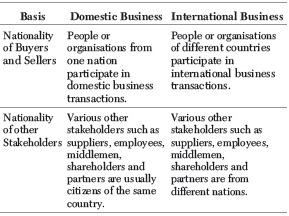
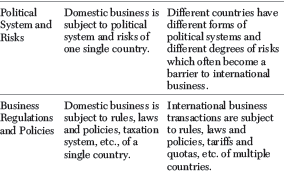
Question. Differentiate between domestic and international business on the following basis
(i) Nationality of buyers and sellers
(ii) Nationality of other shareholders
(iii) Political system and risks
(iv) Business regulations and policies
Answer : Difference between Domestic and International Business
Long Answer Type Questions :
Question. International business has entered into a new era of reforms. India too did not remain cut-off from these developments. India was under a severe debt trap and was facing crippling balance of payment crisis. In 1991, it approached the International Monetary Fund (IMF) for raising funds to tide over its balance of payment deficits. IMF agreed to lend money to India subject to the condition that India would undergo structural changes to be able to ensure repayment of borrowed funds. India had no alternative but to agree to the proposal. It was the very conditions imposed by IMF which more or less forced India to liberalise its economic policies. Since then a fairly large amount of liberalisation at the economic front has taken place. Though the process or reforms have somewhat slowed down, India is very much on the path to globalisation and integrating with the world economy.
While, on the one hand, many Multinational Corporations (MNCs) have ventured into Indian market for selling their products and services. Many Indian companies too have stepped out of the country to market their products and services to consumers in foreign countries.
(i) As per the given case, what do you understand by ‘globalisation’ and ‘liberalisation’?
(ii) IMF forced India to make structural changes so that international trade is encouraged. Do you think that encouraging international trade is good for the country ?
Answer : (i) Globalisation means integration of the economy of the country with the world economy.
Liberalisation means freedom from government regulations in a country to allow for private sector companies to operate business transactions with fewer restrictions.
(ii) Yes, I think that encouraging international trade is beneficial for the country. It provides following benefits to a nation
(a) Earning of Foreign Exchange International trade helps countries to earn foreign exchange. This helps a country to import those goods and services which it cannot produce efficiently.
(b) Better Utilisation of Resources Since, countries tend to produce goods in which they have a comparative advantage, wasteful duplication of resources is prevented and they end up producing more.
(c) Improving Growth Prospects and Employment Potential Many countries follow the principle ‘export and flourish’ and improve their growth prospects, thereby, creating employment
opportunities for their citizens.
(d) Increased Standard of Living International trade helps people of a country to have access to a large variety of goods and services. This helps them to improve their standard of living.
Question. What are the reasons for growing popularity of international trade in the modern times?
Answer : The reasons for the growing popularity of international trade are
(i) Natural Resources are Unevenly Distributed The natural resources are unevenly distributed throughout the world. Some countries are rich in certain resources while other countries in certain other resources. The countries produce goods according to the availability of naturally occurring resources and then sell these to other countries. They also buy the goods produced by some other country, as per their need.
(ii) Availability of Factors of Production Factors of production, viz. land, labour and capital differ from country to country. Because of this, different countries produce different goods and then trade amongst themselves.
(iii) Specialisation Certain countries specialise in the production of certain specific goods. e.g., India specialises in the production of handicrafts. So, handicraft goods are exported from India.
(iv) Cost Benefits The cost of production of goods and services differ from country to country due to difference in geographical, socio-economical and political environment. Some countries can produce goods economically as compared to other countries, thus leading to international trade. For example, China can produce electronic goods cheaply. Because of this , other countries import electronic goods from China.
Free study material for Business Studies
Download Class 11 Business Studies Chapter 11 International Business Practice Worksheets
Practice Exercises for Class 11 Business Studies Chapter 11 International Business
Access structured practice worksheets for Chapter 11 International Business aligned with the 2026 CBSE curriculum. These downloadable exercises for Class 11 Business Studies help students build accuracy and reinforce core concepts for upcoming school tests.
Step-by-Step Solutions and Practice Guidelines
Each worksheet draws directly from authorized standard textbooks to maintain academic accuracy. Evaluating your finished exercises against expert-verified solutions helps master the formal presentation standards expected in school evaluations.
Enhance Speed with Online Practice
Consistent engagement with these exercises builds familiarity with recurring exam themes. If specific areas within Chapter 11 International Business cause trouble, utilize our dedicated NCERT solutions for Class 11 Business Studies to clear up doubts immediately.
FAQs
You can download the latest chapter-wise printable worksheets for Class 11 Business Studies Chapter 11 International Business for free from StudiesToday.com. These have been made as per the latest CBSE curriculum for this academic year.
Yes, Class 11 Business Studies worksheets for Chapter 11 International Business focus on activity-based learning and also competency-style questions. This helps students to apply theoretical knowledge to practical scenarios.
Yes, we have provided solved worksheets for Class 11 Business Studies Chapter 11 International Business to help students verify their answers instantly.
Yes, our Class 11 Business Studies test sheets are mobile-friendly PDFs and can be printed by teachers for classroom.
For Chapter 11 International Business, regular practice with our worksheets will improve question-handling speed and help students understand all technical terms and diagrams.