

Download Class 11 Business Studies Practice Worksheets
Explore structured practice materials through the CBSE Class 11 Business Studies Forms Of Business Organisation Worksheet Set 02. Tailored for Class 11 learners, utilizing these Business Studies worksheets ensures thorough preparation and strengthens problem-solving accuracy before final school evaluations.
Access Chapter 02 Forms of Business Organisation Practice Papers and Solutions
Access the complete worksheet PDF for Class 11 Business Studies below. Regular practice with these targeted academic tasks builds familiarity with standard question patterns and helps secure higher marks in final school examinations.
Mcq Questions for Ncert Class 11 Business Studies Forms of Business Organisation
Question. ……….. defines the rules regarding internal management of a company.
(a) Articles of association
(b) Partnership deed
(c) Memorandum of association
(d) Certificate of incorporation
Answer : A
Question. …………….. clause contains the name of the company with which the company will be known, which has already been approved by the registrar of companies.
(a) Name
(b) Registered office
(c) Objects
(d) Liability
Answer : A
Question. Application for approval of name of a company is to be made to
(a) SEBI
(b) Registrar of companies
(c) GOI
(d) State government in which company is registered
Answer : B
Question. Name the type of partner who is not really a partner but is liable to third parties for the repayment of the firm’s debts.
(a) Sleeping
(b) Active
(c) Nominal
(d) Secret
Answer : C
Question. Name the process by which the shares of a company are allowed to be traded on a stock exchange.
(a) Trading on shares
(b) Listing of shares
(c) Mutualisation of shares
(d) None of the above
Answer : B
Question. After doing her M.Com. from ‘Himachal Pradesh University of Shimla’, Aparna went back to her village in Kinnaur district of Himachal Pradesh. She wanted to contribute for the development of women of her village, so she formed an organisation, the membership of which was open for all the women villagers on a voluntary basis by paying ₹ 500 only which will be treated as their capital.
Aparna knew that the land of her village was suitable for the farming of medicinal plants. So she motivated the members of her organisation for growing medicinal plants in their fields under the guidance and help of the local agricultural department.
It was also decided that the organisation will purchase the produce of each member and sell the same to drug manufacturing companies at a very good price which was not possible for the members individually. The main objective of the organisation is to render services to its members rather than to earn profit.
A computer training center for young boys and girls of the village was started under the guidance of Aparna from the surplus of the profits.
On the basis of the given information, identify the kind of organisation that was formed by her.
(a) Cooperative society
(b) Company
(c) HUF
(d) Partnership
Answer : A
Question. The person or group of persons who perform the work of promotion and form a company is/are known as promoter(s).
(a) True
(b) False
(c) Can’t say
(d) Partially true
Answer : A
Question. Match the following.
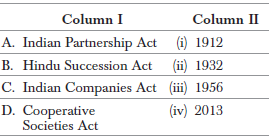
Codes
A B C D
(a) (i) (iii) (ii) (iv)
(b) (iii) (ii) (i) (iv)
(c) (i) (ii) (iii) (iv)
(d) (ii) (iii) (iv) (i)
Answer : D
Question. A company cannot come into existence without
(a) electing directors
(b) getting certificate of incorporation
(c) issuing a prospectus
(d) All of the above
Answer : B
Question. ‘Return of allotment’, signed by a director or secretary is filed with the registrar companies within how many days of allotment of shares?
(a) 15 days
(b) 8 days
(c) 10 days
(d) 30days
Answer : D
Question. In a cooperative society, which of the following principle is followed?
(a) One share one vote
(b) One man one vote
(c) No vote
(d) Multiple votes
Answer : B
Question. A partner by………….is a person who though is not a partner in a firm but knowingly allows himself/herself to be represented as a partner in a firm.
(a) active partner
(b) sleeping or dormant partner
(c) secret partner
(d) partner by holding out
Answer : D
Question. …………… clause specifies the maximum capital which the company will be authorised to raise through the issue of shares.
(a) Name
(b) Capital
(c) Objects
(d) Liability
Answer : B
Question. A type of business organisation where a person is individually responsible for capital, bearing risk and control of management is called …… .
(a) Joint stock company
(b) Cooperative society
(c) Sole proprietorship
(d) Partnership
Answer : C
Question. The ………… is a conclusive evidence of the regularity of the incorporation of a company.
(a) articles of association
(b) partnership deed
(c) memorandum of association
(d) certificate of incorporation
Answer : D
Question. Members may come and members may go, but the company continues to exist. Identity the feature of company highlighted here.
(a) Perpetual succession
(b) Formation
(c) Separate legal entity
(d) Artificial person
Answer : A
Question. Match the following forms the business organisation with their suitable example.
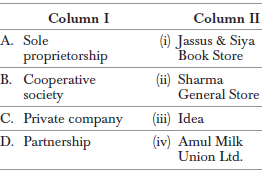
Codes
A B C D
(a) (i) (ii) (iii) (iv)
(b) (ii) (iv) (iii) (i)
(c) (iv) (iii) (ii) (i)
(d) (ii) (iii) (iv) (i)
Answer : B
Question. It can continue as long as the partners want and is terminated when any partner gives a notice of withdrawal from partnership to the firm.
(a) Partnership at will
(b) Particular partnership
(c) General partnership
(d) Limited partnership
Answer : A
Question. Samarth Sharma was born in Delhi and is a fashion designer. He runs his hi-fashion garments business from the posh Greater Kailash market of Delhi. After running the business for eight years, Samarth feels that he should get his business registered in a way that he can save himself from the threat of unlimited liability.
But at the same time, he doesn’t want anyone else to be a part of decision-making or to interfere in his business. On the basis of the given information, state the form of business organisation to be formed by Samarth.
(a) Partnership
(b) Public company
(c) Private company
(d) One person company
Answer : D
Question. A public company publishes and files its annual accounts and reports, as it helps company to maintain secrecy.
(a) True
(b) False
(c) Can’t say
(d) Partially false
Answer : B
Assertion-Reasoning MCQs :
Question. Assertion (A) Personal assets of the partners may be used to pay-off business debts in case of insufficiency of business assets.
Reason (R) Partners of a firm have unlimited liability.
(a) Both Assertion (A) and Reason (R) are true and Reason (R) is the correct explanation of Assertion (A)
(b) Both Assertion (A) and Reason (R) are true, but Reason (R) is not the correct explanation of Assertion (A)
(c) Assertion (A) is true, but Reason (R) is false
(d) Assertion (A) is false, but Reason (R) is true
Answer : A
Question. Assertion (A) Board of directors exercise direct control over the business.
Reason (R) Board of directors are the owners of the company.
(a) Both Assertion (A) and Reason (R) are true and Reason (R) is the correct explanation of Assertion (A)
(b) Both Assertion (A) and Reason (R) are true, but Reason (R) is not the correct explanation of Assertion (A)
(c) Assertion (A) is true, but Reason (R) is false
(d) Assertion (A) is false, but Reason (R) is true
Answer : C
Question. Assertion (A) The managing committee elected by members of the cooperative society is generally not professionally equipped to handle the management functions effectively.
Reason (R) Cooperative society is unable to employ experts because of their inability to pay them high salaries.
(a) Both Assertion (A) and Reason (R) are true and Reason (R) is the correct explanation of Assertion (A)
(b) Both Assertion (A) and Reason (R) are true, but Reason (R) is not the correct explanation of Assertion (A)
(c) Assertion (A) is true, but Reason (R) is false
(d) Assertion (A) is false, but Reason (R) is true
Answer : A
Question. Assertion (A) Timely decisions of sole proprietor help him/her to take advantage of market opportunities as and when they arise.
Reason (R) Sole proprietorship can be easily started or dissolved at any time with minimum legal formalities.
(a) Both Assertion (A) and Reason (R) are true and Reason (R) is the correct explanation of Assertion (A)
(b) Both Assertion (A) and Reason (R) are true, but Reason (R) is not the correct explanation of Assertion (A)
(c) Assertion (A) is true, but Reason (R) is false
(d) Assertion (A) is false, but Reason (R) is true
Answer : B
Question. Assertion (A) Credit cooperative societies are established for providing easy credit on reasonable terms to the members.
Reason (R) Credit cooperative societies provide loans to members out of the amounts collected as capital and deposits from the members and charge low rates of interest.
(a) Both Assertion (A) and Reason (R) are true and Reason (R) is the correct explanation of Assertion (A)
(b) Both Assertion (A) and Reason (R) are true, but Reason (R) is not the correct explanation of Assertion (A)
(c) Assertion (A) is true, but Reason (R) is false
(d) Assertion (A) is false, but Reason (R) is true
Answer : A
Very Short Answer Type Questions
Question. In which form of business profits are not shared?
Answer : In a sole proprietorship all profits, losses, assets and liabilities are the direct and sole responsibility of the owner
Question. Write the names of systems which govern membership in Joint Hindu Family business
Answer : There are two Schools of Hindu Laws which govern the Hindu Undivided Family(HUF):
1. Mitakshara Law
The Mitakshara Law applies tothe whole of India except Bengal and Assam.
2. Dayabhaga Law
Dayabhaga Law applies to the communities like Bengalis and Assamese living in the States of Bengal and Assam and other parts of the world.
Question. What is the minimum no. of persons required to form a co-operative society
Answer : The minimum number of persons required to form a Co-operative is ten (10).
Question. Identify a company which has no restriction of on transfer of shares
Answer : Public company has no restriction of on transfer of shares
Question. Write the name of form of business organisation found only in India
Answer : Joint Hindu family form of business is the form of business which is only found in india
Short /Long Answer type Questions :
Question. Lakshay has set up a cement company on 10th January, 2017. He has got has company registered under Companies Act, 2013. From the day of its incorporation, it acquires an identity separate from its members. Like natural persons, it can own property, incur debts, borrow money and enter into contracts. The Board of Directors of the company will appoint top officials for running the business. Identify the four features of company form of organisation highlighted above by quoting the lines.
Answer. (a) Formation
‘He has got his company registered under Companies Act, 2013.’recipient of all profits.’
(b) Separate Legal Entity
‘From the day of its incorporation it acquires an identity separate from its members.’
(c) Artificial Person
‘Like natural persons, it can own property, incur debts, borrow money and enter into contracts.’
(d) Control
‘The Board of Directors of the company will appoint top officials for running the business.’
Question. Gurpreet, Agam, Shenoy, Dev and Lakshay are partners in a partnership firm. The firm has different types of partners. Gurpreet has contributed capital and participates in the management of firm. He shares profits & losses and is liable to an unlimited extent to the creditors of firm. Agam has contributed capital and shares its profits and losses. He also has unlimited liability but he does not take part in day to day activities of business. Shenoy is a partner, his association with the firm is unknown to general public but in all other respects he is like an active partner. Dev has allowed the firm to use his name as he enjoys good reputation among clients but he does not either contribute capital nor take part in the management. Lakshay, is 15 years of age, and is entitled to the benefits of partnership with mutual consent of all other members. He is not eligible to take part in management of firm and shares only profits and not losses.
(a) In the given case, how many types of partners are involved in the partnership firm?
(b) Who is working as an active partner and what is the nature of his liability?
(c) Who is working as sleeping partner and what is the nature of his liability?
(d) Who is working as secret partner and what is the nature of his liability?
(e) Who is working as nominal partner and what is the nature of his liability?
(f) Is Lakshay a legal partner? Can he be held for the losses of the business? What is the nature of his liability?
Answer. (a) Five
(b) Gurpreet-unlimited liability
(c) Agam-unlimited liability
(d) Shenoy-unlimited liability
(e) Dev-unlimited liability.
(f) Yes, he is a legal partner. No, he cannot be held liable for the losses of the business. His liability is limited to the extent of capital contributed by him.
Question. BSE Limited is the owner and operator of BSE Exchange (Bombay Stock Exchange), India’s largest stock exchange by number of companies listed. The Bombay Stock Exchange was established in year 1875 as the first stock exchange in Asia. Today, BSE has over 5000 companies listed on it, the highest in any exchange around the world.
(i) When and why is a company supposed to make an application to one or more recognised stock exchanges?
(ii) Can the stock exchange reject the application of a company for listing of securities? What are its consequences?
Answer. (i) A public company desirous to raise funds from the public by means of issue of shares and debentures has to make an application to one or more recognised stock exchanges for permission to deal in its shares or debentures.
(ii) Yes, the stock exchange may reject the application of a company for listing of securities if the required specifications are not being fulfilled.
If such permission is not granted within 10 weeks from the date of closure of subscription list, then the allotment will become void. Consequently, all money received from the applicants
will have to be returned to them within 8 days.
Question. Kapoor brothers formed a Joint Hindu Family business.There were three brothers and the eldest of them Ramesh Kapoor became the Karta. The business took a loan of ₹ 40 lakhs for three years but were unable to repay it due to poor financial condition of the business. They sold an ancestral property worth ₹ 25 lakhs and paid to bank. The bank filed a case of recovery for the balance amount. Ramesh Kapoor pleaded to the court that the loan was taken for the business purpose, so all member are liable to repay it. The court rejected the plea of Ramesh Kapoor.
(a) Why did court rejected the plea of Ramesh Kapoor?
(b) In this case who has unlimited and limited liability?
(c) Was the decision of court to claim only from Ramesh Kapoor justified?
Answer. (a) Because Ramesh Kapoor being karta has unlimited liability.
(b) Ramesh Kapoor-unlimited and all other members have limited liability.
(c) Yes as Ramesh Kapoor has unlimited liability.
Question. Compare the status of a minor in a Joint Hindu Family Business with that in a partnership firm.
Answer. A minor is a person who has not attained the age of 18 years (21 years in some case). In case of a Joint Hindu Family Business, membership is by birth. That is why, minors can also be members of the business. The liability of minor is limited to his share in the business. They have to share losses also. In case of a partnership firm, a minor cannot become a partner because he is not capable of entering into a valid contract but he can be admitted to the benefits of partnership firm with mutual consent of all other partners. He cannot be asked to bear the losses.
Question. Partners in affirm has different roles and liabilities, Identify and explain the type of partner in a firm from the given examples:
a) Rama is a partner in a business who has no actual interest in business trade or its profits but she is
Paid fee by the firm for lending its name to firm.
b) In Ram Hari & co. Ltd, Ram & Hari declare Gopal as a partner with knowing that Gopal remain silent
then Gopal will be liable to third parties for any loss.
c) What type of partner is Geeta if she only contribute capital, shar profit and loss if any?
d) What type of patner is Giri in Ram Hari & co. Where he is an outsider but represent himself as a
partner.
Answer : a) Rama is a partner in a business who has no actual interest in business trade or its profits but she is Paid fee by the firm for lending its name to firm- Nominal Partner
b) In Ram Hari & co. Ltd, Ram & Hari declare Gopal as a partner with knowing that Gopal remain silent
then Gopal will be liable to third parties for any loss- Partner by holding out
c) What type of partner is Geeta if she only contribute capital, shar profit and loss if any- Sleeping
Partner
d) What type of patner is Giri in Ram Hari & co. Where he is an outsider but represent himself as a
partner-Partner by Estoppel
Question. Explain the concept of mutual agency in partnership with suitable example
Answer : Mutual agency is the legal relationship between partners in a partnership where each partner has authorization powers and the ability enter the partnership into business contracts. In other words, each partner in the partnership is an agent in the business and the authority to make business decisions that commit or bind the partnership, as a whole, to a business agreement with a third party or entity.
For example, a partner of a grocery store who purchases a delivery truck creates a binding contract in the name of the partnership even if the partnership agreement denies this authority. On the other hand, if a partner in a law firm purchased a snowmobile for the partnership, such as act would not be binding on the partnership. The purchase is clearly outside the scope of partnership business.
Question. What is secret partner
Answer : Secret Partner is A person or partner who is not disclosed in a venture or enterprise. He contributes to the capital. He participates in the management but secretly. He also shares the profits and losses of business. His liability is unlimited as others.
Question. Explain a co-operative organisation in democratic setup.
Answer : The cooperative society is a voluntary association of persons, who join together with the motive of welfare of the members. The principle of ‘one man one vote’ governs the cooperative society. Each member is entitled to equal voting rights. Thus, cooperative society is run on democratic principles.
Question. Explain limitations of Joint Stock Company
Answer : Limitations are as follows
- The formation of a company requires greater time, effort and extensive knowledge of legal requirements and the procedures involved
- Separation of ownership and management leads to lack of effort as well as personal involvement on the part of the officers of a company
- Information of company is provided to Registrar of companies time to time and hence information is available to general public
- The functioning of a company is subject to many legal provisions and compulsions. This reduces the freedom of operations of a company and takes away a lot of time, effort and money
- Communication as well as approval of various proposals to Top, middle and lower level management may cause delays not only in taking decisions but also in acting upon them.
- Board of Directors are representatives of the shareholders who are the owners. The owners have minimal influence in terms of controlling or running the business
- Various demands pose problems in managing the company as it often becomes difficult to satisfy such diverse interest
Question. If registration is optional, why do partnership firms willingly go through this legal formality? Explain the reason with procedure to get them registered.
Answer : It is optional for partnership firm to get registered. But to avoid conflicts between partners it is preferred to have a written agreement.
The consequences of non-registration of a firm are as follows:
(a) A partner of an unregistered firm cannot file a suit against the firm or other partners,
(b) The firm cannot file a suit against third parties, and
(c) The firm cannot file a case against the partners.
The written agreement which specifies the terms and conditions that govern the partnership is called the partnership deed.
The partnership deed generally includes the following aspect:
- Name of firm
- Nature of business and location of business
- Duration of business
- Investment made by each partner
- Distribution of profits and losses
- Duties and obligations of the partners
- Salaries and withdrawals of the partners
- Terms governing admission, retirement and expulsion of a partner
- Interest on capital and interest on drawings
- Procedure for dissolution of the firm
- Preparation of accounts and their auditing
- Method of solving disputes
Procedure for firm registration:
1. Submission of application in the prescribed form to the Registrar of firms. The application should contain the following particulars:
- Name of the firm
- Location of the firm
- Names of other places where the firm carries on business
- The date when each partner joined the firm
- Names and addresses of the partners
- Duration of partnership
This application should be signed by all the partners.
2. Deposit of required fees with the Registrar of Firms.
3. The Registrar after approval will make an entry in the register of firms and will subsequently issue a certificate of registration.
Question. Why cooperative forms of organisation are formed? Explain various types of cooperative societies
Answer : The cooperative society is a voluntary association of persons, who join together with the motive of welfare of the members. They are driven by the need to protect their economic interests in the face of possible exploitation at the hands of middlemen obsessed with the desire to earn greater profits. The process of setting up a cooperative society is simple enough and at the most what is required is the consent of at least ten adult persons to form a society. The capital of a society is raised from its members through issue of shares. The society acquires a distinct legal identity after its registration
Types of Cooperative Societies
- Consumer’s Cooperative Societies
It is formed to protect the interests of consumers
- Society aims at eliminating middlemen to achieve economy in operations
- It purchases goods in bulk directly from the wholesalers and sells goods to the members
- Profits are distributed on the basis of either their capital contributions to the society or purchases made by individual members.
- Producer’s Cooperative Societies
- It is set up to protect the interest of small producer
- The members comprise of producers desirous of procuring inputs for production of goods to meet the demands of consumers
- Profits are distributed on the basis of their contributions to the total pool of goods produced or sold by the society.
- Marketing Cooperative Societies
- It is established to help small producers in selling their products.
- The members consist of producers who wish to obtain reasonable prices for their output
- It pools the output of individual members and performs marketing functions like transportation, warehousing, packaging, etc., to sell the output at the best possible price.
- Profits are distributed according to each member’s contribution
- Farmer’s Cooperative Societies
- It is formed to protect the interests of farmers by providing better inputs at a reasonable cost
- The members comprise farmers who wish to jointly take up farming activities
- The aim is to gain the benefits of large scale farming and increase the productivity.
- Improves the yield and returns to the farmers, but also solves the problems associated with the farming on fragmented land holdings
- Credit Cooperative Societies
- It is established for providing easy credit on reasonable terms to the members.
- The members comprise of persons who seek financial help in the form of loans.
- The aim of such societies is to protect the members from the exploitation of lenders who charge high rates of interest on loans.
- Cooperative Housing Societies
- It is established to help people with limited income to construct houses at reasonable costs.
- The members of these societies consist of people who are desirous of procuring residential accommodation at lower costs.
- The aim is to solve the housing problems of the members by constructing houses and giving the option of paying in instalments
Question. ‘Reva Chemicals’ is a partnership firm. Sona and Mona one two partners in this firm. It is recorded in the Partnership Deed that Sona’s liability is unlimited, whereas Mona’s is limited. Sona wants to set up the Anti-Pollution plant in his factory, but Mona does not let him do so. Almost all the transactions of this firm are done through the internet. The firm Sells its goods to other Business units only. The firm gets its Research and Development work done by another firm, who is a specialist of such work.
i. Describe the type of partnership.
ii. ldentify the two values being overlooked.
iii. Name the type-business being done by the firm
Answer : i. It is a limited partnership where the liability of at least one partner is unlimited whereas the rest may have limited liability. The limited partners do not enjoy the right of management and their acts do not bind the firm or the other partners. Registration of such partnership is compulsory.
ii. The two values which are overlooked are:
- Violation of government rules
- Social responsibility clause is not fulfilled
iii. It is a Business to Business Commerce. B2B e-commerce (also written as e-Commerce, eCommerce or similar variants), short for business-to-business, electronic commerce, is selling products or services between businesses through the internet via an online sales portal. In general, it is used to improve efficiency for companies. Instead of processing orders manually – by telephone or e-mail – with ecommerce orders can be processed digitally.
Question: ABC Ltd. filed an application for registration to registrar of companies. He submitted copy of name approval, memorandum of association, articles of association, address of registered office and paid the required registration fees. His application for registration was rejected on the ground of not submitted some others important documents. List the documents he needs to file so that he can get his company incorporated.
Answer : (a) Statement of authorised capital.
(b) Consent of proposed directiors.
(c) Statutory declaration.
(d) The agreement, if any, with proposed Managing Director or Whole time Director or Manager.
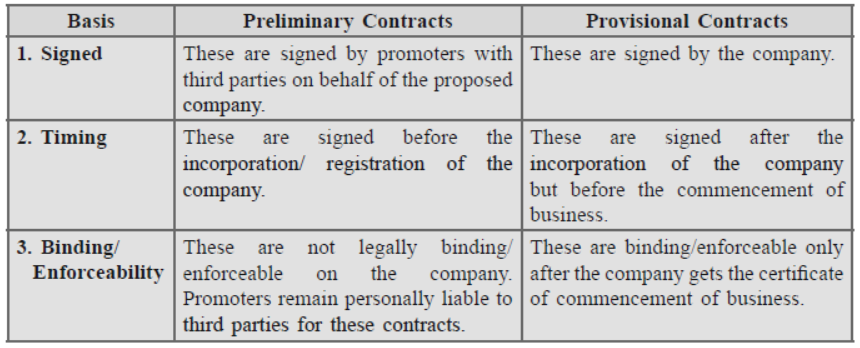
Question: Distinguish between preliminary contracts and provisional contracts.
Answer :
Question: A group of 15 people decides to form a company and hence appointed Creators Pvt. Ltd. Creators Pvt. Ltd. were assigned the job of scanning the business environment and to identify various business opportunities. After thoroughly exploring the environment, Creators Pvt. Ltd. suggested them to start a ‘Cab Services’ in the posh areas of Delhi. Before converting the business opportunities into real project, Creators Pvt. Ltd., conducted feasibility studies and also suggested the name for the company. They have entered into contract on behalf of the company also.
(a) Identify the stage in the formation of a particular form of business organisation.
(b) Under what category is Creators Pvt. Ltd. is working.
(c) Are the contracts which are entered into before incorporation, of above mentioned form of organisation, are binding after incorporation?
Answer : (a) Promotion.
(b) Creators Pvt. Ltd. is working as promoters.
(c) Yes.
Question: Is it necessary for a public company to get its shares listed on a stock exchange? What happens if a public company going for a public issue fails to apply to a stock exchange for permission to deal in its securities or fails to get such permission.
Answer : Yes, it is necessary for a public company to get its shares listed or quoted on a stock exchange. If a company going for a public issue fails to apply to a stock exchange for permission to deal in its securities or fails to gets such permission within 10 weeks from the date of closure of subscription list, then the allotment will become void Consequently, all money received from the applicants will have to be returned to them within 8 days.
Question: Name the following:
(a) A company having at least 7 members.
(b) An enterprise owned by a single person.
(c) A company in which the number of members cannot exceed 200.
(d) Its main aim is to provide services to the members.
(e) This form of business organisation is owned, financed, managed and controlled by a single person.
(f) A document containing terms and conditions of partnership.
Answer : (a) Public company. (b) Sole proprietorship. (c) Private company.
(d) Cooperative society. (e) Sole proprietorship. (f) Partnership deed.
Free study material for Business Studies
CBSE Class 11 Business Studies Worksheets for Chapter 02 Forms of Business Organisation
Mastering Chapter 02 Forms of Business Organisation with Printable Worksheets
Access structured practice worksheets for Chapter 02 Forms of Business Organisation aligned with the 2026 CBSE curriculum. These downloadable exercises for Class 11 Business Studies help students build accuracy and reinforce core concepts for upcoming school tests.
Verified Solutions and NCERT Alignment
Built using official NCERT guidelines for Class 11 Business Studies, these practice sheets provide reliable academic support. Cross-reference your completed work with our detailed solutions to learn standard answer-writing formats for CBSE exams.
Additional Study Resources for Class 11 Business Studies
Consistent engagement with these exercises builds familiarity with recurring exam themes. If specific areas within Chapter 02 Forms of Business Organisation cause trouble, utilize our dedicated NCERT solutions for Class 11 Business Studies to clear up doubts immediately.
FAQs
You can download the latest chapter-wise printable worksheets for Class 11 Business Studies Chapter 02 Forms of Business Organisation for free from StudiesToday.com. These have been made as per the latest CBSE curriculum for this academic year.
Yes, Class 11 Business Studies worksheets for Chapter 02 Forms of Business Organisation focus on activity-based learning and also competency-style questions. This helps students to apply theoretical knowledge to practical scenarios.
Yes, we have provided solved worksheets for Class 11 Business Studies Chapter 02 Forms of Business Organisation to help students verify their answers instantly.
Yes, our Class 11 Business Studies test sheets are mobile-friendly PDFs and can be printed by teachers for classroom.
For Chapter 02 Forms of Business Organisation, regular practice with our worksheets will improve question-handling speed and help students understand all technical terms and diagrams.