

Official NCERT Solutions for Class 7 Mathematics: Chapter 10 Practical Geometry
Review structured textbook solutions for Class 7 Mathematics Chapter 10 Practical Geometry. Built according to NCERT guidelines for the 2026-27 academic year, these downloadable answers support daily revision and problem-solving accuracy.
Chapter-wise Solutions for Mathematics: Chapter 10 Practical Geometry
View or download the dedicated Chapter 10 Practical Geometry solution resource below. Engaging with these textbook answers under focused study conditions ensures continuous academic progress and mastery of the 2026-27 curriculum for Mathematics.
Exercise 10.1
Q.1) Draw a line, say AB, take a point C outside it. Through C, draw a line parallel to AB using ruler and compasses only.
Sol.1) To construct:
A line, parallel to given line by using ruler and compasses.
Steps of construction:
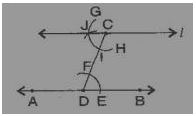
(a) Draw a line-segment AB and take a point C outside AB.
(b) Take any point D on AB and join C to D.
(c) With D as centre and take convenient radius, draw an arc cutting AB at E and CD at F. (d)
With C as centre and same radius as in step 3, draw an arc GH cutting CD at I.
(e) With the same arc EF, draw the equal arc cutting GH at J.
(f) Join JC to draw a line 𝑙. This the required line 𝐴𝐵 ∥ 𝑙
Q.2) Draw a line 𝑙. Draw a perpendicular to 𝑙 at any point on 𝑙. On this perpendicular choose a point 𝑋, 4 𝑐𝑚 away from 𝑙. Through 𝑋, draw a line m parallel to 𝑙.
Sol.2) To construct:
A line parallel to given line when perpendicular line is also given.
Steps of construction:
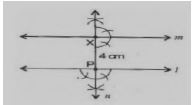
(a) Draw a line 𝑙 and take a point P on it.
(b) At point 𝑃, draw a perpendicular line 𝑛.
(c) Take 𝑃𝑋 = 4 𝑐𝑚 on line 𝑛.
(d) At point 𝑋, again draw a perpendicular line 𝑚. It is the required construction.
Q.3) Let 𝑙 be a line and P be a point not on l. Through P, draw a line m parallel to l. Now join P to any point Q on l. Choose any other point R on m. Through R, draw a line parallel to PQ. Let this meet l at S. What shape do the two sets of parallel lines enclose?
Sol.3) To construct:
A pair of parallel lines intersecting other part of parallel lines.
Steps of construction:
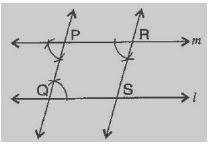
(a) Draw a line 𝑙 and take a point 𝑃 outside of .
(b) Take point 𝑄 on line 𝑙 and join PQ.
(c) Make equal angle at point 𝑃 such that ∠ 𝑄 = ∠ 𝑃.
(d) Extend line at 𝑃 to get line 𝑚.
(e) Similarly, take a point 𝑅 online 𝑚, at point R, draw angles such that P = R.
(f) Extended line at 𝑅 which intersects at 𝑆 online 𝑙.
Draw line 𝑅𝑆. Thus, we get parallelogram 𝑃𝑄𝑅𝑆.
Exercise 10.2
Q.1) Construct Δ 𝑋𝑌𝑍 in which 𝑋𝑌 = 4.5 𝑐𝑚, 𝑌𝑍 = 5 𝑐𝑚 and 𝑍𝑋 = 6 𝑐𝑚.
Sol.1) To construct:
Δ 𝑋𝑌𝑍, where 𝑋𝑌 = 4.5 𝑐𝑚, 𝑌𝑍 = 5 𝑐𝑚 and 𝑍𝑋 = 6 𝑐𝑚.
Steps of construction:

(a) Draw a line segment 𝑌𝑍 = 5 𝑐𝑚.
(b) Taking 𝑍 as centre and radius 6 cm, draw an arc.
(c) Similarly, taking 𝑌 as centre and radius 4.5 𝑐𝑚, draw another arc which intersects first arc at point 𝑋.
(d)Join 𝑋𝑌 and 𝑋𝑍. It is the required Δ 𝑋𝑌𝑍.
Q.2) Construct an equilateral triangle of side 5.5 𝑐𝑚.
Sol.2) To construct:
A Δ 𝐴𝐵𝐶 where 𝐴𝐵 = 𝐵𝐶 = 𝐶𝐴 = 5.5 𝑐𝑚
Steps of construction:
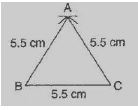
(a) Draw a line segment 𝐵𝐶 = 5.5 𝑐𝑚
(b) Taking points 𝐵 and 𝐶 as centers and radius 5.5 𝑐𝑚, draw arcs which intersect at point A.
(c) Join 𝐴𝐵 and 𝐴𝐶. It is the required Δ 𝐴𝐵𝐶.
Q.3) Draw Δ 𝑃𝑄𝑅 with 𝑃𝑄 = 4 𝑐𝑚, 𝑄𝑅 = 3.5 𝑐𝑚 and 𝑃𝑅 = 4 𝑐𝑚. What type of triangle is this?
Sol.3) To construction: Δ 𝑃𝑄𝑅, in which 𝑃𝑄 = 4 𝑐𝑚, 𝑄𝑅 = 3.5 𝑐𝑚 and 𝑃𝑅 = 4 𝑐𝑚.
Steps of construction:
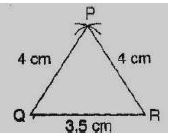
(a) Draw a line segment 𝑄𝑅 = 3.5 𝑐𝑚.
(b) Taking 𝑄 as centre and radius 4 𝑐𝑚, draw an arc.
(c) Similarly, taking 𝑅 as centre and radius 4 𝑐𝑚, draw an another arc which intersects first arc at 𝑃.
(d)Join 𝑃𝑄 and 𝑃𝑅. It is the required isosceles Δ 𝑃𝑄𝑅.
Q.4) Construct Δ 𝐴𝐵𝐶 such that 𝐴𝐵 = 2.5 𝑐𝑚, 𝐵𝐶 = 6 𝑐m and 𝐴𝐶 = 6.5 𝑐𝑚. Measure ∠ 𝐵.
Sol.4) To construct: Δ 𝐴𝐵𝐶 in which 𝐴𝐵 = 2.5 𝑐𝑚, 𝐵𝐶 = 6 𝑐𝑚 and 𝐴𝐶 = 6.5 𝑐𝑚.
Steps of construction:
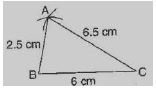
(a) Draw a line segment 𝐵𝐶 = 6 𝑐𝑚.
(b) Taking 𝐵 as centre and radius 2.5 𝑐𝑚, draw an arc.
(c) Similarly, taking 𝐶 as centre and radius 6.5 𝑐𝑚, draw another arc which intersects first arc at point 𝐴.
(d) Join 𝐴𝐵 and 𝐴𝐶.
(e) Measure angle 𝐵 with the help of protractor. It is the required Δ 𝐴𝐵𝐶 where ∠ 𝐵 = 80°.
Exercise 10.3
Q.1) Construct Δ 𝐷𝐸𝐹 such that 𝐷𝐸 = 5 𝑐𝑚, 𝐷𝐹 = 3 𝑐𝑚 and ∠𝑚 𝐸𝐷𝐹 = 90°.
Sol.1) To construct: Δ 𝐷𝐸𝐹 where 𝐷𝐸 = 5 𝑐𝑚, 𝐷𝐹 = 3 𝑐𝑚 and ∠𝑚 𝐸𝐷𝐹 = 90° .
Steps of construction:
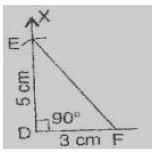
(a) Draw a line segment 𝐷𝐹 = 3 𝑐𝑚.
(b) At point 𝐷, draw an angle of 90 with the help of compass
i.e., ∠ 𝑋𝐷𝐹 = 90 .
(c) Taking 𝐷 as centre, draw an arc of radius 5 𝑐𝑚, which cuts 𝐷𝑋 at the point 𝐸.
(d) Join 𝐸𝐹. It is the required right angled triangle 𝐷𝐸𝐹.
Q.2) Construct an isosceles triangle in which the lengths of each of its equal sides is 6.5 𝑐𝑚 and the angle between them is 110°.
Sol.2) To construct: An isosceles triangle 𝑃𝑄𝑅 where 𝑃𝑄 = 𝑅𝑄 = 6.5 𝑐𝑚 and ∠ 𝑄 = 110° .
Steps of construction:
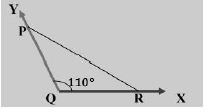
(a) Draw a line segment 𝑄𝑅 = 6.5 𝑐𝑚.
(b) At point 𝑄, draw an angle of with the 110 help of protractor,
i.e., ∠ 𝑌𝑄𝑅 = 110° .
(c) Taking 𝑄 as centre, draw an arc with radius 6.5 𝑐𝑚, which cuts 𝑄𝑌 at point P.
(d) Join 𝑃𝑅 It is the required isosceles triangle 𝑃𝑄𝑅.
Q.3) Construct Δ 𝐴𝐵𝐶 with 𝐵𝐶 = 7.5 𝑐𝑚, 𝐴𝐶 = 5 𝑐𝑚 and ∠𝑚 𝐶 = 60°.
Sol.3) To construct: Δ ABC where 𝐵𝐶 = 7.5 𝑐𝑚, 𝐴𝐶 = 5 𝑐𝑚 and ∠𝑚 𝐶 = 60°.
Steps of construction:
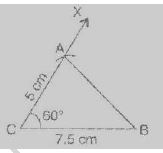
(a) Draw a line segment 𝐵𝐶 = 7.5 𝑐𝑚.
(b) At point 𝐶, draw an angle of 60°with the help of protractor,
i.e., ∠ 𝑋𝐶𝐵 = 60°.
(c) Taking 𝐶 as centre and radius 5 𝑐𝑚, draw an arc, which cuts 𝑋𝐶 at the point 𝐴.
(d) Join 𝐴𝐵 It is the required triangle 𝐴𝐵𝐶.
Exercise 10.4
Q.1) Construct Δ 𝐴𝐵𝐶, given ∠𝑚 𝐴 = 60°,∠ 𝑚 𝐵 = 30°and 𝐴𝐵 = 5.8 𝑐𝑚.
Sol.1) To construct: Δ 𝐴𝐵𝐶 where ∠𝑚 𝐴 = 60°,∠ 𝑚 𝐵 = 30° and 𝐴𝐵 = 5.8 𝑐𝑚.
Steps of construction:
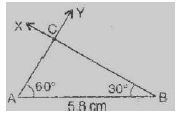
(a) Draw a line segment 𝐴𝐵 = 5.8 𝑐𝑚.
(b) At point A, draw an angle ∠ 𝑌𝐴𝐵 = 60°with the help of compass.
(c) At point B, draw ∠ 𝑋𝐵𝐴 = 30°with the help of compass.
(d) AY and BX intersect at the point 𝐶. It is the required triangle 𝐴𝐵𝐶.
Q.2) Construct Δ 𝑃𝑄𝑅 if 𝑃𝑄 = 5 𝑐𝑚, ∠𝑚 𝑃𝑄𝑅 = 105°and ∠𝑚 𝑄𝑅𝑃 = 40°.
Sol.2) ∠𝑚 𝑃𝑄𝑅 = 105°and ∠𝑚 𝑄𝑅𝑃 = 40°
We know that sum of angles of a triangle is 180 .
∠ 𝑚 𝑃𝑄𝑅 + ∠𝑚 𝑄𝑅𝑃 + ∠𝑚 𝑄𝑃𝑅 = 180
⇒ 105° + 40° + 𝑚∠ 𝑄𝑃𝑅 = 180°
⇒ 145°∠𝑚 𝑄𝑃𝑅 = 180°
⇒ ∠ 𝑚𝑄𝑃𝑅 = 180° − 145°
⇒ 𝑄𝑃𝑅 = 35°
To construct: Δ 𝑃𝑄𝑅 where ∠𝑚 𝑃 = 35°, ∠ 𝑚 𝑄 = 105°and 𝑃𝑄 = 5 𝑐𝑚.
Steps of construction:
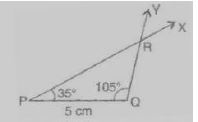
(a) Draw a line segment 𝑃𝑄 = 5 𝑐𝑚.
(b) At point 𝑃, draw ∠ 𝑋𝑃𝑄 = 35°with the help of protractor.
(c) At point 𝑄, draw ∠ 𝑌𝑄𝑃 = 105°with the help of protractor.
(d) 𝑋𝑃 and 𝑌𝑄 intersect at point 𝑅. It is the required triangle 𝑃𝑄𝑅.
Q.3) Examine whether you can construct Δ 𝐷𝐸𝐹 such that 𝐸𝐹 = 7.2 𝑐𝑚,∠𝑚 𝐸 = 110°and
∠𝑚 𝐹 = 80°. Justify your answer.
Sol.3) Given: In ∠𝐷𝐸𝐹,∠ 𝑚 𝐸 = 110°and ∠𝑚 𝐹 = 80°.
Using angle sum property of triangle
∠𝐷 + ∠𝐸 + ∠𝐹 = 180°
⟹ ∠𝐷 + 110 ° + 80° = 180°
⟹ ∠𝐷 + 190 ° = 180°
⟹ ∠𝐷 = 180° − 190 ° = −10 °
Which is not possible.
Exercise 10.5
Q.1) Construct the right angled ∠ 𝑃𝑄𝑅, where ∠𝑚 𝑄 = 90° , 𝑄𝑅 = 8 𝑐𝑚 and 𝑃𝑅 = 10 𝑐𝑚.
Sol.1) To construct: A right angled triangle 𝑃𝑄𝑅 where ∠𝑚 𝑄 = 90°, 𝑄𝑅 = 8 𝑐𝑚 and 𝑃𝑄 = 10 𝑐𝑚.
Steps of construction:
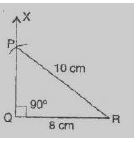
(a) Draw a line segment 𝑄𝑅 = 8 𝑐𝑚.
(b) At point 𝑄, draw 𝑄𝑋 ⊥ 𝑄𝑅.
(c) Taking R as centre, draw an arc of radius 10 𝑐𝑚.
(d) This arc cuts 𝑄𝑋 at point 𝑃.
(e) Join 𝑃𝑄. It is the required right angled triangle 𝑃𝑄𝑅.
Q.2) Construct a right angled triangle whose hypotenuse is 6 cm long and one the legs is 4 cm long.
Sol.2) To construct: A right angled triangle 𝐷𝐸𝐹 where 𝐷𝐹 = 6 𝑐𝑚 and 𝐸𝐹 = 4 𝑐𝑚
Steps of construction:
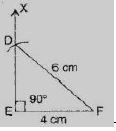
(a) Draw a line segment 𝐸𝐹 = 4 𝑐𝑚.
(b) At point 𝑄, draw 𝐸𝑋 ∠ 𝐸𝐹.
(c) Taking F as centre and radius 6 cm, draw an arc. (Hypotenuse)
(d) This arc cuts the 𝐸𝑋 at point 𝐷.
(e) Join 𝐷𝐹. It is the required right angled triangle 𝐷𝐸𝐹.
Q.3) Construct an isosceles right angled triangle 𝐴𝐵𝐶, where ∠𝑚 𝐴𝐶𝐵 = 90°and 𝐴𝐶 = 6 𝑐𝑚
Sol.3) To construct: An isosceles right angled triangle ABC where ∠𝑚 𝐶 = 90 , 𝐴𝐶 = 𝐵𝐶 = 6 𝑐𝑚.
Steps of construction:
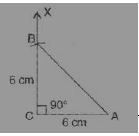
(a) Draw a line segment 𝐴𝐶 = 6 𝑐𝑚.
(b) At point 𝐶, draw 𝑋𝐶 ⊥ 𝐶𝐴.
(c) Taking 𝐶 as centre and radius 6 cm, draw an arc.
(d) This arc cuts 𝐶𝑋 at point 𝐵.
(e) Join BA. It is the required isosceles right angled triangle 𝐴𝐵𝐶.
Free study material for Mathematics
Free NCERT Textbook Explanations: Class 7 Mathematics Chapter 10 Practical Geometry
Official NCERT Solutions for Chapter 10 Practical Geometry
Explore reliable textbook solutions for Chapter 10 Practical Geometry tailored for Class 7 learners. Utilizing these complete exercise answers ensures your preparation aligns exactly with official NCERT standards for Mathematics.
Step-by-Step Explanations for Chapter 10 Practical Geometry
Clear, methodical explanations accompany every challenging problem within the Class 7 Mathematics text. Engaging with these detailed answers lays a solid foundation for advanced learning and improves foundational clarity for upcoming assessments.
Next Steps in Your Mathematics Revision
Frequent review of these structured answers builds strong analytical capabilities and response efficiency. Maximize your academic readiness by combining these textbook solutions with our curated study materials and mock evaluations for Class 7 Mathematics.
FAQs
The complete and updated NCERT Solutions Class 7 Mathematics Chapter 10 Practical Geometry is available for free on StudiesToday.com. These solutions for Class 7 Mathematics are as per latest NCERT curriculum.
Yes, our experts have revised the NCERT Solutions Class 7 Mathematics Chapter 10 Practical Geometry as per 2026 exam pattern. All textbook exercises have been solved and have added explanation about how the Mathematics concepts are applied in case-study and assertion-reasoning questions.
Toppers recommend using NCERT language because NCERT marking schemes are strictly based on textbook definitions. Our NCERT Solutions Class 7 Mathematics Chapter 10 Practical Geometry will help students to get full marks in the theory paper.
Yes, we provide bilingual support for Class 7 Mathematics. You can access NCERT Solutions Class 7 Mathematics Chapter 10 Practical Geometry in both English and Hindi medium.
Yes, you can download the entire NCERT Solutions Class 7 Mathematics Chapter 10 Practical Geometry in printable PDF format for offline study on any device.