

Official NCERT Solutions for Class 7 Mathematics: Chapter 02 Fractions and Decimals
Access comprehensive textbook solutions for Chapter 02 Fractions and Decimals using the official curriculum guides for Class 7 Mathematics. Designed to align with the 2026-27 NCERT standards, these detailed answers help students reinforce core academic concepts.
Chapter-wise Solutions for Mathematics: Chapter 02 Fractions and Decimals
Navigate directly to the solved Mathematics textbook exercises using the digital viewer below. Each solution includes detailed step-by-step explanations, allowing students to instantly cross-check their work and identify areas requiring further revision.
Exercise 2.1
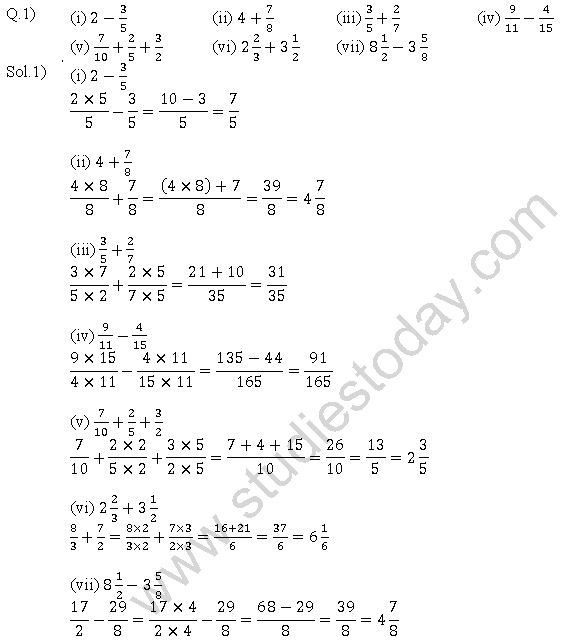
Q.2) Arrange the following in descending order
i) 2/9, 2/3, 8/21
ii) 1/5, 3/7, 7/10
Sol.2) i) 2/9, 2/3, 8/21
Let’s take LCM of 9,3,21
9 = 3 × 3
21 = 3 × 7
3 = 3 × 1
So, we can take two 3’s as a common term since we four 3’s and 7 is coming only once
Therefore ,the required LCM is= 3 × 3 × 7 = 63
For the first number,
⇒ 2/9 × 7/7
= 14/63

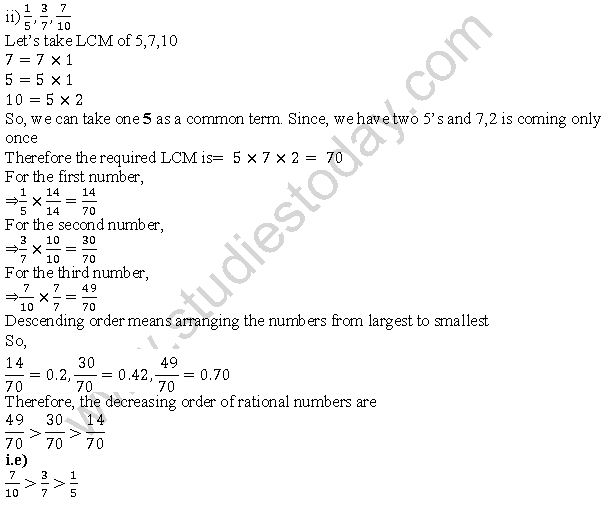
Q.3) In a magic square the sum of the numbers in each row in each column and along the diagonal is the same Is this a magic square ?
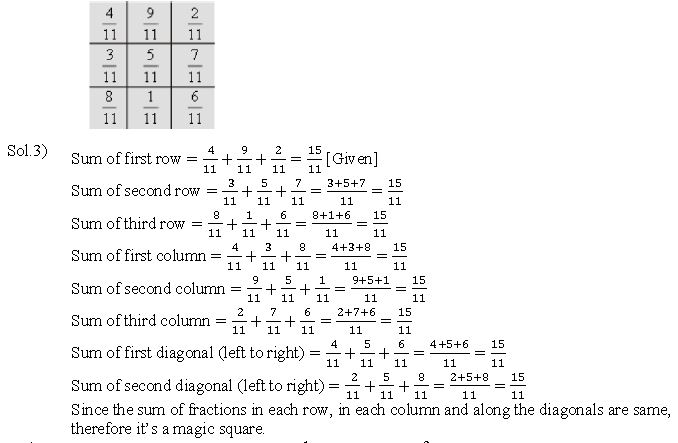
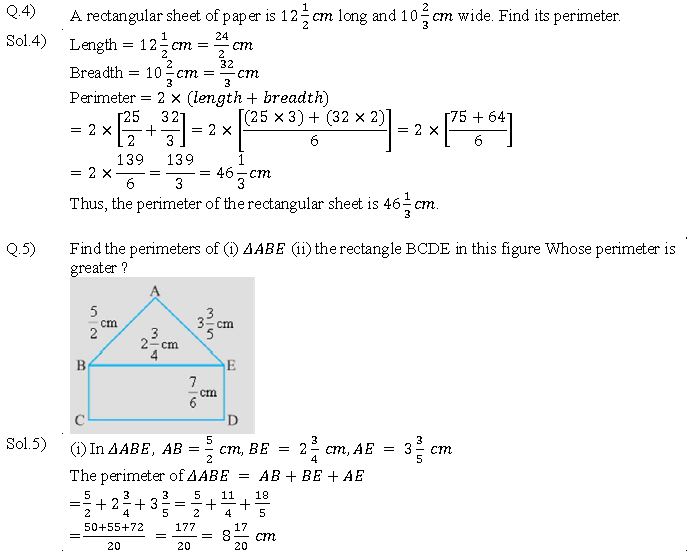
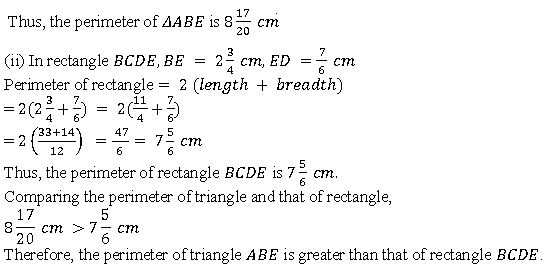
Q.6) Salil wants to put a picture in a frame. The picture is 7(3/5)𝑐𝑚 wide. To fit in the frame, the picture cannot be more than 7(3/10)𝑐𝑚 wide. How much should the picture be trimmed?
Sol.6) Given: The width of the picture = 7(3/5)cm and the width of picture frame = 7(3/10)𝑐𝑚
Therefore, the picture should be trimmed = 7(3/5)– 7(3/10) = 38/5 – 73/10 = 76–73 /10 = 3/10 𝑐𝑚
Thus, the picture should be trimmed by 3/10 𝑐𝑚.
Q.7) Ritu eat 3/5 part of an apple and the remaining apple was eaten by her brother Somu. How much part of the apple did Somu eat? Who had the larger share? By how much?
Sol.7) The part of an apple eaten by Ritu = 3/5
The part of an apple eaten by Somu = 1– 3/5 = 5–3/5 = 2/5
Comparing the parts of apple eaten by both Ritu and Somu 3/5 > 2/5
Larger share will be more by 3/5 – 2/5 = 1/5 part.
Thus, Ritu’s part is 1/5
more than Somu’s part.
Q.8) Michael finished colouring a picture in (7/12) ℎ𝑜𝑢𝑟𝑠. Vaibhav finished colouring the same picture in (3/4) ℎ𝑜𝑢𝑟. Who worked longer? By what fraction was it longer?
Sol.8) Time taken by Michael to colour the picture = (7/12) ℎ𝑜𝑢𝑟
Time taken by Vaibhav to colour the picture = (3/4) ℎ𝑜𝑢𝑟
Converting both fractions in like fractions, 7/12 and 3×3/4×3 = 9/12
Here, 7/12 < 9/12 ⇒ 7/12 < 3/4
Thus, Vaibhav worked longer time.
Vaibhav worked longer time by 3/4 – 7/12 = 9–7/12 = 2/12 = 1/6 ℎ𝑜𝑢𝑟.
Thus, Vaibhav took 1/6 ℎ𝑜𝑢𝑟 more than Michael.
Exercise 2.2
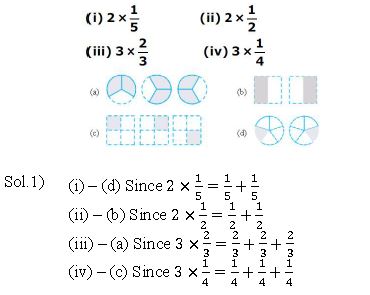
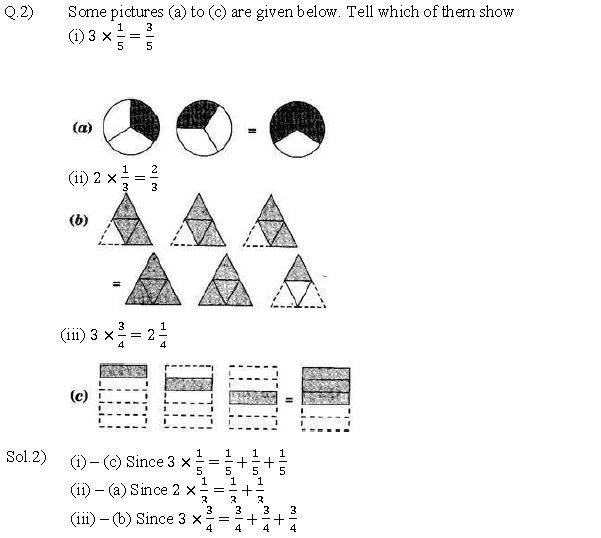
Q.1) Which of the following drawing (a) to (d) show :
Q.3) Multiply and reduce to lowest form:
(i) 7×3/5 (ii) 4×1/3 (iii) 2×6/7 (iv) 5×2/9
(v)2/3×4 (vi) 5/2×6 (vii) 11×4/7 (viii) 20×4/5
(ix) 13×1/3 (x) 15×3/5
Sol.3)

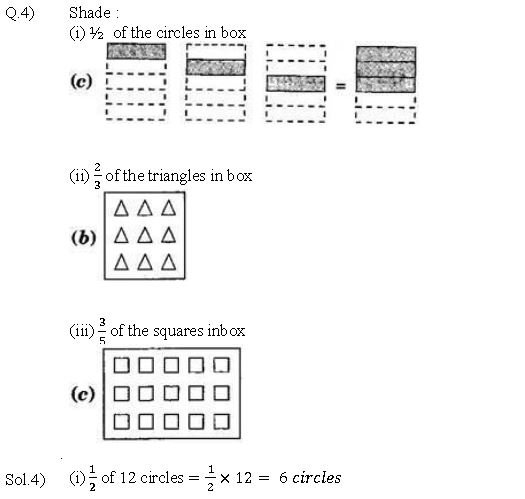
Q.5) Find:
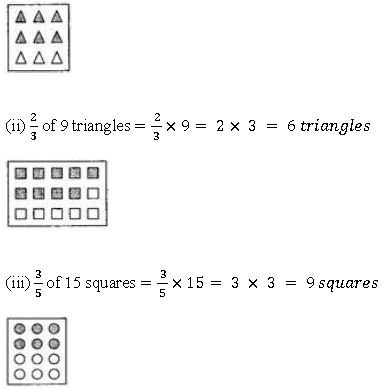
(a) 1/2 of (i) 24 (ii) 46
(b) 2/3 of (i) 18 (ii) 27
(c) 3/4 of (i) 16 (ii) 36
(d) 4/5 of (i) 20 (ii) 35
Sol.5) (a)
(i) 1/2 of 24 = 12
(ii) 1/2 of 46 = 23
(b)
(i) 2/3 of 18 = 2/3 × 18 = 2 × 6 = 12
(ii) 2/3 of 27 = 2/3 × 27 = 2 × 9 = 18
(c)
(i) 𝟑/𝟒 𝑜𝑓 16 = 3/4 × 16 = 3 × 4 = 12
(ii) 3/4 𝑜𝑓 36 = 3/4 × 36 = 3 × 9 = 27
(d)
(i) 4/5 𝑜𝑓 20 = 4/5 × 20 = 4 × 4 = 16
(ii) 4/5 𝑜𝑓 35 = 4/5 × 35 = 4 × 7 = 28
Q.8) Vidya and Pratap went for a picnic. Their mother gave them a water bottle that contained 5 litres of water. Vidya consumed 2/5 of the water. Pratap consumed the remaining water.
(i) How much water did Vidya drink?
(ii)What fraction of the total quantity of water did Pratap drink?
Sol.8) Given: Total quantity of water in bottle = 5 litres
(i) Vidya consumed = 2/5 of 5 litres = 2/5 × 5 = 2 𝑙𝑖𝑡𝑟𝑒𝑠
Thus, Vidya drank 2 litres water from the bottle.
(ii) Pratap consumed = (1– 2/5) part of bottle
= (5–2) 5 = 3/5 part of bottle
Pratap consumed 3/5 of 5 litres water = 3/5 × 5 = 3 𝑙𝑖𝑡𝑟𝑒𝑠
Thus, Pratap drank 3/5 part of the total quantity of water
Exercise 2.3
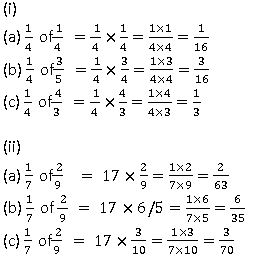
Q.1) Find:
(i) 1/4 of
(a) 1/4
(b) 3/5
(c) 4/3
(ii) 1/7 of
(a) 2/9
(b) 6/5
(c) 3/10
Sol.1)
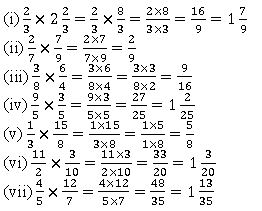
Q.2) Multiply and reduce to lowest form (if possible):
(i) 23 × 2(2/3)
(ii) 27 × 7(9/2)
(iii) 3/8 × 6/4
(iv) 9/5 × 3/5
(v) 1/3 × 15/8
(vi) 11/2 × 3/10
(vii) 4/5 × 12/7
Sol.2)
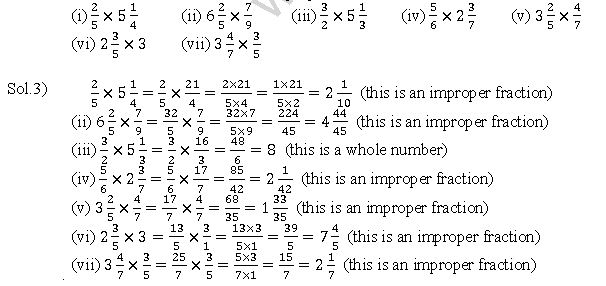
Q.3) For the fractions given below:
(a) Multiply and reduce the product to lowest form (if possible)
(b) Tell whether the fraction obtained is proper or improper.
(c) If the fraction obtained is improper then convert it into a mixed fraction.
Q.4) Which is greater:
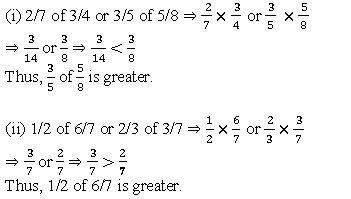
(i) 2/7 of 3/4 or 3/5 of 5/8
(ii) 1/2 of 6/7 or 2/3 of 3/7
Sol.4)
Q.5) Saili plants 4 saplings in a row in her garden The distance between two adjacent saplings is )3/4)𝑚 Find the distance between the first and the last sapling.
Sol.5) The distance between two adjacent saplings = (3/4)𝑚
Saili planted 4 saplings in a row, then number of gap in saplings
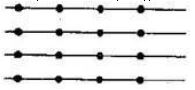
Therefore, the distance between the first and the last saplings = 3 × 3/4 = (9/4) 𝑚 = 2(1/4)𝑚
Thus the distance between the first and the last saplings is 2(1/4)𝑚.
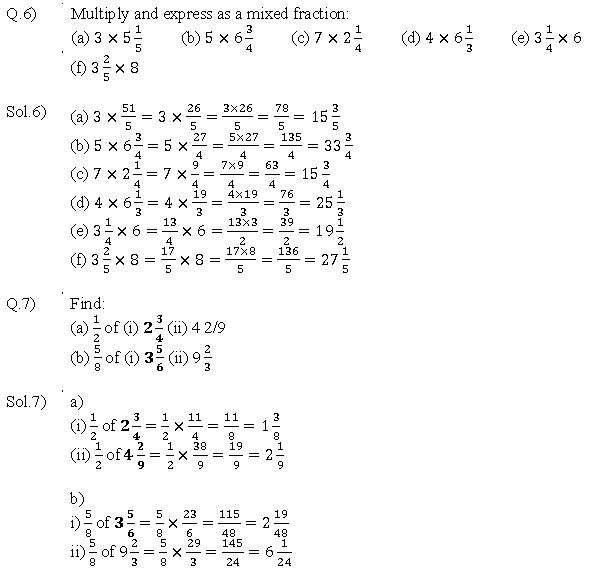
Q.6) Lipika reads a book for 1 3/4 hours every day. She reads the entire book in 6 days. How many hours in all were required by her to read the book?
Sol.6) Time taken by Lipika to read a book = 1(3/4) ℎ𝑜𝑢𝑟𝑠.
She reads entire book in 6 days.
Now, total hours taken by her to read the entire book = 1(3/4) × 6 = 7/4 × 6 = 21/2 = 10(1/2)ℎ𝑜𝑢𝑟𝑠
Thus, 10 hours were required by her to read the book.
Q.7) A car runs 16 km using 1 litre of petrol. How much distance will it cover using 2(3/4) litres of petrol?
Sol.7) In 1 litre of petrol, car covers the distance = 16 km
In 2(3/4) litres of petrol, car covers the distance = 2(3/4) 𝑜𝑓 16 𝑘𝑚 = 11/4 × 16 = 44 𝑘𝑚
Thus, car will cover 44 km distance.
Q.8) (a)
(i) Provide the number in the box ___, such that 2/3 × ___ = 10/30.
(ii) The simplest form of the number obtained in ___ is ___.
(b)
(i) Provide the number in the box ___, such that 3/5 × = 24/75.
(ii) The simplest form of the number obtained in ___ is ___.
Sol.8) (a)
(i) 2/3 × 5/10 = 10/30
(ii) The simplest form of 5/10 is 1/2.
(b) (i) 3/5 × 8/15 = 24/75
(ii) The simplest form of 8/15 is 8/15.
Exercise 2.4
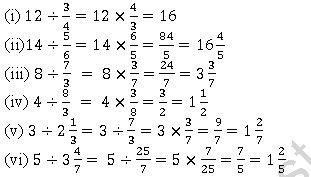
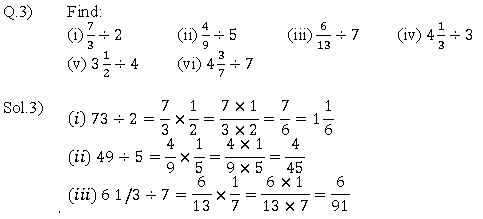
Q.1) Find:
(i) 12 ÷ 3/4
(ii) 14 ÷ 5/6
(iii) 8 ÷ 7/3
(iv) 4 ÷ 8/3
(v) 3 ÷ 2(1/3)
(vi) 5 ÷ 3(4/7)
Sol.1)
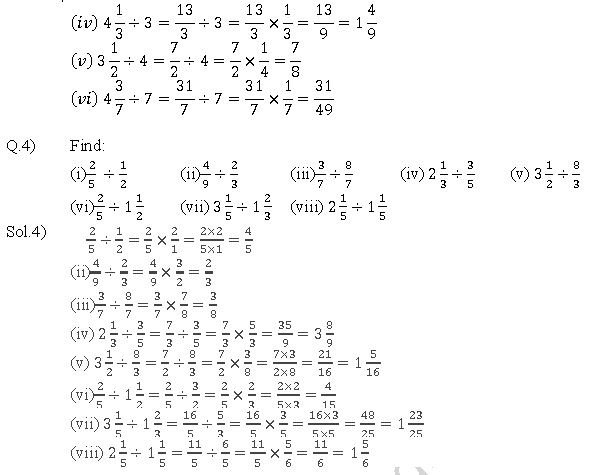
Q.2) Find the reciprocal of each of the following fractions. Classify the reciprocals as proper fraction, improper fractions and whole numbers.
(i) 3/7
(ii) 5/8
(iii) 9/7
(iv) 6/5
(v) 12/7
(vi) 1/8
(vii) 1/11
Sol.2) (i) Reciprocal of 3/7 = 7/3 → Improper fraction
(ii) Reciprocal of 5/8 = 8/5 → Improper fraction
(iii) Reciprocal of 9/7 = 7/9 → Proper fraction
(iv) Reciprocal of 6/5 = 5/6 → Proper fraction
(v)Reciprocal of 12/7 = 7/12 → Proper fraction
(vi) Reciprocal of 1/8 = 8 → Whole number
(vi) Reciprocal of 1/11 = 11 → Whole number
Exercise 2.5
Q.1) Which is greater:
(i) 0.5 or 0.05
(ii) 0.7 or 0.5
(iii) 7 or 0.7
(iv) 1.37 or 1.49
(v) 2.03 or 2.30
(vi) 0.8 or 0.88
Sol.1) (i) 0.5 > 0.05
Converting these decimal numbers into equivalent fractions:
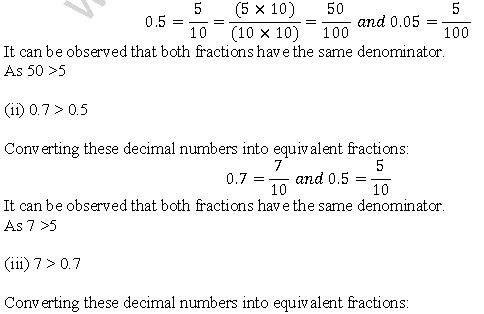
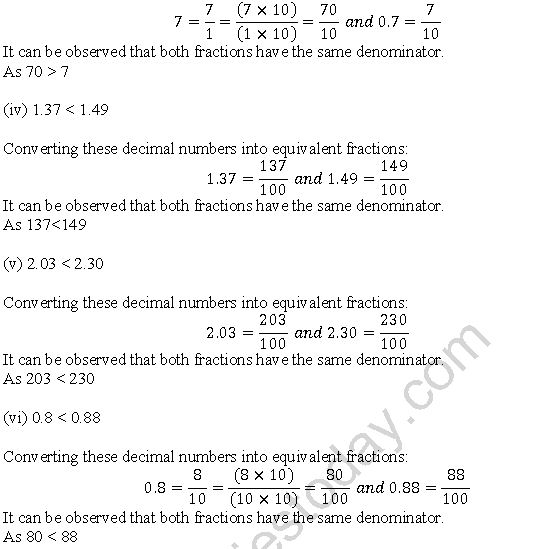
It can be observed that both fractions have the same denominator.
As 80 < 88
Q.2) Express as rupees using decimals:
(i) 7 paise
(ii) 7 rupees 7 paise
(iii) 77 rupees 77 paise
(iv) 50 paise
(v) 235 paise
Sol.2) ∵ 100 paise = Re. 1
∴ 1 paisa = Re. 1/100
7 paise = Re. 7/100 = Re. 0.07
7 rupees 7 paise = Rs. 7 + Re. 7/100 = Rs. 7 + Re. 0.07 = Rs. 7.07
77 rupees 77 paise = Rs. 77 + Re. 77/100 = Rs. 77 + Re. 0.77 = Rs. 77.77
50 paise = Re. 50/100 = Re. 0.50
235 paise = Re. 235/100 = Rs. 2.35
Q.3) (i) Express 5 cm in metre and kilometre.
(ii) Express 35 mm in cm, m and km.
Sol.3) (i) Express 5 cm in meter and kilometre.
∵ 100 cm = 1 meter
∴ 1 cm = 1/100 meter ⇒ 5 cm = 5/100 = 0.05 meter.
Now, ∵ 1000 meters = 1 kilometres
∴ 1 meter = 1/1000 kilometre
⇒ 0.05 meter = 0.051000 = 0.00005 kilometre
(ii) Express 35 mm in cm, m and km.
∵ 10 mm = 1 cm
∴ 1 mm = 1/10 cm ⇒ 35 mm = 35103510 = 3.5 cm
Now, ∵ 100 cm = 1 meter
∴ 1 cm = 1/100 meter ⇒3.5 cm = 3.5100= 0.035 meter
Again, ∵ 1000 meters = 1 kilometres
∴ 1 meter = 1/1000 kilometre
⇒ 0.035 meter = 0.0351000 = 0.000035 kilometre
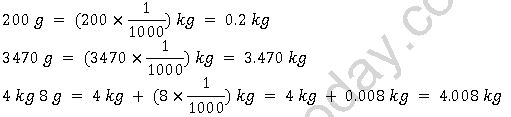
Q.4) Express in kg.:
(i) 200 g (ii) 3470 g (iii) 4 kg 8 g
Sol.4) Les us consider , 1000 g = 1 kg ⇒ 1 g = 1/1000 kg
Q.5) Write the following decimal numbers in the expanded form:
(i) 20.03 (ii) 2.03 (iii) 200.03 (iv) 2.034
Sol.5) (i) 20.03 = 2 × 10 + 0 × 1 + 0 × 1/10 + 3 × 1/100
(ii) 2.03 = 2 × 1 + 0 × 1/10 + 3 × 1/100
(iii) 200.03 = 2 × 100 + 0 × 10 + 0 × 1 + 0 × 1/10 + 3 × 1/100
(iv) 2.034 = 2 × 1 + 0 × 1/10 + 3 × 1/100 + 4 × 1/1000
Q.6) Write the place value of 2 in the following decimal numbers:
(i) 2.56 (ii) 21.37 (iii) 10.25 (iv) 9.42
(v) 63.352
Sol.6) (i) Place value of 2 in 2.56 = 2 × 1 = 2 𝑜𝑛𝑒𝑠
(ii) Place value of 2 in 21.37 = 2 × 10 = 2 𝑡𝑒𝑛𝑠
(iii) Place value of 2 in 10.25 = 2 × 1/10 = 2 𝑡𝑒𝑛𝑡ℎ𝑠
(iv) Place value of 2 in 9.42 = 2 × 1/100 = 2 ℎ𝑢𝑛𝑑𝑟𝑒𝑑𝑡ℎ
(v) Place value of 2 in 63.352 = 2 × 1/1000 = 2 𝑡ℎ𝑜𝑢𝑠𝑎𝑛𝑑𝑡ℎ
Q.7) Dinesh went from place A to place B and from there to place C. A is 7.5 km from B and B is 12.7 km from C. Ayub went from place A to place D and from there to place C. D is 9.3 km from A and C is 11.8 km from D. Who travelled more and by how much?
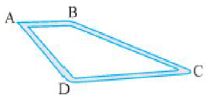
Sol.7) Distance travelled by Dinesh when he went from place A to place B = 7.5 km and from place B to C = 12.7 km.

Total distance covered by Dinesh = AB + BC
= 7.5 + 12.7 = 20.2 km
Total distance covered by Ayub = AD + DC
= 9.3 + 11.8 = 21.1 km
On comparing the total distance of Ayub and Dinesh,
21.1 km > 20.2 km
Therefore, Ayub covered more distance by 21.1 – 20.2 = 0.9 km = 900 m
Q.8) Shyam bought 5 kg 300 g apples and 3 kg 250 g mangoes. Sarala bought 4 kg 800g oranges and 4 kg 150 g bananas. Who bought more fruits?
Sol.8) Total weight of fruits bought by Shyam = 5 kg 300 g + 3 kg 250 g = 8 kg 550 g
Total weight of fruits bought by Sarala = 4 kg 800 g + 4 kg 150 g = 8 kg 950 g
On comparing the quantity of fruits,
8 kg 550 g < 8 kg 950 g
Therefore, Sarala bought more fruits.
Q.9) How much less is 28 km than 42.6 km?
Sol.9) We have to find the difference of 42.6 km and 28 km.
42.6 – 28.0 = 14.6 km
Therefore 14.6 km less is 28 km than 42.6 km.
Exercise 2.6
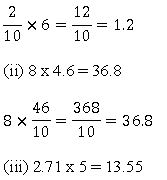
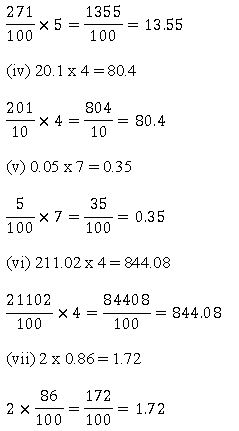
Q.1) Find:
(i) 0.2 x 6 (ii) 8 x 4.6 (iii) 2.71 x 5
(iv) 20.1 x 4 (v) 0.05 x 7 (vi) 211.02 x 4
(vii) 2 x 0.86
Sol.1) (i) 0.2 x 6 = 1.2
Q.2) Find the area of rectangle whose length is 5.7 cm and breadth is 3 cm.
Sol.2) Given: Length of rectangle = 5.7 𝑐𝑚 and
Breadth of rectangle = 3 𝑐𝑚
Area of rectangle = 𝐿𝑒𝑛𝑔𝑡ℎ × 𝐵𝑟𝑒𝑎𝑑𝑡ℎ
= 5.7 × 3 = 17.1𝑐𝑚2
Thus, the area of rectangle is 17.1𝑐𝑚2.
Q.3) Find:
(i) 1.3 x 10 (ii) 36.8 x 10 (iii) 153.7 x 10
(iv) 168.07 x 10 (v) 31.1 x 100 (vi) 156.1 x 100
(vii) 3.62 x 100 (viii) 3.07 x 100 (ix) 0.5 x 10
(x) 0.08 x 10 (xi) 0.9 x 100 (xii) 0.03 x 1000
Sol.3) (i) 1.3 x 10 = 13.0
(ii) 36.8 x 10 = 368.0
(iii) 153.7 x 10 = 1537.0
(iv) 168.07 x 10 = 1680.7
(v) 31.1 x 100 = 3110.0
(vi) 156.1 x 100 = 15610.0
(vii) 3.62 x 100 = 362.0
(viii) 43.07 x 100 = 4307.0
(ix) 0.5 x 10 = 5.0
(x) 0.08 x 10 = 0.80
(xi) 0.9 x 100 = 90.0
(xii) 0.03 x 1000 = 30.0
Q.4) A two-wheeler covers a distance of 55.3 km in one litre of petrol. How much distance will it cover in 10 litres of petrol?
Sol.4) ∵ In one litre, a two-wheeler covers a distance = 55.3 km
∴ In 10 litres, a two- wheeler covers a distance = 55.3 x 10 = 553.0 km
Thus, 553 km distance will be covered by it in 10 litres of petrol.
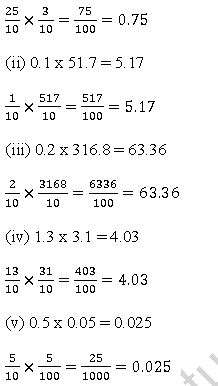
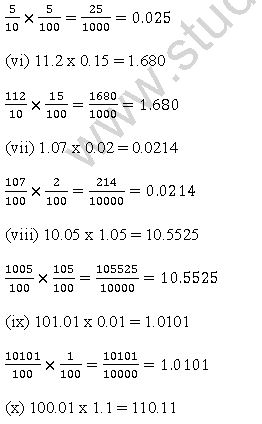
Q.5) Find:
(i) 2.5 x 0.3 (ii) 0.1 x 51.7 (iii) 0.2 x 316.8
(iv) 1.3 x 3.1 (v) 0.5 x 0.05 (vi) 11.2 x 0.15
(vii) 1.07 x 0.02 (viii) 10.05 x 1.05 (ix) 101.01 x 0.01
(x) 100.01 x 1.1
Sol.5) (i) 2.5 x 0.3 = 0.75
Exercise 2.7
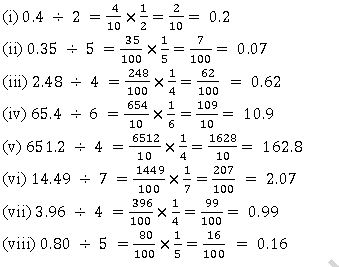
Q.1) Find:
(i) 0.4 ÷ 2 (ii) 0.35÷ 5
(iii) 2.48÷ 4 (iv) 65.4 ÷ 6
(v) 651.2÷ 4 (v) 14.49÷ 7
(vii) 3.96÷ 4 (viii) 0.80÷ 5
Sol.1)
Q.2) Find:
(i) 4.8 ÷ 10 (ii) 52.5 ÷ 10 (iii) 0.7 ÷ 10
(iv) 33.1÷ 10 (v) 272.23÷ 10 (vi) 0.56 ÷ 10
(vii) 3.97÷ 10
Sol.2) (i) 4.8 ÷ 10 = 4.8/10 = 0.48
(ii) 52.5 ÷ 10 = 52.5/10 = 5.25
(iii) 0.7 ÷ 10 = 0.7/10 = 0.07
(iv) 33.1 ÷ 10 = 33.1/10 = 3.31
(v) 272.23 ÷ 10 = 272.23/10 = 27.223
(vi) 0.56 ÷ 10 = 0.56/10 = 0.056
(vii) 3.97 ÷ 10 = 3.97/10 = 0.397
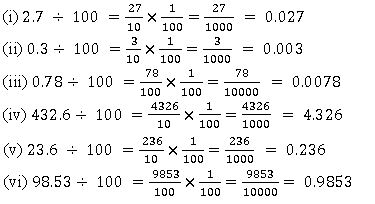
Q.3) Find:
(i) 2.7 ÷ 100 (ii) 0.3÷ 100 (iii) 0.78 ÷ 100
(iv) 432.6 ÷ 100 (v) 23.6 ÷ 100 (vi) 98.53 ÷ 100
Q.4) Find:
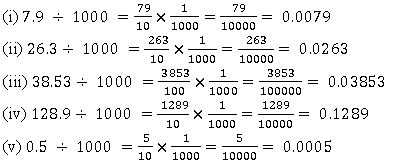
(i) 7.9 ÷ 1000 (ii) 26.3 ÷ 1000 (iii) 38.53 ÷ 1000
(iv) 128.9 ÷ 1000 (v) 0.5 ÷1000
Sol.4)
Q.5) Find:
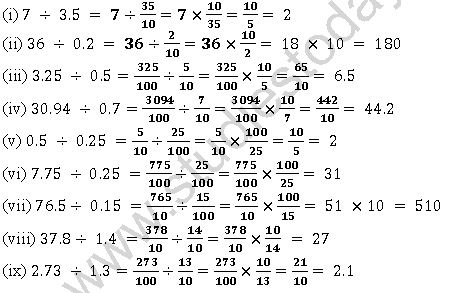
(i) 7 ÷ 3.5 (ii) 36÷ 0.2 (iii) 3.25 ÷ 0.5
(iv) 30.94÷ 0.7 (v) 0.5 ÷ 0.25 (vi) 7.75÷ 0.25
(vii) 76.5÷ 0.15 (viii) 37.8÷ 1.4 (ix) 2.73 ÷ 1.3
Sol.5)
Q.6) A vehicle covers a distance of 43.2 km in 2.4 litres of petrol. How much distance will it cover in one litre petrol?
Sol.6) ∵ In 2.4 litres of petrol, distance covered by the vehicle = 43.2 km
∴ In 1 litre of petrol, distance covered by the vehicle = 43.2 ÷ 2.4
= 43210 ÷ 2410
= 18 𝑘𝑚
Thus, it covered 18 km distance in one litre of petrol.
Free study material for Mathematics
Step-by-Step Textbook Answers: Class 7 Mathematics Chapter 02 Fractions and Decimals
Official NCERT Solutions for Chapter 02 Fractions and Decimals
Review comprehensive exercise answers for Class 7 Mathematics Chapter 02 Fractions and Decimals. Fully updated to match current NCERT syllabus guidelines, these textbook solutions help students verify their work and maintain accurate study notes.
Step-by-Step Explanations for Chapter 02 Fractions and Decimals
Beyond providing final answers, these guides offer step-by-step breakdowns for complex queries in the Class 7 Mathematics module. This approach helps students balance theoretical depth with practical problem-solving skills required for NCERT exams.
Next Steps in Your Mathematics Revision
Consistent practice with these solution guides cultivates faster problem-solving habits and clearer logical structuring. For a complete preparation experience, pair these textbook answers with our dedicated revision notes and sample papers for Class 7 Mathematics.
FAQs
The complete and updated NCERT Solutions Class 7 Mathematics Chapter 2 Fractions and Decimals is available for free on StudiesToday.com. These solutions for Class 7 Mathematics are as per latest NCERT curriculum.
Yes, our experts have revised the NCERT Solutions Class 7 Mathematics Chapter 2 Fractions and Decimals as per 2026 exam pattern. All textbook exercises have been solved and have added explanation about how the Mathematics concepts are applied in case-study and assertion-reasoning questions.
Toppers recommend using NCERT language because NCERT marking schemes are strictly based on textbook definitions. Our NCERT Solutions Class 7 Mathematics Chapter 2 Fractions and Decimals will help students to get full marks in the theory paper.
Yes, we provide bilingual support for Class 7 Mathematics. You can access NCERT Solutions Class 7 Mathematics Chapter 2 Fractions and Decimals in both English and Hindi medium.
Yes, you can download the entire NCERT Solutions Class 7 Mathematics Chapter 2 Fractions and Decimals in printable PDF format for offline study on any device.