

Official NCERT Solutions for Class 7 Mathematics: Chapter 06 Triangle and its properties
Access comprehensive textbook solutions for Chapter 06 Triangle and its properties using the official curriculum guides for Class 7 Mathematics. Designed to align with the 2026-27 NCERT standards, these detailed answers help students reinforce core academic concepts.
Chapter-wise Solutions for Mathematics: Chapter 06 Triangle and its properties
Navigate directly to the solved Mathematics textbook exercises using the digital viewer below. Each solution includes detailed step-by-step explanations, allowing students to instantly cross-check their work and identify areas requiring further revision.
Exercise 6.1
Q.1) In Δ PQR, D is the mid-point of QR.
PM is _______
PD is ________
Is QM = MR?
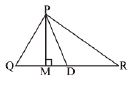
Sol.1) Given: QD = DR
∴ PM is altitude.
PD is median.
No, 𝑄𝑀 ≠ 𝑀𝑅 as D is the mid-point of QR
Q.2) Draw rough sketches for the following:
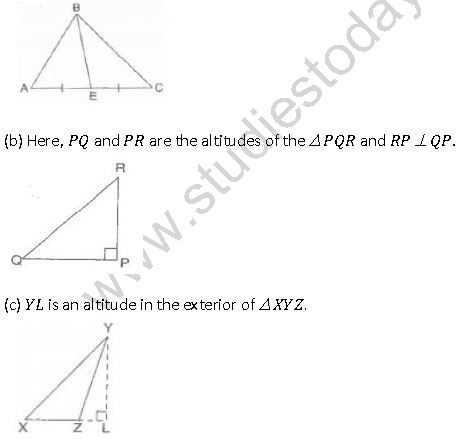
(a) In Δ 𝐴𝐵𝐶, BE is a median.
(b)In Δ 𝑃𝑄𝑅, PQ and PR are altitudes of the triangle.
(c) In Δ 𝑋𝑌𝑍, YL is an altitude in the exterior of the triangle.
Sol.2) (a) Here, BE is a median in Δ𝐴𝐵𝐶 and 𝐴𝐸 = 𝐸𝐶
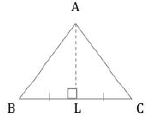
Q.3) Verify by drawing a diagram if the median and altitude of a isosceles triangle can be same
Sol.3) Isosceles triangle means any two sides are same.
Take Δ𝐴𝐵𝐶 and draw the median when 𝐴𝐵 = 𝐴𝐶.
AL is the median and altitude of the given triangle.
Exercise 6.2
Q.1) Find the value of the unknown exterior angle 𝑥 in the following diagrams:
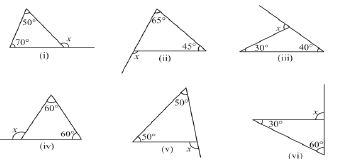
Sol.1) Since, Exterior angle = Sum of interior opposite angles, therefore
(i) 𝑥 = 50° + 70° = 120°
(ii) 𝑥 = 65° + 45° = 110°
(iii) 𝑥 = 30° + 40° + 170°
(iv) 𝑥 = 60° + 60° = 120°
(v) 𝑥 = 50° + 50° = 100°
(vi) 𝑥 = 60° + 30° = 90°
Q.2) Find the value of the unknown interior angle𝑥in thefollowing figures:
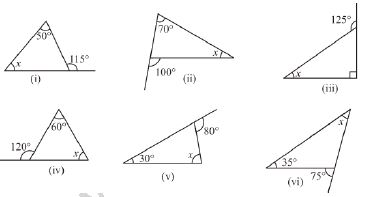
Sol.2) Since, Exterior angle = Sum of interior opposite angles, therefore
(i) 𝑥 + 50° = 115° ⇒𝑥 = 115° − 50° = 65°
(ii) 70° + 𝑥 = 100° ⇒𝑥 = 100°−70° = 30°
(iii) 𝑥 + 90° = 125° ⇒𝑥 = 125° − 90° = 35°
(iv) 60° + 𝑥 = 120° ⇒𝑥 = 120° − 60° = 60°
(v) 30° + 𝑥 = 80° ⇒𝑥 = 80° − 30° = 50°
(vi) 𝑥 + 35° = 75° ⇒𝑥 = 75° − 35° = 40°
Exercise 6.3
Q.1) Find the value of unknown 𝑥 in the following diagrams:
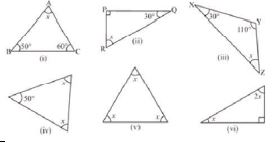
Sol.1) (i) In ∠𝐴𝐵𝐶, Δ 𝐵𝐴𝐶 + ∠ 𝐴𝐶𝐵 + ∠ 𝐴𝐵𝐶 = 180°[By angle sum property of a triangle]
⇒ 𝑥 + 50° + 60° = 180°
⇒ 𝑥 + 110° = 180°
⇒ 𝑥 = 180° − 110° = 70°
(ii) In Δ 𝑃𝑄𝑅,∠ 𝑅𝑃𝑄 + ∠ 𝑃𝑄𝑅 + ∠ 𝑅𝑃𝑄 = 180° [By angle sum property of a triangle]
⇒ 90° + 30° + 𝑥 = 180°
⇒ 𝑥 + 120° = 180°
⇒ 𝑥 = 180° − 120° = 60°
(iii) In Δ 𝑋𝑌𝑍,∠ 𝑍𝑋𝑌 + ∠ 𝑋𝑌𝑍 + ∠ 𝑌𝑍𝑋 = 180° [By angle sum property of a triangle]
⇒ 30° + 110° + 𝑥 = 180°
⇒ 𝑥 + 140° = 180°
⇒ 𝑥 = 180° − 140° = 40°
(iv) In the given isosceles triangle,
𝑥 + 𝑥 + 50° = 180° [By angle sum property of a triangle]
⇒ 2𝑥 + 50° = 180°
⇒ 2𝑥 = 180° − 50°
⇒ 2𝑥 = 130°
⇒ 𝑥 = 130°/2 = 65°
(v) In the given equilateral triangle,
𝑥 + 𝑥 + 𝑥 = 180° [By angle sum property of a triangle]
⇒ 3𝑥 = 180°
⇒ 𝑥 = 180°/3 = 60° =
(vi) In the given right angled triangle,
𝑥 + 2𝑥 + 90° = 180° [By angle sum property of a triangle]
⇒ 3𝑥 + 90° = 180
⇒ 3𝑥 = 180° − 90°
⇒ 3𝑥 = 90°
⇒ 𝑥 = 90°/3 = 30°
Q.2) Find the values of the unknowns 𝑥 and 𝑦 in the following diagrams:
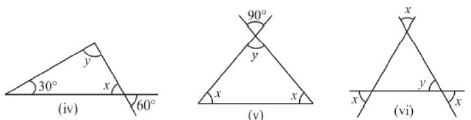
Sol.2) (i) 50° + 𝑥 = 120° [Exterior angle property of a Δ ]
𝑥 = 120° − 50° = 70°
Now, 50° + 𝑥 + 𝑦 = 180° [Angle sum property of a Δ ]
⇒ 50° + 70° + 𝑦 = 180°
⇒ 120° + 𝑦 = 180°
⇒ 𝑦 = 180° − 120° = 60°
(ii) 𝑦 = 80° ……….(i) [Vertically opposite angle]
Now, 50° + 𝑥 + 𝑦 = 180° [Angle sum property of a Δ ]
50° + 80° + 𝑦 = 180°[From equation (i)]
130° + 𝑦 = 180°
⇒ 𝑦 = 180° − 130° = 50°
(iii) 50° + 60° = 𝑥[Exterior angle property of a Δ ] 110° = x
⇒ 𝑥 = 110°
Now 50° + 60° + 𝑦 = 180° [Angle sum property of a Δ ]
⇒110° + 𝑦 = 180°
⇒ 𝑦 = 180° − 110°
⇒ 𝑦 = 170°
(iv) 𝑥 = 60° ……….(i) [Vertically opposite angle]
Now, 30° + 𝑥 + 𝑦 = 180° [Angle sum property of a Δ ]
⇒50° + 60° + 𝑦 = 180° [From equation (i)]
⇒90° + 𝑦 = 180°
⇒ 𝑦 = 180° − 90° = 90°
(v) 𝑦 = 90° ……….(i) [Vertically opposite angle]
Now, 𝑦 + 𝑥 + 𝑥 = 180° [Angle sum property of a Δ ]
⇒ 90° + 2𝑥 = 180° [From equation (i)]
⇒ 2𝑥 = 180° − 90°
⇒ 2𝑥 = 90°
⇒ 𝑥 = 45°/2
(vi) 𝑥 = 𝑦 ……….(i) [Vertically opposite angle]
Now, 𝑥 + 𝑥 + 𝑦 = 180° [Angle sum property of a Δ ]
2𝑥 + 𝑥 = 180° [From equation (i)]
⇒ 3𝑥 = 180°
⇒ 𝑥 = 180°/3 = 60°
Exercise 6.4
Q.1) Is it possible to have a triangle with the following sides?
(i) 2 cm, 3 cm, 5 cm (ii) 3 cm, 6 cm, 7 cm (iii) 6 cm, 3 cm, 2 cm
Sol.1) Since, a triangle is possible whose sum of the lengths of any two sides would be greater than the length of third side.
(i) 2 cm, 3 cm, 5 cm
2 + 3 > 5 No
2 + 5 > 3 Yes
3 + 5 > 2 Yes
This triangle is possible
(ii) 3 cm, 6 cm, 7 cm
3 + 6 > 7 Yes
6 + 7 > 3 Yes
3 + 7 > 6 Yes
This triangle is not possible.
(iii) 6 cm, 3 cm, 2 cm
6 + 3 > 2 Yes
6 + 2 > 3 Yes
2 + 3 > 6 No
This triangle is not possible.
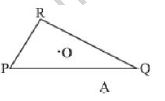
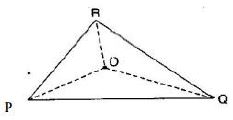
Q.2) Take any point O in the interior of a triangle PQR. Is:
(i) OP + OQ > PQ ?
(ii) OQ + OR > QR ?
(iii) OR + OP > RP ?
Sol.2) Join OR, OQ and OP.
(i) Is OP + OQ > PQ ?
Yes, POQ form a triangle.
(ii) Is OQ + OR > QR ?
Yes, RQO form a triangle.
(iii) Is OR + OP > RP ? P
Yes, ROP form a triangle
Q.3) AM is a median of a triangle ABC. Is AB + BC + CA > 2AM? (Consider the sides of triangles Δ 𝐴𝐵𝑀 and Δ 𝐴𝑀𝐶.)
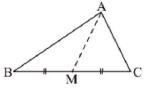
Sol.3) Since, the sum of lengths of any two sides in a triangle should be greater than the length of third side.
Therefore, In Δ 𝐴𝐵𝑀, 𝐴𝐵 + 𝐵𝑀 > 𝐴𝑀 ... (i)
In Δ 𝐴𝑀𝐶, 𝐴𝐶 + 𝑀𝐶 > 𝐴𝑀 ... (ii)
Adding eq. (i) and (ii),
𝐴𝐵 + 𝐵𝑀 + 𝐴𝐶 + 𝑀𝐶 > 𝐴𝑀 + 𝐴𝑀
⇒ 𝐴𝐵 + 𝐴𝐶 + (𝐵𝑀 + 𝑀𝐶) > 2𝐴𝑀
⇒ 𝐴𝐵 + 𝐴𝐶 + 𝐵𝐶 > 2𝐴𝑀
Hence, it is true.
Q.4) ABCD is a quadrilateral. Is 𝐴𝐵 + 𝐵𝐶 + 𝐶𝐷 + 𝐷𝐴 > 𝐴𝐶 + 𝐵𝐷?
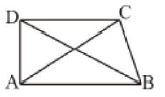
Sol.4) Since, the sum of lengths of any two sides in a triangle should be greater than the length of third side.
Therefore, In Δ 𝐴𝐵𝐶, 𝐴𝐵 + 𝐵𝐶 > 𝐴𝐶 ……….(i)
In Δ 𝐴𝐷𝐶, 𝐴𝐷 + 𝐷𝐶 > 𝐴𝐶 ……….(ii)
In Δ 𝐷𝐶𝐵, 𝐷𝐶 + 𝐶𝐵 > 𝐷𝐵 ……….(iii)
In Δ 𝐴𝐷𝐵, 𝐴𝐷 + 𝐴𝐵 > 𝐷𝐵 ……….(iv)
Adding equations (i), (ii), (iii) and (iv), we get
𝐴𝐵 + 𝐵𝐶 + 𝐴𝐷 + 𝐷𝐶 + 𝐷𝐶 + 𝐶𝐵 + 𝐴𝐷 + 𝐴𝐵 > 𝐴𝐶 + 𝐴𝐶 + 𝐷𝐵 + 𝐷𝐵
⇒ (𝐴𝐵 + 𝐴𝐵) + (𝐵𝐶 + 𝐵𝐶) + (𝐴𝐷 + 𝐴𝐷) + (𝐷𝐶 + 𝐷𝐶) > 2𝐴𝐶 + 2𝐷𝐵
⇒ 2𝐴𝐵 + 2𝐵𝐶 + 2𝐴𝐷 + 2𝐷𝐶 > 2(𝐴𝐶 + 𝐷𝐵)
⇒ 2(𝐴𝐵 + 𝐵𝐶 + 𝐴𝐷 + 𝐷𝐶) > 2(𝐴𝐶 + 𝐷𝐵)
⇒ 𝐴𝐵 + 𝐵𝐶 + 𝐴𝐷 + 𝐷𝐶 > 𝐴𝐶 + 𝐷𝐵
⇒ 𝐴𝐵 + 𝐵𝐶 + 𝐶𝐷 + 𝐷𝐴 > 𝐴𝐶 + 𝐷𝐵
Hence, it is true.
Q.5)` ABCD is quadrilateral. Is 𝐴𝐵 + 𝐵𝐶 + 𝐶𝐷 + 𝐷𝐴 < 2 (𝐴𝐶 + 𝐵𝐷) ?
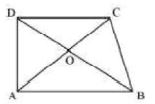
Sol.5) Since, the sum of lengths of any two sides in a triangle should be greater than the length of third side.
Therefore, 𝐼𝑛 Δ 𝐴𝑂𝐵, 𝐴𝐵 < 𝑂𝐴 + 𝑂𝐵 ……….(i)
In Δ 𝐵𝑂𝐶, 𝐵𝐶 < 𝑂𝐵 + 𝑂𝐶 ……….(ii)
In Δ 𝐶𝑂𝐷, 𝐶𝐷 < 𝑂𝐶 + 𝑂𝐷 ……….(iii)
In Δ 𝐴𝑂𝐷, 𝐷𝐴 < 𝑂𝐷 + 𝑂𝐴 ……….(iv)
Adding equations (i), (ii), (iii) and (iv), we get
𝐴𝐵 + 𝐵𝐶 + 𝐶𝐷 + 𝐷𝐴 < 𝑂𝐴 + 𝑂𝐵 + 𝑂𝐵 + 𝑂𝐶 + 𝑂𝐶 + 𝑂𝐷 + 𝑂𝐷 + 𝑂𝐴
⇒ 𝐴𝐵 + 𝐵𝐶 + 𝐶𝐷 + 𝐷𝐴 < 2𝑂𝐴 + 2𝑂𝐵 + 2𝑂𝐶 + 2𝑂𝐷
⇒ 𝐴𝐵 + 𝐵𝐶 + 𝐶𝐷 + 𝐷𝐴 < 2[(𝐴𝑂 + 𝑂𝐶) + (𝐷𝑂 + 𝑂𝐵)]
⇒ 𝐴𝐵 + 𝐵𝐶 + 𝐶𝐷 + 𝐷𝐴 < 2(𝐴𝐶 + 𝐵𝐷)
Hence, it is proved.
Q.6) The lengths of two sides of a triangle are 12 cm and 15 cm. Between what two measures should the length of the third side fall?
Sol.6) Since, the sum of lengths of any two sides in a triangle should be greater than the length of third side.
It is given that two sides of triangle are 12 cm and 15 cm.
Therefore, the third side should be less than 12 + 15 = 27 𝑐𝑚.
And also the third side cannot be less than the difference of the two sides.
Therefore, the third side has to be more than 15 – 12 = 3 𝑐𝑚.
Hence, the third side could be the length more than 3 cm and less than 27 cm.
Exercise 6.5
Q.1) PQR is a triangle right angled at P. If 𝑃𝑄 = 10 𝑐𝑚 and 𝑃𝑅 = 24 𝑐𝑚, find QR.
Sol.1) Given: PQ = 10 cm, PR = 24 cm
Let QR be x cm.
In right angled triangle QPR,
(𝐻𝑦𝑝𝑜𝑡𝑒𝑛𝑢𝑠𝑒)2 = (𝐵𝑎𝑠𝑒)2 + (𝑃𝑒𝑟𝑝𝑒𝑛𝑑𝑖𝑐𝑢𝑙𝑎𝑟)2 [By Pythagoras theorem]
⇒ (𝑄𝑅)2 = (𝑃𝑄)2 + (𝑃𝑅)2
⇒ 𝑥2 = (10)2 + (24)2
⇒ 2𝑥 = 100 + 576 = 676
⇒ 𝑥 = √676 = 26 𝑐𝑚
Thus, the length of QR is 26 𝑐𝑚

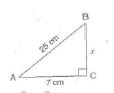
Q.2) ABC is a triangle right angled at C. If 𝐴𝐵 = 25 𝑐𝑚 and 𝐴𝐶 = 7 𝑐𝑚, find 𝐵𝐶.
Sol.2) Given: 𝐴𝐵 = 25 𝑐𝑚, 𝐴𝐶 = 7 𝑐𝑚
Let BC be 𝑥 𝑐𝑚.
In right angled triangle ACB,
(𝐻𝑦𝑝𝑜𝑡𝑒𝑛𝑢𝑠𝑒)2 = (𝐵𝑎𝑠𝑒)2 + (𝑃𝑒𝑟𝑝𝑒𝑛𝑑𝑖𝑐𝑢𝑙𝑎𝑟)2 [By Pythagoras theorem]
⇒ (𝐴𝐵)2 = (𝐴𝐶)2 + (𝐵𝐶)2
⇒ (25)2 = (7)2 + (𝑥)2
⇒ 625 = 49 + 2𝑥
⇒ 2𝑥 = 625 – 49 = 576
⇒ 𝑥 = √576 = 24 𝑐𝑚
Thus, the length of BC is 24 𝑐𝑚.
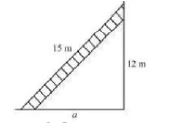
Q.3) A 15 m long ladder reached a window 12 m high from the ground on placing it against a wall at a distance a. Find the distance of the foot of the ladder from the wall.
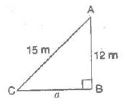
Sol.3) Let AC be the ladder and A be the window.
Given: AC = 15 m, AB = 12 m, CB = a m
In right angled triangle ACB,
(𝐻𝑦𝑝𝑜𝑡𝑒𝑛𝑢𝑠𝑒)2 = (𝐵𝑎𝑠𝑒)2 + (𝑃𝑒𝑟𝑝𝑒𝑛𝑑𝑖𝑐𝑢𝑙𝑎𝑟)2 [By Pythagoras theorem]
⇒ (𝐴𝐶)2 = (𝐶𝐵)2 + (𝐴𝐵)2
⇒ 152 = 𝑎2 + 122
⇒ 225 = 2 𝑎 + 144
⇒ 2 𝑎 = 225 – 144 = 81
⇒ 𝑎 = √81 = 9 𝑐𝑚
Thus, the distance of the foot of the ladder from the wall is 9 m.
Q.4) Which of the following can be the sides of a right triangle?
i) 2.5 cm,6.5 cm, 6 cm.
ii) 2 cm, 2 cm, 5 cm.
iii) 1.5 cm,2cm,2.5 cm
Sol.4) Let us consider, the larger side be the hypotenuse and also using Pythagoras theorem
(𝐻𝑦𝑝𝑜𝑡𝑒𝑛𝑢𝑠𝑒)2 = (𝐵𝑎𝑠𝑒)2 + (𝑃𝑒𝑟𝑝𝑒𝑛𝑑𝑖𝑐𝑢𝑙𝑎𝑟)2 [By Pythagoras theorem]
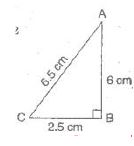
(i) 2.5 cm, 6.5 cm, 6 cm
In Δ𝐴𝐵𝐶,
(𝐴𝐶)2 = (𝐶𝐵)2 + (𝐴𝐵)2
L.H.S. = (6.5)2 = 42.25 𝑐𝑚
R.H.S. = (6)2 + (2.5)2 = 36 + 6.25 = 42.25 𝑐𝑚
Since, L.H.S. = R.H.S.
Therefore, the given sides are of the right angled triangle.
Right angle lies on the opposite to the greater side 6.5 𝑐𝑚, i.e., at B.
(ii) 2 cm, 2 cm, 5 cm
In the given triangle, (5)2 = (2)2 + (2)2
L.H.S. = (5)2 = 25
R.H.S. = (2)2 + (2)2 = 4 + 4 = 8
Since, 𝐿. 𝐻. 𝑆. ≠ 𝑅. 𝐻. 𝑆.
Therefore, the given sides are not of the right angled triangle.
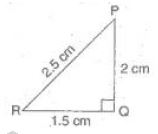
(iii) 1.5 cm, 2 cm, 2.5 cm
In Δ PQR, (𝑃𝑅)2 = (𝑃𝑄)2 + (𝑅𝑄)2
L.H.S. = (2.5)2 = 6.25 𝑐𝑚
R.H.S. = (1.5)2 + (2)2 = 2.25 + 4 = 6.25 𝑐𝑚
Since, L.H.S. = R.H.S.
Therefore, the given sides are of the right angled triangle.
Right angle lies on the opposite to the greater side 2.5 𝑐𝑚, i.e., at Q.
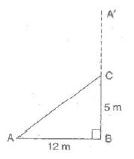
Q.5) A tree is broken at a height of 5 𝑚 from the ground and its top touches the ground at a distance of 12 𝑚 from the Base of the tree. Find the original height of the tree.
Sol.5) Let A’CB represents the tree before it broken at the point C and let the top A’ touches the ground at A after it broke.
Then Δ𝐴𝐵𝐶 is a right angled triangle, right angled at B.
Using Pythagoras theorem, In Δ𝐴𝐵𝐶
(𝐴𝐶)2 = (𝐶𝐵)2 + (𝐴𝐵)2
⇒ (𝐴𝐶)2 = (5)2 + (12)2
⇒ (𝐴𝐶)2 = 25 + 144
⇒ (𝐴𝐶)2 = 169
⇒ 𝐴𝐶 = 13 𝑚
Hence, the total height of the tree = 𝐴𝐶 + 𝐶𝐵 = 13 + 5 = 18 𝑚.
Q.6) Angles Q and R of a Δ 𝑃𝑄𝑅 are 25° and 65°. Write which of the following is true :
i) 𝑃𝑅2 + 𝑄𝑅2 = 𝑅𝑃2 ii) 𝑃𝑄2 + 𝑅𝑃2 = 𝑄𝑅2 iii) 𝑅𝑃2 + 𝑄𝑅2 = 𝑃𝑄2
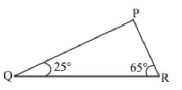
Sol.6) In Δ 𝑃𝑄𝑅,
∠ 𝑃𝑄𝑅 + ∠ 𝑄𝑅𝑃 + ∠ 𝑅𝑃𝑄 = 180° [By Angle sum property of a Δ]
⇒ 25° + 65° + ∠𝑅𝑃𝑄 = 180°
⇒ 90° + ∠ 𝑅𝑃𝑄 = 180°
⇒ ∠ 𝑅𝑃𝑄 = 180° − 90° = 90°
Thus, Δ PQR is a right angled triangle, right angled at P.
(𝐻𝑦𝑝𝑜𝑡𝑒𝑛𝑢𝑠𝑒)2 = (𝐵𝑎𝑠𝑒)2 + (𝑃𝑒𝑟𝑝𝑒𝑛𝑑𝑖𝑐𝑢𝑙𝑎𝑟)2 [By Pythagoras theorem]
⇒ (𝑄𝑅)2 = (𝑃𝑅)2 + (𝑄𝑃)2
Hence, Option (ii) is correct
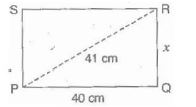
Q.7) Find the perimeter of the rectangle whose length is 40 cm and a diagonal is 41 cm.
Sol.7) Given diagonal (𝑃𝑅) = 41 𝑐𝑚, length (𝑃𝑄) = 40 𝑐𝑚
Let breadth (QR) be x cm.
Now, in right angled triangle PQR,
(𝑃𝑅)2 = (𝑅𝑄)2 + (𝑄𝑃)2 [By Pythagoras theorem]
⇒ 412 = 𝑥2 + 402
⇒ 1681 = 𝑥2 + 1600
⇒ 𝑥2 = 1681 – 1600
⇒ 𝑥2 = 81
⇒ 𝑥 = √ 81 = 9 𝑐𝑚
Therefore, the breadth of the rectangle is 9 𝑐𝑚.
Perimeter of rectangle = 2(𝑙𝑒𝑛𝑔𝑡ℎ + 𝑏𝑟𝑒𝑎𝑑𝑡ℎ) = 2 (9 + 49) = 2 × 49 = 98 𝑐𝑚
Hence, the perimeter of the rectangle is 98 cm.
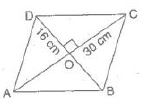
Q.8) The diagonals of a rhombus measure 16 cm and 30 cm. Find its perimeter.
Sol.8) Given: Diagonals 𝐴𝐶 = 30 𝑐𝑚 and 𝐷𝐵 = 16 𝑐𝑚.
Since the diagonals of the rhombus bisect at right angle to each other.
Therefore, 𝑂𝐷 = 𝐷𝐵/2 = 16/2 = 8 𝑐𝑚
And 𝑂𝐶 = 𝐴𝐶/2 = 30/2 = 15 𝑐𝑚
Now, In right angle triangle 𝐷𝑂𝐶,
(𝐷𝐶)2 = (𝑂𝐶)2 + (𝑂𝐷)2 [By Pythagoras theorem]
⇒ (𝐷𝐶)2 = (8)2 + (15)2
⇒ (𝐷𝐶)2 = 64 + 225
⇒ 𝐷𝐶 = √289 = 17 𝑐𝑚
Perimeter of rhombus = 4 × 𝑠𝑖𝑑𝑒 = 4 × 17 = 68 𝑐𝑚
Thus, the perimeter of rhombus is 68 𝑐𝑚.
Free study material for Mathematics
NCERT Solutions for Class 7 Mathematics Chapter 06 Triangle and its properties
Accessing Chapter 06 Triangle and its properties Solutions
Access structured NCERT textbook solutions for Chapter 06 Triangle and its properties. Designed in alignment with the latest academic curriculum for Class 7 Mathematics, these answers cover all end-of-chapter exercises to support daily learning and homework completion.
Concept-Driven Answers for Class 7 Mathematics
Clear, methodical explanations accompany every challenging problem within the Class 7 Mathematics text. Engaging with these detailed answers lays a solid foundation for advanced learning and improves foundational clarity for upcoming assessments.
Maximizing Study Efficiency
Consistent practice with these solution guides cultivates faster problem-solving habits and clearer logical structuring. For a complete preparation experience, pair these textbook answers with our dedicated revision notes and sample papers for Class 7 Mathematics.
FAQs
The complete and updated NCERT Solutions Class 7 Mathematics Chapter 6 Triangle and its properties is available for free on StudiesToday.com. These solutions for Class 7 Mathematics are as per latest NCERT curriculum.
Yes, our experts have revised the NCERT Solutions Class 7 Mathematics Chapter 6 Triangle and its properties as per 2026 exam pattern. All textbook exercises have been solved and have added explanation about how the Mathematics concepts are applied in case-study and assertion-reasoning questions.
Toppers recommend using NCERT language because NCERT marking schemes are strictly based on textbook definitions. Our NCERT Solutions Class 7 Mathematics Chapter 6 Triangle and its properties will help students to get full marks in the theory paper.
Yes, we provide bilingual support for Class 7 Mathematics. You can access NCERT Solutions Class 7 Mathematics Chapter 6 Triangle and its properties in both English and Hindi medium.
Yes, you can download the entire NCERT Solutions Class 7 Mathematics Chapter 6 Triangle and its properties in printable PDF format for offline study on any device.