

NCERT Solutions for Class 7 Mathematics: Chapter 13 Exponents and Power
Review structured textbook solutions for Class 7 Mathematics Chapter 13 Exponents and Power. Built according to NCERT guidelines for the 2026-27 academic year, these downloadable answers support daily revision and problem-solving accuracy.
Practice Class 7 Mathematics Solutions: Chapter 13 Exponents and Power
View or download the dedicated Chapter 13 Exponents and Power solution resource below. Engaging with these textbook answers under focused study conditions ensures continuous academic progress and mastery of the 2026-27 curriculum for Mathematics.
Exercise 13.1
Q.1) Find the value of:
(i) 26 (ii) 93 (iii) 112 (iv) 54
Sol.1) (i) 26
2 × 2 × 2 × 2 × 2 × 2 = 64
(ii) 93
9 × 9 × 9 = 729
(iii) 112
11 × 11 = 121
(iv) 54
5 × 5 × 5 × 5 = 65
Q.2) Express the following in exponential form:
(i) 6 × 6 × 6 × 6 (ii) 𝑡 × 𝑡 (iii) b × b × b × b (iv) 5 × 5 × 7 × 7 × 7
(v) 2 × 2 × a × a (vi) a × a × a × c × c × c × c × 𝑑
Sol.2) (i) 6 × 6 × 6 × 6
64
(ii) 𝑡 × 𝑡
𝑡2
(iii) b × b × b × b
b4
(iv) 5 × 5 × 7 × 7 × 7
52 × 73
(v) 2 × 2 × a × a
22 × a2
(vi) a × a × a × c × c × c × c × 𝑑
c3 × c4 × 𝑑
Q.3) Express each of the following numbers using exponential notation:
(i) 512 (ii) 343 (iii) 729 (iv) 3125
Sol.3) i) 512
= 2 × 2 × 2 × 2 × 2 × 2 × 2 × 2 × 2 = 29
(ii) 343
= 7 × 7 × 7 = 73
(iii) 729
= 3 × 3 × 3 × 3 × 3 × 3 = 36
(iv) 3125
= 5 × 5 × 5 × 5 × 5 = 55
Q.4) Identify the greater number, wherever possible, in each of the following:
(i) 43 and 34 (ii) 53 or 35 (iii) 28 or 82
(iv) 1002 or 2100 (v) 210 or 102
Sol.4) (i) 43 and 34
43 = 4 × 4 × 4 = 64
34 = 3 × 3 × 3 × 3 = 81
Since 64 < 81
Hence, 43 < 34
Thus, 34 is greater than 43.
(ii) 53 or 35
53 = 5 × 5 × 5 = 125
35 = 3 × 3 × 3 × 3 × 3 = 243
Hence, 53 < 35
Since, 125 < 243
Thus, 35 is greater than 53.
(iii) 28 or 82
28 = 2 × 2 × 2 × 2 × 2 × 2 × 2 × 2 = 256
82 = 8 × 8 = 64
Hence, 28 > 82
Since, 256 > 64 Thus, 28is greater than 82.
(iv) 1002 or 2100
= 100 × 100 = 10,000
= 2 × 2 × 2 × 2 × 2 × … . .14 t𝑖m𝑒𝑠 × … × 2 = 16,384 × … . .× 2
Since, 10,000 < 16,384 × … . .× 2
Thus, 2100is greater than 1002.
(v) 210 or 102
= 2 × 2 × 2 × 2 × 2 × 2 × 2 × 2 × 2 × 2 = 1024
= 10 × 10 = 100
Since, 1,024 > 100
Thus, 210 > 102
Q.5) Express each of the following as product of powers of their prime factors:
(i) 648 (ii) 405 (iii) 540 (iv) 3,600
Sol.5) (i) 648
= 2 × 2 × 2 × 2 × 3 × 3 × 3
= 24 × 33
(ii) 405
= 3 × 3 × 3 × 3 × 5
= 34 × 5
(iii) 540
= 2 × 2 × 3 × 3 × 3 × 5
= 22 × 33 × 5
(iv) 3,600
= 2 × 2 × 2 × 2 × 3 × 3 × 5 × 5
= 24 × 32 × 52
Q.6) Simplify:
(i) 2 × 10³ (ii) 72 × 22 (iii) 23 × 5 (iv) 3 × 44
(v) 0 × 102 (vi) 52 × 33 (vii) 24 × 32 (viii) 32 × 104
Sol.6) i) 2 × 103
= 2 × 10 × 10 × 10
= 2 × 1000 = 2000
(ii) 72 × 22
= 7 × 7 × 2 × 2 = 196
(iii) 23 × 5
= 2 × 2 × 2 × 5 = 40
(iv) 3 × 44
= 3 × 4 × 4 × 4 × 4 = 768
(v) 0 × 102
= 0 × 10 × 10 = 0
(vi) 52 × 33
= 5 × 5 × 3 × 3 × 3 = 675
(vii) 24 × 32
= 2 × 2 × 2 × 2 × 3 × 3 = 144
(viii) 32 × 104
= 3 × 3 × 10 × 10 × 10 × 10 = 90,000
Q.7) Simplify:
i) (−4)3
ii) (−3) × (−2)3
iii) (−3)2 × (−5)2
iv) (−2)3 × (−10)3
Sol.7) i) (−4)3
= (−4) × (−4) × (−4) = −64
ii) (−3) × (−2)3
= (−3) × (−2) × (−2) = 24
iii) (−3)2 × (5)2
= (−3) × (−3) × (−5) × (−5) = 225
iv) (−2)3 × (−10)3
= (−2) × (−2) × (−2) × (−10) × (−10) × (−10) = 8000
Q.8) Compare the following numbers:
(i) 2.7 × 10¹²; 1.5 × 10⁸ (ii) 4 × 10¹⁴; 3 × 10¹⁷
Sol.8) (i) 2.7 × 10¹²; 1.5 × 10⁸
because exponent on 10 is larger in case of first number
On comparing the exponents of base 10,
2.7 × 10¹² > 1.5 × 10⁸
(ii) 4 × 10¹⁴; 3 × 10¹⁷
because exponent on 10 is smaller in case of first number.
On comparing the exponents of base 10
4 × 10¹⁴ < 3 × 10¹⁷
Exercise 13.2
Q.1) Using laws of exponents, simplify and write the answer in exponential form:
(i) 32 × 34 × 38 (ii) 615 ÷ 610 (iii) a3 × a2 (iv) 7𝑥 × 72
(v) (52)3 × 53 (vi) 25 × 55 (vii) a4 × b4 (viii) (34)3
(ix) (220 ÷ 215) × 23 (x) 8t ÷ 82
Sol.1) (i) 32 × 34 × 38 = (3)2+4+8 (am × an = am+n)
= 314
(ii) 615 ÷ 610 = (6)15−10 (am ÷ an = am−n)
= 65
(iii) a3 × a2 = a(3+2) (am × an = am+n)
= a5
(iv) 7x × 72 = 7𝑥+2 (am × an = am+n)
(v) (52)3 ÷ 53
= 52×3 ÷ 53 (am)n = amn
= 56 ÷ 53 (am ÷ an = am−n)
= 56−3 (am ÷ an = am−n)
= 53
(vi) 25 × 55
= (2 × 5)5 [am × bm = (a × b) m ]
= 105
(vii) a4 × b4
= (ab)4 [am × bm = (a × b) m ]
(viii) (34)3 = 34×3 = 312 (am)n = amn
(ix) (220 ÷ 215) × 23
= (220−15) × 23 (am ÷ an = am−n)
= 25 × 23
= (25+3) = 28 (am × an = am+n)
(x) 8t ÷ 82 = 8t−2 (am ÷ an = am−n)
Q.2) Simplify and express each of the following in exponential form:
i) 23×34×4/3×32 ii) [(52)3 × 54] ÷ 57 iii) 254 ÷ 53 iv) 3×72×118/21×11
v) 37/34×33 vi) 20 + 30 + 40 vii) 20 × 30 × 40 viii) (30 + 20) × 50
ix) 28×α5/43×α3 x) ( α5/α3) × α8 xi) 45×α8b3/45×α5b2 xii) (23 × 2)2
Sol.2) i) 23×34×4/3×32
= 23×34×22/3×25 = 23+2×34/3×52 [αm × α𝑛 = αm+𝑛]
= 25×34/3×25 = 25−5 × 34−3 [αm ÷ α𝑛 = αm−𝑛]
= 20 × 33 = 1 × 33 = 33
ii) [(52)3 × 54] ÷ 57
= [56 × 54] ÷ 57 [(αm)𝑛 = αm×𝑛]
= [56+4] ÷ 57 [αm × α𝑛 = αm+𝑛]
= 510 ÷ 57
= 510−7 = 53 [αm ÷ α𝑛 = αm−𝑛]
iii) 254 ÷ 53
= (52)4 ÷ 53 = 58 ÷ 53 [(αm)𝑛 = αm×𝑛]
= 58−3 = 55 [αm ÷ α𝑛 = αm−𝑛]
iv) 3×72×118/21×11
= 3×72×118/3×7×113
= 31−1 × 72−1 × 118−3 [αm ÷ α𝑛 = αm−𝑛]
= 30 × 71 × 115 = 7 × 115
v) 37/34×33 = 37
34+3 = 37/37 [αm × α𝑛 = αm+𝑛]
= 37−7 = 30 = 1 [αm ÷ α𝑛 = αm−𝑛]
vi) 20 + 30 + 40 [α0 = 1]
= 1 + 1 + 1 = 3
vii) 20 × 30 × 40 [α0 = 1]
= 1 × 1 × 1 = 1
viii) (30 + 20) × 50 [α0 = 1]
= (1 + 1) × 1 = 2 × 1 = 2
ix) 28×α5/43×α3
= 28×α5/(22)3×α3 = 28×α5/26×α3 [(αm)𝑛 = αm×𝑛]
= 28−6 × α5−2 = 22 × α2 [αm ÷ α𝑛 = αm−𝑛]
= (2α)2 [αm × b𝑚 = (α × b)𝑚]
x) (α5/α3) × α8
= (α5−3) × α8 = α2 × α8 [αm ÷ α𝑛 = αm−𝑛]
= α2+8 = α10 [αm × α𝑛 = αm+𝑛]
xi) 45×α8b3/45×α5b2
= 45−5 × α8−5 × b3−2 = 40 × α3 × b [αm ÷ α𝑛 = αm−𝑛]
= 1 × α3 × b = α3b [α0 = 1]
xii) (23 × 2)2
= (23+1)2 = (24)2 [αm × α𝑛 = αm+𝑛]
= 24×2 = 28
Q.3) Say true or false and justify your answer:
i) 10 × 1011 = 10011 ii) 23 > 52 iii) 23 × 32 = 65 iv) 30 = (1000)0
Sol.3) i) 10 × 1011 = 10011
LHS 101+11 = 1012 and RHS (102)11 = 1022
False, because first number will have 12 zeroes while the second number will have 22 zeroes at
the end.
Since, 𝐿𝐻𝑆 ≠ 𝑅𝐻𝑆
∴ given statement is false.
ii) 23 > 52
LHS 23 = 8 and RHS 52 = 25
Since, 𝐿𝐻𝑆 ≠ 𝑅𝐻𝑆
False, because first number is 8 while second number is 25.
∴ given statement is false.
iii) 23 × 32 = 65
LHS 23 × 32 = 8 × 9 = 72 and RHS 65 = 7,776
Since, LHS is not greater than RHS
∴ given statement is false.
iv) 30 = (1000)0
LHS 30 = 1 and RHS (1000)0 = 1
Since, 𝐿𝐻𝑆 = 𝑅𝐻𝑆
True, because both are equal to 1.
∴ given statement is true.
Q.4) Express each of the following as a product of prime factors only in exponential form:
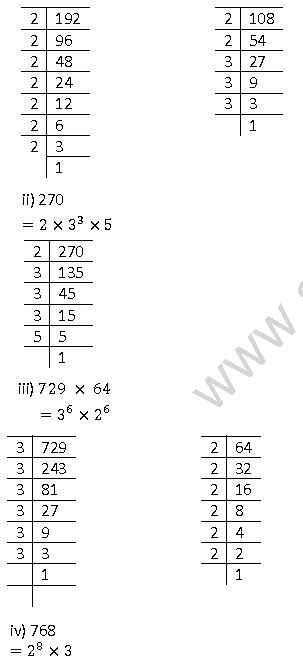
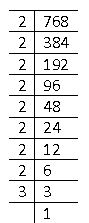
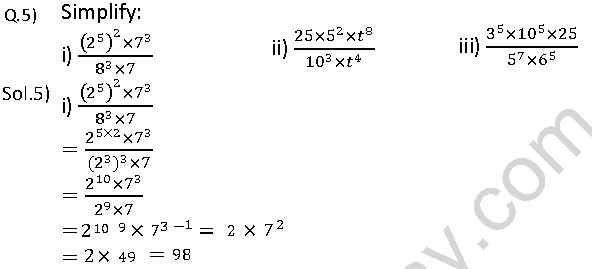
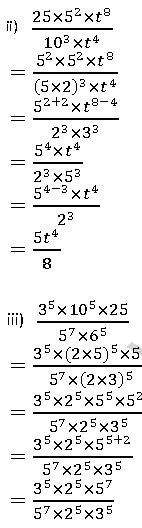
i) 108 × 192 ii) 270 iii) 729 × 64 iv) 768
Sol.4) i) 108 × 192
= (22 × 33) × (26 × 3)
= 22+6 × 33+1
= 28 × 34
= 25−5 × 35−5 × 55−5
= 20 × 30 × 3^ 0
= 1 × 1 × 1 = 1
Exercise 13.3
Q.1) Write the following numbers in the expanded forms :
279404, 3006194, 2806196, 120719, 20068
Sol.1) (i) 2,79,404
= 2,00,000 + 70,000 + 9,000 + 400 + 00 + 4
= 2 × 100000 + 7 × 10000 + 9 × 1000 + 4 × 100 + 0 × 10 + 4 × 1
= 2 × 10⁵ + 7 × 10⁴ + 9 × 10³ + 4 × 10² + 0 × 101 + 4 × 100
(ii) 30,06,194
= 30,00,000 + 0 + 0 + 6,000 + 100 + 90 + 4
= 3 × 1000000 + 0 × 100000 + 0 × 10000 + 6 × 1000 + 1 × 100 + 9 × 10 + 4 × 1
= 3 × 10⁶ + 0 × 105 + 0 × 104 + 6 × 10³ + 1 × 10² + 9 × 10 + 4 × 100
(iii) 28,06,196
= 20,00,000 + 8,00,000 + 0 + 6,000 + 100 + 90 + 6
= 2 × 1000000 + 8 × 100000 + 0 × 10000 + 6 × 1000 + 1 × 100 + 9 × 10 + 6 × 1
= 2 × 10⁶ + 8 × 10⁵ + 0 × 104 + 6 × 10³ + 1 × 10² + 9 × 10 + 6 × 100
(iv) 1,20,719
= 1,00,000 + 20,000 + 0 + 700 + 10 + 9
= 1 × 100000 + 2 × 10000 + 0 × 1000 + 7 × 100 + 1 × 10 + 9 × 1
= 1 × 10⁵ + 2 × 10⁴ + 0 × 103 + 7 × 10² + 1 × 101 + 9 × 100
(v) 20,068
= 20,000 + 00 + 00 + 60 + 8
= 2 × 10000 + 0 × 1000 + 0 × 100 + 6 × 10 + 8 × 1
= 20 × 104 + 0 × 103 + 0 × 102 + 6 × 101 + 8 × 100
Q.2) Find the number from each of the following expanded forms :
i) 8 × 10⁴ + 6 × 10³ + 0 × 102 + 4 × 101 + 5 × 100
ii) 4 × 10⁵ + 5 × 10⁴ + 3 × 10² + 2 × 100
iii) 3 × 10⁴ + 7 × 10² + 5 × 100
iv) 9 × 10⁵ + 2 × 10² + 3 × 101
Sol.2) i) 8 × 10⁴ + 6 × 10³ + 0 × 102 + 4 × 101 + 5 × 100
= 8 × 10000 + 6 × 1000 + 0 × 100 + 4 × 10 + 5 × 1
= 80000 + 6000 + 0 + 40 + 5
= 86,045
ii) 4 × 10⁵ + 5 × 10⁴ + 3 × 10² + 2 × 100
= 4 × 100000 + 0 × 10000 + 5 × 1000 + 3 × 100 + 0 × 10 + 2 × 1
= 400000 + 0 + 5000 + 3000 + 0 + 2
= 4,05,302
iii) 3 × 10⁴ + 7 × 10² + 5 × 100
= 3 × 10000 + 0 × 1000 + 7 × 100 + 0 × 10 + 5 × 1
= 30000 + 0 + 700 + 0 + 5
= 30,705
iv) 9 × 10⁵ + 2 × 10² + 3 × 101
= 9 × 100000 + 0 × 10000 + 0 × 1000 + 2 × 100 + 3 × 10 + 0 × 1
= 900000 + 0 + 0 + 200 + 30 + 0
= 9,00,230
Q.3) Express the following numbers in standard form:
(i) 5,00,00,000 (ii) 70,00,000 (iii) 3,18,65,00,000
(iv) 3,90,878 (v) 39087.8 (vi) 3908.78
Sol.3) (i) 5,00,00,000 = 5 × 1,00,00,000 = 5 × 10⁷
(ii) 70,00,000 = 7 × 10,00,000 = 7 × 10⁶
(iii) 3,18,65,00,000 = 31865 × 100000
= 3.1865 × 10000 × 100000 = 3.1865 × 10⁹
(iv) 3,90,878 = 3.90878 × 100000 = 3.90878 × 10⁵
(v) 39087.8 = 3.90878 × 10000 = 3.90878 × 10⁴
(vi) 3908.78 = 3.90878 × 1000 = 3.90878 × 10³
Q.4) Express the number appearing in the following statements in standard form:
(a) The distance between Earth and Moon is 384,000,000 m.
(b) Speed of light in vacuum is 300,000,000 m/s. (c) Diameter of Earth id 1,27,56,000 m.
(d) Diameter of the Sun is 1,400,000,000 m. (e) In a galaxy there are on an average
100,000,000,0000 stars.
(f) The universe is estimated to be about 12,000,000,000 years old.
(g) The distance of the Sun from the centre of the Milky Way Galaxy is estimated to be
300,000,000,000,000,000,000 m.
(h) 60,230,000,000,000,000,000,000 molecules are contained in a drop of water weighing 1.8
gm.
(i) The Earth has 1,353,000,000 cubic km of sea water.
(j) The population of India was about 1,027,000,000 in march, 2001.
Sol.4) (a) The distance between Earth and Moon
= 384,000,000 m = 384 × 1000000 m
= 3.84 × 100 × 1000000 = 3.84 × 10⁸ m
(b) Speed of light in vacuum
= 300,000,000 m/s = 3 × 100000000 m/s
= 3 × 10⁸ m/s
(c) Diameter of the Earth
= 1,27,56,000 m = 12756 × 1000 m
= 1.2756 × 10000 × 1000 m = 1.2756 × 10⁷ m
(d) Diameter of the Sun
= 1,400,000,000 m = 14 × 100,000,000 m
= 1.4 × 10 × 100,000,000 m = 1.4 × 10⁹ m
(e) Average of Stars
= 100,000,000,000 = 1 × 100,000,000,000
= 1 × 10¹¹
(f) Years of Universe
= 12,000,000,000 years = 12 × 1000,000,000 years
= 1.2 × 10 × 1000,000,000 years = 1.2 × 10¹⁰ years
(g) Distance of the Sun from the center of the Milky Way Galaxy
= 300,000,000,000,000,000,000 m
= 3 × 100,000,000,000,000,000,000 m
= 3 × 10²⁰ m
(h) Number of molecules in a drop of water weighing 1.8 𝑔m
= 60,230,000,000,000,000,000,000 = 6023 × 10,000,000,000,000,000,000
= 6.023 × 1000 × 10,000,000,000,000,000,000 = 6.023 × 10²²
(i) The Earth has Sea water
= 1,353,000,000 km3 = 1,353 × 1000000 km3
= 1.353 × 1000 × 1000,000 km3 = 1.353 × 10⁹ km3
(j) The population of India
= 1,027,000,000 = 1027 × 1000000
= 1.027 × 1000 × 1000000
= 1.027 × 10⁹
Free study material for Mathematics
Free NCERT Textbook Explanations: Class 7 Mathematics Chapter 13 Exponents and Power
Official NCERT Solutions for Chapter 13 Exponents and Power
Access structured NCERT textbook solutions for Chapter 13 Exponents and Power. Designed in alignment with the latest academic curriculum for Class 7 Mathematics, these answers cover all end-of-chapter exercises to support daily learning and homework completion.
Step-by-Step Explanations for Chapter 13 Exponents and Power
Beyond providing final answers, these guides offer step-by-step breakdowns for complex queries in the Class 7 Mathematics module. This approach helps students balance theoretical depth with practical problem-solving skills required for NCERT exams.
Next Steps in Your Mathematics Revision
Consistent practice with these solution guides cultivates faster problem-solving habits and clearer logical structuring. For a complete preparation experience, pair these textbook answers with our dedicated revision notes and sample papers for Class 7 Mathematics.
FAQs
The complete and updated NCERT Solutions Class 7 Mathematics Chapter 13 Exponents and Power is available for free on StudiesToday.com. These solutions for Class 7 Mathematics are as per latest NCERT curriculum.
Yes, our experts have revised the NCERT Solutions Class 7 Mathematics Chapter 13 Exponents and Power as per 2026 exam pattern. All textbook exercises have been solved and have added explanation about how the Mathematics concepts are applied in case-study and assertion-reasoning questions.
Toppers recommend using NCERT language because NCERT marking schemes are strictly based on textbook definitions. Our NCERT Solutions Class 7 Mathematics Chapter 13 Exponents and Power will help students to get full marks in the theory paper.
Yes, we provide bilingual support for Class 7 Mathematics. You can access NCERT Solutions Class 7 Mathematics Chapter 13 Exponents and Power in both English and Hindi medium.
Yes, you can download the entire NCERT Solutions Class 7 Mathematics Chapter 13 Exponents and Power in printable PDF format for offline study on any device.