

NCERT Solutions for Class 11 Biology: Chapter 04 Animal Kingdom
Review structured textbook solutions for Class 11 Biology Chapter 04 Animal Kingdom. Built according to NCERT guidelines for the 2026-27 academic year, these downloadable answers support daily revision and problem-solving accuracy.
Practice Class 11 Biology Solutions: Chapter 04 Animal Kingdom
Navigate directly to the solved Biology textbook exercises using the digital viewer below. Each solution includes detailed step-by-step explanations, allowing students to instantly cross-check their work and identify areas requiring further revision.
NCERT Solutions for Class 11 Biology for Chapter 4 Animal Kingdom
1. What are the difficulties that you would face in classification of animals, if common fundamental features are not taken into account?
Answer: The present form of classification starts with grouping organisms based on broad common fundamental features like arrangement of cells, body symmetry, nature of coelom, patterns of digestive, circulatory or reproductive systems. If these features are not taken into account, the animals will be classified
wrongly and
There will be no phylogenetic relationship between the classified groups. For example, if birds and bats are classified in one group on the basis of the ability to fly, it will result in wrong classification as they are completely different organisms.
Millions of organisms have been discovered to date and there are still more to be discovered. With this humungous number of varied forms of organisms it becomes imperative to classify them by common fundamental features based on morphological, anatomical and genetic features thereby resulting in a classification which shows the phylogenetic relationship.
2. If you are given a specimen, what are the steps that you would follow to classify it?
Answer: Taxonomy is the study of principles and procedures of classification. Classification is the arrangement of living things according to their similarities and differences which bring order in the vast assemblage of living things in the world. A specimen can be classified in a step wise process using the following classification categories:
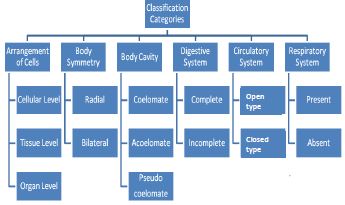
3. How useful is the study of the nature of body cavity and coelom in the classification of animals?
Answer: Coelom is a fluid filled cavity formed between the gut wall and the body wall lined by the mesodermal cells. Presence or absence of coelom is an important criterion for animal classification. The animals with bilateral symmetry are further classified into three types of groups based on the presence or absence of coelom. They are as follows:
a) Coelomates: In these animals true coelom lined by mesoderm is present e.g. Annelids, Arthropoda, Mollusca, Echinodermata, Hemichordata, Chordata.
b) Pseudocoelomates: In these animals the body cavity is not lined by mesoderm instead the mesoderm is present in scattered pouches between the ectoderm and the endoderm g. Aschelminthes.
c) Acoelomates: In these animals body cavity is absent e.g. Platyhelminthes.
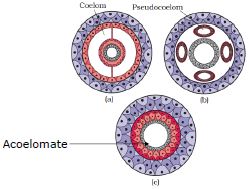
Figure: Three types of body cavity: (a)True coelom as seen in coelomates, (b)Patches of coelom between the ectoderm and the endoderm as seen in pseudocoelomates& (c)Mesodermal cells present but no body cavity as seen in acoelomates
Ref: NCERT Biology, Textbook for Class XI, Chapter-4, Animal Kingdom, Page no. 48.
4. Distinguish between intracellular and extracellular digestion?
Answer:
|
Intracellular digestion |
Extracellular digestion |
|
Digestion which takes place within the cytoplasm of the organism. There is no alimentary canal. |
Digestiontakes place in the alimentary canal of the animal. |
|
Digestive enzymes are secreted in the food vacuoles. |
Digestive enzymes are secreted in the cavity of alimentary canal. |
|
It is not a very efficient process. |
Process is very efficient. |
|
Most organisms that use intracellular digestion belong to Kingdom Protista, such as amoeba and paramecium. Simple multicellular animals that belong to the phylum porifera (sponges) also show intracellular digestion. |
All multicellular organisms except sponges show extracellular form of digestion e.g. annelids, crustaceans, arthropods, and chordates. |
5. What is the difference between direct and indirect development?
Answer:
|
Indirect development |
Direct development |
|
Has a larval stage which is morphologically distinct from the adult. |
Larval stage is absent, the embryo develops into a mature organism (looks like a miniature adult) without entering into the larval stage. |
|
A process called metamorphosis transforms the larva into a mature adult. |
Metamorphosis is absent. |
|
Found in invertebrates and amphibians. |
Found in fishes, reptiles and mammals. |
6. What are the peculiar features that you find in parasitic platyhelminthes?
Answer: The peculiar features of parasitic platyhelminthes are as follows:
a)Hooks and suckers are present to attach to the wall of the gut
b)They have an extra coating (of glycocalyx) to protect themselves from being digested in the gut.
c) They absorb nutrients from the host directly through their body surface.Their digestive systems are less evolved as compared to the free living platyhelminthe
d)Locomotory organs like cilia and sensory organs like the primitive eye are absent in the parasitic forms of flat worms.
e)Parasitic flat worms are mostly hermaphrodite ensuring reproduction in the host. The reproductive capacity is enhanced with most of their body lumen packed with testes and eggs.
Click here to get ncert solutions for class 11 biology free download pdf.
7. What are the reasons that you can think of for the arthropods to constitute the largest group of the animal kingdom?
Answer: Arthropoda is the largest phylum of animal kingdom. Over two-thirds of all known species on earth are arthropods. The following are the reasons for arthropods to constitute the largest group of the animal kingdom:
a. Arthropods are very diverse in structure and form.
b. The diversity in form is responsible for their dispersion into varied habitats. Arthropods are known to inhabit the ocean depths to the tallest mountain peaks.
c. Their hard exoskeleton made of chitin is tough and protects the animal from extreme dryness. The exoskeleton is also insoluble in water and weak alkaline and acidic solution
d. They have joint appendages that allows for efficient and precise movements. Many appendages are modified to meet the need of the arthropod for a specific foraging behavior or a habitat.
e. Their reproductive cycle is short and the female lays numerous eggs at one time.
8. Water vascular system is the characteristic of which group of the following:
(a) Porifera
(b) Ctenophora
(c) Echinodermata
(d) Chordata
Answer: Water vascular system is the characteristic of Echinodermata.
9. “All vertebrates are chordates but all chordates are not vertebrates”. Justify the statem
Answer: To understand the above statement, one needs to define the two words – notochord and vertebra – from which the terms chordates and vertebrates are derived, respectively.
Notochord: The notochord is a flexible rod-shaped structure found in embryos of all chordates.
Vertebral column: The vertebral column, also known as backbone or spine, is a bony structure found in vertebrates. It is formed from individual bones called vertebrae.
Chordata is a phylum which is divided into three sub phyla - Urochordata, Cephalochordata and Vertebrata. All the chordates at some point of their lives possess a notochord. However, in vertebrates, this notochord is replaced by the vertebral column in the adult stage. Hence it is right to state that “All vertebrates are chordates but all chordates are not vertebrates”.
10. How important is the presence of air bladder in Pisces?
Answer: Air bladder/ swim bladder is a sac filled with air that regulates buoyancy in fishes. It plays a very important role in Pisces. The fishes (like Osteichthyes) where air bladder is present, it plays the following roles:
The air bladder controls the buoyancy by enabling the fish to stay at a particular water depth without having to waste energy in swimming continously.
It acts as a resonating chamber to produce or receive sound.
In another kind of fishes (like Chondrichthyes), air bladder is absent. Therefore these fishes have to swim constantly to avoid sinking resulting in consumption of lot of energy.
11. What are the modifications that are observed in birds that help them fly?
Answer: Some of the modifications that help birds to fly are listed below:
a)The forelimbs are modified into wings
b)Birds have feathers that helps them fly, steer and balance
c)Long bones are hollow with air cavities making their body weight light
d)Birds have air sacs that connect to the lungs and provide them with additional oxygen which is essential for flying
e)Birds have well developed eye sight and brains that help them gauge any approaching danger as well as to forage for food.
12. Could the number of eggs or young ones produced by an oviparous and viviparous mother be equal? Why?
Answer: An oviparous mother lays more eggs at one time as compared to the number of offspring a viviparous mother gives birth to at any given time. This is because of the following reasons:
In oviparous mother, the eggs are laid soon after fertilization, or eggs are externally fertilized. Therefore many eggs can be laid at one time. This also provides evolutionary advantage as many eggs are liable to be eaten, destroyed during the period of development.
In the case of the viviparous mother, she has to house the embryo in the uterus till the full term of development. The embryo also draws nutrition from its mother. The mother thus is constrained by space in the uterus.
13. Segmentation in the body is first observed in which of the following:
(a) Platyhelminthes
(b) Aschelminthes
(c) Annelida
(d) Arthropoda
Answer: (c)Annelida.
14. Match the following:
(i) Operculum (a) Ctenophora
(ii) Parapodia (b) Mollusca
(iii) Scales (c) Porifera
(iv) Comb plates (d) Reptilia
(v) Radula (e) Annelida
(vi) Hair (f) Cyclostomata and Chondrichthyes
(vii) Choanocytes (g) Mammalia
(viii) Gill slits (h) Osteichthyes
Answer:
|
(i) Operculum |
(h) Osteichthyes |
|
(ii) Parapodia |
(e) Annelida |
|
(iii) Scales |
(d) Reptilia |
|
(iv) Comb plates |
(a) Ctenophora |
|
(v) Radula |
(b) Mollusca |
|
(vi) Hair |
(g) Mammalia |
|
(vii) Choanocytes |
(c) Porifera |
|
(viii) Gill slits |
(f) Cyclostomata and Chondrichtyes |
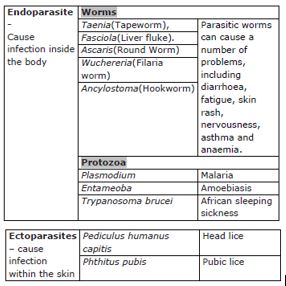
15. Prepare a list of some animals that are found parasitic on human beings?
Answer:
Free study material for Biology
NCERT Solutions for Class 11 Biology Chapter 04 Animal Kingdom
Textbook Solutions for Class 11 Biology Chapter 04 Animal Kingdom
Access structured NCERT textbook solutions for Chapter 04 Animal Kingdom. Designed in alignment with the latest academic curriculum for Class 11 Biology, these answers cover all end-of-chapter exercises to support daily learning and homework completion.
Mastering Theoretical and Practical Questions
Beyond providing final answers, these guides offer step-by-step breakdowns for complex queries in the Class 11 Biology module. This approach helps students balance theoretical depth with practical problem-solving skills required for NCERT exams.
Effective Self-Study and Homework Assistance
Frequent review of these structured answers builds strong analytical capabilities and response efficiency. Maximize your academic readiness by combining these textbook solutions with our curated study materials and mock evaluations for Class 11 Biology.
FAQs
The complete and updated NCERT Solutions Class 11 Biology Chapter 4 Animal Kingdom is available for free on StudiesToday.com. These solutions for Class 11 Biology are as per latest NCERT curriculum.
Yes, our experts have revised the NCERT Solutions Class 11 Biology Chapter 4 Animal Kingdom as per 2026 exam pattern. All textbook exercises have been solved and have added explanation about how the Biology concepts are applied in case-study and assertion-reasoning questions.
Toppers recommend using NCERT language because NCERT marking schemes are strictly based on textbook definitions. Our NCERT Solutions Class 11 Biology Chapter 4 Animal Kingdom will help students to get full marks in the theory paper.
Yes, we provide bilingual support for Class 11 Biology. You can access NCERT Solutions Class 11 Biology Chapter 4 Animal Kingdom in both English and Hindi medium.
Yes, you can download the entire NCERT Solutions Class 11 Biology Chapter 4 Animal Kingdom in printable PDF format for offline study on any device.