

Download NCERT Solutions for Class 11 Biology Chapter 07 Structural Organisation in Animals
Review structured textbook solutions for Class 11 Biology Chapter 07 Structural Organisation in Animals. Built according to NCERT guidelines for the 2026-27 academic year, these downloadable answers support daily revision and problem-solving accuracy.
Access NCERT Solutions and Answers
Navigate directly to the solved Biology textbook exercises using the digital viewer below. Each solution includes detailed step-by-step explanations, allowing students to instantly cross-check their work and identify areas requiring further revision.
NCERT Solutions for Class 11 Biology for Chapter 7 Structural Organisation in Animals
1. Answer in one word or one line:
(i) Give the common name of Periplanata americana.
Answer: Cockroach
(ii) How many spermathecae are found in earthworm?
Answer: Eight spermathecae are found in earthworm.
(iii)What is the position of ovaries in cockroach?
Answer: The two large ovaries are found lying laterally in the 2nd-6th abdominal segment.
(iv)How many segments are present in the abdomen of cockroach?
Answer: 10 segments are present in the abdomen of both male and female cockroaches.
(v) Where do you find Malpighian tubules?
Answer: Malpighian tubules are found at the junction of midgut and hindgut of a cockroach.
2. Answer the following:
(i) What is the function of nephridia? Answer: Nephridia (sing.: nephridium) are the excretory organs of earthworm. They regulate the volume and composition of body fluids and excrete out the wastes of the body through a pore to the surface in the body.
(ii) How many types of nephridia are found in earthworm based on their location?
Answer: Based on the location, three types of nephridia are found in earthworm:
a) Septal nephridia: They are present on both the sides of intersegmental septa of segment 15 to the last. They open into the intestine.
b) Integumentary nephridia: They are very minute and hardly visible to naked eye. They are present attached to the lining of the body wall from segment 3 to the last. They open separately on the body surface.
c) Pharyngeal nephridia: They are present as three paired structures at the sides of the oesophagus in 4th, 5th and 6th segment.
3. Draw a labelled diagram of the reproductive organs of an earthworm.
Answer:
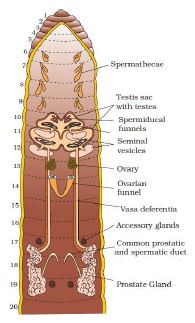
Figure: Reproductive system of earthworm (Ref: NCERT Biology, Textbook for Class XI, Chapter No. 7, Structural Organization in Animals, Page no. 110)
4. Draw a labelled diagram of alimentary canal of a cockroach
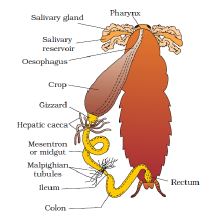
Figure: Alimentary canal of cockroach (Ref: NCERT Biology, Textbook for Class XI, Chapter No. 7, Structural Organization in Animals, Page no. 113)
5. Distinguish between the followings: (a) Prostomium and peristomium
Answer:
|
Prostomium |
Peristomium |
|
It is the lobe at the anterior end of earthworm that serves as a covering for the mouth. |
It is the first body segment of an earthworm. Also known as buccal segment. |
|
It is sensory in function. Also helps to crack open the soil when earthworm wants to enter in it. |
It contains the mouth. |
(b) Septal nephridium and pharyngeal nephridium
Answer:
|
Septal nephridium |
Pharyngeal nephridium |
|
It is present on both sides of intersegmental septa of segment 15 to the last one. |
It is present as three paired tufts in the 4th, 5th and 6th segment. |
6. What are the cellular components of blood?
Answer: Blood is a fluid connective tissue. It contains red blood cells (RBCs), white blood cells (WBCs) and platelets (together constituting ~45% of volume) suspended in plasma (~55% of volume).
Red Blood Cells: Red blood cells, or erythrocytes, are biconcave, large microscopic cells without nuclei. They carry oxygen from the lungs to body’s tissue and take carbon dioxide back to lungs to be exhaled out from the body.
White Blood Cells: White blood cells, or leukocytes exist in variable numbers and types (granulocytes and agranulocytes) but constitute only about 1% of blood's volume. Leukocytes are not limited to blood. Most are produced in bone marrow from the same kind of stem cells that produce red blood cells.
Platelets: Platelets, or thrombocytes, are small, colorless cell fragments without nuclei in the blood. Their main function is to interact with clotting proteins to stop or prevent bleeding.
7. What are the following and where do you find them in animal body.
(a) Chondrocytes
Answer: Chondrocytes are cells of healthy cartilage tissue. They are found in the small cavities within the matrix secreted by them. Examples of cartilage tissue are tip of nose, outer ear joints, etc.
(b) Axons
Answer: The long slender projections of the nerve cells of nervous tissues are called axons. They help in sending messages by conducting electrical impulses away from the neuron’s cell body. They are present in the neural tissues like brain, spinal cord, nerves etc.
(c) Ciliated epithelium
Answer: When the columnar or cuboidal cells of epithelia bear cilia on their free surface, they are called ciliated epithelium. They help in the movement of particles or mucus in a particular direction over the epithelium. They are present in the inner surface of hollow organs like bronchioles and fallopian tubes.
9. Distinguish between
a. Simple epithelium and compound epithelium
Answer:
|
Simple epithelium |
Compound epithelium |
|
It is composed of single layer of cells. |
It is composed of two or more layers of cells. |
|
Provides lining for body cavities, ducts and tubes of the body. |
Provides protection against chemical and mechanical stresses. |
|
Involved in the process of secretion, diffusion, absorption, etc. |
Limited role in secretion and absorption due to presence of multiple layers. |
|
Found in the ducts of glands, tubules of nephrons, walls of blood vessels, air sacs of lungs, lining of alimentary canal etc. |
Cover the dry skin surface, moist surface of buccal cavity, pharynx, salivary glands and pancreatic ducts. |
b. Cardiac muscle and striated muscle
Answer:
|
Cardiac muscle |
Striated muscle |
|
Cardiac muscle is a contractile tissue which has the ability to contract. |
Striated muscle is a bundle of fibres grouped together in parallel fashion. |
|
It is involuntary in nature. |
It is voluntary in nature. |
|
They are found only in heart. |
They are found in biceps, triceps and limbs. |
c.Dense regular and dense irregular connective tissues
Answer:
|
Dense regular connective tissues |
Dense irregular connective tissues |
|
Fibres and fibroblasts show a regular orientation in dense regular connective tissues. Collagen fibres are present in rows between many parallel bundles of fibres. |
Fibres (collagen) and fibroblasts show an irregular orientation in dense irregular connective tissues. |
|
Example: Tendons and ligaments. |
Example: Skin. |
d. Adipose and blood tissue
Answer:
|
Adipose tissue |
Blood tissue |
|
Adipose tissue is a type of loose connective tissue where adipocytes and fibres are loosely arranged. |
Blood tissue is a type of fluid connective tissue which is composed of red blood cells, white blood cells and platelets in plasma. |
|
It is semi-fluid in nature |
It is fluid in nature. |
|
The cells are specialized to store fats. |
The cells help in the transportation of food, wastes, gases and hormones from one part of the body to another. Also involved in defence and coagulation. |
e. Simple gland and compound gland
Answer:
|
Simple gland |
Compound gland |
|
Also known as unicellular gland. |
Also known as compound (multicellular) gland. |
|
Consists of isolated glandular/secretory cell. |
Consists of cluster of glandular/secretory cells. |
|
Example: Goblet cells of alimentary canal. |
Example: Salivary gland. |
10. Mark the odd one in each series:
(a) Areolar tissue; blood; neuron; tendon
Answer: Neuron
(b) RBC; WBC; platelets; cartilage
Answer: Cartilage
(c) Exocrine; endocrine; salivary gland; ligament
Answer: Ligament
(d) Maxilla; mandible; labrum; antenae
Answer: Antenae
(e) Protonema; mesothorax; metathorax; coxa
Answer: Protonema
11. Match the terms in column I with those in column II:
|
Column I |
Column II |
||
|
a |
Compound epithelium |
i. |
Alimentary canal |
|
b |
Compound eye |
ii. |
Cockroach |
|
c |
Septal nephridia |
iii. |
Skin |
|
d |
Open circulatory system |
iv. |
Mosaic view |
|
e |
Typhlosole |
v. |
Earthworm |
|
f |
Osteocytes |
vi. |
Phallomere |
|
g |
Genitalia |
vii. |
Bone |
Answer:
|
Column I |
Column II |
||
|
a |
Compound epithelium |
iii |
Skin |
|
b |
Compound eye |
iv |
Mosaic view |
|
c |
Septal nephridia |
v. |
Earthworm |
|
d |
Open circulatory system |
ii. |
Cockroach |
|
e |
Typhlosole |
i. |
Alimentary canal |
|
f |
Osteocytes |
vii |
Bone |
|
g |
Genitalia |
vi |
Phallomere |
12. Mention briefly about the circulatory system of earthworm.
Answer: Characteristic features of the circulatory system of earthworm:
It consists of blood vessels, capillaries and heart.
Carries food, waste and respiratory gases along with coelomic fluid.
Blood vascular system is closed in nature and blood remains confined to heart and blood vessels.
Contractions of heart pump blood in one direction.
Smaller blood vessels supply the gut, nerve cord and the body wall.
Blood cells and haemoglobin are produced in blood glands present in 4th, 5th and 6th segment and then dissolved in the blood plasma. Blood cells are phagocytic in nature.

Figure: Closed circulatory system of earthworm (Ref: NCERT Biology, Textbook for Class XI, Chapter No. 7, Structural Organization in Animals, Page no.109)
13. Draw a neat diagram of digestive system of frog.
Answer:

Figure: Digestive system of Frog (Ref: NCERT Biology, Textbook for Class XI, Chapter No. 7, Structural Organization in Animals, Page no. 117)
14. Mention the function of the following
(a) Ureters in frog
Answer: The two ureters emerging from the kidneys of male frog act as urinogenital duct that carry both urine and sperms. In female frogs, ureter carries only urine and excretes it out through cloaca.
(b) Malpighian tubules
Answer: Malpighian tubules present at the junction of midgut and hindgut is involved in the removal of excretory products from the haemolymph of cockroaches.
(c) Body wall in earthworm
Answer: The body wall in earthworm performs the following functions:
Helps retain water,
Helps in motion,
Helps in respiration (diffusion of gases),
Helps in contraction of the earthworm,
Secretes mucus which helps in locomotion and burrowing,
Also performs sensory function.
8. Describe various types of epithelial tissues with the help of labelled diagrams.
Answer: Epithelial tissue is the tissue provides lining to a body part and has a free surface either facing body fluid or the outside environment. There are two major types of epithelial tissues:
A.Simple epithelium: It is composed of a single layer of cells and functions as a lining for body cavities, ducts and tubes. On the basis of structural modification, simple epithelium is further divided into three types
Squamous epithelium: Single thin layer of flattened cells with irregular boundaries mostly involved in diffusion process. E.g. cells of walls of blood vessels, air sacs of lungs.
Cuboidal epithelium: Single layer of cube-like cells. They are mostly found in ducts of glands and nephrons and are mainly involved in secretion and absorption.
Columnar epithelium: Single layer of tall and slender cells with microvilli on the free surface. They are found in the lining of stomach and intestine and are involved in secretion and absorption.
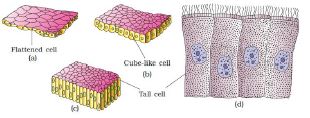
Figure: Simple epithelium: (a) Squamous (b) cuboidal (c) Columnar (d) Columnar cells bearing cilia(Ref: NCERT Biology, Textbook for Class XI, Chapter No. 7, Structural Organization in Animals, Page no. 101)
Sometimes, cuboidal or columnar epithelium bear cilia (known as ciliated epithelium) and move particles in specific direction or get specialized for secretion (known as glandular epithelium).
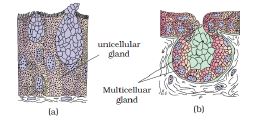
Figure: Glandular epithelium (Ref: NCERT Biology, Textbook for Class XI, Chapter No. 7, Structural Organization in Animals, Page no. 102)
B.Compound epithelium: It consists of two or more cell layers and has protective function e.g. our skin. They mainly provide protection against chemical and mechanical stresses. They form a dry protective layer of the skin, moist surface of buccal cavity, pharynx, inner lining of ducts of salivary glands and of pancreatic ducts.
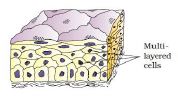
Figure: Compound epithelium (Ref: NCERT Biology, Textbook for Class XI, Chapter No. 7, Structural Organization in Animals, Page no. 102)
Free study material for Biology
Biology Class 11 Curriculum Solutions: Chapter 07 Structural Organisation in Animals
Chapter Exercise Answers for Class 11 Biology
Explore reliable textbook solutions for Chapter 07 Structural Organisation in Animals tailored for Class 11 learners. Utilizing these complete exercise answers ensures your preparation aligns exactly with official NCERT standards for Biology.
Detailed Answer Guides for Chapter 07 Structural Organisation in Animals
Clear, methodical explanations accompany every challenging problem within the Class 11 Biology text. Engaging with these detailed answers lays a solid foundation for advanced learning and improves foundational clarity for upcoming assessments.
Complete Preparation Kit for Class 11 Exams
Frequent review of these structured answers builds strong analytical capabilities and response efficiency. Maximize your academic readiness by combining these textbook solutions with our curated study materials and mock evaluations for Class 11 Biology.
FAQs
The complete and updated NCERT Solutions Class 11 Biology Chapter 7 Structural Organisation in Animals is available for free on StudiesToday.com. These solutions for Class 11 Biology are as per latest NCERT curriculum.
Yes, our experts have revised the NCERT Solutions Class 11 Biology Chapter 7 Structural Organisation in Animals as per 2026 exam pattern. All textbook exercises have been solved and have added explanation about how the Biology concepts are applied in case-study and assertion-reasoning questions.
Toppers recommend using NCERT language because NCERT marking schemes are strictly based on textbook definitions. Our NCERT Solutions Class 11 Biology Chapter 7 Structural Organisation in Animals will help students to get full marks in the theory paper.
Yes, we provide bilingual support for Class 11 Biology. You can access NCERT Solutions Class 11 Biology Chapter 7 Structural Organisation in Animals in both English and Hindi medium.
Yes, you can download the entire NCERT Solutions Class 11 Biology Chapter 7 Structural Organisation in Animals in printable PDF format for offline study on any device.