

NCERT Solutions for Class 11 Biology: Chapter 01 The Living World
Explore reliable textbook solutions for Chapter 01 The Living World tailored for Class 11 learners. Utilizing these Biology answers ensures thorough preparation and strengthens foundational knowledge before final NCERT evaluations.
Practice Class 11 Biology Solutions: Chapter 01 The Living World
View or download the dedicated Chapter 01 The Living World solution resource below. Engaging with these textbook answers under focused study conditions ensures continuous academic progress and mastery of the 2026-27 curriculum for Biology.
NCERT Solutions for Class 11 Biology for Chapter 1 The Living World
1.Why are living organisms classified?
Answer: There is incredible diversity amongst living organisms. Till date about 1.8 million species have been identified and described. Each year thousands of new species are added to the list. It is estimated that 9 million species are yet to be discovered. The classification system helps to standardize the naming and identification of this diverse group of living organisms. It also streamlines the process of placing the newly discovered organisms in the correct place.
- Classifying organisms gives biologists logical groupings of animals based on common observable characteristics that make them easier to study.
- It also provides a universal nomenclature/ scientific names to the organisms that can be used worldwide without causing any conflict or confusion as local names of the same species vary from place to place.
- Classification of organisms helps us to understand the wide diversity that exists amongst the life forms and the evolutionary pattern.
2.Why are the classification systems changing every now and then?
Answer: Classification system is changing every now and then because over the past few hundred years there have been many scientific breakthroughs which have made classification more logical and effective. While the earliest classification methods relied on morphological similarities, in recent times genetic analysis of organisms (DNA fingerprinting) has enabled scientists to bring another dimension to organizing organisms with much more precision.
Also many new organisms have been discovered over the time which required creating new branches in the taxonomic tree or rearranging the systematic position of animals based on new knowledge/ information.
3. What different criteria would you choose to classify people that you meet often?
Answer: If you consider your class as a group of individuals that you have to classify, you could use the following criteria:
- Gender
- Appearance - height, weight, skin colour, hair type, eye colour
- Native place
- Culture they belong too
- Language
- Grades in school
- Personality attributes like confidence level, empathy to peers, discipline, cleanliness etc.
4. What do we learn from identification of individuals and populations?
Answer: The taxonomical study or classification of living organisms requires the identification of individuals and populations. This helps the scientists to establish similarities and dissimilarities among the individuals such that they can be categorized into different species. The differentiating characters could be distinct morphological or genetic markers that help in characterizing the various populations.
5. Given below is the scientific name of Mango. Identify the correctly written name.
Mangifera Indica
Mangifera indica
Answer: Mangifera indica is the right answer.
[Note: In the binomial system of nomenclature the first name (Magnifera in this case) indicates the genus and the first letter of the genus is always written in capital letter. The second name which indicates the species (indica in this case) is always written in small letters. Biological names are written in italics.]
For more study material for biology please click here - ncert exemplar class 11 biology
6. Define a taxon. Give some examples of taxa at different hierarchical levels.
Answer: Taxon (plural Taxa) is a unit used in biology for the classification of organisms. Taxa are arranged in a hierarchy from kingdom to species (or subspecies). A given taxon ordinarily includes several taxa of lower rank. In the classification of micro-organism, plants, and animals, certain taxonomic categories are universally accepted (see the picture below). These categories, in descending order, are kingdom, phylum, class, order, family, genus, species, and subspecies, or race. Terms for naming genetically controlled variants within a species are not taxa.
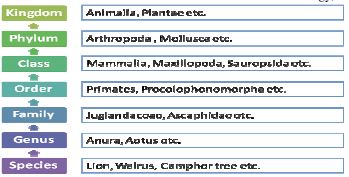
Figure: Examples of taxa at various hierarchical levels.
7. Can you identify the correct sequence of taxonomical categories?
(a) Species Order Phylum Kingdom
(b) Genus Species Order Kingdom
(c) Species Genus Order Phylum
Answer: Options (a) and (c)
Option (b) is wrong as species should come before genus.
8. Try to collect all the currently accepted meanings for the word ‘species’. Discuss with your teacher the meaning of species in case of higher plants and animals on one hand, and bacteria on the other hand.
Answer: Various acceptable definitions of species are:
1. Species is the basic unit of biological classification or taxonomic ra It constitutes a group of organisms that can interbreed and produce fertile offspring.
2. A species is a group of organisms with a shared, closed gene pool.
3.Sometimes a group of organisms that look alike morphologically are categorized under one species. This method of grouping has been used in cases when there is no way to test if the organism can interbreed for example in the case of different types of whales in the wild. But this approach has its problems. This is because there are many examples like in dogs where two breeds may look very different but are capable of interbreeding.
4. In organisms like bacteria interbreeding capabilities cannot form the basis of grouping them into species as they can reproduce asexually. Classification of bacteria is a multipronged approach. It involves phenotypic analysis, molecular analysis (both at the protein and the DNA/ RNA levels) and more recently genomics (complete profiling of the genetic material).
Therefore the definitions 1 and 2 are applicable for higher plants and animals in most cases because it is easier to interbreed them and also study their morphology and anatomy. But the same cannot be applicable to bacteria. This is because bacteria reproduce asexually and are morphologically not distinct in most cases.
9. Define and understand the following terms: (i)Phylum (ii)Class (iii)Family (iv)Order (v) Genus
Answer:
Phylum: Phylum is the primary subdivision of a taxonomic kingdom that groups together all classes of organisms that have the same body plan. It is a taxonomic rank below kingdom and above class. In botany the term division is interchangeably used with phylum. The animal kingdom contains 35 phyla while the plant kingdom contains 12 divisions. The different phyla are differentiated by features related to body plan like the presence or absence of notochord or the dorsal hollow neural system. Chordata, arthropoda are some examples of phyla.
Class: This taxonomic category includes related orders. For example Mammalia is a class that includes the order Carnivora (cat, dog, tiger belong to this order) and Primata (monkey, gorilla and gibbon belong to this order).
Family: Family is a group of related genera with less similarity as is seen in the genus and species. For example, the genera Felis (cat) and Panthera (lion, tiger, leopard) are included in the family Felidae because of many common features the two genera share. Cats and dogs on the other hand are two very different looking animals therefore they are categorized in different families which are Felidae and Cancidae respectively.
Order: Order constitutes of families which have fewer similar characters. The taxonomic category from Order onwards is made up of categories which are less similar morphologically as compared to family, genus or species. For example both Felidae (the family to which a cat belongs) and Cancidae (the family to which a dog belongs) are grouped in the order Carnivora.
Genus: A group of related species comprise a genus. The organisms in a genus have common characters and differ considerably from the organisms of other genus. For example, lion, leopard and tiger are different species belonging to the genus Panthera. This genus differs from another genus Felis which includes cats.
10. How is a key helpful in the identification and classification of an organism?
Answer: Key is a taxonomical aid (a printed book or computer aided device) that helps in identification of biological entities such as plants, animals, fossils and microorganisms based on similarities and dissimilarities. The identification is based on a pair of contrasting characters and allows the scientists to make a choice between two opposing characters. This results in acceptance of only one and rejection of the other. Each statement in the key is called a lead. Separate keys are required for each taxonomic category such as family, genus and species for identification purposes. Keys are generally analytical in nature.
Therefore once the scientist has the organism he wants to classify he answers a question about one or more features (characters) of the entity to be identified in a step wise way. For example, a step in a botanical key may ask about the colour of flowers, or the disposition of the leaves along the stems. A key for insect identification may ask about the number of bristles on the rear leg.
11. Illustrate the taxonomical hierarchy with suitable examples of a plant and an animal.
Answer: Taxonomic hierarchy is a method of grouping together living organisms that share common features. This system was formulated by Swedish biologist Carl Linnaeus (1707-1778). The various steps of taxonomic hierarchy are called ranks or taxa (singular - taxon).
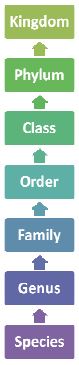
Figure: Taxonomic Hierarchy showing the various taxonomic categories that are used to classify living organisms.
Example: Taxonomic categories of Wheat (plant) and Elephant (animal):
|
Taxa |
Wheat |
Elephant |
|
Kingdom |
Plantae |
Animalia |
|
Phylum |
Angiospermae |
Chordata |
|
Class |
Monocotyledonae |
Mammalia |
|
Order |
Poales |
Proboscida |
|
Family |
Poaceae |
Elephantidae |
|
Genus |
Triticum |
Elephas |
|
Species |
aestivum |
maximus |
Free study material for Biology
Step-by-Step Textbook Answers: Class 11 Biology Chapter 01 The Living World
Accessing Chapter 01 The Living World Solutions
Explore reliable textbook solutions for Chapter 01 The Living World tailored for Class 11 learners. Utilizing these complete exercise answers ensures your preparation aligns exactly with official NCERT standards for Biology.
Concept-Driven Answers for Class 11 Biology
Each solution includes detailed reasoning to foster genuine comprehension of Chapter 01 The Living World concepts. Reviewing these step-by-step breakdowns allows learners to master both analytical and descriptive questions expected in school evaluations.
Maximizing Study Efficiency
These resources act as an effective roadmap for daily homework tasks and independent study. Supplement your review of Chapter 01 The Living World with official sample papers and interactive practice tests available on our platform free of charge.
FAQs
The complete and updated NCERT Solutions Class 11 Biology Chapter 1 The Living World is available for free on StudiesToday.com. These solutions for Class 11 Biology are as per latest NCERT curriculum.
Yes, our experts have revised the NCERT Solutions Class 11 Biology Chapter 1 The Living World as per 2026 exam pattern. All textbook exercises have been solved and have added explanation about how the Biology concepts are applied in case-study and assertion-reasoning questions.
Toppers recommend using NCERT language because NCERT marking schemes are strictly based on textbook definitions. Our NCERT Solutions Class 11 Biology Chapter 1 The Living World will help students to get full marks in the theory paper.
Yes, we provide bilingual support for Class 11 Biology. You can access NCERT Solutions Class 11 Biology Chapter 1 The Living World in both English and Hindi medium.
Yes, you can download the entire NCERT Solutions Class 11 Biology Chapter 1 The Living World in printable PDF format for offline study on any device.