

Practice CBSE Class 6 Mathematics Whole Numbers MCQs Set A provided below. The MCQ Questions for Class 6 Chapter 2 Whole Numbers Mathematics with answers and follow the latest CBSE/ NCERT and KVS patterns. Refer to more Chapter-wise MCQs for CBSE Class 6 Mathematics and also download more latest study material for all subjects
MCQ for Class 6 Mathematics Chapter 2 Whole Numbers
Class 6 Mathematics students should review the 50 questions and answers to strengthen understanding of core concepts in Chapter 2 Whole Numbers
Chapter 2 Whole Numbers MCQ Questions Class 6 Mathematics with Answers
Question: The whole number which does not have a predecessor in whole number system is
a) 0
b) 1
c) 2
d) none of these
Answer: 0
Question: The predecessor of the smallest 4- digit number is
a) 999
b) 1000
c) 1001
d) 99
Answer: 999
Question: The predecessor of 1 million is
a) 99999
b) 999999
c) 1000001
d) 9999
Answer: 99999
Question: The product of the predecessor and the successor of the greatest 2- digit number is
a) 9800
b) 9700
c) none of these
d) 9900
Answer: 9800
Question: The sum of the successor of the greatest 3- digit number and the predecessor of the smallest 3- digit number is
a) 1099
b) 1101
c) 1100
d) 1000
Answer: 1099
Question: The number of whole numbers between 22 and 54 is
a) 31
b) 32
c) 42
d) 30
Answer: 31
Question: The number of whole numbers between the smallest whole number and the greatest 2- digit number is
a) 98
b) 88
c) 99
d) 100
Answer: 98
Question: If a is whole number such that a+a=a, then a is equal to
a) 0
b) 1
c) 2
d) none of these
Answer: 0
Question: The value of (93×63+93×37) is
a) 9300
b) 93000
c) none of these
d) 930
Answer: 9300
Question: Which of the following is not equal to zero?
a) (5-0) ÷5
b) (10-10) ÷5
c) 0÷5
d) 0×5
Answer: (5-0) ÷5
Question: Which of the following statement is true?
a) 13-21 is not a whole no
b) 21×1 = 21×0
c) 21-13 is not a whole number
d) 21 – (13-5) = (21-13) -5
Answer: 13-21 is not a whole no
Question: On dividing a number by 9 we get 47 as quotient and 5 as remainder. The number is
a) 428
b) 429
c) none of these
d) 418
Answer: 428
Question: Number of whole numbers between 38 and 68 is
a) 31
b) 30
c) 29
d) 28
Answer: 28
Question: What will be the product of 838*103 using distributive property?
a) 86314
b) 72416
c) 80925
d) 64640
Answer: 86314
Question: Ajay stays in a hotel that charges Rs.200 for room and Rs.60 for breakfast and 80 for Lunch. He stayed there for 10 days, how much will be his total bill amount while checkout?
a) 2700
b) 4000
c) 3400
d) 3900
Answer: 2700
Question: How many whole numbers are there between 99 and 300?
a) 200
b) 150
c) 130
d) 100
Answer: 200
Question: Which whole number does not have predecessor?
a) 0
b) -1
c) 2
d) 1
Answer: 0
Question: Find the population of a town which has 240000 Men, 170000 women and 50000 Childrens?
a) 460000
b) 400000
c) 370000
d) 490000
Answer: 460000
Question: What is the value of 7280*94+7280*14?
a) 786240
b) 700240
c) 765020
d) 865900
Answer: 786240
Question: What is the value of 50/0?
a) Not Defined
b) 0
c) 50
d) 1
Answer: Not Defined
Question: From the following, which one is the largest whole number?
a) 99
b) 71
c) 9
d) 48
Answer: 99
Question: A school has 40 students in each class and charge Rs.800 from all students. Total classes are 10, what will be total monthly income of school?
a) 3,20,000
b) 3,80,000
c) 2,70,000
d) 4,00,000
Answer: 3,20,000
Question: Which one is least natural number amongst the following?
a) 1
b) 2
c) -1
d) 0
Answer: 1
Question: If a is any whole number, then a ÷ 1 =
a) a
b) 1
c) 0
d) a2
Answer: a
Question: The whole number occurring just before 567890
a) 567889
b) 567888
c) 567800
d) 567891
Answer: 567889
Question: ________ is the only whole number which is not a natural number
a) 0
b) 1
c) 2
d) 3
Answer: 0
Question: The whole number whose successor is 379600 is
a) 379599
b) 379601
c) 379600
d) 379590
Answer: 379599
Question: The whole number whose predecessor is 74999 is
a) 75000
b) 70000
c) none of these
d) 74998
Answer: 75000
Question: The successor of 3799 is
a) 3800
b) 3790
c) 3890
d) 3798
Answer: 3800
Question: Number of whole number between 81 and 101
a) 19
b) 20
c) 21
d) 22
Answer: 19
Question: The number of 3-digit numbers between 94 and 607.
a) 507
b) 508
c) 509
d) 506
Answer: 507
Question: The number _______ is called the multiplicative identify
a) 1
b) 0
c) -1
d) none of these
Answer: 1
Question: Dividend = ________ × quotient + remainder
a) divisor
b) quotient
c) remainder
d) dividend
Answer: divisor
Question: (21+18) + _______ = (21 + 13) + 18
a) 13
b) none of these
c) 18
d) 21
Answer: 13
Question: 3056 + 0 = _______ = 0 + 3056
a) 3056
b) 3057
c) none of these
d) 0
Answer: 3056
Question:
(i) If the product of two whole numbers is zero then one number will be zero
(ii) If the product of two whole numbers is zero then both number will be zero
a) Both can be true
b) both are false
c) only ii can be true
d) Only I can be true
Answer: Both can be true
Question: Simplify 126x55+126x45
a) 12600
b) 12400
c) 12500
d) 12000
Answer: 12600
Question: Smallest natural number is
a) 1
b) -1
c) 0
d) 2
Answer: 1
Question: If the product of two whole numbers is one if
a) two numbers are 1
b) not defined
c) none of these
d) one number is 1
Answer: two numbers are 1
Question: Which of the following will not represent 0
a) 1+0
b) 0x0
c) 0/2
d) (10-10)/2
Answer: 1+0
Question: Find value of 297x17 + 297x3
a) 5940
b) 5980
c) 5942
d) 5970
Answer: 5940
Question: Divide 7 / 0
a) not defined
b) 1
c) 0
d) 7
Answer: not defined
Question: Which is the smallest whole number
a) 0
b) 2
c) -1
d) 1
Answer: 0
Question: Write the successor of 1997
a) 1998
b) none of these
c) 1997
d) 1996
Answer: 1998
Question: What is the predecessor of 17
a) 16
b) 18
c) 0
d) 17
Answer: 16
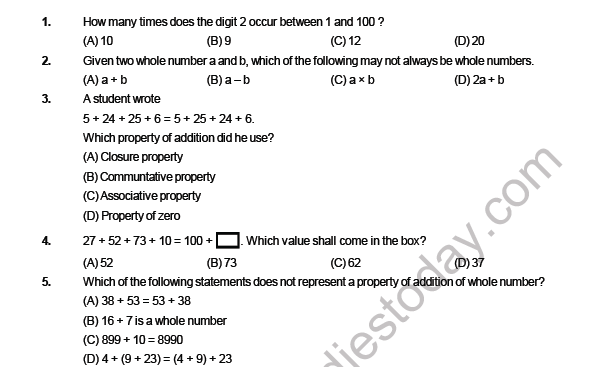
Question: How many times does the digit 2 occur between 1 and 100 ?
a) 20
b) 12
c) 9
d) 10
Answer: 20
Question: Given two whole number a and b, which of the following may not always be whole numbers.
a) a – b
b) a × b
c) 2a + b
d) a + b
Answer: a – b
Question: A student wrote 5 + 24 + 25 + 6 = 5 + 25 + 24 + 6. Which property of addition did he use?
a) Communtative property
b) Associative property
c) Property of zero
d) Closure property
Answer: Communtative property
Question: 27 + 52 + 73 + 10 = 100 + ? Which value shall come
a) 62
b) 37
c) 73
d) 52
Answer: 62
Question: Which of the following statements does not represent a property of addition of whole number?
a) 16 + 7 is a whole number
b) 899 + 10 = 8990
c) 4 + (9 + 23) = (4 + 9) + 23
d) 38 + 53 = 53 + 38
Answer: 16 + 7 is a whole number
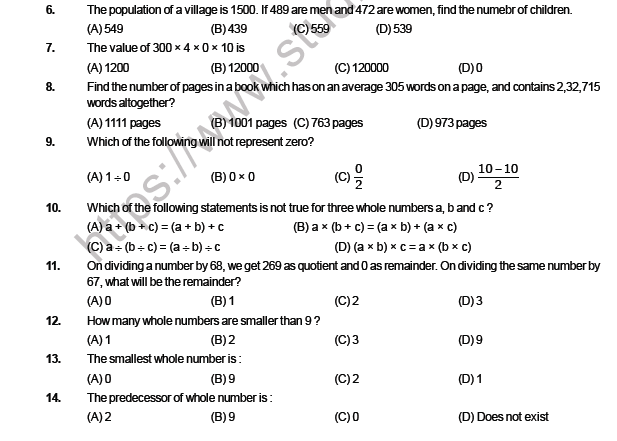
Question: The population of a village is 1500. If 489 are men and 472 are women, find the numebr of children.
a) 539
b) 559
c) 439
d) 549
Answer: 539
Question: The value of 300 × 4 × 0 × 10 is
a) 0
b) 120000
c) 12000
d) 1200
Answer: 0
Question: Find the number of pages in a book which has on an average 305 words on a page, and contains 2,32,715 words altogether?
a) 763 pages
b) 973 pages
c) 1001 pages
d) 1111 pages
Answer: 763 pages
Question: Which of the following will not represent zero?
a) 1 / 0
b) 0 × 0
c) 0 / 2
d) 10 –10 /2
Answer: 1 / 0
Question: Which of the following statements is not true for three whole numbers a, b and c ?
a) a + (b + c) = (a + b) + c
b) a / (b / c) = (a / b) / c
c) Both
d) None of these
Answer: a + (b + c) = (a + b) + c
Question: On dividing a number by 68, we get 269 as quotient and 0 as remainder. On dividing the same number by 67, what will be the remainder?
a) 1
b) 3
c) 2
d) None of these
Answer: 1
Question: How many whole numbers are smaller than 9 ?
a) 9
b) 3
c) 2
d) None of these
Answer: 9
Question: The smallest whole number is :
a) 0
b) 9
c) 2
d) 1
Answer: 0
Question: The predecessor of whole number is
a) 0
b) 9
c) 2
d) Does not exist
Answer: 0
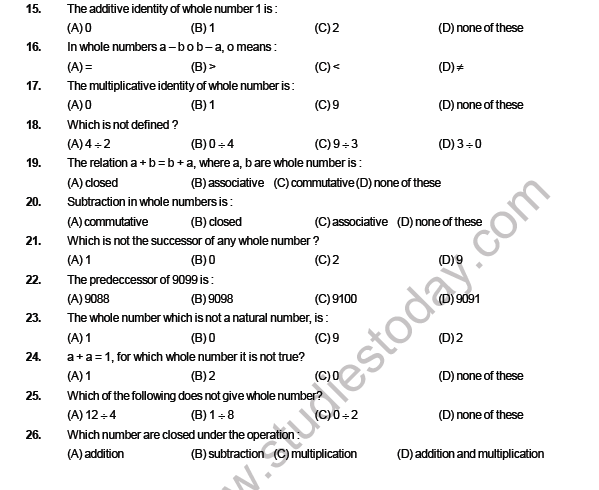
Question: The additive identity of whole number 1 is :
a) 0
b) 1
c) 2
d) none of these
Answer: 0
Question: The multiplicative identity of whole number is
a) 1
b) 9
c) none of these
d) 0
Answer: 1
Question: Which is not defined ?
a) 3 / 0
b) 9 / 3
c) 0 / 4
d) None of these
Answer: 3 / 0
Question: The relation a + b = b + a, where a, b are whole number is
a) commutative
b) none of these
c) associative
d) closed
Answer: commutative
Question: Subtraction in whole numbers is
a) none of these
b) associative
c) closed
d) commutative
Answer: none of these
Question: Which is not the successor of any whole number ?
a) 0
b) 2
c) 9
d) 1
Answer: 0
Question: The predeccessor of 9099 is
a) 9098
b) 9100
c) 9091
d) 9088
Answer: 9098
Question: The whole number which is not a natural number, is
a) 0
b) 9
c) 2
d) 1
Answer: 0
Question: a + a = 1, for which whole number it is not true?
a) 0
b) none of these
c) 2
d) 1
Answer: 0
Question: Which of the following does not give whole number?
a) 1 / 8
b) 0 / 2
c) 12 / 4
d) none of these
Answer: 1 / 8
Question: Which number are closed under the operation
a) addition and multiplication
b) multiplication
c) subtraction
d) addition
Answer: addition and multiplication
Question: Which number is identity for multiplication of whole numbers:
(a) 1
(b) 0
(c) 10
(d) 100
Answer: 1
Question: Which number is identity for Addition of whole number
(a) 0
(b) 100
(c) 1
(d) 10
Answer: 0
Question: Whole numbers are closed under which operation
(a) Addition
(b) Division
(c) Subtraction
(d) None of these
Answer: Addition
Question: Which natural number has no predecessor
(a) 1
(b) 10
(c) 100
(d) 0
Answer: 1
Question: Predecessor of which two digit number has a single digit
(a) 10
(b) 9
(c) 0
(d) 11
Answer: 10
Question: The natural numbers along with zero form the collection of
(a) Whole numbers
(b) Integers
(c) Rational numbers
(d) Real numbers
Answer: Whole numbers
Question: I) All natural numbers are also whole numbers
(II) One is the smallest natural number
(a) both are true
(b) both are false
(c) only II is true
(d) only I is true
Answer: both are true
Question: Smallest natural number is
(a) 1
(b) 2
(c) -1
(d) 0
Answer: 1
Question: The line on which we represent the natural number is known as
(a) number line
(b) counting line
(c) digit line
(d) zero line
Answer: number line
Question: The product multiplication of a number with zero is always
(a) zero
(b) one
(c) none of these
(d) the number itself
Answer: zero
Question: How many natural numbers are there
(a) infinitly many
(b) 1000
(c) 100
(d) 10
Answer: infinitly many
Question: The sum of two whole numbers is always:
(a) a whole number
(b) 100
(c) zero
(d) odd number
Answer: a whole number
Question: The sum of a natural number with a whole number is always:
(a) a natural number
(b) even number
(c) 100
(d) 0
Answer: a natural number
Question: The largest whole number is:
(a) can not be found
(b) 9979
(c) 9999
(d) 99
Answer: can not be found
Question: The difference of largest number of three digit and smallest natural number is
(a) 998
(b) 997
(c) 996
(d) 995
Answer: 998
Question: Find a whole number n such that n=2n
(a) 0
(b) 100
(c) 20
(d) 1
Answer: 0
Question: Find the whole number if n +4 =9
(a) 5
(b) 3
(c) 4
(d) 6
Answer: 5
Question: Find the sum 837+ 208 + 603
(a) 1648
(b) 1148
(c) 1548
(d) 1148
Answer: 1648
Question: Find the value of 1507 - (625/25)
(a) 1482
(b) 1580
(c) 1370
(d) 1234
Answer: 1482
Question: Find product 12x35
(a) 420
(b) 12600
(c) 400
(d) 34840
Answer: 420
Question: State the property in statement:256x24=24x256
(a) Associative property in multiplication
(b) commutative property in multiplication
(c) Distributive property in multiplication
(d) Closure property in multiplication
Answer: Associative property in multiplication
Question: If 36 flats cost Rs 68251500 What is the cost of each flat
(a) Rs 198670
(b) Rs 1895875
(c) Rs 135649
(d) Rs 203456
Answer: Rs 198670
Question: Largest number formed by digits 2,4,0,3,6,9 is
(a) 964320
(b) 903642
(c) 392460
(d) 432900
Answer: 964320
Question: The school canteen charges Rs 20 for lunch Rs 4 for milk for each day How much money do you spend in 5 days on these things
(a) 120
(b) 20
(c) 5
(d) 100
Answer: 120
Question: State the property used statement (29x36)x18=29x(36x18)
(a) Associative property in multiplication
(b) Commutative property in multiplication
(c) Distributive property in multiplication
(d) Closure property in multiplication
Answer: Associative property in multiplication
Question: Write the correct number to complete: 13x100x______= 1300000
(a) 1000
(b) 10
(c) 10000
(d) 100
Answer: 1000
Question: 0 divided by 6 is
(a) 0
(b) 6
(c) 1
(d) 60
Answer: 0
Question: 5 divided by 0 is
(a) not defined
(b) 1
(c) 0
(d) 5
Answer: not defined
Question: Fill in the blanks to make the statement true 6245+(631+751)=631+_______)+751
(a) 6245
(b) 200
(c) 751
(d) 231
Answer: 6245
Question: Study the pattern 1x8+1=9 12x8+2=98 Next step is-
(a) 123x8+3=987
(b) 120x8+3=963
(c) 1234x8+4=9876
(d) 13x8+3=987
Answer: 123x8+3=987
Question: Which is the successor of 1099999 ?
(i) 1100001
(ii) 1100000
(iii) 1099998
(iv) 9999999
Question: Which is the predecessor of 208090 ?
(i) 208089
(ii) 208091
(iii) 218090
(iv) 198090
Question: What is the value of 8x1769x125
(i) 1769000
(ii) 1768000
(iii) 1768010
(iv) 1769010
Question: What is the value of 81265x169 – 81265x 69
(i) 81265000
(ii) zero
(iii) 8126500
(iv) 8026500
Question: Which of the following is the additive identity in the set of Whole numbers ?
(i) 1
(ii) zero
(iii) -- 1
(iv) any number
Question: The school canteen charges Rs. 20 for lunch & Rs. 5 for milk each day. How much money will be charged in 5 days on these things?
(i) Rs. 125
(ii) Rs.25
(iii) Rs. 75
(iv) Rs. 100
Important Practice Resources for Class 6 Mathematics
MCQs for Chapter 2 Whole Numbers Mathematics Class 6
Students can use these MCQs for Chapter 2 Whole Numbers to quickly test their knowledge of the chapter. These multiple-choice questions have been designed as per the latest syllabus for Class 6 Mathematics released by CBSE. Our expert teachers suggest that you should practice daily and solving these objective questions of Chapter 2 Whole Numbers to understand the important concepts and better marks in your school tests.
Chapter 2 Whole Numbers NCERT Based Objective Questions
Our expert teachers have designed these Mathematics MCQs based on the official NCERT book for Class 6. We have identified all questions from the most important topics that are always asked in exams. After solving these, please compare your choices with our provided answers. For better understanding of Chapter 2 Whole Numbers, you should also refer to our NCERT solutions for Class 6 Mathematics created by our team.
Online Practice and Revision for Chapter 2 Whole Numbers Mathematics
To prepare for your exams you should also take the Class 6 Mathematics MCQ Test for this chapter on our website. This will help you improve your speed and accuracy and its also free for you. Regular revision of these Mathematics topics will make you an expert in all important chapters of your course.
You can get most exhaustive CBSE Class 6 Mathematics Whole Numbers MCQs Set A for free on StudiesToday.com. These MCQs for Class 6 Mathematics are updated for the 2025-26 academic session as per CBSE examination standards.
Yes, our CBSE Class 6 Mathematics Whole Numbers MCQs Set A include the latest type of questions, such as Assertion-Reasoning and Case-based MCQs. 50% of the CBSE paper is now competency-based.
By solving our CBSE Class 6 Mathematics Whole Numbers MCQs Set A, Class 6 students can improve their accuracy and speed which is important as objective questions provide a chance to secure 100% marks in the Mathematics.
Yes, Mathematics MCQs for Class 6 have answer key and brief explanations to help students understand logic behind the correct option as its important for 2026 competency-focused CBSE exams.
Yes, you can also access online interactive tests for CBSE Class 6 Mathematics Whole Numbers MCQs Set A on StudiesToday.com as they provide instant answers and score to help you track your progress in Mathematics.