

Multiple Choice Questions (MCQs) for Class 6 Mathematics: Chapter 03 Playing with Numbers
Review structured MCQ sets for Class 6 Mathematics Chapter 03 Playing with Numbers. Built according to official CBSE guidelines, these downloadable questions support daily revision and core concept reinforcement.
Practice Chapter 03 Playing with Numbers MCQs for Class 6 Mathematics
View or download the dedicated Chapter 03 Playing with Numbers MCQ resource below. Practicing these 50 objective questions regularly builds familiarity with standard exam patterns and helps secure higher marks in final Mathematics evaluations.
Question: Which is greatest 3-digit number exactly divisible by 8,10,12
a) 960
b) 980
c) 360
d) 120
Answer: 960
Question: Divisibility by 2,5,10 can be checked by
a) Last digit
b) Sum of digits
c) Last two digits
d) Last three digits
Answer: Last digit
Question: Find the least number which when divided by 6,15 and 18 leave remainder 5 in each case
a) 95
b) 180
c) 90
d) 185
Answer: 95
Question: L.C.M. of two co-prime numbers is always
a) Product of numbers
b) Sum of numbers
c) None
d) Difference of numbers
Answer: Product of numbers
Question: Find the L.C.M. of 12 and 18
a) 36
b) 6
c) 12
d) 18
Answer: 36
Question: 4= 2x2 , 15= 3x5, so H.C.F. of 4 and 15 is
a) 1
b) 0
c) 2
d) 3
Answer: 1
Question: What is the H.C.F. two consecutive odd numbers
a) 1
b) 2
c) 4
d) 8
Answer: 1
Question: What is the H.C.F. two consecutive even numbers
a) 2
b) 4
c) 8
d) 1
Answer: 2
Question: What is the H.C.F. of 18 and 48
a) 6
b) 8
c) 4
d) 2
Answer: 6
Question: The sum of two consecutive odd number is always divisible by
a) 4
b) 2
c) 6
d) 8
Answer: 4
Question: The product of three consecutive numbers is always divisible by
a) 6
b) 8
c) 4
d) 2
Answer: 6
Question: Which of the following numbers has 4 different prime factors
a) 210
b) 100
c) 120
d) 24
Answer: 210
Question: Which of the following expression has prime factors
a) 56=7x2x2x2
b) 70= 2x5x7
c) 54=2x3x9
d) 24=2x3x4
Answer: 56=7x2x2x2
Question: What are the prime factors of greatest 4 digit number
a) 3x3x11x101
b) 9x11x101
c) 3x33x101
d) 3 x3 x 11 x11
Answer: 3x3x11x101
Question: The product of L.C.M and H.C.F. of two numbers is equal to
a) Product of numbers
b) Sum of numbers
c) Difference of numbers
d) Quotients of numbers
Answer: Product of numbers
Question: If a number is divisible two co-prime numbers than it is divisible by their
a) Product also
b) Difference also
c) Sum also
d) Quotient also
Answer: Product also
Question: Common factors of 15 and 25 are
a) 5
b) 75
c) 25
d) 15
Answer: 5
Question: Which of the following pair is co-prime
a) 18 and 35
b) 6 and 8
c) 7 and 35
d) 30 and 415
Answer: 18 and 35
Question: Two numbers having only 1 as common factor are called
a) Co- prime numbers
b) Composite numbers
c) Odd numbers
d) Prime numbers
Answer: Co- prime numbers
Question:
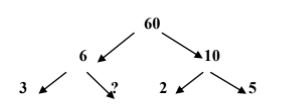
The missing number is:
a) 2
b) 3
c) 4
d) 1
Answer: 2
Question: A number is divisible by 4 if its
a) Last two digits are divisible by 4
b) Last digit is 4
c) Last digit is 0
d) Last digit is 8
Answer: Last two digits are divisible by 4
Question: Which of the following number is divisible by 3
a) 123
b) 121
c) 124
d) 122
Answer: 123
Question: If a number is divisible by 2 and 3 both then is divisible by
a) 6
b) 8
c) 10
d) 5
Answer: 6
Question: The smallest composite number is
a) 4
b) 3
c) 2
d) 1
Answer: 4
Question: Tell the maximum consecutive numbers less then 100 so that there is no prime number between them
a) 7
b) 8
c) 6
d) 5
Answer: 7
Question: The sum of two odd and one even numbers is
a) Even
b) Odd
c) Prime
d) Composite
Answer: Even
Question: The only prime number which is also even
a) 2
b) 1
c) 4
d) 6
Answer: 2
Question: Which of the following is smallest prime number:
a) 2
b) 3
c) 4
d) 1
Answer: 2
Question: The multiple of 2 are also called
a) Even numbers
b) Odd numbers
c) Prime numbers
d) Composite numbers
Answer: Even numbers
Question: Which number is neither prime nor composite
a) 1
b) 2
c) 3
d) 0
Answer: 1
Question: All factors of 6 are
a) 1,2,3,6
b) 1,2,3
c) 2,3
d) 1,6
Answer: 1,2,3,6
Question: Which of the following is an odd composite number?
a) 9
b) 11
c) 12
d) 7
Answer: 9
Question: The number of even number between 68 and 90 is
a) 11
b) 2
c) 31
d) 10
Answer: 11
Question: Which of the following is a prime number?
a) 97
b) 91
c) 87
d) 69
Answer: 97
Question: Which of the following is a pair of twin- prime numbers?
a) 43,47
b) 59,61
c) 73,79
d) 19,21
Answer: 43,47
Question: The number of distinct prime factors of the largest 4-digit number is
a) 2
b) 3
c) 5
d) none of these
Answer: 2
Question: The number of distinct prime factors of the smallest 5 digit number is
a) 2
b) 4
c) 6
d) 8
Answer: 2
Question: The sum of the prime factors of 1729 is
a) 39
b) 32
c) 19
d) 13
Answer: 39
Question: Which of the following is a pair of co-prime numbers?
a) 8,45
b) 3,18
c) 5,35
d) 6,39
Answer: 8,45
Question: Every natural number has an infinite number of
a) multiples
b) none of these
c) factors
d) prime factors
Answer: multiples
Question: Which of the following number is divisible by 4?
a) 506784
b) 732106
c) 9301538
d) 308594
Answer: 506784
Question: Which of the following number is divisible by 8?
a) 703568
b) 305678
c) 505268
d) 503786
Answer: 703568
Question: Which of the following number is divisible by 3?
a) 42063
b) 52871
c) 37036
d) 50762
Answer: 42063
Question: Which of the following number is divisible by 9?
a) 972063
b) 730542
c) 785423
d) 5612844
Answer: 972063
Question: Which of the following numbers is divisible by 6?
a) 650374
b) 798653
c) 750972
d) 560324
Answer: 650374
Question: The digit by which * should be replaced in 54 * 281 so that the number formed is divisible by 9 is
a) 7
b) 8
c) 9
d) 6
Answer: 7
Question: The digit by which * should be replaced in 7254 * 98 so that the number formed is divisible by 22 is
a) 6
b) 2
c) 1
d) 0
Answer: 6
Question: If a number is divisible by 5 and 6 both, then it may not be divisible by
a) 30
b) 15
c) 10
d) 60
Answer: 30
Question: The number of common prime factors of 60, 75 and 105 is
a) 5
b) 4
c) 3
d) 2
Answer: 5
Question: The HCF of 144 and 198 is
a) 18
b) 12
c) 9
d) 6
Answer: 18
Question: The LCM of 30 and 45 is
a) 90
b) 45
c) 30
d) 15
Answer: 90
Question: The LCM of 4 and 44 is
a) 44
b) 176
c) 11
d) 4
Answer: 44
Question: The LCM of 7 and 13 is
a) 91
b) 13
c) 7
d) 1
Answer: 91
Question: If HCF of two numbers is 15 and their product is 1575, then their LCM is
a) 105
b) 525
c) 1575
d) 15
Answer: 105
Question: The numbers having more than two factors are called
a) Composite numbers
b) Prime numbers
c) Even numbers
d) Odd numbers
Answer: Composite numbers
Question: The numbers having two factors are called
a) Prime
b) Composite
c) Odd
d) Even
Answer: Prime
Question: Which of following number is multiple of 8
a) 16
b) 2
c) 4
d) 10
Answer: 16
Question: How many factors does 36 has
a) 9
b) 7
c) 10
d) 8
Answer: 9
Question: A number for which sum of all its factors is equal to twice number is called
a) Perfect number
b) Prime number
c) Odd number
d) even number
Answer: Perfect number
Question: Every number is multiple of
a) Itself
b) 10
c) 2
d) 1
Answer: Itself
Question: The numbers of multiples of given number are
a) Infinite
b) Finite
c) 2
d) 1
Answer: Infinite
Question: Numbers of factors of given number are:
a) Finite
b) Infinite
c) 1
d) 2
Answer: Finite
Question: Which number is factor of every number
a) 1
b) 2
c) 10
d) 100
Answer: 1
Question: The exact divisor of number 9 is
a) 3
b) 4
c) 5
d) 2
Answer: 3
Question. Which of the following is the factor of every number ?
(a)-- 1
(b) zero
(c) 1
(d) any number
Question. How many factors does 36 have ?
(a) 5
(b) 6
(c) 7
(d) 9
Question. Which of the following is the smallest prime number ?
(a) 1
(b) 2
(c) 3
(d) 5
Question. How many prime numbers are there between 1 & 20 ?
(a) 7
(b) 8
(c) 9
(d) 10
Question. Which of the following is the smallest composite number ?
(a) 2
(b) 3
(c) 4
(d) 5
Question. Which of the following is the HCF of the numbers 20,28 &36 ?
(a) 20
(b) 36
(c) 4
(d) 5
Question. Which of the following is the LCM of the numbers 20,30 &60 ?
(a) 20
(b) 30
(c) 60
(d) 36000
Free study material for Mathematics
Practice MCQs for Class 6 Mathematics Chapter 03 Playing with Numbers
About Chapter 03 Playing with Numbers MCQs for Class 6 Mathematics
Explore reliable practice questions for Chapter 03 Playing with Numbers tailored for Class 6 Mathematics learners. Use these multiple-choice formats to evaluate preparedness and strengthen problem-solving skills.
How to Verify Your MCQ Answers
Each question includes structured solution keys mapped directly to standard CBSE textbooks, helping students evaluate their reasoning and correct mistakes early in their revision.
Enhance Speed with Online MCQ Tests
Wrap up your chapter revision by testing your knowledge against standard question formats. Everything on our platform is provided free of charge.
FAQs
You can get most exhaustive CBSE Class 6 Mathematics Playing with Numbers MCQs for free on StudiesToday.com. These MCQs for Class 6 Mathematics are updated for the 2026-27 academic session as per CBSE examination standards.
Yes, our CBSE Class 6 Mathematics Playing with Numbers MCQs include the latest type of questions, such as Assertion-Reasoning and Case-based MCQs. 50% of the CBSE paper is now competency-based.
By solving our CBSE Class 6 Mathematics Playing with Numbers MCQs, Class 6 students can improve their accuracy and speed which is important as objective questions provide a chance to secure 100% marks in the Mathematics.
Yes, Mathematics MCQs for Class 6 have answer key and brief explanations to help students understand logic behind the correct option as its important for 2026 competency-focused CBSE exams.
Yes, you can also access online interactive tests for CBSE Class 6 Mathematics Playing with Numbers MCQs on StudiesToday.com as they provide instant answers and score to help you track your progress in Mathematics.