

Multiple Choice Questions (MCQs) for Class 12 Computer Science: Database Concepts
Access targeted multiple-choice questions for Database Concepts designed to align with the latest CBSE academic syllabus for Class 12 Computer Science. These objective practice sets help students evaluate their conceptual understanding and improve exam readiness.
Practice Database Concepts MCQs for Class 12 Computer Science
View or download the dedicated Database Concepts MCQ resource below. Practicing these 50 objective questions regularly builds familiarity with standard exam patterns and helps secure higher marks in final Computer Science evaluations.
Question. A relational database is a collection of
(a) Attributes
(b) Tables
(c) Records
(d) Fields
Answer : B
Question. ____________ refers to the attribute that can uniquely identify tuples within the relation.
(a) Foreign key
(b) Consolidate key
(c) Alternate Key
(d) Primary key
Answer : D
Question. An Alternate key can be defined as
(a) An attribute which is a primary key
(b) An attribute which is not a primary key
(c) A candidate key
(d) None of these
Answer : B
Question. Consider a table with following structure: Employee(Emp_id, Emp_name, Dept, Desig, basic) In this table which attribute can be used as a primary key?
(a) Emp_id
(b) Emp_name
(c) Dept
(d) Desig
Answer : A
Question. An attribute whose value is derived from the primary key of some other table.
(a) Primary key
(b) Foreign key
(c) Alternate key
(d) None of these
Answer : B
Question. Each table comprises of ______ and ________ .
(a) rows, columns
(b) data, information
(c) database, table
(d) None of these
Answer : A
Question. How many rules were laid down by E.F Codd?
(a) 10
(b) 11
(c) 12
(d) 13
Answer : C
Question. DBMS stands for
(a) Database Microsoft System
(b) Database Migration System
(c) Database Management System
(d) None of the above
Answer : C
Question. If we delete an attribute of a table
(a) degree increases
(b) cardinality increases
(c) degree and cardinality increase
(d) degree decreases
Answer : D
Question. A table can have ………… primary key(s).
(a) 1
(b) 2
(c) 3
(d) multiple
Answer : A
Question. Software that is used to create , manipulate , maintain a relational database management system is called
(a) documentation software
(b) spreadsheet software
(c) RDBMS
(d) designing software
Answer : C
Question. Which of the following component of database system consists of various secondary storage devices on which data is stored?
(a) Hardware
(b) User
(c) Data
(d) Software
Answer : A
Question. A field of a table is termed as __________.
(a) Row
(b) Attribute
(c) Key
(d) Tuple
Answer : B
Question. A RDBMS must comply with at least _______ rules.
(a) 4
(b) 5
(c) 6
(d) 7
Answer : C
Question. A tuple in RDBMS is referred to _________ of a table.
(a) Record
(b) Field
(c) Table
(d) Key
Answer : A
Assertion and Reason Based MCQs
Directions : In the following questions, A statement of Assertion (a) is followed by a statement of
Reason (R). Mark the correct choice as.
(a) Both A and R are true and R is the correct explanation for A.
(b) Both A and R are true and R is not correct explanation for A.
(c) A is true but R is false.
(d) A is false but R is true.
Question. Assertion (A): INSERT command is an SQL command.
Reason (R): NOT NULL constraint ensures that a column cannot have a NULL value.
Answer : B
Question. Assertion (A): The data in a table once added can be modified later.
Reason (R): ALTER TABLE command is used to modify table structure.
Answer : B
Question. Assertion (A): UNIQUE constraint holds same value for the column.
Reason (R): There can be multiple UNIQUE constraints.
Answer : D
Question. Assertion (A): In hierarchical model, searching for a record is very time consuming.
Reason (R): The data is organised in a tree structure
Answer : A
Question. Assertion (A): The columns that are not PRIMARY should have FOREIGN KEY constraint.
Reason (R): Referential integrity is ensured through FOREIGN KEY.
Answer : A
Question. Assertion (A): Indexes can be created at the time of table creation.
Reason (R): By default indexes are in descending order.
Answer : C
Case Based MCQs :
Anita has created a table 'Players' to store the details of players who play in her sports academy. She has planned to create the following table with columns :
PlayerId, PlayerName , Game, Type , AadharNo
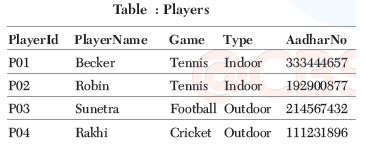
Answer the following questions, which based on the given information.
Question. Which column(s) can act as candidate key?
(a) Only PlayerId
(b) Only AadharNo
(c) Both (a) and (b)
(d) Type
Answer : C
Question. What is the degree of the table?
(a) 1
(b) 2
(c) 3
(d) 5
Answer : D
Question. Which column can she make the primary key?
(a) PlayerId
(b) PlayerName
(c) Game
(d) Type
Answer : A
Question. What will be the cardinality of the table, if two columns are added to the table?
(a) 7
(b) 6
(c) 4
(d) None of these
Answer : C
Question. Which column is the foreign key in the table?
(a) PlayerName
(b) Type
(c) Game
(d) None of these
Answer : D
Consider the following SQL command:
CREATE TABLE MEMBER
( MEM_ID INTEGER NOT NULL,
NAME CHAR(15) NOT NULL,
DATE_JOIN DATE,
SEX CHAR(1) CHECK (SEX= ‘M’ OR SEX = ‘F’),
ADDRESS VARCHAR(100) NOT NULL,
PH_NO CHAR(15),
PRIMARY KEY (MEM_NO),
INDEX MEM_IDX (DATE_JOIN)
);
Now answer the following questions:
Question. The INDEX command in above example will
(a) Create an index on field DATE_JOIN
(b) Create an index namely MEM_IDX
(c) Both (a) and (b)
(d) None of the above
Answer : C
Question. NOT NULL ensures that
(a) Column cannot have blank value
(b) Column will not accept any value
(c) Column has a fixed value
(d) Column has a unique value
Answer : A
Question. The ______ constraint ensures that the value entered specifies a certain condition.
(a) NOT NULL
(b) NULL
(c) CHECK
(d) All of these
Answer : C
Question. By default format of date entered is
(a) DD-MM-YY
(b) MM-DD-YY
(c) YYYY-MM-DD
(d) DD-MM-YYYY
Answer : C
Question. PRIMAY KEY in above example ensures that
(a) MEM_ID is entered primarily
(b) MEM_ID will hold a uniquely identified value
(c) MEM_ID will not remain blank
(d) All of these
Answer : D
Free study material for Computer Science
Practice MCQs for Class 12 Computer Science Database Concepts
About Database Concepts MCQs for Class 12 Computer Science
Test your conceptual understanding of Database Concepts with these targeted multiple-choice questions. Designed in alignment with the latest CBSE curriculum for Class 12 Computer Science, these problem sets build accuracy and prepare students for objective exams.
How to Verify Your MCQ Answers
Cross-reference your completed choices with comprehensive NCERT solutions for Class 12 Computer Science to ensure absolute clarity across all sub-topics in this chapter.
Enhance Speed with Online MCQ Tests
Follow up your worksheet practice by attempting the interactive online Computer Science MCQ test for this chapter to evaluate your execution speed. All platform resources are free to access.
FAQs
You can get most exhaustive CBSE Class 12 Computer Science Database Concepts MCQs Set 01 for free on StudiesToday.com. These MCQs for Class 12 Computer Science are updated for the 2026-27 academic session as per CBSE examination standards.
Yes, our CBSE Class 12 Computer Science Database Concepts MCQs Set 01 include the latest type of questions, such as Assertion-Reasoning and Case-based MCQs. 50% of the CBSE paper is now competency-based.
By solving our CBSE Class 12 Computer Science Database Concepts MCQs Set 01, Class 12 students can improve their accuracy and speed which is important as objective questions provide a chance to secure 100% marks in the Computer Science.
Yes, Computer Science MCQs for Class 12 have answer key and brief explanations to help students understand logic behind the correct option as its important for 2026 competency-focused CBSE exams.
Yes, you can also access online interactive tests for CBSE Class 12 Computer Science Database Concepts MCQs Set 01 on StudiesToday.com as they provide instant answers and score to help you track your progress in Computer Science.