

Official Class 11 Informatics Practices Revision Material: CBSE Class 11 Informatics Practices Relational Database Management System Notes And Questions
Explore reliable concept summaries and revision materials through the CBSE Class 11 Informatics Practices Relational Database Management System Notes And Questions. Tailored for Class 11 learners, utilizing these notes for Informatics Practices Relational Database Management System And Questions ensures thorough preparation and strengthens core academic definitions before final evaluations.
Chapter-wise Concept Summaries: Relational Database Management System And Questions
Navigate directly to the revision notes for Relational Database Management System And Questions using the digital viewer below. Each summary is structured to highlight high-weightage sections, allowing students to instantly access critical definitions and focus on core exam topics.
RELATIONAL DATABASE MANAGEMENT SYSTEM
Data:
Basic/raw facts about something which is not organized, for example details of some students which is not organized.
Data Item:
Each piece of information about an entity, such as name of a person or address, age or name of a product or the price is a Data Item.
Database:
A well organised collection of data that ensures safety, security and integrity of data.
DataBase Management System(DBMS)
Comprehensive software that provides the essential services to create, manage and maintain the databases. In short a DBMS provides the means to store the data in the database, to edit or delete the data stored, to search and analyze the data in the database. They also provide various safety and security mechanisms that ensures that in any case stored data will be safe and accessible.
Relational DataBase Management System(RDBMS) :
A Database Management System that conforms at-least half of the 12 rules defined by Dr. E.F. Codd (1970) in his research document. In a relational data model, the data is organized into tables (i.e. Rows and Columns). These tables are called Relations. A row in a table represents a relationship among a set of values. Since table is a collection of relationships it is generally referred to using the mathematical term Relation.
Database Systems:
Systems comprising of Databases and Database Management Systems are simply referred as database systems.
Advantages of Data Base System:
1) Reduce data redundancy (duplication of data)
2) Control data inconsistency to a large extent
3) Database facilitate sharing of data
4) Enforce standards
5) Centralized databases can ensure data security
Examples of Common Database Management Systems:
MySQL ,INGRES, POSTGRES, ORACLE, DB2.
Levels of Database Implementation:
1. Internal Level ( Physical Level) :
It describes how the data are actually stored on the storage media.
2. Conceptual Level :
It describes what data are actually stored in the database. It also describes the relationships existing among data.
3. External Level (View Level) :
It is closest to the users and is concerned with the way in which the data are viewed by individual users External Level
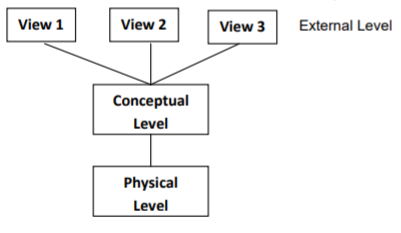
Data Independence: The ability to modify a scheme definition in one level without affecting a scheme definition in the next higher level.
Two Level of Data Independence:
1. Physical Data Independence: It refers to the ability to modify the scheme followed at the physical level without affecting the scheme followed at the conceptual level.
2. Logical data Independence It refers to the ability to modify the scheme followed at the conceptual level without affecting the scheme followed at the External level.
Data Model:
A way by which data structures and their relationships are analyzed.
Different Data Models :
1. Relational data model
2. Network data model
3. Hierarchical data model
Relational data model:
In this model data is organized into tabular structures called relations. A database may contain many relations providing a better classification of data based on its nature and use. Multiple relations are then linked/ associated together on some common key data values (foreign key).
Network Data Model :
In this model data is represented by collections of records and relationships among data are represented by links. A record is collection of fields i.e. attributes, each of which contents only one data value.
Hierarchical data model :
In this model records are organized as trees, data is represented by collection of records connected to one another through links.
Basics of Relational Model
Relation :
A tabular structure containing data. To be a relation is must satisfy following four conditions:
• Atomicity : At every row-column intersection (Cell) there must be an atomic value i.e. a value that can not be further subdivided.
• No duplicity: No two rows of relation will be identical i.e. in any two rows value in at least one column must be different.
• Ordering of rows is immaterial.
• Ordering of columns is immaterial.
Tuple :
A row in a relation is called a tuple
Attribute :
A column in a relation is called an attribute
Domain :
Domain of an attribute refers to the set of all the possible values for that attribute.
Degree :
Number of attributes in a relation is the degree of that relation
Cardinality :
Number of tuples in a relation is the cardinality of that relation.
Candidate Key:
A set of one or more minimal attributes used to uniquely identify a tuple in the relation
Please click the link below to download pdf file for CBSE Class XI Informatics Practices Relational Database Management System Concepts and Questions.
Download CBSE Revision Notes: Class 11 Informatics Practices Relational Database Management System And Questions
Key Concepts and Summary for Class 11 Informatics Practices Relational Database Management System And Questions
Access structured revision notes for Relational Database Management System And Questions designed in alignment with the latest CBSE curriculum for Class 11 Informatics Practices. These summaries help clarify core themes and support effective daily study.
NCERT-Aligned Chapter Summary and Notes
Built using the official NCERT book for Class 11 Informatics Practices, these notes provide reliable academic guidance. Pair your summary review with our recommended NCERT solutions to master optimal problem-solving approaches.
Next Steps in Your Exam Preparation
Wrap up your chapter revision by testing your knowledge against standard question formats. Everything on our platform is provided free of charge.
FAQs
You can download the teacher prepared revision notes for CBSE Class 11 Informatics Practices Relational Database Management System Notes And Questions from StudiesToday.com. These notes are designed as per 2026-27 academic session to help Class 11 students get the best study material for Informatics Practices.
Yes, our CBSE Class 11 Informatics Practices Relational Database Management System Notes And Questions include 50% competency-based questions with focus on core logic, keyword definitions, and the practical application of Informatics Practices principles which is important for getting more marks in 2026 CBSE exams.
Yes, our CBSE Class 11 Informatics Practices Relational Database Management System Notes And Questions provide a detailed, topic wise breakdown of the chapter. Fundamental definitions, complex numerical formulas and all topics of CBSE syllabus in Class 11 is covered.
These notes for Informatics Practices are organized into bullet points and easy-to-read charts. By using CBSE Class 11 Informatics Practices Relational Database Management System Notes And Questions, Class 11 students fast revise formulas, key definitions before the exams.
No, all study resources on StudiesToday, including CBSE Class 11 Informatics Practices Relational Database Management System Notes And Questions, are available for immediate free download. Class 11 Informatics Practices study material is available in PDF and can be downloaded on mobile.